Manual M3 · Austral Manual Series
Download PDF ↓Versión en español
Elegibilidad de Proyectos para APP — Manual M3 de Austral
Version 1.0 · 21 September 2026
Austral Intelligence · David Duarte Arancibia, with Mika (Austral's analysis agent)
Platform module that runs the method: PPP Eligibility Index (/eligibility) — the qualitative gate that hands over to Value for Money analysis (/vfm, manual M1) as soon as a project is Eligible
Languages: English (this edition) and Spanish · HTML and PDF at austral‑intelligence.com/manuals
This manual explains how to decide, before spending on a financial model, whether an infrastructure project can even be a candidate for a public‑private partnership (PPP). It presents the PPP Eligibility Index as a self‑contained eight‑step method with eight yes/no criteria —need, outputs, size, legal framework, risk transfer, measurability, institutional capacity and market interest—, with the rule that an answer is evidence, not an opinion, and with a conjunction gate against the weighted score that Peru and Colombia use: eight "yes" answers is Eligible, a single "no" is Not eligible and is reported the moment it is given, and nothing is offset between criteria; it takes an explicit position in that disagreement with regional practice and defends it. It walks the method through two projects —the series' generic regional hospital, Eligible with its eight pieces of evidence, and a rural health centre that fails three criteria, receives its conditions and is re‑assessed as Eligible—, with the one‑page report that each assessment produces; shows how it runs on the Austral platform, screen by screen; and explains, honestly, why an eight‑question questionnaire does fit in a spreadsheet, and where that spreadsheet breaks all the same. It is written for PPP units, line ministries, ministries of finance and auditors.
Austral Intelligence (2026). Eligibility of Projects for PPP. Manual M3, Austral Manual Series, version 1.0, September 2026. https://austral-intelligence.com/manuals/eligibility/
This English edition translates the Spanish v1.0 text (20 September 2026) section by section, paragraph by paragraph. Where the two editions differ, the Spanish edition is the reference text.
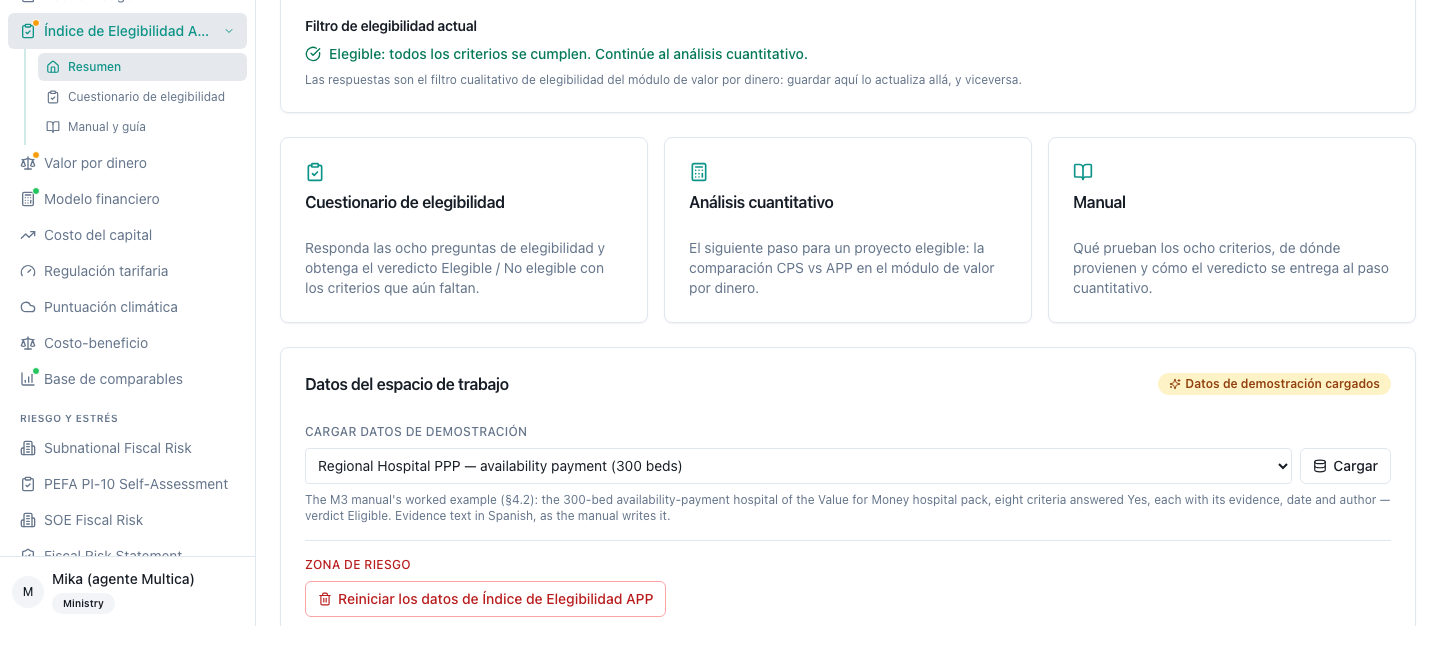
Every figure in the worked example (section 4) and in the screenshots (section 5) is generic: the hospital is the same hypothetical 300‑bed hospital of the series, loaded as the module's own demonstration pack (default); the rural health centre is entirely hypothetical (health_centre). Neither comes from a client or from a real project, and neither should be used as a reference for an actual project. The screenshots were taken on production releases c4353470 and, for the live collaboration in §5.2, de6904e5, current as of the date of each capture; where a later correction to the platform superseded something a figure shows, that figure's caption says so. The methodologies cited are credited to their authors; the only product name in the manual is Austral.
A ministry has a project that the socio‑economic appraisal has already approved —the hospital, the road, the plant— and someone proposes doing it as a public‑private partnership (PPP). Before the financial model, before the Public Sector Comparator and before hiring transaction advisers there is a cheaper, earlier question: can this project even be a candidate for a PPP? The eligibility filter exists to answer it with eight yes‑or‑no questions and one rule, and to put in writing why. Its product on the Austral platform is the PPP Eligibility Index; its method is the one in this manual.
The thesis of the section fits in one sentence. PPP programmes do not lose most of their money in mispriced contracts: they lose it in projects that should never have been structured as a PPP —services nobody could specify, risks nobody could transfer, single‑bidder markets— and that reached tender because nobody asked those questions while they were still cheap. Across the Chilean panel, 78 of 123 concessions were renegotiated (63%), and the renegotiations that cost the most trace back to a weakness in preparation —an optimistic forecast, an incomplete design, a risk the public side should have retired before tender—, not to a valuation error (Austral, The Renegotiation Triangle, §1.2 and §4; Engel, Fischer and Galetovic, 2014; §2.4 of this manual). The filter asks those questions first.
The filter asks a single question: does this project meet the minimum conditions for a PPP to be a reasonable procurement route? Eight conditions, all of them necessary: that the need exists; that the project can be defined by outputs; that it is large enough to pay the transaction costs of a PPP; that the legal framework is stable; that there are material risks that can be transferred; that the service can be measured so that payment depends on it; that the State has the institutional capacity to run a twenty‑year contract; and that there is confirmed interest from more than one qualified operator and financier. A project that meets them is Eligible; one that fails any of them is Not eligible, and it is so from the first "no", without waiting for the rest; one with answers still pending and no "no" is In progress; one with no answer at all is Not completed. There is no score, no weighting and no cut‑off mark: the "8 of 8" the screen shows is a tally, not a grade, and the manual never says "7 of 8" (§3, Step 4).
From that follows, just as clearly, what the filter does not answer.
What eligibility is not
- It is not a social appraisal. It does not say whether the project is worth doing. That was decided by the socio‑economic appraisal —the national investment system's recommendation, the viability declaration—, earlier and with a different metric, and it is a precondition of the filter (§3, Step 0): a project without it is not filtered, it is appraised.
- It is not a value‑for‑money analysis. It does not say whether the PPP costs the State less than public works, risk‑adjusted. That is the question of manual M1 of this series, it is answered with numbers and it comes after: an Eligible project can have a negative VfM, and then it is not a PPP.
- It is not an affordability test. It does not say whether the State can pay for the contract or how much room it takes from the commitment ceiling. That is Step 12 of M1 and manual M2; the portfolio's affordability is verified as a precondition, not scored as a criterion.
- It is not a prioritisation. It does not rank the portfolio or say which project goes first. Two Eligible projects are equally eligible, and ranking them requires weighing attributes —impact, readiness, alignment with strategy— that the gate refuses to trade off. For that the manual points to the World Bank's Infrastructure Prioritization Framework and to Austral, The Pipeline Under the Ceiling (§2.6).
The practical consequence is the one that governs everything else: an Eligible verdict is a licence to spend at the next step, not a value‑for‑money finding. It is exactly what OECD principle 5 calls a procurement option pre‑test: an upfront test on the project's characteristics that "should enable government to decide whether it is prudent to further investigate a PPP option" (§2.2). Investigating further costs money —a financial model, a risk register, a formal market sounding, advisers— and the filter is the decision to incur that cost. A Not eligible verdict saves that expense or, better, says what would have to change to justify it.
The filter has a precise place and it arrives early: at project identification, the first stage of the PPP cycle in the World Bank's PPP Reference Guide (module 3, §3.1), after the socio‑economic appraisal and before the feasibility study with its four tests —economic, commercial, value‑for‑money and fiscal— (§2.1). Every national guide that formalises it places it there, even where they disagree on the rest: after knowing the project is worth doing, before spending to find out whether it suits a PPP (§2.5).
Three moments of use, with three different users of the same questionnaire.
What is not appropriate, and is the most frequent use in practice, is the fourth one: answering the filter after running VfM, to confirm a result that has already come out positive. A filter filled in after the fact always passes, and stops being a filter. The method fixes the sequence as a rule (§3, Step 3), and the platform makes it visible: a positive VfM with a failed filter is not labelled "positive" but conflicting (§1.5; §4.4).
The filter is answered by two hands, and that division is a rule of the method, not an institutional courtesy. Austral, From Gatekeeper to Orchestrator, sets out the division‑of‑labour rule for the analytical work of a PPP: each step is assigned to the actor with the lowest information cost on the variables that step needs; the technical half of the project belongs to the sector and the financial and policy half belongs to the Ministry of Finance (§2.4 of the paper; §2.6 of this manual). Applied to the eight criteria:
Two further readers use the same instrument for a different purpose. Development banks, which receive from a government a list of "PPP projects" and need to know, before financing preparation, how many of them actually are: the filter applied in series to that list, with the unmet criteria tabulated, says more about the programme than any single verdict. And comptrollers and auditors, who recompute nothing: they verify that the filter was applied before deciding the procurement route and not afterwards, that every "yes" has its evidence and every "no" its condition, and that the record carries a date and a responsible party. The reviewer's checklist, at the close of §3, is written for them.
For a project, the method produces four things, and all four travel together in the one‑page eligibility report (§3, Step 5; template in §4.2):
For the portfolio, the output is the list of Eligible projects that move on to M1's VfM with its Step 1 already answered, and the table of unmet criteria for the rest. With no numeric thresholds: the one figure the filter uses —the screen's size reference, "typically above US$ 20 million"— is presented as an order of magnitude, with the table of national thresholds alongside it (§2.5), not as a criterion.
It is worth saying by the negative, because that is where the filter is misused. The filter does not rank the portfolio (§1.1). It does not say which payment mechanism to use —availability, toll, hybrid—: it asks whether the service can be measured to tie a payment to it, not which one. It does not size anything: not the investment, not the payment, not the State's contribution; that belongs to the financial model and to VfM. It does not replace the formal market sounding of the structuring stage: criterion 8 asks for an early sounding that confirms interest from more than one operator, not a list of bidders. And an Eligible project with a negative VfM is not a PPP: the gate opens the analysis, it does not close it.
What it does do is bound what the quantitative analysis can say afterwards. In M1 the filter is Step 1 of the method and the gate on the qualitative axis of the decision map: a positive VfM with a failed filter is conflicting, not positive —"a low cost does not fix a failed gate"—; a failed filter sets the qualitative level at very low, whatever the score of the other instruments, and an undecided filter caps it at medium‑low (M1, Step 9). §4.4 shows it with the hospital: the same VfM of +5.8% reads conditional with an Eligible filter and unfavourable with a single "no".
Three things, in the order of the series.
A self‑contained method. Section 3 develops the eight steps —from scope to handover— with what goes in, what comes out and what the rule is at each one, and closes with the reviewer's checklist. It is written to be applied with a form and an evidence folder; section 2 credits every criterion and every rule to the source that sets it —the PPP Reference Guide, the OECD Principles, Peru's eligibility guidelines, the Colombian business case, the Australian options analysis, the Brazilian legal gate— and says where the sources disagree and what position the manual takes.
A reproducible example. Section 4 walks the eight steps through two projects. The 300‑bed regional hospital under an availability payment from M1, Eligible with eight "yes" answers and the evidence for each, and its handover to VfM, where M1 is waiting for it with VfM +32.0, a +5.8% of the comparator —positive by a small margin, with the PSC at the government's risk‑free rate (2.70% real) and the PPP at that rate plus a 0.9% spread—. And a hypothetical US$ 12 M rural health centre with clinical services included, Not eligible on size, measurability and market interest, with its three conditions and its re‑assessment. A box shows what happens with the hospital when the filter is answered after the numbers.
The tool that runs it, and that the client keeps. Section 5 shows the PPP Eligibility Index screen by screen, with what it records and what it still does not. Section 6 is honest about both: an eight‑question questionnaire does fit in a spreadsheet, and the platform earns its keep through what it prevents —the after‑the‑fact filter, the duplicate copy, the "7 of 8" that turns into a grade— and through the link to VfM, not through what it calculates. Section 7 gathers the references with their verification status.
A reader who only wants to know whether an eligibility report that lands on their desk for signature was done properly can go straight to the reviewer's checklist at the close of section 3; one who wants to see the whole method in three pages can go to the hospital example in §4.2.
Every criterion and every rule of the method in §3 has behind it a guideline that a ministry applies or once applied. This section says where each one comes from, with section or paragraph, so that a reviewer can argue the rule at its source and not in the manual. Three layers: the international guidelines that define the suitability filter as a stage of the PPP cycle (the World Bank's PPP Reference Guide, the OECD Principles, APMG's certification guide); the national guidelines that formalise it —as eligibility criteria with regulatory force (Peru), as a staged business case (Colombia, United Kingdom), as a procurement‑options analysis with a size threshold (Australia, Canada, South Africa) or as a legal gate (Brazil)—, with Chile as the case with no formal filter; and the economics that explain why these criteria and not others. Table 2.7 links every step of §3 to its source and to the screen of §5 that runs it.
Reading warning: the sources agree that, before valuing a PPP, one has to ask whether the project is of the kind that can be a PPP, and on the content of that question (specifiable outputs, transferable risks, measurable service, size, market, public capacity). They do not agree on how to answer it —a gate of necessary conditions or a weighted score with a cut‑off mark—, on whether affordability is part of the filter, or on whether the filter is applied before or after the project is approved as a public investment. The manual adopts a position on each point (strict conjunction; affordability and the socio‑economic appraisal as preconditions, not criteria; the filter after the socio‑economic appraisal and before any financial model) and presents it as a decision, not as a consensus. The index's eight questions are Austral's own formulation of the criteria these sources state in different ways; none of them carries a literal list of eight questions, and the manual does not attribute one to them.
The PPP Reference Guide, Version 3 (World Bank, ADB and IDB, 2017), module 3 "PPP Cycle", devotes its §3.1 "Identifying PPP Projects" (pp. 115–119) to the stage this manual develops, in three subsections. §3.1.1 "Identifying Priority Public Investment Projects" sets the precondition: the starting point of a PPP is a priority public‑investment project that comes out of the ordinary investment‑planning process —sector strategy, options analysis, feasibility and cost‑benefit, prioritisation within the fiscal envelope—, because a PPP "is a public investment" and "needs to serve clearly identified socio‑economic objectives", all the more so because the contract fixes the asset and the service for decades. Projects that originate outside that process —sector reforms, unsolicited proposals— "should be subjected to the same analysis and screening as any other public investment and any other proposed PPP". This is Step 0 of §3: the filter is applied to a project whose socio‑economic appraisal is done or under way, and it does not replace it.
§3.1.2 "Screening for PPP Potential" defines the filter: identifying, "with the information available", whether the project "could deliver more value if implemented as a PPP", by checking "whether it is likely to meet the criteria" for moving to the next level of development; the detailed value‑for‑money assessment comes later (§3.2.4). For that "many governments introduce PPP potential criteria or checklists", and the Guide takes as its example box 3.2, "PPP Potential Screening Factors in South Africa", with the four factors of the South African PPP Manual (module 4, p. 13): scale of the project (do the transaction costs make sense?; it points to §2.1, where some governments set a minimum size); outputs capable of clear specification (is there reason to believe a contract can be written that holds the provider accountable?); opportunities for risk transfer and the other value drivers of a PPP (allocating each risk "to the party best able to control or bear it"); and market capability and appetite (is there a commercially viable project and a level of interest that an early sounding can confirm?). It adds the suitability filter of India's PPP Toolkit, which adds to those factors public‑sector support, with "an assessment of public‑sector capacities to implement the project as a PPP", and the barriers to implementation; the criteria list of Hong Kong's Guide to PPPs (2007, pp. 31–32) for admitting a candidate into the first business case; and UNESCAP's Qualitative Value‑for‑Money Toolkit (2017), which the Guide describes as a set of criteria usable "for prioritisation" and for detecting weaknesses in the project. §3.1.3 "Building an Initial PPP Pipeline" already separates what §2.6 will separate: once candidates have been filtered, a young programme can apply additional criteria to decide which to develop first —readiness, sector relevance, "high implementability"—, and that is prioritisation, not eligibility.
Three points from the Guide that the manual keeps as they stand. First, timing: box 3.1, "PPP Selection in the Public Investment Planning Process", shows that the filter is applied at different points in the cycle —after budgeting the project as a public investment (Australia, the Netherlands), after approving it with its cost‑benefit analysis (Chile: "all public investment projects go through a cost‑benefit analysis […] and must reach a social rate of return; PPP projects are drawn from that list") or after pre‑feasibility (Korea, South Africa)—; in every case, after knowing the project is worth doing. Second, size: §2.1.2 "PPP Program Scope" records that "many governments set a minimum size" because "small PPP projects may not make sense given the relatively high transaction costs", and its table 2.2 gives the thresholds of Australia (above A$ 50 million), Brazil (R$ 20 million when the law was enacted) and Colombia (6,000 monthly minimum wages), plus Singapore (S$ 50 million) in the text; it is the basis of criterion 3 and of the threshold table in §2.5. Third, the relationship with qualitative VfM: §3.2.4 says that the qualitative value‑for‑money analysis —"testing the rationale for the PPP: whether the project is of the right type for private financing and whether the conditions are in place for the PPP to create value"— "can overlap with the screening in §3.1.2" and "may be repeated throughout project development". Manual M1 treats that overlap as its Step 1; this manual treats it as the whole method. They are the same eight answers.
Table 2.1 — The Reference Guide's criteria and the index's eight questions. The correspondence is Austral's: the Guide does not state eight questions or fix their order, and two of the eight (legal framework, need) do not appear in its list of factors because the Guide treats them as a precondition of the programme (module 2) or of the project (§3.1.1), not as criteria of the filter. The manual makes them explicit because a filter applied in a country with a recent PPP framework, or to a project with no quantified gap, cannot take them for granted.
| Index criterion | Where the Reference Guide states it | How it states it |
|---|---|---|
| 1 Need | §3.1.1 (priority public‑investment project, identified socio‑economic objectives); UNESCAP 2017 via §3.1.2 | Precondition of the candidate, not a filter factor |
| 2 Outputs | Box 3.2, "outputs capable of clear specification" | Filter factor (South Africa) |
| 3 Size | Box 3.2, "scale of the project"; §2.1.2 and table 2.2 (minimum size) | Filter factor; programme threshold |
| 4 Legal framework | Module 2, §2.2 "PPP Legal Framework" (programme framework); India's filter via §3.1.2 (implementation barriers) | Precondition of the programme |
| 5 Risk transfer | Box 3.2, "opportunities for risk transfer (and other PPP value drivers)"; box 1.2 (value drivers) | Filter factor |
| 6 Measurability | Box 3.2, within "outputs capable of clear specification" ("a contract that holds the provider accountable"); §3.2.4 (payment tied to performance) | Implicit in the outputs factor; the index separates it out |
| 7 Institutional capacity | India's filter via §3.1.2 ("public‑sector capacities to implement the project as a PPP"); §3.2.6 (management capacity, in the appraisal) | Filter factor (India); appraisal criterion (Guide) |
| 8 Market interest | Box 3.2, "market capability and appetite" (early sounding) | Filter factor |
The Recommendation of the Council on Principles for the Public Governance of Public‑Private Partnerships (OECD, 4 May 2012; OECD/LEGAL/0392) orders twelve principles into three blocks, and two of them are the direct source of half the filter. Block A —"a clear, predictable and legitimate institutional framework supported by competent and adequately resourced authorities"— asks (principle 1) that political leadership ensure public understanding of "the relative costs, benefits and risks of PPPs and traditional procurement"; (principle 2) that "the contracting authorities, PPP units, the central budget authority, the supreme audit institution and sector regulators" have "clear mandates and sufficient resources"; and (principle 3) that "any significant regulation affecting the operation of PPPs is clear, transparent and enforced". Principles 2 and 3 are criteria 7 and 4: without a PPP unit with a mandate and without a stable legal framework there is no eligible project, whatever its technical merit.
Block B —"grounding the selection of PPPs in value for money"— is the core. Principle 4 requires prioritising every investment "at the highest political level", with a decision to invest "separate from how the project is procured and financed" and "with no institutional, procedural or accounting bias for or against PPPs": that is why the socio‑economic appraisal is a precondition and not a criterion (Step 0), and why the filter does not rank the portfolio (§2.6). Principle 5 is the filter itself: "carefully investigating which investment method is likely to yield the most value for money", assessing "the key risk factors and the characteristics of the specific project" through a procurement option pre‑test that "should enable government to decide whether it is prudent to further investigate a PPP option". It is the most precise definition there is of this manual's product: an upfront test, on the project's characteristics, whose output is a licence to keep studying, not a decision to procure. Principle 6 —"transferring risks to those best able to manage them", to "whichever party can prevent the risk materialising at least cost, or for which the risk, once materialised, costs least"— is criterion 5, and its second half ("costs least to bear it") is the one §2.4 develops with the retention frontier. Principle 9, in the same block, asks that governments "ensure there is sufficient competition in the market through a competitive tender process" and, "where there are few operators", a level playing field for entrants: that is criterion 8.
Block C (principles 10–12: affordability and a sustainable envelope owned by the central budget authority; budgetary transparency of costs and contingent liabilities; integrity of procurement) sits outside the filter and inside manual M2 and Step 12 of M1. The fact that the OECD places affordability in a block separate from selection backs the decision to treat it as a portfolio precondition, not as a project eligibility criterion.
The APMG Public‑Private Partnership (PPP) Certification Guide (APMG International, with the World Bank, ADB, IDB, EBRD, IDB Invest and PPIAF, 2016) is the text of the CP3P certification and organises the cycle into eight chapters; chapter 3, "Project Identification and PPP Screening", covers this stage and draws a sharp distinction between two acts that everyday language runs together: the identification of the project (which comes out of planning and the assessment of need) and the screening, or PPP suitability filter (whether the identified project can and should be developed as a PPP), both of them ahead of the appraisal of chapter 4, where the economic, commercial, fiscal and value‑for‑money viability tests live. The manual uses that division: eligibility (chapter 3 of the guide) against viability (chapter 4), and chapter 3's suitability checklist as a third witness that the factors of table 2.1 belong to practice, not to an invention of the index.
The filter's criteria are not a list of accumulated good practices; they come out of a theory of when bundling design, construction, financing and operation into a single long‑term contract creates value and when it destroys it. Four pieces of that theory explain six of the eight criteria; the other two (size, legal framework) are about transaction costs and political risk, and the national guidelines treat them as thresholds.
Hart (2003) — incomplete contracts: when quality is contractible. In "Incomplete Contracts and Public Ownership: Remarks, and an Application to Public‑Private Partnerships" (Economic Journal, 113(486), C69–C76), Hart models the PPP as bundling construction and operation into a contractor who internalises the effect of the investment in the works on the cost of operating them. Bundling pays off when the quality of the service can be specified and measured in the contract —so that the contractor cannot cut corners on the works at the service's expense without being paid less— while the quality of the works, by contrast, is hard to contract on; separate public works pay off when the opposite holds. From this come criteria 2 and 6: a project whose outputs cannot be written into enforceable service levels, or whose quality nobody knows how to measure, is the case in which the theory says the PPP does not pay off, whatever it costs. Manual M1 calls this "the trap of the service nobody knows how to measure" (Step 1); this manual turns it into a criterion with evidence (indicators with a baseline and a verifier).
Iossa and Martimort (2015) — when to bundle and when not to. "The Simple Microeconomics of Public‑Private Partnerships" (Journal of Public Economic Theory, 17(1), 4–48) orders the literature into an agency model: bundling creates value when there is a positive externality between the investment in the works and the operating costs (designing to keep maintenance cheap), when performance is observable so that it can be paid for, and when demand risk is predictable or assignable enough that the long‑term contractor does not demand a premium that wipes out the gain; and it warns of the costs of bundling —renegotiation, rigidity, the cost of private finance— when those conditions fail. It is the joint foundation of criteria 2, 5 and 6, and of the rule that the filter asks whether there are risks to transfer and a service to measure, not how many.
Engel, Fischer and Galetovic (2014) — when a PPP and when public works. The Economics of Public‑Private Partnerships: A Basic Guide (Cambridge University Press) brings the practical list: a PPP pays off when the quality of the service is contractible, when the full life cycle can be put under a single responsible party and when the tender is competitive; and it documents why it fails when it is not. Its chapter on renegotiation —with the Chilean and Latin American evidence that Guasch (2004) also gathers— is the source of the thesis of §1: most of the fiscal cost of a PPP programme does not come from mispriced contracts but from badly selected and badly prepared projects.
Austral, The Renegotiation Triangle — incomplete preparation as the origin of renegotiation (criterion 2). The paper locates the institutional bias that makes renegotiations expensive when they "trace back to a weakness in project preparation: an optimistic demand forecast, an incomplete design, unresolved land or permits, a risk the public side should have retired before tender" (§1.2), and measures the cost across the Chilean panel: 78 of 123 concessions renegotiated (63%), with a median renegotiated value of 11.7% of the official budget and a mean of 25.6% (§4). Criterion 2 asks, before tender, whether the project can be specified by outputs; a "no" is the early signal of the renegotiation that the triangle later prices.
Austral, The Optimal Risk‑Retention Frontier — transferring is not maximising the transfer (criterion 5). The maxim "allocate each risk to the party best able to manage it" —repeated by the Reference Guide, the OECD and every national guideline— "is correct, it is intuitive, and it is almost never quantified" (§1). The paper breaks it down into its two halves, managing (who can reduce the probability or the impact) and bearing (who absorbs the loss at least cost), shows that they come apart on macro risks (aggregate demand, exchange rate) and adds the condition "at a reasonable cost" (§4): there is a bankability ceiling beyond which the private party will not take the risk at any price. For the filter the consequence is one of formulation: criterion 5 asks whether there are material risks (construction, availability, maintenance) that can be assigned to whoever manages them best —a necessary condition of Hart's bundling—, not whether every risk in the project can be transferred. A "yes" grounded in "everything can be transferred" is the typical error Step 2 flags, and the paper is its refutation.
Austral, The Intelligent Gate — what competition signals and what it does not (criterion 8). It is easy to cite this paper backwards —as proof that a single‑bidder tender foretells renegotiation—, and the manual cites it for what it says. Across the same Chilean panel (123 concessions) and a Brazilian one (250), The Intelligent Gate tested whether structural red flags at tender —a single bidder, thin competition, award below the sector norm— predict subsequent renegotiation, and found a robust null: the hazard ratio for a single bidder is 0.91 (95% CI 0.47–1.73), three estimators across three definitions of the outcome agree, and "no structural flag […] predicts elevated renegotiation" in a regime where renegotiation is endemic (§6–§7). What the paper rescues is what this manual uses: the competition flag is "a signal of process integrity, not a forecast of renegotiation" (§8.1), and competition remains the only way to discover the price and to discipline the bid (§2.1, with the public‑procurement‑integrity literature; OECD 2012, principle 9). Criterion 8 asks, for that reason, whether there is confirmed interest from more than one qualified operator and financier —because without competition there is no market price and no demonstrable value for money—, and it does not promise that a sounding with several interested parties will avoid renegotiation. When §3 points to the paper in the typical error of criterion 8 ("a sounding done with a single operator"), it does so in these terms.
Table 2.5 — How eight countries formalise the filter. Gate = every condition must be met; score = weighted criteria with a cut‑off mark; business case = staged questions with no mark; threshold = a numeric size condition. The US$ conversions are orders of magnitude at September 2026 exchange rates and serve only the reading of criterion 3.
| Country | Instrument and status | Criteria | Form | Size threshold | Who decides | Timing | What happens with a "no" |
|---|---|---|---|---|---|---|---|
| Peru | Lineamientos para la aplicación de los criterios de elegibilidad (Guidelines on applying the eligibility criteria; MEF, 2018) under LD 1362; Law 32441 (2025) and its regulations (DS 316‑2025‑EF, art. 60.8) keep the seven criteria and task the MEF with new guidelines | 7 (risk transfer; service measurement; advantages and limitations of public works; size; competition for the market; institutional strength; user financing) | Weighted score 1–3 per criterion, normalised to 20, cut‑off at 11.50; +1 for user financing | 10,000 national UIT / 7,000 regional‑local UIT for co‑financed PPPs (art. 38; ≈ S/ 55 M and S/ 38.5 M in 2026; on the order of US$ 15 M and US$ 11 M) | The owning entity, in the Evaluation Report; MEF opinion only for regional and local governments (art. 61.4) | Formulation stage, a requirement for entering the Promotion Process | "Not in a position to contemplate the PPP modality" |
| Colombia | Law 1508 of 2012 (art. 3, para. 1: 6,000 SMMLV); Decree 1082 of 2015; DNP Res. 3656/2012 and 857/2023 (comparator); DNP, Guía de APP (PPP Guide), chap. 2 "Eligibility stage" (2016) | Five justifications (strategic, economic, financial, legal‑commercial, managerial) with checklists; for unsolicited proposals, three legal criteria (public interest, financing structure, competition with existing projects) | Business case by questions, no score; the quantitative PSC decides the modality | Investment > 6,000 monthly minimum wages (on the order of US$ 2–3 M) | The executing entity; a prior opinion from the DNP or from the territorial planning entity | Before structuring; the PSC, before opening the selection process | With no favourable opinion there is no PPP |
| Chile | DS MOP 900 (Ley de Concesiones, Concessions Law), art. 2 final paragraphs and art. 1 bis (Law 20.410, 2010); Law 20.530, art. 3(h) | None specific to PPPs: social return (national investment system) + Concessions Council opinion on projects and modality + qualification of unsolicited proposals | Implicit eligibility: a social‑return gate, neutral to the modality; the modality is decided by the MOP with an advisory opinion | None in law | The MOP (Directorate General of Concessions); the Ministry of Social Development and Family (MDSF) for the social return; the Ministry of Finance signs off | Before tender: "while that report is not available, the tender process may not begin" | With no social‑return report there is no tender; with no public‑interest declaration the unsolicited proposal does not go forward |
| United Kingdom | HM Treasury, Value for Money Assessment Guidance (2004; updated Nov. 2006); quantitative tool withdrawn 5 Dec. 2012; PF2 abandoned in 2018 | Viability, desirability and achievability, some forty questions | Qualitative, by stage (programme, project, tender) + quantitative; no score | None formal ("PFI generally for large projects") | The department and project team, with the Treasury | Programme (spending review), business case, before the tender announcement | Does not proceed as PFI; the cause is investigated |
| Australia | National PPP Guidelines, vol. 1 Procurement Options Analysis (Dec. 2008), §3.1.1; National PPP Policy Framework (Oct. 2015), §3.1.3 | Value‑for‑money drivers (§4.3.2 of the framework) assessed in the delivery‑options analysis | Options analysis with a triggering threshold | A$ 50 million total capital value triggers the PPP evaluation; bundling similar projects counts; smaller ones may qualify (on the order of US$ 33 M) | The contracting department; the state Treasury | After approving and budgeting the project as a public investment (Reference Guide, box 3.1) | Another delivery model is chosen |
| Canada | Federal P3 Screen under the New Building Canada Fund (Feb. 2014), withdrawn 2015–2016; PPP Canada, P3 Business Case Development Guide; Infrastructure Ontario (provincial practice) | PPP suitability and value for money | Mandatory filter for federal funding | Total eligible cost > C$ 100 million (on the order of US$ 73 M) | PPP Canada (federal); provincial agencies | When applying for federal funding | Funding conditional on delivery as a P3 if the filter came out favourable |
| South Africa | National Treasury, PPP Manual, module 4 PPP Feasibility Study (2004), p. 13 | Scale; specifiable outputs; risk transfer; market capability and appetite | List of factors within the needs‑ and options‑analysis | None in law; scale is a factor | The contracting institution; Treasury (TA I approval) | Pre‑feasibility (Reference Guide, box 3.1) | Conventional procurement is followed |
| Brazil | Lei 11.079/2004, art. 2 §4 (as worded by Lei 13.529/2017) | Minimum value; minimum term; subject matter | Legal gate: the contract may not be entered into if any one fails | Contract ≥ R$ 10 million (previously R$ 20 M); ≥ 5 years; subject matter that is not solely labour, equipment supply or works (on the order of US$ 2 M) | The law | At the time of contracting | Nullity: the contract cannot be entered into as a PPP |
Peru is the country that turned eligibility into a rule, and that is why it is the most useful counterpoint to this manual. The Lineamientos para la aplicación de los criterios de elegibilidad de los proyectos de Asociación Público Privada (Guidelines on applying the eligibility criteria for PPP projects; MEF, Directorate General for Private Investment Promotion Policy, December 2018) define themselves as "a qualitative methodological instrument for analysing the value‑for‑money principle" (§I) and are applied in the Evaluation Report of the formulation stage, "a requirement for bringing the project into the Promotion Process" (§II). Seven criteria, six weighted (level of risk transfer 15%; capacity to measure or verify availability and quality of service 10%; advantages and limitations of traditional public works 20% + 20%, in two questions: evidence of cost overruns and delays in public works, and the entity's capacity to operate and maintain; project size 20%; competition for the market 10%; institutional strength 5%) and one that adds a point (user financing, if own‑source revenue covers at least 40% of total cost). Each criterion is scored 1, 2 or 3 with a "response indicator" that must be justified with sources (§4.1 c: documents from earlier stages, market feedback, experts, similar projects) —the same evidence requirement as Step 2—; the weighted score is normalised to 20 and the project "is in a position to contemplate the PPP modality" at 11.50 or above (§4.3). Size is measured in UIT: nationally, 1 point between 10,000 and 50,000 UIT, 2 up to 250,000 and 3 above; regionally and locally, 7,000 / 25,000 / 100,000 (§4.2.4). Competition is measured by potential bidders: up to two, 1 point; two to five, 2; more than five, 3 (§4.2.5). And institutional strength requires a PPP unit with experience in contracts of similar type, size and complexity (§4.2.6) — almost a literal match for criterion 7.
The legal framework changed and the method survived. Law 32441 (El Peruano, 16 September 2025) repealed legislative decrees 1224 and 1362, and its regulations, Supreme Decree 316‑2025‑EF (El Peruano, 24 December 2025), keep eligibility in four places: the Evaluation Report must contain the "value‑for‑money analysis, through the application of the eligibility criteria" (art. 60.3, item 5); "the MEF approves the guidelines for applying the eligibility criteria […] for the purpose of assessing and determining the benefits of developing a project as a PPP against the general public‑procurement regime", with the same list of seven criteria (art. 60.8); the MEF's opinion on the Evaluation Report of regional and local governments "rules only on the application of the eligibility criteria", and National Government projects no longer require it (arts. 61.4 and 61.5); and the Integrated Evaluation Report of the structuring and transaction stages applies them again (art. 65.2, item 7). The regulations also set minimum amounts for promoting state‑co‑financed PPPs: above 10,000 UIT for projects of national competence and above 7,000 UIT for regional and local governments (art. 38), matching the floors of the size criterion in the guidelines. And in July 2026 the MEF approved Lineamientos metodológicos para la priorización de proyectos de APP del Gobierno Nacional (Methodological guidelines for prioritising National Government PPP projects; Directorial Resolution 002‑2026‑EF/68.01, El Peruano, 9 July 2026), which make explicit the sequence this manual defends in §2.6: first a preliminary eligibility assessment as a minimum entry condition, then a multi‑criteria ranking of the projects that clear it. Until the MEF issues the guidelines the new regulations task it with, the 2018 text remains the one in force.
Where this manual departs, said plainly: the Peruvian method is a score, and a score compensates. A project with "low or no capacity for risk transfer" (1 point on the 15% criterion) and no performance indicators or penalties (1 point on the 10% one) can clear the 11.50 cut‑off if it is large, if the entity operates public works poorly and if there is evidence of cost overruns. The guidelines know this and say so: if the PPP turns out more beneficial but no indicators or penalties exist, "it will fall to the entity […] to develop and implement them" (note 7 to §4.2.2) — that is, the condition is deferred. §3 of this manual takes the opposite position (Step 4): the eight criteria are necessary conditions, and the one that fails is written down as a condition, not offset by the rest. What the manual does take from Peru is the rest of it: the requirement to justify every answer with sources, the experienced PPP unit as an institutional criterion, the size floors differentiated by level of government, and the regulatory separation between eligibility and prioritisation.
Colombia. DNP Resolution 3656 of 2012 is often described as carrying a "multi‑criteria eligibility analysis" ahead of the comparator. It does not: its sole annex is the Metodología del Comparador Público Privado (Public Sector Comparator Methodology, quantitative), and its article 1 only adds that the entity "may supplement the justification […] using a commonly accepted evaluation methodology that identifies, weighs and values the benefits and risks" of the PPP; Resolution 857 of 2023 replaced that annex with another one, also quantitative (§1 context of the convenience analysis; §2 documentation; §3 PSC calculation), with no eligibility criteria. What Colombia has is a legal size gate —Law 1508 of 2012, art. 3, paragraph 1: only PPP projects whose investment amount exceeds 6,000 current legal monthly minimum wages may be carried out (the Reference Guide, table 2.2, converted this to about US$ 1.46 million in 2017)— and an eligibility stage developed by the DNP as a business case: the Guía de Asociaciones Público Privadas (PPP Guide), chapter 2, "Eligibility stage of a PPP project" (preliminary version, 11 February 2016), organises the stage with HM Treasury's five‑case model —strategic, economic, financial, commercial and management— and a checklist for each: whether the project sits in a long‑term plan and an identified need exists; whether it "has characteristics that allow it to be developed through a PPP" ("a sizeable investment amount, the wish for the infrastructure to be used over the long term, the existence of private operators interested in the project"); whether other options were analysed ("PPPs are not always the best alternative. Traditional public works can secure better outcomes for low‑value projects or ones that require speed"); what the estimated investment is ("small‑scale projects are feasible to implement by bundling several tendered projects into a single package"); who pays; what risks exist and whether demand exists; whether the entity has the capacity to manage the contract (§1.1.1–1.1.5). The guide names a "multi‑criteria tool" as part of the economic justification alongside the comparator (§1.1.2), but the tool is not in the regulation itself. For unsolicited proposals, the law sets three eligibility criteria at the pre‑feasibility stage: public interest, the proposed financing structure and the level of competition with projects already structured or in operation (§2.1.1). Colombia thus falls in the column of the qualitative business case with no score plus the PSC as the decider of modality, not in that of the weighted score.
Chile has no formal PPP eligibility filter, and the manual presents it as the case of implicit eligibility —with a box on two Chilean contracts as witnesses. The Ley de Concesiones de Obras Públicas (Public Works Concessions Law; DFL MOP 164 of 1991, consolidated text under DS MOP 900 of 1996) allows the execution, repair, maintenance or operation of any state public work to be concessioned (art. 1) and opens the system to unsolicited proposals: "any natural or legal person may apply to the Ministry to execute public works through the concession system", and the MOP rules on the application "on reasoned grounds" within a year, using the criteria set by the regulations (art. 2). The only legal gate ahead of tender is neutral to the modality: "investment projects to be executed through the concession system must be supported, as an internal document of the Administration, by a report issued by the Ministry of Social Development […] grounded in a technical and economic assessment that analyses its social return. […] While that report is not available, the tender process may not begin" (art. 2, final paragraphs). This is the satisfactory recommendation of the National Investment System, which Law 20.530 entrusts to the Ministry of Social Development and Family (art. 3(h): "assessing investment initiatives that request State financing, to determine their social return", under art. 19 bis of DL 1.263). The decision on modality —concession or public works— is taken by the MOP with the prior opinion of the Concessions Council created by Law 20.410 (2010): an advisory body of five councillors plus the minister, "responsible for reporting on the type of infrastructure to be developed under this law, on the projects and on the modalities of the concession regime, taking into account […] the social appraisal approved by the competent planning body", whose report the MOP "must request" before "declaring unsolicited proposals to be in the public interest", before deciding that an unsolicited proposal is to be executed through another mechanism, and before "analysing publicly initiated projects being considered for execution through the concession system" (art. 1 bis). Neither the law nor the regulations state suitability criteria: in Chile, the index's eight questions are answered inside the reasoned qualification of the unsolicited proposal or the Council's analysis, with no public record of the reasoning.
Box — how it reads in the contracts. In the Puente Industrial tender (Biobío Region), bidders asked whether the project needed a social‑return study, where the 7.26% rate came from and how social return was defined; the MOP gave the same answer three times: "the assessment of the project's social return is not a matter for the Tender Terms. See what is established in article 2, final paragraph, of the Concessions Law", and that "the corresponding report has been issued by the Ministry of Social Development" (Clarifying Circular No. 3, answers 57, 80 and 81). The gate exists, it was met, and it is not discussed with the market: it is an internal document of the Administration, and the project reached tender with the modality already decided. On Route 5, Caldera–Antofagasta section, Exempt Resolution No. 203 (DGC, 2025) notes that the works "originate in an unsolicited proposal of the same name […] which was declared to be in the public interest by Official Letter DGOP No. 191, of 4 February 2015", and the tender terms identify the proponent in article 1.4.1.4 —the public‑interest declaration as the de facto filter for unsolicited proposals, with the Concessions Council's opinion behind it. The same pattern repeats in the tender terms for the Alto Hospicio–Iquique and Bicentenario cable cars, for Route 5 Puerto Montt–Pargua and for Santiago's Orbital Sur. The lesson for the manual: a system can run for decades with eligibility decided by an experienced ministry and validated by social return; what it lacks is the record of why each project was a concession and not public works, and that record is what Step 3 and Step 5 require.
United Kingdom. The Treasury's Value for Money Assessment Guidance (August 2004, updated November 2006) is the version closest to this manual in structure, and it is cited as a method, not as current practice. Three stages —programme (at the spending review, over the family of projects), project (at the business case) and procurement (before the tender announcement)—, and at each one a qualitative assessment of viability ("whether there are efficiency, accountability or equity issues that require services to be delivered directly by Government […] and the extent to which service requirements can be adequately captured in a contractual approach, with a clear output specification"), desirability ("the relative benefits of different procurement routes, such as the incentives and risk transfer of PFI against the Government's lower cost of borrowing") and achievability ("the likely level of market interest and whether the public client would have sufficient capacity to manage the complex processes involved") (§3.11 and table 5.1 of the 2004 edition), followed by the quantitative one. Viability = criteria 2 and 6; desirability = criterion 5; achievability = criteria 7 and 8: the correspondence with the index is almost complete, and with no score. The Treasury withdrew the quantitative tool on 5 December 2012 (NAO 2013), replaced PFI with PF2 and abandoned PF2 in the October 2018 budget; the general appraisal framework today is the Green Book (M1, §2.2), with no PPP‑specific filter.
Australia. The National PPP Guidelines (Infrastructure Australia, December 2008) open with volume 1, Procurement Options Analysis, whose §3.1.1 "PPP Suitability" sets the size rule: "projects with a total capital value in excess of A$ 50 million have the potential to deliver value for money through PPP delivery. This capital expenditure should trigger the assessment of the PPP as a potential procurement method […]. Value may include the bundling of a small number of similar projects. Projects of less than A$ 50 million may also be suitable if they exhibit sufficient value‑for‑money drivers". The National PPP Policy Framework (October 2015), §3.1.3 "Financial thresholds", repeats the threshold word for word and points to the value drivers of its §4.3.2. Two things matter for this manual: the threshold is a trigger, not an exclusion (it forces the PPP to be considered; it does not forbid a smaller one), and the modality decision is taken after approving and budgeting the project as a public investment (Reference Guide, box 3.1): the socio‑economic appraisal as a precondition, once again.
Canada. In February 2014 the federal government introduced, under the New Building Canada Fund, a mandatory P3 Screen: "every proposed project with a total eligible cost above C$ 100 million will go through a P3 screen to determine whether it could be delivered as a P3 and generate better value for money; if so, funding will be conditional on the project being delivered as a P3", with PPP Canada as the assessor and its P3 Business Case Development Guide as the method. The filter was scrapped by the following government in 2015–2016 and PPP Canada dissolved in 2018; current practice is provincial (Infrastructure Ontario, Assessing Value for Money, 2015, whose §2 describes project selection for the AFP model). It is cited for its design —a high threshold, a filter external to the sponsoring entity, a binding consequence— and for its political fragility.
South Africa supplies the original list the Reference Guide reproduces (box 3.2): the PPP Manual, module 4 (PPP Feasibility Study, Practice Note 05 of 2004), asks, in the needs‑ and options‑analysis before the comparator, that scale, the specifiability of outputs, opportunities for risk transfer and market capability and appetite be considered (p. 13). Manual M1 already verified the module for the PSC; the filter's page is cited through the Reference Guide.
Brazil is the pure legal gate: Lei 11.079 of 2004, art. 2, §4, prohibits entering into a parceria público‑privada contract "whose value is below R$ 10,000,000.00" (as worded by Lei 13.529 of 2017; the original text said R$ 20 million, the figure the Reference Guide records), "whose period of service provision is shorter than five years" or "whose sole subject matter is the supply of labour, the supply and installation of equipment, or the execution of public works". These are three necessary conditions with no weighting —a conjunction, like this manual's—, but over attributes of the contract, not of the project: they say nothing about outputs, measurability or market. It shows that the gate form is known to the law; what this manual adds is the content.
Where they part ways, on three axes. Form: a gate (Brazil by law; the United Kingdom and this manual by method) against a weighted score with a cut‑off (Peru) against a business case with no mark (Colombia, Australia, South Africa) against nothing explicit (Chile). Affordability: inside the filter as a criterion (Peru, with the point for user financing; Colombia, in the financial justification) or outside it, as a portfolio precondition and a later test (Reference Guide §3.2.5, OECD block C, the United Kingdom, this manual). Size: an explicit threshold (Australia A$ 50 M as a trigger; Canada C$ 100 M for federal funding; Peru 10,000 / 7,000 UIT; Colombia 6,000 SMMLV; Brazil R$ 10 M as a prohibition) or a qualitative one ("enough to attract interest given the transaction costs": South Africa, the United Kingdom, this manual). Thresholds range from about US$ 2 million (Brazil, Colombia) to about US$ 70 million (Canada), and the two programmes with the most real PPPs behind them (Australia, Peru at national level) sit between US$ 15 and 35 million: the screen's reference figure —"typically above US$ 20 million"— falls inside that range, and the manual presents it as an order of magnitude, with this table alongside it and without turning it into a criterion. The country that sets a low threshold (Brazil, Colombia) does so to bound the legal regime, not to secure market interest; the one that sets it high (Canada) does so to justify an expensive filter. Criterion 3 of this manual asks the second question.
Three different questions, which the guidelines separate and everyday language runs together. The manual answers the first and points to the other two.
| Eligibility | Prioritisation | Viability | |
|---|---|---|---|
| Question | Can this project be a PPP candidate? | Which of the candidates goes first? | Does this PPP pay off and is it bankable? |
| Who | The sector + the PPP unit / Ministry of Finance, by two hands (§1.3) | Government, at the highest political level (OECD, principle 4); the Ministry of Finance against the ceiling | The PPP unit with advisers; the Ministry of Finance on fiscal matters |
| Instrument | Eight criteria with evidence and a gate (§3) | Multi‑criteria prioritisation framework (IPF); portfolio optimisation under a ceiling | Four tests from Reference Guide §3.2 (economic, commercial, VfM, fiscal) |
| Output | Eligible / Not eligible (with conditions) / In progress | Ranking or sequencing of the portfolio | Decision to tender; reserve price; fiscal register |
| Manual in the series | M3 | Referral: Marcelo et al. 2016; Austral, The Pipeline Under the Ceiling | M1 (VfM), M2 (FCCL) |
Why the index does not prioritise. A filter of necessary conditions does not rank: two Eligible projects are equally eligible, and an "8 of 8" is not a mark that allows them to be compared. Ranking requires weighing attributes —socio‑economic impact, readiness, affordability, alignment with strategy— that are exactly what the gate refuses to trade off; mixing the two into a single score is what the Peruvian method does and what this manual avoids. For prioritisation the manual points to two sources. The World Bank's Infrastructure Prioritization Framework (Marcelo, Mandri‑Perrott, House and Schwartz, 2016) ranks a portfolio of already‑filtered candidates on two axes, a socio‑economic index and a financial index, and it does so after checking that every project meets the minimum conditions — eligibility is its input, not its output. And Austral, The Pipeline Under the Ceiling, takes the portfolio of eligible PPPs and rations it against a ceiling on firm and contingent commitments —the 12% of GDP in Peru's Law 32441 is its case study—, showing that "the binding constraint is not the ceiling but the arithmetic with which a ministry adds up its guarantees" (abstract; §3–§4): that is capital budgeting under a constraint, not eligibility, and it needs eligibility to be settled beforehand so as not to spend ceiling room on projects that should never have been PPPs. Peru has just written this sequence into its regulations: eligibility as a "minimum entry condition", multi‑criteria prioritisation afterwards (Directorial Resolution 002‑2026‑EF/68.01, §2.5).
Why viability comes later. The Reference Guide says it through its own structure: §3.1 identifies and filters; §3.2 appraises. An Eligible verdict is a licence to spend on the four tests, and its result can be negative —M1's quantitative VfM can side with public works, M2's fiscal analysis can declare the project unaffordable—; a Not eligible verdict saves that expense. The symmetric case is the one M1 already treats in its Step 9: a positive quantitative VfM with a failed filter is not a "positive" result but a conflicting one, and VfM's decision map sets the qualitative level at "very low" with a failed filter and caps it at "medium‑low" with an undecided filter (M1, Step 9). The filter is the gate on the qualitative axis of that map, and that is why it is answered before running the numbers: answered afterwards, to confirm a result, it stops being a filter (M1, Step 1; §3, Step 3).
What Austral adds and cites as its own. Three rules of §3 are not in any of the guidelines above, and the manual attributes them to Austral. (i) The gate fixes the qualitative axis of VfM: the filter's verdict is not a separate document but the first entry of M1's 6 × 5 decision map, and a failed filter bounds what the quantitative side can say. (ii) The filter is answered before the numbers and recorded with a date: the sequence matters because the Reference Guide (§3.2.4) and the literature (Heald 2003, cited in M1) document the "possibility of manipulation" of the comparator to reach the desired conclusion, and a filter filled in after the fact is the cheapest form of that manipulation. (iii) Evidence for every "yes" and a condition for every "no": the Peruvian requirement to justify every indicator (§4.1 c) is generalised —an answer with no support is a provisional "no"— and completed with the condition, which turns a Not eligible verdict into a redesign plan (Step 6) rather than a dead file. The division of who answers what (criteria 1, 2, 5, 6 the sector; 3, 4, 7, 8 the PPP unit with the Ministry of Finance) applies to this stage Austral's division‑of‑labour rule, From Gatekeeper to Orchestrator (§2.4): every analytical step to the actor with the lowest information cost on its variables, and the step that mixes both halves to whichever has the advantage on the financial side. It is a frame, not a product: the three rules apply with a form and a folder.
| Step (§3) | Rule it executes | Source (section) | Screen (§5) |
|---|---|---|---|
| 0 Scope and preconditions | Minimum project sheet; socio‑economic appraisal done or under way; before any financial model; portfolio affordability verified, not scored | Reference Guide v3, §3.1.1 and box 3.1; OECD 2012, principles 4 and 10; Chile, DS 900, art. 2 final paragraphs; Australia, box 3.1 of the Guide | Module start (C1) |
| 1 The eight criteria | Eight yes/no questions, in order, with guidance notes; "don't know" = provisional "no" | Reference Guide v3, §3.1.2 and box 3.2; South Africa, mod. 4, p. 13; OECD 2012, principles 2, 3, 5, 6 and 9; HM Treasury 2004/2006, §3.11 and table 5.1; Peru, Lineamientos 2018, §4.2; Austral's correspondence (table 2.1) | Questionnaire (C2) |
| 2 Evidence per criterion | No evidence, no "yes"; criterion → evidence → who → typical error table | Peru, Lineamientos 2018, §4.1 c and §4.3 (mandatory justification); Colombia, DNP Guía de APP, chap. 2, checklists 1–3; Hart 2003 and Iossa–Martimort 2015 (criteria 2, 5, 6); Austral, Retention Frontier §1 and §4 (criterion 5); Austral, Intelligent Gate §2.1 and §8.1 (criterion 8); GIH, PPP Risk Allocation Tool (criterion 5 matrices) | Questionnaire (C2), evidence field per criterion |
| 3 Answer and record | Before running the numbers; binary; date, responsible party and condition for every "no" | Reference Guide v3, §3.2.4 (manipulation of the comparator); OECD 2012, principle 5 (pre‑test); M1, Step 1; Austral (§2.6, rule ii) | Questionnaire (C2), date and author stamp per criterion; collaboration (C7) |
| 4 The gate | Eligible = eight "yes" answers; Not eligible at the first "no", reported without waiting; In progress otherwise; no weighting and no cut‑off | Hart 2003 (necessary conditions for bundling); Brazil, Lei 11.079 art. 2 §4 (legal gate); counter‑example: Peru, Lineamientos 2018, §4.3 (11.50/20 cut‑off) | Questionnaire (C2), verdict card; API result (§5.2) |
| 5 The eligibility report | One page: project sheet, eight answers with evidence and conditions, verdict, date, responsible parties, next step; signed by both hands | Peru, DS 316‑2025‑EF, art. 60.3 (contents of the Evaluation Report); Colombia, Res. 3656/2012, art. 1 (prior opinion); Austral, Gatekeeper to Orchestrator §2.4 (division of labour) | One‑page eligibility report and VfM exports (C6) |
| 6 Review and re‑assessment | A second pair of eyes on the evidence; full re‑assessment once the conditions are met; history | Peru, DS 316‑2025‑EF, arts. 61.4 and 65.2 (MEF opinion; re‑application in the IEI); Chile, DS 900, art. 1 bis (Council opinion); HM Treasury 2004/2006 (three stages) | Collaboration (C7); each assessment's report as history [to be built: per‑project assessment history] |
| 7 The handover | Eligible → M1's VfM as its Step 1; a failed filter sets the qualitative level at "very low", an undecided one caps it at "medium‑low"; the move to the quantitative side is not blocked | Reference Guide v3, §3.1.2 → §3.2 and §3.2.4 (overlap with qualitative VfM); OECD 2012, principle 5; M1, Steps 1 and 9; Austral (§2.6, rule i) | Filter inside VfM (C4); VfM report with a failed filter (C5) |
| Outside the method: prioritisation | Referral | Marcelo et al. 2016; Austral, Pipeline Under the Ceiling; Peru, RD 002‑2026‑EF/68.01 | — |
This section is the complete method, written so that someone with a form and an evidence folder can apply it without the tool: every step says what goes in, what comes out, how it is decided and what the rule is. The sourcing of every criterion and every rule is in section 2 and is not repeated. There are no formulas and no default values: the method computes nothing. What it has is eight questions, one rule and a record, and the discipline lives in the record.
Three warnings before starting. The filter is applied to a project that already is worth doing —the socio‑economic appraisal comes earlier and is a precondition, not a criterion—, and it answers a single question: whether that project can be a PPP candidate. It is answered before running any number of the PPP: a filter filled in afterwards, to go along with a result, always passes and stops being a filter. And its verdict is a conjunction: eight necessary conditions, none of them replaceable by the rest; the "8 of 8" that will appear on the screens and in the reports is a tally, not a grade, and this manual never says "7 of 8".
In. The project's minimum sheet: name; sector; sponsoring entity; scope (what is built and what service is provided, and what is left out); estimated investment; expected term; payment mechanism under consideration (user‑pays, availability payment, hybrid); stage of the cycle (identification, profile, preliminary design); and the status of the socio‑economic appraisal —approved, under way, not started— with the reference to the investment sheet or to the national investment system's recommendation. For the portfolio, also the sector's or country's commitment ceiling and the annual payment the project would use out of it.
Out. A one‑line decision: the project is ready for the filter or it is not, and why. And the sheet, which will head the report of Step 5.
How it is decided. Three checks that are not criteria and are not scored. (i) Socio‑economic appraisal approved or under way, or its national equivalent (the national investment system's satisfactory recommendation; the viability declaration): the filter asks whether a worthwhile project can be a PPP, not whether it is worthwhile. Every guideline that formalises the filter places it after that decision (§2.1, box 3.1 of the Reference Guide; §2.5, Australia and Chile). (ii) Before any financial model of the PPP: if a comparator or a PPP model already exists, the filter arrives late, and Step 3 says what to do about it. (iii) Portfolio affordability verified, not scored: the estimated annual payment fits within the sector's ceiling; if it does not fit, the problem is not one of eligibility but of the portfolio, and it is handled with manual M2, not this one. A project with no defined scope —no purpose, no estimated investment, no payment mechanism in view— is not filtered, it is defined: the eight questions cannot be answered about an idea.
Decision rule. A project is filtered once its socio‑economic appraisal is done or under way, with a defined scope, before any financial model of the PPP. It is enough for the appraisal to be under way, because the filter is cheap and its result can steer it —a timely Not eligible verdict saves the appraisal from being built around a modality that will not be used—; approval is required before tender, as in the Chilean gate (§2.5), not before filtering. The preconditions are recorded on the sheet as met or not met; they never enter the count of criteria.
In. The sheet from Step 0.
Out. The eight questions, in this order, with their guidance note —as the PPP Eligibility Index states them in the platform's four languages— and, for each one, the actor who answers it.
| # | Criterion | The question | Who answers |
|---|---|---|---|
| 1 | Need | Does the need for new infrastructure or a substantial improvement exist? | Sector |
| 2 | Outputs | Can the project be clearly defined in terms of outputs? | Sector |
| 3 | Size | Is the project large enough to attract private‑sector interest? | PPP unit / Ministry of Finance |
| 4 | Legal framework | Does a stable and favourable legal and regulatory framework exist? | PPP unit / Ministry of Finance |
| 5 | Risk transfer | Are there opportunities to transfer risks to the private sector? | Sector |
| 6 | Measurability | Can service quality and performance be measured objectively? | Sector |
| 7 | Institutional capacity | Do government support and institutional capacity exist? | PPP unit / Ministry of Finance |
| 8 | Market interest | Is there market interest from qualified private operators? | PPP unit / Ministry of Finance |
How it is decided. Every question is answered yes or no, in the order of the table, by whoever has the information and can support it with evidence: the technical criteria —1, 2, 5 and 6— are answered by the line ministry or the contracting authority; the policy and market criteria —3, 4, 7 and 8— by the PPP unit with the Ministry of Finance (§1.3; Austral, From Gatekeeper to Orchestrator, §2.4). The division is not a courtesy: the sector cannot certify that a market exists, and the Ministry of Finance cannot certify that a clinical service can be measured. Each question's guidance note is part of the question —it says what counts as a "yes"— and is read before answering: need is a gap that justifies a long‑term contract, not a purchase or a repair; outputs are enforceable service levels, not inputs; size is measured against the transaction costs of a PPP, with the guidance figure as an order of magnitude (table 2.5), not as a cut‑off; the legal framework is the law and regulation in force and not under reform; risk transfer asks whether there are material risks worth transferring, not whether all of them can be transferred; measurability requires an indicator, a baseline and a verifier; institutional capacity is the State's own, not that of its advisers; and market interest means more than one credible operator and more than one credible financier.
Decision rule. The order is the table's: need before outputs, outputs before size; a team that starts with market interest is sounding out a project it still cannot describe. A criterion the team does not know how to answer is a provisional "no" with the condition "provide evidence", never a "yes" by default. And the answers belong to each half: the PPP unit keeps the record, but it does not answer for the sector, nor the other way round (Step 6).
Where teams go wrong. Answering all eight criteria from a single office, with the four that require information from the other side answered by inference. Reading criterion 5 as "can the risks be transferred?" and answering "yes" because a contract can be written to say anything: the question is whether there are material risks that it pays off to transfer, and a project where most of them must stay with the State is not a candidate even if the contract could say otherwise (Austral, The Optimal Risk‑Retention Frontier; §2.4). And reading criterion 3 as a threshold: the guidance figure is an order of magnitude, with a table of national thresholds alongside it (§2.5), not a cut‑off.
The eight are Austral's own formulation of the suitability criteria that the PPP Reference Guide states through the four South African factors —scale, specifiable outputs, opportunities for risk transfer, market capability and appetite— and through OECD principles 2, 3, 5, 6 and 9 (§2.1, table 2.1; §2.2). No source carries the literal list; each criterion is sourced in section 2. What the national guidelines add and this manual does not turn into a criterion: the socio‑economic appraisal and affordability, which are preconditions of Step 0 (Peru includes user financing as an extra point; Colombia the financial justification; this manual leaves them outside the filter and verifies them beforehand); the asset's useful life against the contract term, which is evidence for criterion 2 (an asset that wears out before the contract ends cannot be specified by outputs all the way through); and social acceptance, which is evidence for criterion 1 (a need the community rejects is not an evidenced need). Adding criteria would not make the filter more demanding; it would make it longer and less clear about which question it answers.
One line on manual M1's qualitative questionnaire (its Step 2, twenty‑eight questions across six sections), because the two instruments look alike and are not the same. The filter asks whether the minimum condition is met —there is more than one qualified operator with confirmed interest— and it is answered once, as a gate; the questionnaire grades how much it is met —how many, how solidly— and adds points on the qualitative axis of the decision map. That is why a project can be Eligible with eight "yes" answers and still mark "no" on the questionnaire for competitive tension or the capacity to administer the contract, as happens with the hospital in §4.2: it is not a contradiction, it is the difference between passing through a door and measuring how much road is left on the other side of it.
In. The eight questions from Step 1 and the project's identification folder.
Out. For each criterion, the minimum evidence that supports a "yes" —the document or the data, with its reference— and, if it does not exist, a record that it is missing.
| # | Criterion | Minimum evidence for a "yes" | Who provides it | Typical error |
|---|---|---|---|---|
| 1 | Need | A quantified gap (bed shortfall, capacity shortfall, coverage shortfall) in the sector plan or in the investment sheet; the social‑return recommendation; a record that the project sits in an approved or consulted plan | Sector | Confusing need with political will: a project that "has to be done" with no measured gap and no plan behind it |
| 2 | Outputs | A draft output specification: service levels, indicators and standards; a preliminary payment matrix with deductions; the asset's useful life against the term | Sector | Specifying inputs —square metres, number of doctors, staff hours— instead of outputs; or a "yes" for a service that only exists as an intention to specify it |
| 3 | Size | Estimated investment against the reference figure and the national thresholds (table 2.5), and against the country's transaction costs (advisers, sounding, tender, supervision, as a fraction of the investment); if the project is small, the bundling analysis with other similar projects | PPP unit / Ministry of Finance | Forcing the bundling of projects with no synergy —different sectors, different entities, different payment mechanisms— to reach a figure |
| 4 | Legal framework | The PPP law and regulations in force, with the date of the last reform; precedents of contracts in the same sector under that regime; a dispute‑resolution mechanism (technical panel, arbitration) with resolved cases | PPP unit / Ministry of Finance | Treating a recently reformed or still‑reforming framework as stable; or supporting the criterion with the law alone and not with the regulations that make it operable |
| 5 | Risk transfer | A preliminary risk matrix with the tentative allocation —at least one material transferable risk (works, maintenance, life cycle) and the ones retained, stated—; the platform's risk‑allocation tool or a reference sector matrix (GIH) can serve as a template | Sector | Answering "yes" because "everything can be transferred": the criterion asks whether there are transferable risks, not whether all of them are; transferring a hospital's demand risk or regulatory change does not create value, it makes it more expensive (§2.4, Retention Frontier) |
| 6 | Measurability | For every output of criterion 2: an indicator with a baseline, a measurement method and a verifier (who measures, with what system, who audits); a contract precedent that pays against those indicators | Sector | A service nobody knows how to measure marked "yes" because "it can be supervised": supervising is not measuring, and with no enforceable indicator, payment cannot be tied to performance (the trap M1 flags in its Step 1) |
| 7 | Institutional capacity | A PPP unit with a legal mandate, a team and a budget; long‑term contracts under management and their performance; a plan and budget for contract supervision; written political backing (cabinet decision, government plan, budget law) | PPP unit / Ministry of Finance | Counting the transaction advisers' capacity as the State's own; the advisers leave at financial close and the contract runs for twenty years |
| 8 | Market interest | A documented early sounding: who was consulted, what they were shown, how many and which ones responded, on what terms; more than one operator and more than one financier; sector precedents of tenders with more than one bidder | PPP unit / Ministry of Finance | A sounding done with a single operator —or with the contractor who brought the idea—; the criterion calls for possible competition, and a market with a single interested party does not discover the price (§2.4, The Intelligent Gate) |
How it is decided. The table is worked through criterion by criterion, and next to each one the evidence is recorded with its reference (document, section, date), or a record that it does not exist. The evidence does not have to be a full study: at the identification stage, a draft specification, a preliminary matrix, or an early sounding with minutes is enough. What is not enough is intent ("it will be specified by outputs", "a sounding will be done"): that is a condition, and it goes in Step 3 next to a "no".
One clarification on criterion 8, because it is worth stating plainly. A sounding with a single interested party is not a forecast of renegotiation: Austral's evidence on the Chilean panel (The Intelligent Gate, §8.1) is a robust null —concessions awarded to a single bidder are not renegotiated more than the rest. What a market with a single interested party does compromise is process integrity and price discovery: without competition there is no way to know whether the bid is the cost of the service or the price a rival‑free bidder chose to charge (§2.4; OECD, principle 9). That is why the criterion calls for more than one, and why its evidence is the sounding and not a promise of an open tender.
Decision rule. No evidence, no "yes". The table's column is the minimum required per criterion, not a suggestion: an answer that does not reach it is recorded as a provisional "no" with the condition "provide evidence", and the verdict of Step 4 counts it as a "no". The minimum is demanding for the identification stage, where many documents are drafts —which is why the table accepts drafts, preliminary matrices and sounding minutes—, and it is what makes the record useful to the comptroller: a "yes" has a named document behind it, not a judgement call. The evidence is recorded next to the answer —in the same record the verdict reads, not in an email or a separate annex— so that the reviewer of Step 6 and the report of Step 5 find it where the answer is.
Where teams go wrong. Answering first and looking for the evidence afterwards, so that the evidence is chosen to support the answer. Accepting evidence from another project —the earlier hospital's sounding, another sector's specification— without saying why it holds for this one. And the most frequent one: treating the evidence column as paperwork, with a "yes" whose support is "see folder", which nobody opens.
In. The evidence from Step 2.
Out. The filter's record: the eight answers (yes / no), each with its evidence, the date and the party responsible for the answer, and, for every "no", the condition —what would have to change in the project, the regulation or the market for that criterion to become a "yes".
How it is decided. Each half answers its four criteria against the evidence it provided, and the record keeps, for each criterion, who answered and when. The scale is binary by design: there is no "yes with conditions", no "partial yes", no "probably". Either the condition is met —and it is a "yes" with evidence— or it is not —and it is a "no" with the condition written down. The condition is written at the time of answering, not at the end: it is what turns a rejection into a redesign plan (Step 6), and it is more precise when written by whoever just looked at the evidence. A well‑written condition says what changes and who changes it: "bundle the five centres of the provincial plan into a US$ 60 M programme", not "improve the size".
Decision rule. The filter is answered before running any number of the PPP —before the financial model, before the comparator, before M1's VfM—, and the record carries the date of every answer so the sequence can be checked: the date is part of the record, not a condition for the report's validity. If the filter is filled in afterwards, to go along with a result that already came out, it stops being a filter: the temptation to write the "yes" the result needs is the cheapest form of the manipulation the Reference Guide documents for the comparator (§3.2.4) and that M1 treats in its Step 1. When a project arrives with the numbers already done —it happens—, the filter is answered all the same, with a date, and the reviewer of Step 6 reads the sequence knowing it arrived late; on the platform, the reversed order also carries a visible cost (Step 7; §6.1).
Where teams go wrong. The "yes with remarks": a criterion that is not met but "will be", recorded as a "yes" with a note. The note gets lost; the "yes" stays. The method forces it to be a "no" with a condition, and the verdict counts it as such. And answering by two hands but recording with one: the sector's answers rewritten by the PPP unit "to standardise them", which separates the evidence and the responsibility from the answer.
In. The eight answers from the record.
Out. The verdict and, with it, the list of unmet criteria with their conditions:
| State of the record | Verdict |
|---|---|
| All eight answered "yes" | Eligible |
| At least one answered "no" | Not eligible — and it is reported the moment it is given, without waiting for the rest |
| No "no", some unanswered | In progress |
| None answered | Not completed |
How it is decided. It is a conjunction: eight necessary conditions, none of them replaceable. There is no weighting, no score, no cut‑off mark. The tally —"8 of 8 answered, 5 met, 3 not met"— is information for the report, not a verdict: a project with five "yes" and three "no" answers is not "three criteria away from passing", it is out until the three conditions are met and it is assessed again in full (Step 6). The "no" is reported the moment it is given because the rule has already decided, but the team completes all eight regardless: the report needs every condition, and a project re‑assessed only on the criterion that failed first comes back with the others still standing and a round lost (§4.3).
Why a gate and not a score. This is the manual's central position, and it is worth saying what it costs. The eight criteria are necessary conditions for a PPP, not attributes that get added up: a large, necessary project, with a sound legal framework and bankable, whose outputs cannot be specified, is not "7 of 8", is not a PPP, because a twenty‑year contract over an output that cannot be written down gets renegotiated from year one (§2.4, Hart; Renegotiation Triangle). A weighted score reintroduces the very compensation the filter exists to prevent. The counterpoint is the Peruvian method (§2.5): with the weights of the 2018 Lineamientos —15% risk transfer, 10% measurability, 20% + 20% advantages over public works, 20% size, 10% competition, 5% institutional strength—, a project that scores 1 (the minimum) on risk transfer, on measurability and on competition for the market, and the maximum on everything else, adds up to 2.25 out of 3 —on the order of 15 out of 20 once normalised to the value‑20 scale, as §4.3 of the Lineamientos requires— and comfortably clears the 11.50 cut‑off: a project with no risks to transfer, no indicators to tie payment to and a market of at most two bidders comes out "eligible", because it is large and because the country's public works run over budget. The guidelines themselves know this and defer the condition ("it will fall to the entity to develop and implement" the indicators that do not exist). The manual takes the opposite position: the criterion that fails is written down as a condition and is not offset. At the other extreme is Brazil, whose PPP law is a pure gate —a contract below R$ 10 million, a term shorter than five years, or a subject matter of only works or supply: the contract cannot be entered into (§2.5)—: the gate's form is known to the law; what this manual adds is the content.
What the conjunction costs, said with the same frankness: it is hard on a project that fails one fixable criterion —a sounding that was never done, a specification a month away from existing. That is what the condition of Step 3 and the re‑assessment of Step 6 are for: the gate does not archive projects, it returns them with instructions. And it does not stop the numbers from being explored (Step 7); it stops them from being read as if the gate were open.
Decision rule. Eligible only with eight "yes" answers. A "no" is Not eligible and is reported the moment it is given. No weighting, no cut‑off, no third value. The verdict is recalculated from the answers every time it is read —in the report, in the review, in the handover—, never copied from an earlier document: a record cannot report an Eligible verdict its answers do not support.
Where teams go wrong. Averaging. A committee that reads "7 of 8" and approves it "with remarks" has just turned the gate into a score without deciding to. The second error is the "yes" written to complete the 8: when one is missing and the rest are there, the incentive pushes towards writing it; the evidence of Step 2 is what stops it. And the third, more subtle: reading a Not eligible verdict as a judgement on the project rather than on the modality. The health centre in §4.3 is still a good public‑investment project the day the filter fails it; what it is not, yet, is a PPP.
In. The record from Step 3 and the verdict from Step 4.
Out. A one‑page document, the same for all four states, with this content and in this order:
It is the template of §4.2 exactly as the platform prints it (§5); outside the platform, it is filled in by hand in the same order. Evidence and conditions can be abridged so the report fits on one page; the verdict, the answers and the criteria are never abridged, and if the report abridged anything, it says so.
How it is decided. The report is issued in all four states, not only with an Eligible verdict: an In progress verdict is the record of what is missing and who owes it; a Not eligible verdict is the list of conditions the sector takes away; a Not completed verdict —eight dashes and the verdict "Not completed"— is an honest report that nobody answered. What the report never says, in any state, is "approved with remarks" or "eligible subject to": the condition accompanies a "no", and the verdict is the one from Step 4. In the report of an Eligible project, the section of remarks for the next step —what the filter let through by meeting the minimum condition and that VfM must grade, such as the hospital's competitive tension (§4.2)— is useful and is not part of the verdict.
Decision rule. One report per assessment, dated, with both halves identified: the party responsible for the technical criteria and for the policy and market criteria, and the Step 6 reviewer. The report is signed by both hands —the sector for its four criteria, the PPP unit with the Ministry of Finance for theirs— and neither half signs alone: the sector cannot declare Eligible a project with no market, and the Ministry of Finance cannot declare it over a service the sector does not know how to measure (§1.3). The signature is the author stamp every criterion carries —who answered and when— and the report's issue is the reviewer's: there is no signature block, nor is one needed, because the report already says, criterion by criterion, who stands behind each answer. Outside the platform, the hand‑filled report carries those same three names on its sheet.
In. The report from Step 5 with its record.
Out. The review —passed or with objections— of the evidence; and, for a Not eligible verdict, the re‑assessment schedule once the conditions are met, with the earlier assessment kept on file.
How it is decided. The second pair of eyes is crossed: the Ministry of Finance or the PPP unit reviews the criteria the sector answered (1, 2, 5, 6), and the sector reviews the ones they answered (3, 4, 7, 8). The review looks at the evidence, not at the verdict: that the output specification exists as a document and not as an intention; that the sounding has a date, a list of who was consulted and their answers; that the risk matrix has a tentative allocation and states what is retained; that every evidence reference leads to a document that can be opened. An objection returns the criterion to a provisional "no" with the condition "provide evidence", and the verdict is recalculated. The reviewer cannot change an answer: it can reject its evidence.
The re‑assessment is complete: all eight questions, not just the one that failed. The reason is in §4.3 and it is worth repeating: the conditions change the project —bundling five centres, taking the clinical service out of the contract, widening the sounding— and the "yes" answers of the first round were given for a project that no longer exists. A programme of five facilities has an interface risk the single centre did not have, a need that now has to be evidenced for all five, and an institutional capacity that now requires inspection at five sites. The second assessment is a new record with its own date, its own authors and its own report, which cites the first one and the conditions met.
Decision rule. Crossed review of the evidence before the report is issued; re‑assessment of all eight questions, never of just one —it is a rule, not a recommendation: the exception for the isolated, minor "no" is the one that gets abused, and "the sounding that will be finished in two weeks with the project unchanged" is verified by re‑assessing, not by assuming it—; and the record keeps the earlier assessment —the first one is what explains the second. Today the platform keeps one record per workspace, the latest state with its date and its author per criterion, and the per‑project assessment history is on the roadmap [to be built]; in the meantime, the earlier assessment is kept as its own one‑page report, issued and filed before the record is touched again (§5.4).
Where teams go wrong. Reviewing the verdict ("we agree it's Eligible") instead of the evidence. Re‑assessing only the criterion that failed and discovering, at tender, that the "yes" to criterion 8 belonged to the US$ 12 M project and not to the US$ 60 M programme. And reviewing one's own half —the sector reviewing its own four criteria—, which is not reviewing at all.
In. The verdict from Step 4, in any of its states, and the record.
Out. An Eligible project enters manual M1's value‑for‑money analysis with the filter already answered as its Step 1; in the other states, the verdict still travels with the quantitative analysis if the team decides to explore it, and it bounds what that analysis can say.
How it is decided. The filter is the gate on VfM's qualitative axis, and M1 reads it in two places (its Step 9). In the combined verdict, which crosses the two halves at every reading:
| Filter | Quantitative VfM | Combined verdict |
|---|---|---|
| Eligible | positive (≥ 5% of the comparator) | Positive — both signals point the same way |
| Eligible | marginal (0–5%) | Marginal — obliges a look at the switching values |
| Not eligible | positive or marginal | Conflicting — "quantitatively cheaper but qualitatively unsuitable; a low cost does not fix a failed gate" |
| Eligible | negative | Conflicting — in the other direction |
| Not eligible | negative | Negative |
| In progress or Not completed | any | Incomplete |
And in the decision map of six qualitative levels by five probability bands: M1's three graded instruments —incentives, questionnaire, non‑financial benefits— add up points and fix the level; the filter does not add, it pins. A Not eligible filter pins the level at very low whatever the instruments say; an In progress or Not completed filter caps it at medium‑low; an Eligible filter does not touch it. On the hospital of §4, with the same +5.76% and the same simulated probability of 72%, the map's cell reads conditional with an Eligible filter, unfavourable with a single "no" and conditional, capped, with the criterion unanswered (box 4.4): VfM does not move; what changes is what the number means.
Decision rule. The move to the quantitative analysis is not blocked: a team can explore the comparator before closing the filter, and sometimes it pays to —a clearly negative VfM saves the sounding. The practice the manual recommends is, all the same, to close the filter before opening the quantitative side: the rule does not block; the practice waits, because a filter closed before the numbers is the only one that never needs defending afterwards. What the rule fixes is the reading: a project that does not clear the gate should not be tendered as a PPP on the strength of its numbers alone, and M1 labels it conflicting, never positive, while the "no" still stands. The handover carries the full record —answers, evidence, conditions, dates—, not just the verdict: M1's committee turns the filter's remarks into structuring conditions (M1, §4.10). And an Eligible project with a negative VfM is not a PPP: the gate opens the analysis, it does not close it (§1.5).
Where teams go wrong. Reading the "+5.8%" and not the band: the VfM report spells out conflicting and the committee quotes the percentage. Treating the handover as a change of hands —"the filter belonged to the PPP unit; VfM belongs to the advisers"— so the filter's conditions never reach the model. And the error at the root, the one that motivates Step 3: running VfM, getting the positive result, and going back to "close" the filter, with the doubtful criterion forced to "yes" (box 4.4).
| Step | In | Out | Rule |
|---|---|---|---|
| 0 Scope | Project sheet; status of the socio‑economic appraisal; portfolio ceiling | Ready for the filter, or not and why | Socio‑economic appraisal done or under way; before any PPP model; affordability verified, not scored; no scope, no filtering |
| 1 The eight criteria | The sheet | Eight yes/no questions with their guidance note and their owner | 1, 2, 5, 6 the sector; 3, 4, 7, 8 the PPP unit with the Ministry of Finance; "don't know" = provisional "no" |
| 2 Evidence | The questions and the folder | Minimum evidence per criterion, with reference | No evidence, no "yes"; the table's minimum is mandatory; next to the answer, not apart |
| 3 Answer and record | The evidence | Record: answer, evidence, date and author per criterion; condition for every "no" | Before the numbers, with a checkable date; binary; condition written at the time of answering |
| 4 The gate | The eight answers | Eligible / Not eligible / In progress / Not completed, with the criteria not met and their conditions | Conjunction: eight "yes" answers; a "no" decides and is reported the moment it is given; no weighting and no cut‑off; verdict recalculated from the answers |
| 5 Report | Record and verdict | One page: sheet, verdict with rule, table of eight with evidence and condition, criteria not met, next step, footer | In all four states; signed by both hands through the author stamps and the issue; never "approved with remarks" |
| 6 Review and re‑assessment | The report | Crossed review of the evidence; re‑assessment schedule | Each half reviews the other; re‑assessment of all eight, no exception; the earlier assessment is kept |
| 7 Handover | The verdict and the record | To M1's VfM as its Step 1; combined verdict and decision map | Not blocked, but closing the filter first is recommended; Not eligible pins the level at very low, In progress caps it at medium‑low; positive with a failed filter = conflicting |
Reviewer's checklist. Ask for: (1) the sheet from Step 0 with the reference to the socio‑economic appraisal and the affordability check, and the date of the first financial model of the PPP if one exists; (2) the eight answers with their referenced evidence, each one reaching the minimum of the Step 2 table and every piece of evidence leading to a document that can be opened; (3) who answered each criterion: the technical ones the sector, the policy and market ones the PPP unit with the Ministry of Finance, with no crossover; (4) the date of each answer, earlier than the numbers; (5) a written condition for every "no", saying what changes and who changes it; (6) the verdict by conjunction —eight "yes" answers or Not eligible— with no averaging, no "with remarks", no third value; (7) the one‑page report with its six blocks, issued even when the state is In progress or Not eligible, with the author stamps of both halves and the reviewer's issue; (8) for a re‑assessment, the eight new answers and the earlier report cited; (9) at the handover, that the VfM report reads the same filter —and that its combined verdict does not say positive with a "no" still standing.
This section walks the eight steps of §3 through two projects. The first is the 300‑bed regional hospital under an availability payment from manual M1 of this series: the reader will recognise it, its qualitative status is documented —Eligible with eight "yes" answers— and on the other side of the gate a value‑for‑money analysis is already waiting, with its figures. The second is a hypothetical rural health centre, smaller and with the clinical service inside the contract, which fails three criteria, receives three conditions and is re‑assessed. A single Eligible case would teach little: the gate is understood through what it rejects and what it does with the rejection. A closing box shows the hospital with the filter answered after the numbers.
Neither project contains client data. The hospital's figures are M1's, version 1.1 (§4 of that manual), and are cited without recalculation; the evidence that supports each "yes" is what the example assumes, and it is declared as an assumption, just as in M1 (its §4.2: "in a real case every 'yes' carries its own line of support"). The health centre is entirely hypothetical. The figures in box 4.4 are platform runs on the hospital, with the filter modified as indicated. Figures in millions of dollars (US$ M) unless stated otherwise.
| (a) 300‑bed regional hospital | (b) Rural health centre | |
|---|---|---|
| Sponsoring entity | Ministry of Health (regional care network) | Provincial health service |
| Scope | Design, construction, financing and maintenance of the building and its base equipment; building‑management services (maintenance, cleaning, laundry, catering, security, waste, sterilisation). Clinical staff and medical supplies outside the contract | Design, construction, financing and maintenance of a 30‑bed primary‑care centre, with the clinical service inside the contract (doctors, nursing, consultations) |
| Estimated investment | 150.0 (about US$ 500,000 per bed) | 12.0 |
| Term | 3 years of works + 17 of operation (20) | 2 years of works + 13 of operation (15) |
| Payment mechanism envisaged | Availability payment, 36.0 a year (+2%/year), no user revenue | Annual payment by availability and by consultations delivered |
| Stage of the cycle | Identification; medical programme defined; preliminary design | Identification; preliminary architectural programme |
| Socio‑economic appraisal | Favourable recommendation from the national investment system (bed shortfall in the regional network) — precondition met | Favourable recommendation (primary‑care shortfall in the province) — precondition met |
| Portfolio affordability | Sector's annual ceiling for availability commitments: 600; the hospital's peak payment (49.4 in year 20) uses 8.2% — verified, not scored (M1, §4.8) | Estimated payment on the order of 2.5 a year; verified |
| Ready for the filter? | Yes | Yes |
Both preconditions of Step 0 are verified and not scored: neither project enters the filter because it is socially profitable or because it fits within the ceiling, and a project without the first would not be filtered at all. What follows is the different question —whether each one can be a PPP—, answered by two hands: the sector answers criteria 1, 2, 5 and 6; the PPP unit with the Ministry of Finance answers criteria 3, 4, 7 and 8 (§1.3).
The eight answers with their evidence. The order is Step 1's; the evidence column is what Step 2 requires as a minimum and what the example assumes exists in the project folder.
| # | Criterion | Answer | Evidence that supports it | Who answers |
|---|---|---|---|---|
| 1 | Need | Yes | Bed shortfall in the regional network, quantified in the sector's investment plan; favourable social‑return recommendation. Social acceptance: hospital included in the approved regional plan | Sector |
| 2 | Outputs | Yes | Draft output specification: availability of beds, functional areas and base equipment with standards (temperature, cleanliness, replacement times); preliminary payment matrix with deductions for unavailable areas. Building's useful life (≥ 40 years) longer than the contract (20) | Sector |
| 3 | Size | Yes | Investment of 150.0, seven times the screen's reference figure (US$ 20 M) and above every national threshold in table 2.5; the country's estimated transaction costs (advisers, sounding, tender) on the order of 1–2% of the investment | PPP unit / Ministry of Finance |
| 4 | Legal framework | Yes | PPP law and regulations in force with no pending reform; two hospitals in the programme already awarded under the same regime; dispute‑resolution mechanism (technical panel and arbitration) with precedents | PPP unit / Ministry of Finance |
| 5 | Risk transfer | Yes | Preliminary risk matrix with the tentative allocation M1 later values (its §4.3.2): construction cost overrun, commissioning, maintenance with deductions and life cycle fully transferred; design and cost of the building services mostly transferred; clinical demand and regulatory change retained. There are material risks to transfer; not all of them are meant to be transferred (the retention‑frontier reading, §2.4) | Sector |
| 6 | Measurability | Yes | Availability indicators by functional area with a baseline (the standard of the hospitals already awarded), a measurement method (an incident‑management system with time logging) and a verifier (a government inspector with an annual external audit); a precedent from a programme contract that pays against them with deductions | Sector |
| 7 | Institutional capacity | Yes | The ministry's PPP unit, with a legal mandate, its own team and two hospital contracts under management; a supervision budget already envisaged (M1 loads 2% of the investment per year, 3.0/year) | PPP unit / Ministry of Finance |
| 8 | Market interest | Yes | Documented early sounding: four consortia answered the market questionnaire, two of them with hospitals already operating in the region, and two financiers confirmed appetite for a 20‑year availability payment; the programme's two earlier tenders each received more than one bidder | PPP unit / Ministry of Finance |
The verdict (Step 4). Eight "yes" answers: Eligible. No criterion unmet, no condition. The "8 of 8" the screen prints is the tally; the verdict is the conjunction.
Two remarks before moving to the report, because they are the ones a reviewer would make. The first: criterion 5 is answered "yes" because there are material risks to transfer —construction, maintenance, life cycle—, not because all of them are; clinical demand stays with the State under any modality, and M1 treats it for that reason as a systematic risk that neither creates nor destroys value (its §4.3.2). A "yes" grounded in "everything can be transferred" would have been the typical error of Step 2. The second: criterion 8 is answered "yes" with a sounding of four interested parties, and yet M1's qualitative questionnaire (its Step 2, 25 of 28) marks "no" on the question about competitive tension and on the one about the capacity to administer the contract. It is not a contradiction: the filter asks whether the minimum condition is met —there is more than one qualified operator with confirmed interest—, and the questionnaire grades how much it is met —four interested parties are not four bids; a unit with two contracts is capacity, not slack. That is why the filter is a gate and the questionnaire a score, and why M1's committee ends up requiring, as a structuring condition, a sounding that verifies at least three consortia and a contract‑administration unit staffed before signing (M1, §4.10, point 4). The filter lets the project through; it does not say the road ahead is clear.
The eligibility report (Step 5). One page, with the template the manual proposes for any project; it is the one the platform prints from the questionnaire (§5.2, Step 5) and the one filled in by hand outside it.
PPP Eligibility Report — 300‑bed regional hospital
Sheet. Ministry of Health · 300‑bed regional hospital under an availability payment · estimated investment US$ 150 M · 20‑year contract · stage: identification, preliminary design · socio‑economic appraisal: favourable recommendation (investment‑sheet reference no.) · portfolio affordability: verified (8.2% of the sector ceiling in the peak year).
Answers. 1 Need — yes (bed shortfall; social return). 2 Outputs — yes (availability specification by area; preliminary payment matrix). 3 Size — yes (150 against a reference of 20). 4 Legal framework — yes (PPP law in force; two hospitals awarded). 5 Risk transfer — yes (works, maintenance and life cycle transferable; demand retained). 6 Measurability — yes (availability indicators with baseline, measurement and verifier; precedent with deductions). 7 Institutional capacity — yes (PPP unit with two contracts under management). 8 Market interest — yes (sounding: four consortia, two financiers).
Verdict: ELIGIBLE (8 of 8). Criteria not met: none. Conditions: none.
Remarks for the next step. Competitive tension and contract‑administration capacity: meet the minimum condition; verify at structuring (formal sounding with at least three consortia; contract‑administration unit staffed before signing).
Date of the record · Responsible party for the technical criteria (sector) · Responsible party for the policy and market criteria (PPP unit / Ministry of Finance) · Reviewer (Step 6).
Next step: value‑for‑money analysis (manual M1), with this filter as its Step 1.
Review (Step 6). The second pair of eyes —the Ministry of Finance over the sector's criteria, the PPP unit over its own— reviews the evidence, not the verdict: that the output specification exists as a document and not as an intention, that the sounding has a date and answers, that the risk matrix has a tentative allocation. With the evidence in the folder, the report is signed by both hands and the hospital passes.
The handover (Step 7). The project enters M1's VfM with its Step 1 already answered. What M1 finds on the other side, in its version 1.1 and under the two‑rate convention —the comparator at the government's risk‑free rate, 2.70% real (the 20‑year indexed bond, spot, dated), and the PPP at that rate plus a 0.9% spread for the transferred systematic risk—:
| VfM result (M1 v1.1, §4) | Figure |
|---|---|
| Adjusted Public Sector Comparator (at 2.70%) | 555.07 |
| Cost of the PPP to the State (at 3.60%) | 523.10 |
| VfM = PSC − PPP | +31.97 → +5.76% of the PSC: positive (≥ 5%, by 0.8 points) |
| Probability that the PPP turns out cheaper (Monte Carlo, 1,000 runs) | 72.1% |
| Combined verdict (Eligible filter + positive VfM) | Positive |
| Decision‑map cell (qualitative axis High, 7 of 8 points; 50–75% band) | Conditional, at its upper edge |
| Sensitivity: risk‑free rate at the bond's ten‑year average (1.85%) | +19.96 → +3.38%: marginal, P 58.3% |
| Single‑rate reading (5.5% real on both legs) | +29.48 → +6.36%: positive, P 77.3%, favourable cell |
The point this manual wants read in that table is the filter's place in it. The combined verdict is positive because both halves point the same way: an Eligible filter and a positive VfM. The map's qualitative axis is worth 7 of 8 points through M1's three graded instruments (incentives, questionnaire, non‑financial benefits), and the filter does not limit it, because the gate is open; the cell —conditional— is decided by the simulated probability, not by the filter. And the result is fragile for reasons the filter cannot see and does not try to: the availability payment (switching value +9.0%), operation (−12.6%), the risk‑free rate chosen within the range of the bond itself. None of that is a matter of eligibility. The filter said the hospital could be a PPP; M1 says how much it is worth being one, and on what conditions. An Eligible verdict is the licence to run that calculation, and the calculation returns a positive result by a small margin, conditional, with five express conditions (M1, §4.10). That is a handover done well.
First assessment. The provincial health service proposes a 30‑bed primary‑care centre, worth US$ 12 M, and wants the concessionaire to also provide the clinical service: "a full‑scope PPP". The eight answers, in order:
| # | Criterion | Answer | Evidence or reason | Condition (for every "no") |
|---|---|---|---|---|
| 1 | Need | Yes | Primary‑care shortfall in the province; favourable recommendation | — |
| 2 | Outputs | Yes | Draft specification: availability of the building and its services; for the clinical service, consultations per day and waiting times proposed as outputs | — |
| 3 | Size | No | 12.0 against the US$ 20 M reference and below the national threshold of the two programmes with the most real PPPs (table 2.5); the country's PPP transaction costs —advisers, sounding, tender, on the order of US$ 1 M— would be 8% of the investment | Bundle the five health centres of the provincial plan into a single programme (5 × 12 = 60.0), with a common specification and payment mechanism |
| 4 | Legal framework | Yes | The same law and regulations as the hospital; sector precedents | — |
| 5 | Risk transfer | Yes | Works and maintenance transferable; demand for consultations retained | — |
| 6 | Measurability | No | For the building there are availability indicators; for the clinical service there is no indicator with a baseline, measurement method or verifier to tie payment to, the quality of care depends on the public referral network, and no contract in the country pays for clinical outcomes | Take the clinical service out of the contract and pay for the availability of the infrastructure and the non‑clinical services; the health service supplies the clinical staff |
| 7 | Institutional capacity | Yes | The ministry's PPP unit (the hospital's) would manage the contract; the provincial service has no unit of its own and does not need one | — |
| 8 | Market interest | No | Informal sounding: one regional builder interested in the works; no clinical‑service operator; no financier for a 12.0, 15‑year contract | A widened sounding, formal and documented, on the five‑centre availability programme, with building‑services operators and the hospital programme's financiers |
The verdict is known at criterion 3. The moment size is answered "no", the project is Not eligible —Step 4's rule does not wait for the rest of the questions, and the screen shows it that way. The team completes all eight regardless, and the method requires it: the report needs every condition, because a project re‑assessed only on criterion 3 would have come back with 6 and 8 still standing and a second round lost. Result: three criteria not met, three conditions.
The report of the first assessment. Sheet; eight answers; verdict: NOT ELIGIBLE; criteria not met 3, 6 and 8 with their conditions (the screen prints the tally, five met and three not met; the report prints the three, which is what matters); date and responsible parties; next step: re‑assessment once the conditions are met; does not move to VfM. What the report does not say, and must not say, is "approved with remarks" or "eligible subject to": the condition is text attached to a "no", not a third value of the verdict (§3, Step 3). And the move to the quantitative analysis is not blocked —the provincial service can explore a model if it wants to—, but a health centre that does not clear the gate should not be tendered as a PPP on the strength of its numbers alone.
What the conditions do to the project. The three conditions are not remarks on the project: they redesign it. What enters the second assessment is not "the health centre with three improvements" but a different project: a five‑centre programme, availability‑paid for the infrastructure and the non‑clinical services, worth US$ 60 M, with the clinical service in the hands of the health service. That is why Step 6 requires a complete re‑assessment: the "yes" answers of the first round were given for a project that no longer exists.
Second assessment (full re‑assessment).
| # | Criterion | Answer | What changed and with what evidence |
|---|---|---|---|
| 1 | Need | Yes | The gap across the five centres sits in the provincial plan; the social‑return recommendation covers all five (verified: a precondition of the programme, not of one centre) |
| 2 | Outputs | Yes | A common availability specification by building and by non‑clinical service, with a deduction matrix; the clinical service is no longer an output of the contract |
| 3 | Size | Yes | 60.0: three times the reference; above the national Peruvian and the Australian thresholds (table 2.5); the programme's transaction costs < 2% |
| 4 | Legal framework | Yes | Unchanged; it is verified that the regulation admits multi‑facility contracts (precedent: bundled public‑works contracts in the same sector) |
| 5 | Risk transfer | Yes | Works, maintenance and life cycle of five buildings transferable; demand retained; the new interface risk with the State's clinical staff is identified and stays with the State |
| 6 | Measurability | Yes | Availability indicators and non‑clinical‑service indicators with a baseline and a verifier, taken from the hospital's contract; a direct precedent of payment with deductions |
| 7 | Institutional capacity | Yes | The same PPP unit; the five‑facility contract requires a government inspector present at each one — the unit budgets for it as part of supervision (evidence: the programme's supervision plan) |
| 8 | Market interest | Yes | Formal sounding on the programme: three consortia (two with building‑services contracts in the health sector) and two financiers from the hospital programme responded with interest and terms (term, payment indexation) |
Verdict: ELIGIBLE (8 of 8). Second report, referencing the first and the three conditions met; the record keeps both assessments —on the platform, today, as the first report downloaded before the record is touched again: the per‑project history is [to be built], §4.5. Next step: the programme enters M1's VfM as its Step 1, and what VfM says —whether five small buildings scattered across a province produce value for money given the supervision costs they demand— is a different question. This manual does not answer it; its job ended at deciding the question was worth asking.
The lesson of the case is in the path, not the ending: the gate rejected a project, and the rejection, written as three conditions, gave the sector back a different and better project —bigger, with a contract that pays for what can be measured and a market that exists. A weighted score would have let the first one through: with high scores on need, legal framework and risk transfer, a weighted "5 of 8" easily clears a cut‑off mark, and the clinical service nobody knew how to measure would have entered the contract, only to come back out, twenty years later, in the renegotiation (§2.5, the position against Peru's score).
The same hospital, the filter answered after a positive VfM, and criterion 6 forced to "yes". The team runs M1's VfM first, gets +5.8% and P 72%, and fills in the filter to go along with the report. Someone doubts criterion 6 —do the availability indicators really have a baseline and a verifier?— but VfM has already come out positive, and the "yes" gets written. What the platform does when the reviewer sends 6 back to "no" is exactly what the rule of Step 3 exists to produce, and it is reproduced in the hospital's workspace by changing a single answer:
State of the filter Combined verdict (M1, Step 9) Qualitative axis of the map Map cell (50–75% band, P 72%) Eight "yes" — Eligible Positive: "both signals point the same way" High (7 of 8 points); gate open Conditional Criterion 6 at "no" — Not eligible Conflicting — reconsider: "quantitatively cheaper but qualitatively unsuitable; a low cost does not fix a failed gate (an unenforceable output specification, a thin market). Resolve the unmet criteria first" Very low, pinned by the gate (the instruments still add up to 7 of 8) Unfavourable: "the PPP does not hold up; consider public works" Criterion 6 unanswered — In progress Incomplete Medium‑low, capped by the gate Conditional (the row drops from High to Medium‑low; within the 50–75% band both rows read conditional) VfM did not move: +5.76% across all three rows, with the same simulated probability. What changed is what the number means. With a single "no" the verdict moves from positive to conflicting and the cell from conditional to unfavourable, and the report's sentence stops recommending that the PPP proceed and starts recommending that the criterion be resolved. It is the rule of §2.6(i): the gate fixes VfM's qualitative axis, and a failed filter bounds what the quantitative side can say. And it is the reason for the rule of Step 3: if the filter is answered afterwards, to confirm, the temptation to write the "yes" carries a visible price —a +5.8% nobody can read as positive— and the reviewer has a place to look for it. The middle row teaches the other half: an undecided filter does not label VfM as conflicting but as incomplete, and it caps the qualitative level without pinning it; the map does not punish doubt, it punishes a "no".
Both cases can be reproduced in the guest workspace, with no client data, with three caveats the current platform forces on the reader:
default), which already writes the same eight "yes" answers with the evidence from table 4.2, its date and its author per criterion, already labelled with the hospital rather than with VfM's own default pack (a toll road, as it carried until then). For case (b), the health_centre pack freezes the first assessment half‑answered (criteria 1 and 2 at "yes", 3 at "no" with its condition, five still to answer) for figure 5.2; completing it through to the re‑assessment of the following table is still done by hand, criterion by criterion, and the verdict card appears the moment 3 is marked "no".For box 4.4: with the hospital loaded into VfM and the simulation run (M1, annex 4.A), open the Eligibility Index's questionnaire, change criterion 6 to "no", save, and read the verdict banner and the map on VfM's report screen; set 6 back to "yes" and check that the verdict returns to positive and the cell to conditional. The hospital's record with its eight "yes" answers stays saved in the workspace that produced M1's figures, and it is the one its combined verdict and its map read from.
The method of §3 can be run with a form and a folder. This section describes how the PPP Eligibility Index runs it: which screen corresponds to each step, what it asks for, what it delivers, what the analyst decides and where the limit is. The screenshots are from the two projects of §4 —never client data—, taken from an account (not a guest workspace: the author stamps per criterion and the exports require it) and are numbered in the order of the method, not of the menu. Everything that follows exists today; where a capability is not implemented, it is said. And because the module computes nothing, the section is deliberately short: what the platform contributes here is a record —one question, one rule, two doors— and what that record prevents (§6).
The module lives at platform.austral-intelligence.com/workspaces/<workspace>/eligibility, with three screens: home, the questionnaire (…/eligibility/screen) and the online manual (…/eligibility/manual). The same questionnaire has a second door inside the Value for Money module (…/vfm/screening), and both read and write the same record (§5.3). A record is shared by sending a link. No registration is needed to try it: on entering, a guest workspace is created with its own database, which is kept if it is later converted into an account. The guest can answer, save and read the verdict; downloads —the eligibility report, the VfM Excel workbook and PDF, the session file— require an account, as does every download on the platform.
Three points of form. The module is in Spanish, English, French and Portuguese —criteria, guidance notes, verdict, report—, with English as the reference version; the VfM door, by contrast, shows the criteria in English (the shared evidence and condition fields do follow the reader's language). The module ships its own online manual page (four sections: what it is for, the eight criteria, the relationship with value for money, the methodological basis): this manual is its extended version, not its replacement. And a warning the screen itself repeats: a workspace is a project (§5.4); to filter another project, another workspace is used.
Figure 5.1 — PPP Eligibility Index home: the "Current eligibility filter" card with the record's status (⟨Eligible: every criterion is met⟩ for the hospital of §4.2); the three navigation cards —questionnaire, quantitative analysis, manual—; and the workspace data card with the demonstration pack loaded (⟨Demonstration data loaded⟩) and the filter reset.
Label: PPP Eligibility Index (home). Input: none; it reads the record. Output: the status card with one of four texts —Not started: no criterion has been answered yet · In progress: n of 8 criteria answered · Eligible: every criterion is met · Not eligible: n criteria not met— and the notice that the answers are the ones the Value for Money module's qualitative filter reads. Analyst's decision: none; it is Step 4's dashboard. Limit: the home screen does not show the Step 0 sheet —project name, investment, status of the socio‑economic appraisal—; the project's name is the workspace's name, and the sheet is kept in the report and the folder. The workspace data card shows whether the record is a demonstration one or the user's (§5.5).
Label: Eligibility questionnaire (…/eligibility/screen). Input: for each of the eight criteria, in Step 1's order: the question text and its guidance note in the reader's language; the Yes / No buttons; the evidence field (always visible: "brief note or document supporting the answer", up to 2,000 characters); and, only under a "no", the condition to meet field ("what would have to change for this criterion to be met"). Output: in the header, the verdict badge —Eligible / Not eligible / In progress / Not completed— and the last save's date and author; the progress bar (n / 8 answered, percentage); under every criterion, its own Saved ⟨date⟩ · by ⟨author⟩ stamp; the verdict card, which appears once all eight are answered or the moment there is a "no" —ELIGIBLE with the invitation to move on to the quantitative side; NOT ELIGIBLE with the list of unmet criteria, each with its number and text—; three counters (answered, met, not met); and the next‑step card towards the quantitative analysis, highlighted only with an Eligible verdict. Analyst's decision: every answer, its evidence and, under a "no", its condition —Step 3's complete record. Saving is a single button for all eight; nothing is saved until it is pressed, and the badge and the card recalculate while answering, before saving, so the verdict about to be recorded can be seen. Limit: Step 1's two halves have no separate boxes: the sector / PPP‑unit division shows in each criterion's author (whoever last saved that criterion), not in a responsible‑party field; and a criterion's stamp only moves when that criterion changes —answer, evidence or condition—, so a save that does not touch it does not change its date. The condition written under a "no" is kept if the answer returns to "yes", but it is neither shown nor printed while the criterion is met.
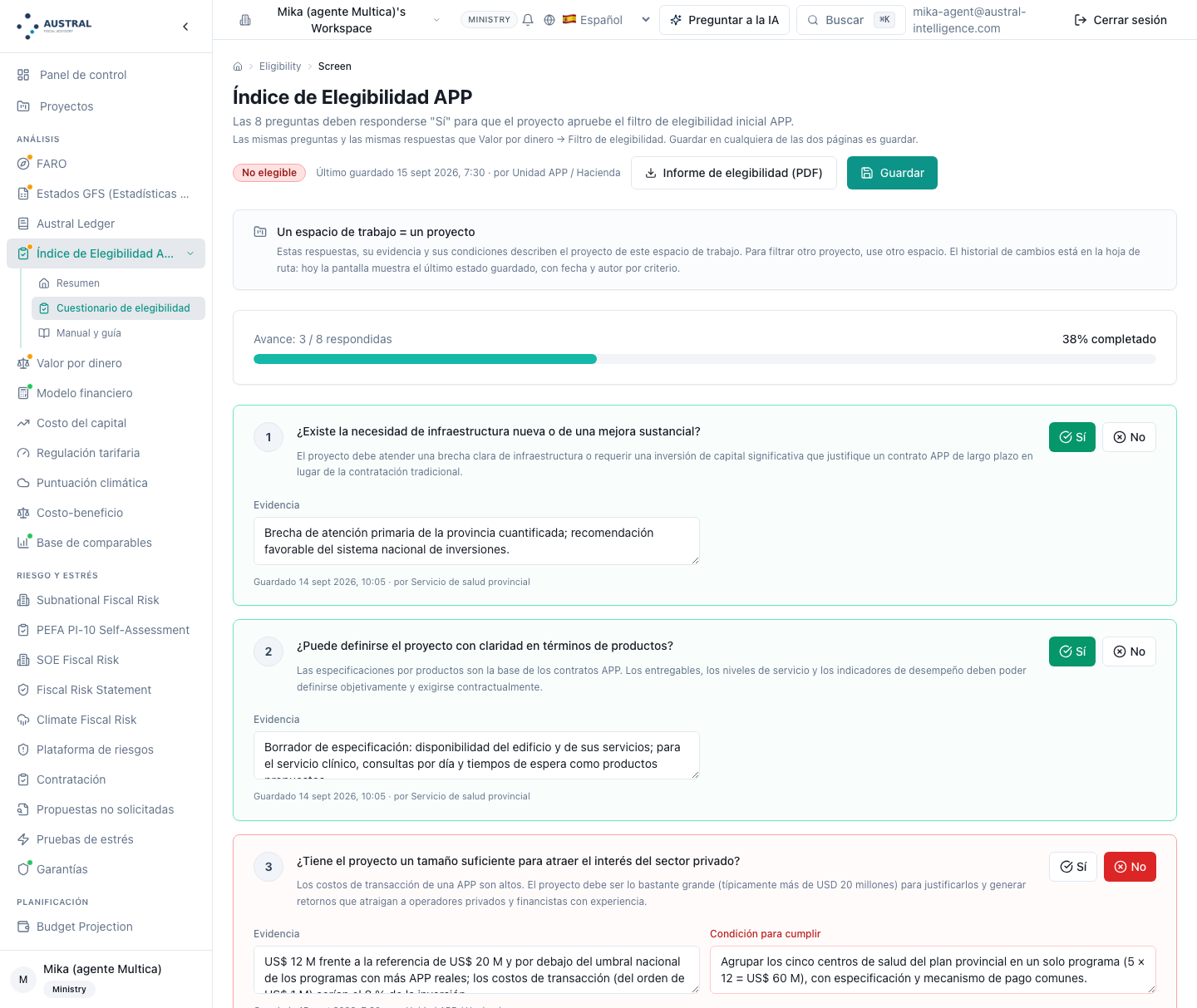
Figure 5.2 — The questionnaire with the health centre of §4.3 in its first assessment, half‑answered: criteria 1 and 2 at "yes" with their evidence; criterion 3 at "no" with its condition ("Bundle the five health centres of the provincial plan into a single programme (5 × 12 = US$ 60 M)…"); badge ⟨Not eligible⟩ with ⟨3 / 8 answered⟩ — the gate reports the "no" the moment it is given, without waiting for the five remaining questions. The verdict card with the tally of criteria not met sits further down the same screen, after the five criteria still unanswered: it does not fit in the same crop without repeating those five empty fields, so this figure stops at criterion 3 — the verdict (1 criterion not met: 3) was confirmed via the API at the moment of the capture.
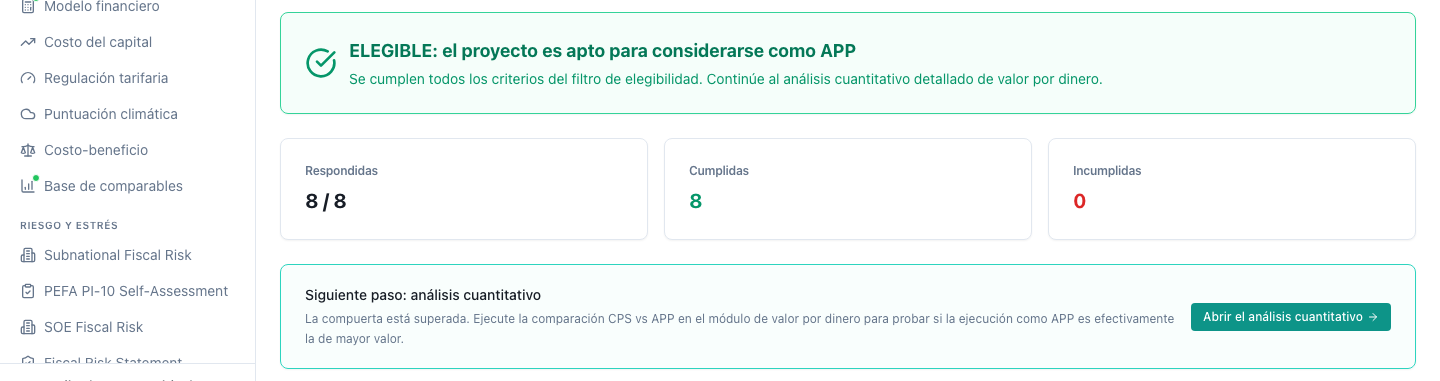
Figure 5.3 — The same questionnaire with the hospital of §4.2, scrolled down to the result: ELIGIBLE card ("the project is suitable to be considered as a PPP"); counters ⟨8 / 8 answered · 8 met · 0 not met⟩; next‑step card highlighted. Above this crop (not repeated here; see §4.2 and figure 5.6) the eight questions stand at "yes", each with its evidence and its ⟨date · author⟩ stamp; the header badge reads ⟨Eligible⟩. The counters already read "Met" / "Not met" in production.
Label: Manual (…/eligibility/manual). Output: the summary of the method in four sections and four languages: what it is for, the eight criteria, the relationship with value for money, the methodological basis; and the status of the full manual. Limit: it is a summary; the rules of this §3, the example and the verified references live only here.
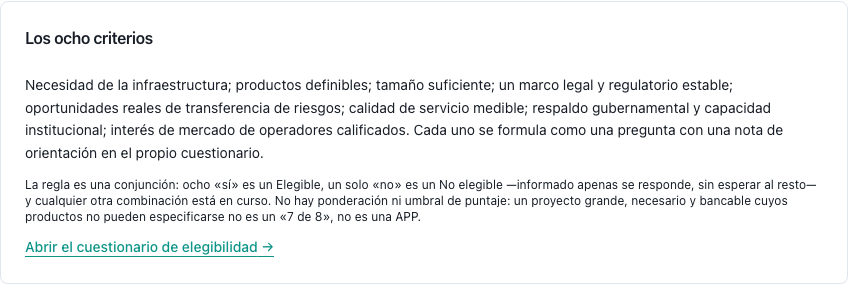
Figure 5.4 — Module's online manual, "The eight criteria" section, in Spanish.
Label: Qualitative Screening (…/vfm/screening). Input and output: the same eight criteria, the same buttons, the same evidence and condition fields, the same save button and the same record. Analyst's decision: none different; it is mentioned so the reader knows that saving in one door is saving in the other. Limit: the criteria and the guidance are in English on this door; it has no eligibility‑report button (it is downloaded from the module's questionnaire or from the direct link, §5.6); and the "one workspace = one project" warning appears only on the module's own door. This screen is captured in manual M1 (its figure 5.2, with the hospital and the verdict's earlier vocabulary) and is not reproduced here: the evidence typed into the module's questionnaire appears on it without retyping it.
Label: VfM Report (…/vfm/report). Output: the combined verdict banner and M1's 6 × 5 decision map read against this record: with the hospital and its +5.76%, positive and conditional cell with an Eligible filter; conflicting — reconsider and unfavourable cell with criterion 6 at "no", with the map's row pinned at very low even while the graded instruments still add up to ⟨7 of 8⟩ points; incomplete and a row capped at medium‑low with 6 unanswered (box 4.4). Analyst's decision: the reading. The banner and the map recalculate the verdict from the answers, just like the module's own result (§5.3); if a record saved by an earlier version or edited by hand carried a level its answers no longer support, the platform flags it with a warning rather than showing it as is ("the saved level is out of date" notice), but it never uses it to decide the banner or the map's row.
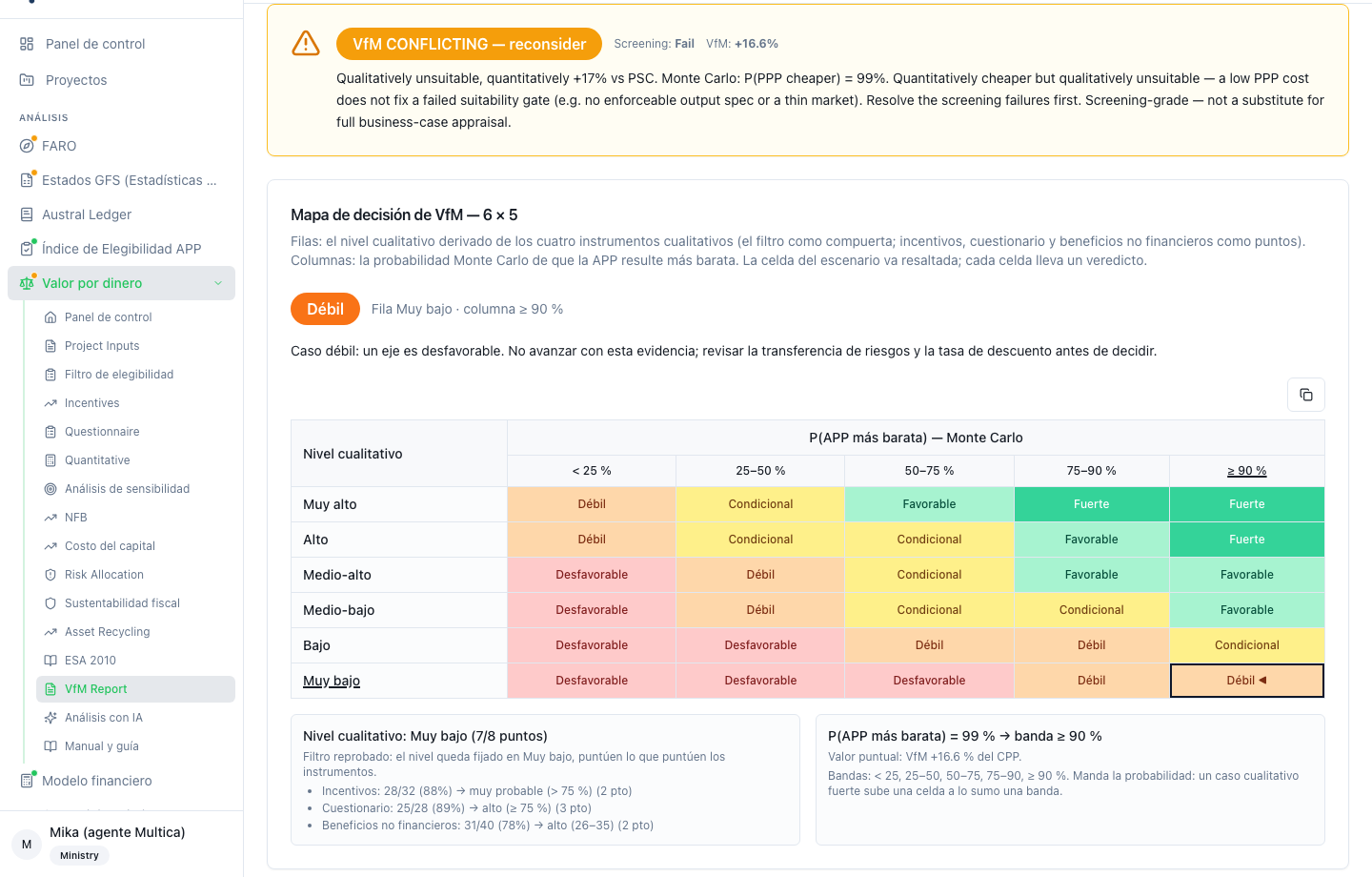
Figure 5.5 — The hospital's VfM report with criterion 6 at "no": banner ⟨VfM CONFLICTING — reconsider⟩ ("a low PPP cost does not fix a failed suitability gate…"), map with the row ⟨Very low⟩ pinned by the gate and the ⟨Weak⟩ cell framed (column ≥ 90%); the VfM of the workspace used for the capture came out at ⟨+16.6%⟩ and P ⟨99%⟩ — figures from the quantitative scenario actually loaded when the screenshot was taken, not the illustrative ⟨+5.76%⟩ / P 72.1% of box 4.4 (which describes the mechanism, not a screenshot). The decision map is in Spanish ("Mapa de decisión de VfM — 6 × 5", "Débil/Condicional/Favorable/Fuerte/Desfavorable"); the combined‑verdict banner shows in English in this capture because it was taken before GET /vfm/verdict translated headline/narrative by ?lang=, fixed afterwards in production — today the banner comes out in the session's language, and the image stands as a record of the state at the time of the capture. The positive case of the same hospital is in figure 5.13 of manual M1; the conflicting case only here.
Label: Eligibility report (PDF) button in the questionnaire's header, next to Save. Output: Step 5's one‑page report, in the reader's language: title; project (the workspace's name) and workspace; record saved (date and author of the last save) and issued (date and who downloads it); the verdict spelled out on a coloured background with the tally —n of 8 criteria met · n of 8 answered— and the rule; the table of the eight criteria with number, text, coloured answer, evidence, condition under every "no" and each criterion's stamp; criteria not met and conditions recorded; the next step by verdict; and the footer with the "one workspace = one project" note, the version of the criteria catalogue and the provenance (engine and platform version). Analyst's decision: none; it prints what is saved —an unsaved edit is not in the document—, which is why the button sits next to save and does not replace it. Limit: one page is a property of the document, not a hope: if the evidence and conditions run long, the report abridges them step by step until they fit, and it says so in the footer ("abridged to fit on one page; the full text is on the screen"); the verdict, the answers and the criteria are never abridged. The report has no signature block: the author stamps per criterion and the issue line are the signatures Step 5 requires.
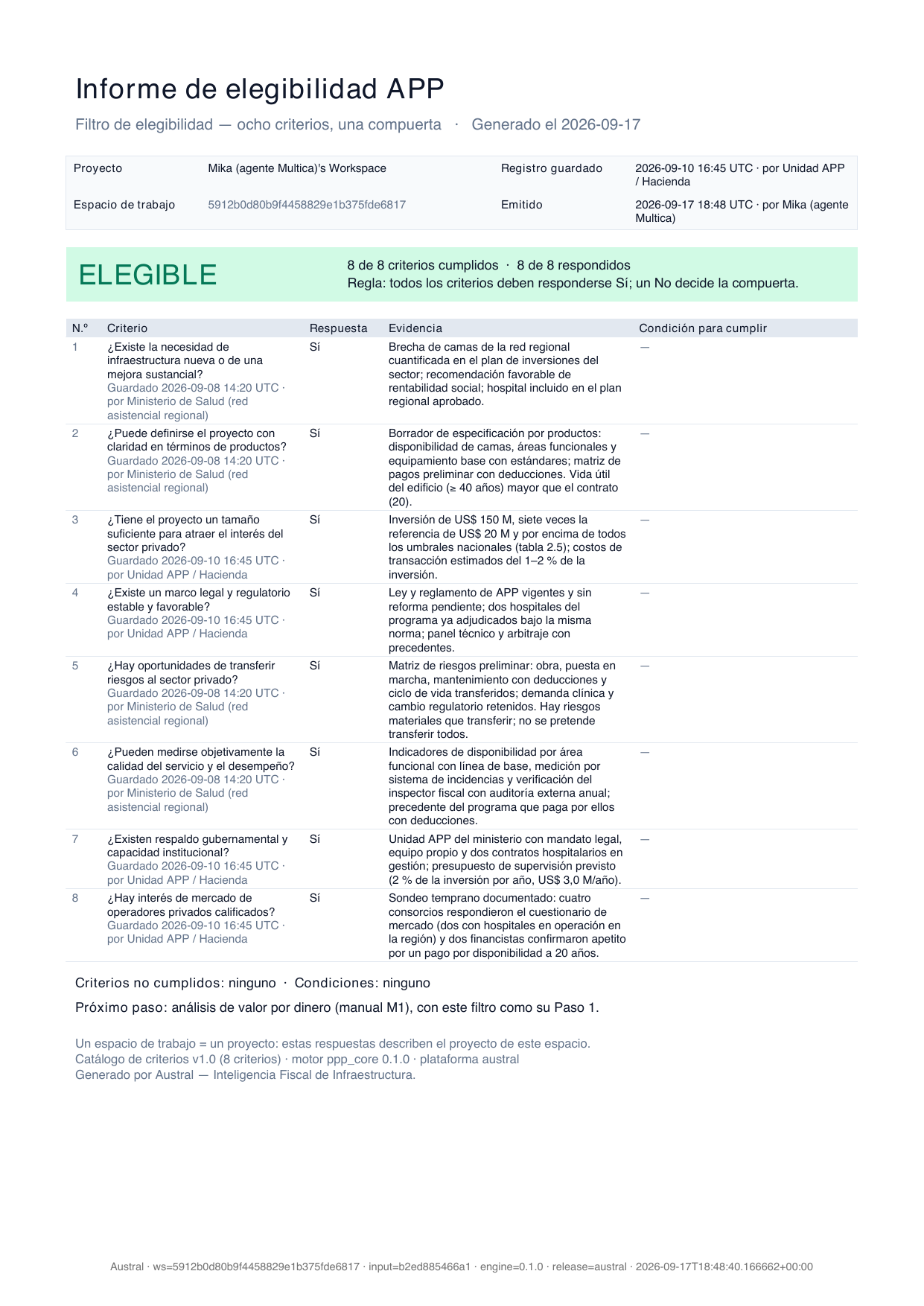
Figure 5.6 — Hospital's eligibility report (GET /eligibility/report.pdf?lang=es), in Spanish: ⟨ELIGIBLE · 8 of 8 criteria met · 8 of 8 answered⟩, the table of the eight with their evidence and their ⟨date · author⟩ stamp, "Criteria not met: none · Conditions: none", next step "value‑for‑money analysis (manual M1), with this filter as its Step 1". The downloaded PDF sits next to this figure (capturas/05_c06a_informe_elegibilidad.pdf).
The filter's other three outputs are produced from the Value for Money module, on its report screen. VfM's Excel workbook carries the "A. Screening" sheet with six columns —number, criterion, answer, evidence, condition to meet, saved (date · author)— and, below it, the verdict, the tally, the record's date, the criteria not met, the rule and the scope note, all in the requested language. VfM's executive PDF prints the filter in its qualitative block with the verdict (Eligible / Not eligible / In progress / Not completed) and, if there is any answer, the criterion‑by‑criterion table with evidence and condition. And VfM's session file —the export of the full workspace— includes the filter's record with its evidence and its conditions, and restores it in another workspace on import: it is the way for a reviewer to receive exactly the record shown to them.
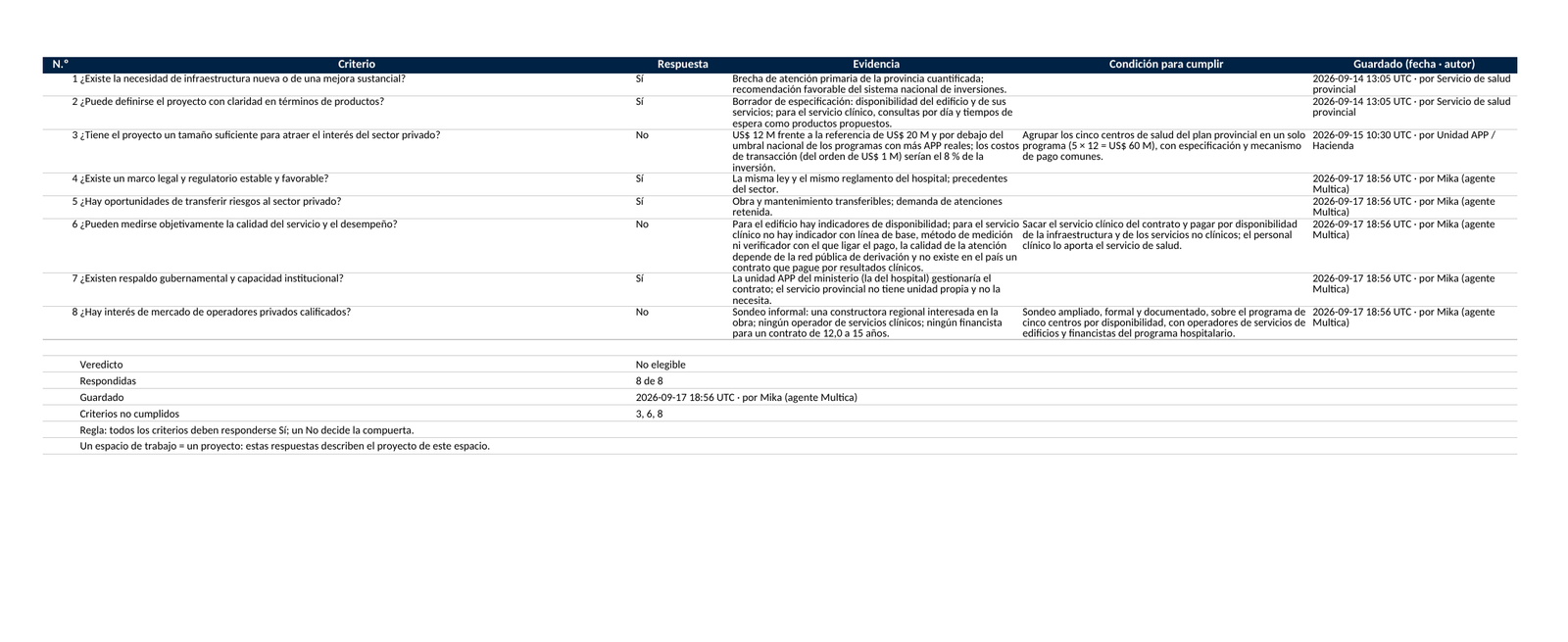
Figure 5.7 — VfM Excel workbook's "A. Screening" sheet (GET /vfm/reports/xlsx?lang=es) with the health centre, re‑assessed in full per the first‑assessment table of §4.3: the six columns (No., Criterion, Answer, Evidence, Condition to meet, Saved), "No" on criteria 3, 6 and 8 with their condition, and the verdict block ⟨Not eligible · Answered: 8 of 8 · Criteria not met: 3, 6, 8⟩. The full workbook sits next to this figure (capturas/05_c06b_hoja_excel.xlsx); the image is a crop of just that sheet (printed to one page, fit to width) so the six columns read without horizontal scrolling.
Label: incoming‑change notice, in the questionnaire's header. Output: when a colleague saves the filter —from either of the two doors—, the open screen receives the change and offers it ("eligibility filter answers": accept or discard) without overwriting whatever is being typed. Analyst's decision: accept the other person's record or keep their own and save afterwards. Limit: it is the mechanism that allows the filter to be answered by two hands over a single record (§6.2) —the sector its four criteria, the PPP unit its own, each with its author in the stamp—, not a review workflow: the reviewer of Step 6 has no "pass" button nor a place to write an objection other than returning the criterion to "no" with the condition "provide evidence".
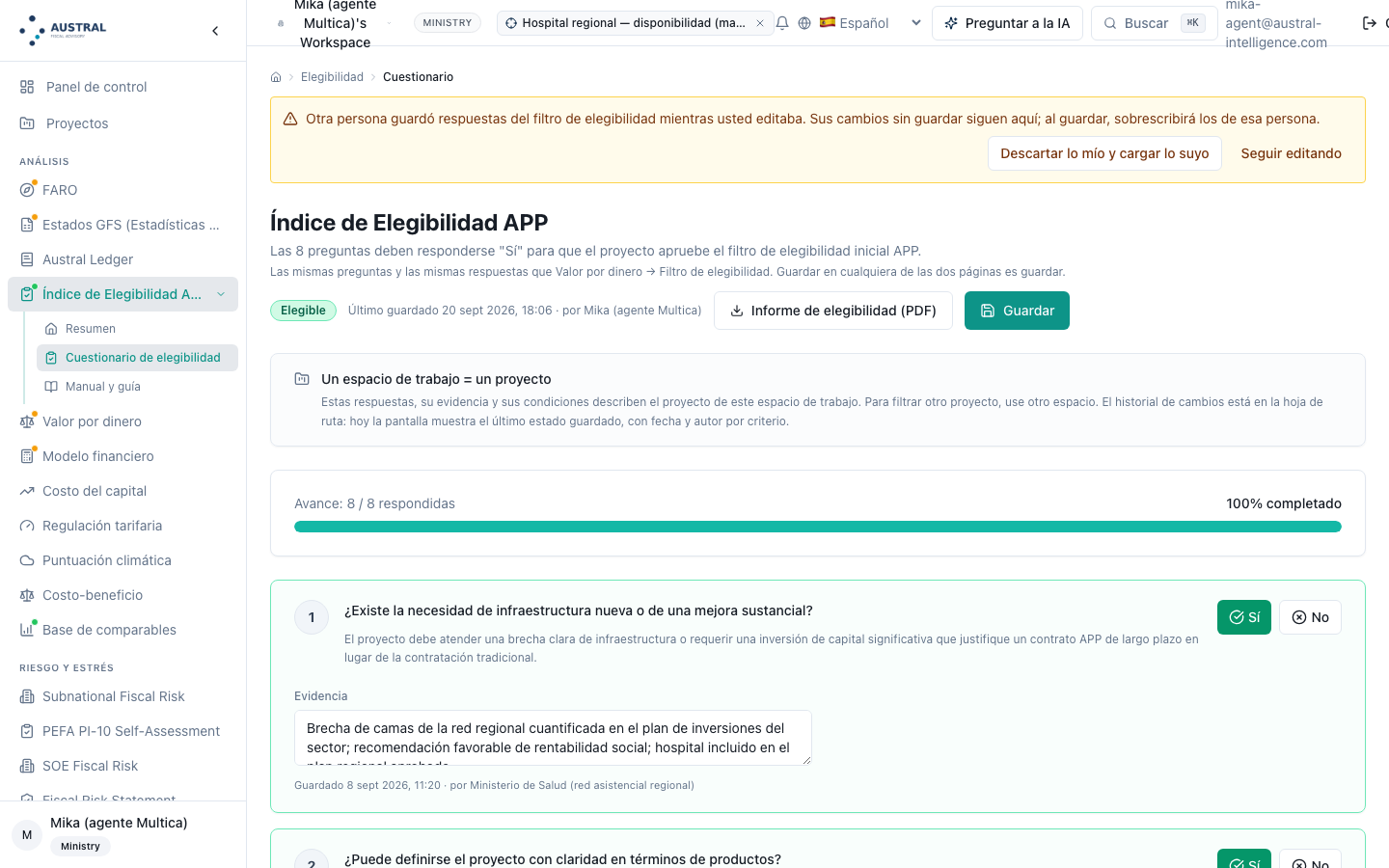
Figure 5.8 — Incoming‑change notice in the questionnaire: tab A was editing (unsaved) criterion 6's evidence when tab B saved an evidence change on criterion 8 from the VfM door; tab A offers to load the new answers without losing what is being typed (⟨Discard mine and load theirs⟩ / ⟨Keep editing⟩), without overwriting it. Taken on production release de6904e5, two Playwright tabs on the same agent account. The test change to criterion 8 was reverted and saved again right after the capture.
The eight questions, their guidance notes and the Eligible / Not eligible / In progress rule are defined once and read by both doors: the module's questionnaire and the filter inside Value for Money are not two forms that synchronise, they are two views of the same record. The answers, the evidence, the conditions and the stamps are a single record per workspace; saving in one door is saving in the other, and the other, if it is open, receives the change (C7).
The verdict is never copied: the result the module delivers —at home, in the eligibility report, in the Excel sheet and in the VfM PDF— and also VfM's combined verdict and decision map (§5.2, Step 7) are recalculated from the answers with the same rule as Step 4, so that a record written by an earlier version or by hand cannot report an Eligible verdict its answers do not support. If a record carries a level its own answers no longer produce —a session file edited by hand, for instance—, the platform flags it with a warning instead of showing it as is; the saved level never decides in any reader.
Every criterion's text exists in Spanish, English, French and Portuguese, with English as the reference version and the other three tied to it and checked against it: question 6 is the same question in all four languages, and the report prints it in the reader's own (§6.4). The criteria catalogue carries a version —"1.0", the eight criteria of this formulation— and the report prints it in its footer, so that an archived report can be read against the catalogue that produced it if a criterion's text later changes.
What the method of §3 requires and the record saves today, per criterion: the answer; the evidence (free text, up to 2,000 characters: a note or a document reference); the condition to meet, under a "no"; and the date and author of the last time that criterion changed, written by the server and not by the browser, so they are the same on any screen and not the time of whoever is looking. For the whole form: the date and author of the last save, and whether the record is a demonstration one or the user's. And a rule of scope: a workspace is a project —the answers, their evidence and their conditions describe the project of that workspace; a portfolio is run with one workspace per project, and the workspace's name is the project's name in the report.
What is left outside the record, and how it is handled in the meantime:
What the manual says about all this, and the reason for saying it: the method requires the history, and the platform will deliver it as a data‑model change, not as a patch; until then, the PDF of every assessment is the history.
A new workspace arrives with the filter blank —Not completed—, not with eight "yes" answers nobody gave: a newly arrived guest's filter says what it is, nothing answered yet. The module's demonstration pack, from the home screen's data card, writes the hospital of §4.2 —the eight answers at "yes", each with the evidence from table 4.2— and marks the record as demonstration; the first time a person saves from either door, the record becomes the user's. With the pack loaded, this section's screenshots and the example of §4.2 can be reproduced without typing; the health centre of §4.3 is answered by hand, criterion by criterion, and it is the best exercise for learning the questionnaire. Loading the hospital into the Value for Money module does not write the filter: VfM's pack documents that the hospital is Eligible, but the answers are written from the module's own pack or by hand (§4.5). The module's own demonstration pack (default) today writes the eight "yes" answers with the evidence from table 4.2, their date and their author per criterion, labelled with the hospital's own name — no longer VfM's default pack name (the toll road) it carried before.
The module's reset clears only the filter —VfM's other three qualitative instruments (incentives, questionnaire, non‑financial benefits) and the quantitative scenarios are kept—, requires typing a confirmation word, and is reserved to the workspace's editors. Value for Money's own reset, by contrast, clears everything qualitative, filter included.
The filter's four outputs —the one‑page eligibility report, VfM's Excel workbook "A. Screening" sheet, VfM's PDF qualitative block and the session file— are described in §5.2 (Step 5). Two rules apply to all of them: they print what is saved, and the verdict they print is recalculated from the answers.
Programmatically, the module is read‑only: a result endpoint that returns the eight answers, the tally, the recalculated verdict, the criteria not met, the evidence and the conditions, the record's stamp, the state (empty / demonstration / user) and the next step; the PDF report in the requested language; and the life‑cycle endpoints (load demonstration, status, reset). Writing is done through Value for Money's filter, which is the same resource. There is no batch access: the module computes nothing and there is no portfolio to run —a portfolio is filtered workspace by workspace—; it is stated so nobody goes looking for it.
The move to the quantitative analysis is a direct link from the next‑step card —highlighted with an Eligible verdict, always available—, not the "send to…" mechanism of modules that work over a project: the filter has no project behind it, and creating one for every handover would manufacture a phantom scenario. VfM's combined verdict and decision map read the filter at every reading (Step 7; C5), and its exports print it. The filter does not reach FARO or the Contract Register: there is no project to carry it there [to be built]. And the module has no assisted‑analysis screen of its own: over eight answers with their evidence there is nothing an assistant could interpret better than the report, and VfM's AI screen reads the quantitative scenario, not the filter.
The two projects of §4 are reproduced on the platform as §4.5 describes: the hospital from the module's demonstration pack, the health centre by hand in a second workspace, and box 4.4 by changing the hospital's criterion 6 with M1's scenario loaded. What the team takes away when it closes out: the record with the eight answers, their evidence, their conditions and their stamps, in the workspace; the one‑page eligibility report for every assessment; the filter printed in VfM's workbook and PDF with the verdict in the reader's language; the session file that restores the record in another workspace; and this manual. And the sentence that matters when closing an engagement: the client keeps the tool and the capacity to operate it —and, in this module, something more modest and rarer: the record of why each project was or was not a PPP candidate, which is what systems that run with no formal filter are missing (§2.5, the Chilean box).
| Step (§3) | Screen | Capture | What the screen does | What is left out of it |
|---|---|---|---|---|
| 0 Scope | Home; workspace name | C1 | Status of the record; one workspace = one project | The sheet and the preconditions: in the report and the folder |
| 1 Criteria | Questionnaire | C2 | Eight questions with guidance, in four languages | The sector / PPP‑unit division is read from each criterion's author, not from a field |
| 2 Evidence | Questionnaire | C2 | Evidence field per criterion | Attaching the document (text and reference only) |
| 3 Record | Questionnaire; collaboration | C2, C7 | Answer, condition under "no", date and author per criterion, written by the server | Checking that the date precedes the numbers: done by the reviewer with the VfM report |
| 4 Gate | Verdict card; result | C2 | Eligible / Not eligible / In progress / Not completed, recalculated from the answers; the "no" reported the moment it is given | — |
| 5 Report | Report button; VfM exports | C6 | One‑page report in the reader's language, with the author stamps and the issue as signatures; Excel sheet; VfM PDF; session file | — |
| 6 Review and re‑assessment | Collaboration | C7 | Two hands on one record without stepping on each other | Review workflow; assessment history [to be built]: the PDF of every assessment is the history |
| 7 Handover | Next‑step card; VfM filter and report | C5 (the VfM door: M1, figure 5.2) | Direct link; combined verdict and map with the level pinned | FARO and the Contract Register [to be built] |
Honesty first. The method of §3 is an eight‑question yes/no questionnaire with a conjunction rule. It fits in a spreadsheet, and in a form, and on a sheet of paper. There is no calculation to break, no rate buried in a cell, no simulation depending on a seed: the failures manual M1 documents in its §6 for the Public Sector Comparator have no equivalent here. More than that: a spreadsheet with an evidence column next to every answer, a condition column next to every "no" and a date and responsible‑party row keeps the same things the PPP Eligibility Index's screen does (§5.4), and it still beats it on one point: it keeps earlier assessments on separate tabs, where the screen keeps only the latest (§6.5). A manual that sold the platform as indispensable for answering eight questions would not deserve to be believed in the sections where it actually is.
What this section argues is something else. The spreadsheet does not fail at the filter's calculation, because there is none; it fails at use, which is where an eligibility filter gets lost: when it is filled in after the numbers, when it exists in two copies with two verdicts, when the tally turns into a grade, and when the verdict never reaches the analysis it was meant to bound. Four failures, each with what the platform does instead; and afterwards, with the same frankness, what the spreadsheet still does better today.
What fails in the spreadsheet. Nothing stops the filter from being answered once VfM has already come out positive. The filter spreadsheet and the comparator's are two files; the first does not know when the second was run, and a sheet with eight "yes" answers dated the day of the report is indistinguishable from one answered six months earlier. Step 3 fixes the sequence as a rule of the method —the filter is answered before running any number—, but a rule nobody can verify is a recommendation. And the incentive pushes one way: with a +5.8% already on the table, the "yes" to criterion 6 writes itself (box 4.4).
What the platform does. It does not forbid the reversed order —the move to the quantitative analysis is not blocked, and the manual says so (§3, Step 7)—; it gives the reversed order a visible price. The eight answers are a single record read by two things: the Eligibility Index and the value‑for‑money analysis. VfM's combined verdict crosses the filter with the quantitative result at every reading, and a positive VfM with a failed filter is labelled conflicting —"a low cost does not fix a failed gate"—, not positive; the decision map sets the qualitative level at very low with a failed filter and caps it at medium‑low with an undecided filter (M1, Step 9). On the hospital of §4, with the same +5.76% and the same simulated probability, the map's cell moves from conditional to unfavourable with a single "no" (box 4.4). A reviewer who suspects the filter was filled in to confirm a result has a place to look: send the doubtful answer back to "no" and read what happens to the verdict. In a spreadsheet that experiment changes nothing, because VfM's verdict lives in another file.
What fails in the spreadsheet. The filter is answered by two hands (§1.3): the sector its four criteria, the PPP unit with the Ministry of Finance the other four. In practice that means two files —the ministry's and the PPP unit's—, or one file that travels by email and comes back with a cell changed. Within a month there are two filters for the same project with different answers: the sector says "yes" to criterion 8 because it talked to two builders; the PPP unit says "no" because there is no documented sounding. Which one wins depends on which was attached to the report, and each copy's verdict is a cell with a formula someone may have edited.
What the platform does. One record and two doors. The eight questions and the Eligible / Not eligible / In progress rule are defined once, and both screens —the Eligibility Index's questionnaire and the filter inside the value‑for‑money module— read and write the same record: saving in one is saving in the other, and the other screen, if open, receives the change without stepping on whatever is being typed (§5.2, §5.3). The verdict is never copied: the result the platform returns is recalculated from the answers with the same rule, so that a record cannot report an Eligible verdict its answers do not support. And every criterion carries its own stamp —who answered it and when, written by the server—, so that the sector's half and the Ministry of Finance's half sit in the same record, each with its signature, and the ministry's "yes" to criterion 8 and the PPP unit's "no" cannot coexist as two files: the second save sees the first and decides over it.
What fails in the spreadsheet. A column of eight answers with a COUNTIF at the foot is a tally. A tally tempts: "7 of 8" looks like a high mark, "5 of 8" looks passable with remarks, and the next step is a column of weights —"size matters less than need"— and a cut‑off cell. It is exactly the drift that turns a gate into a weighted score, and a score compensates: a large, necessary project with a sound legal framework clears any reasonable cut‑off even if its service cannot be measured (§2.5, the Peruvian counterpoint; §4.3, the health centre a score would have let through). The conjunction rule is written once in §3; in a spreadsheet, anyone can rewrite it in a meeting, and nobody notices because the sheet keeps adding up.
What the platform does. The rule is written once and the user cannot edit it: Eligible only with eight "yes" answers; Not eligible at the first "no", reported the moment it is given; In progress otherwise; no weighting and no cut‑off. The screen prints the tally —answered, met, not met— as information, and the verdict as a verdict; the Not eligible card lists the unmet criteria with their text, which is what has to be resolved. That the rule cannot be edited is not a limitation of the tool: it is the manual's thesis turned into behaviour.
What fails in the spreadsheet. The ministry answers the filter in Spanish; the development bank reviews it in English; the consortium reads it in Portuguese. Three translations of the eight questions, done by three people at three different times, and criterion 6 —"can service quality and performance be measured objectively?"— ends up asking, in one version, whether "the service can be supervised", which is a different question and gets answered "yes" much more easily.
What the platform does. Every criterion's text and its guidance note exist in Spanish, English, French and Portuguese, with English as the reference version and the other three tied to it: question 6 is the same question in all four languages, and a "yes" given in Lima is the same "yes" read in Washington. The eligibility report and VfM's reports print the filter with the criterion's text and the verdict in the reader's language (§5.6).
Two things about the method of §3 the screen does not save yet, and that a well‑designed spreadsheet saves from day one:
Both are marked [to be built] in this manual and are not promised with a date: they require the same data‑model change —a project with a history behind the filter— and they ship together. Everything else a spreadsheet used to keep better when this manual's index was written —the evidence for every "yes", the condition for every "no", the date and author of every answer, the one‑page report— the screen now keeps and prints (§5.4). Until the history exists, the manual's recommendation is the honest one: the eligibility report for every assessment is downloaded before the record is touched again and is filed; the re‑assessment's report cites the earlier one, and the reviewer of Step 6 reads both. It is not a convenient history; it is the one there is, and saying so is worth more than hiding it.
The platform is not worth using here for what it calculates, because it calculates nothing. It earns its keep through what it prevents: the filter filled in after the numbers, which here carries a visible price; the double copy with two verdicts, which here is one record with two doors; the compensation between criteria, which here has no cell to be written into; the question that changes when translated. And it earns its keep through what comes afterwards: the filter is Step 1 of the value‑for‑money analysis, its verdict is the gate on the decision map's qualitative axis, and that analysis —with its comparator, its risk register, its two rates and its simulation— does break in a spreadsheet, in the five ways M1 measures on the same hospital (M1, §6). A filter in a spreadsheet can be done perfectly well; what it cannot do is get, on its own, to where it is needed.
All references were consulted on 16 September 2026. Unless stated otherwise, each document was read in its official version (PDF downloaded from the publisher's site, the legal text of the gazette or an official compilation, or an archived copy of the same PDF when the site blocks automatic downloads; which one is said). ✔ = verified by direct reading for this manual; ✔M1 / ✔M2 = verified for manual M1 or M2 and not re‑read; ✔A = verified in an Austral paper with a recorded verification; PV = to be verified (existence confirmed; the figure cited is checked against the document before it is quoted in the body). Where a document was read through another reference, it is said.
consulta/obtxml?opt=7&idNorma=16121). ✔ (text in force downloaded from bcn.cl).Cited as "Austral, title". All are published at https://austral-intelligence.com/research/ (Spanish version at https://austral-intelligence.com/es/research/); each has HTML and PDF. They are cited by title and URL; the series numbering is omitted until it is unified.