Manual M12 · Austral Manual Series
Download PDF ↓Versión en español
Diseño Institucional de Programas de Concesiones — Manual M12 de Austral
Version 1.0 · 28 September 2026
Austral Intelligence · David Duarte Arancibia, with Mika (Austral's analysis agent)
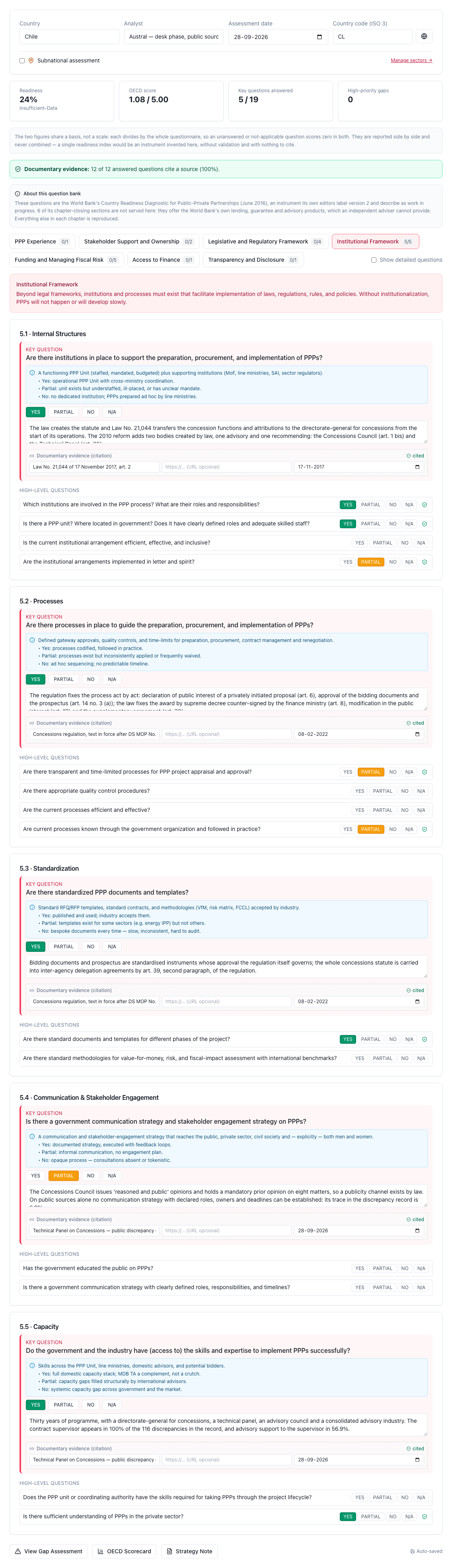
What runs it: a service, not a module. M12 accompanies the Institutional Design service (T3) — governance, powers, an approval map, mandate agreements, portfolio and prioritisation. No platform module runs "institutional design" as such: what exists are three diagnostic instruments already implemented that cover parts of the method — the Country PPP Readiness Diagnostic (/crd), the PIMA self-assessment (/budget/pima) and the PEFA PI-10 self-assessment (/pefa) — plus four surfaces that serve as proof of existence of a concrete institution (the eligibility index /eligibility for the qualitative gateway, the Fiscal Risk Statement /frs for the disclosure institution, the Contract Registry /contracts for the auditable register, and the /budget/pipeline portfolio together with the Infrastructure Fund /infrasfund for the ceiling and the headroom). The rest of the method — the inventory of powers and the approval map — has no platform surface and is delivered as a template.
Languages: English (this edition) and Spanish, both complete · HTML and PDF at austral-intelligence.com/manuals
This manual is the one manual in the Austral series whose subject is not a project or a contract but a programme and the institutions that decide it. Its unit of analysis is the act with legal effect — declaring the public interest of an unsolicited proposal, approving the bidding documents, awarding, approving a modification with fiscal effect, authorising early termination — together with the body that issues it, the rule that grants it, the phase of the cycle in which it binds, and the evidence that it is actually exercised. Its thesis is that a ministry of finance, a contracting authority and a PPP unit can each hold a power written in one place and exercised in another, and that closing that gap is the cheapest and most postponed fiscal decision a country can make — cheaper than any of the twelve calculation manuals that precede it in the series, because it buys nothing, borrows nothing and builds no fund. It sets out a self-contained nine-step method, built on the World Bank's Country PPP Readiness Diagnostic and PPP Reference Guide, on the OECD Council Recommendations on public governance of PPPs (OECD/LEGAL/0392) and on the governance of infrastructure (OECD/LEGAL/0460), on the IMF's Public Investment Management Assessment (PIMA) framework, on PEFA indicator PI-10, and on Chile's statutory concession framework cited article by article — declaring, step by step, which thresholds come from those sources and which are Austral's own contribution. It keeps three words apart that the source instruments themselves routinely blur — power, function and gateway — and carries the distinction through a subtraction the manual publishes instead of an index: strength (what the rule grants) minus effectiveness (what the body actually exercises). It works the method over two cases in opposite directions: the Chilean concession system, read from its own public case file of technical-panel disputes, where the power exists and the gap is in how it is exercised and shared between two principals under delegated competence; and the Republic of Lemuria, the series' synthetic country, where the power does not exist yet and no amount of added capacity substitutes for it. It explains why the diagnosis is delivered today as a word-processor report and not as a spreadsheet, and the five specific ways that format destroys what this method needs. It is written for ministries of finance, contracting authorities, PPP units, supreme audit institutions and the multilateral banks that finance institutional reform.
Austral Intelligence (2026). Institutional Design of Concession Programmes. Manual M12, Austral Manual Series, version 1.0, September 2026. https://austral-intelligence.com/manuals/institutional-design/
Section 4 works two cases, and the two carry figures of different kinds. Case A (Chile) uses only material already public: the counts over the 116 Technical Panel dispute folders with available text (2,965 documents) come from a reproducible script, _cifras_seccion4.py, published together with the manual, whose full output lives in _cifras_seccion4_salida.md; nothing there is hand-transcribed. No figure from Chile's budget office is reproduced, by standing house rule — the manual cites its institutional role and refers the reader to M2 and M9 for the figures themselves, and says so in the text so the omission does not read as an oversight. Case B (the Republic of Lemuria) uses the platform's own declared data for the fictitious country and its 81-contract reference portfolio, read directly from the platform's source code by the same script — no database, no running service — so that a figure in the manual and a figure in the product can never drift apart. None of it is a client figure, in either case. Figures compared against GDP or budget are kept as a percentage with their base year stated; where a fiscal ceiling (an annual flow) and a stock of accumulated commitments (an existence figure) both appear, the manual states which is which and does not divide one by the other.
This is the first complete English edition of Manual M12, translated from the Spanish edition of 28 September 2026. All seven sections are written, and section 5 — what the Institutional Design service delivers — is closed against the platform in production on 28 September 2026, with its eleven figures taken that day over the two cases of section 4. Every figure, table and citation is carried over unchanged from the Spanish text, checked one by one; where the two editions differ, including after a later correction to either one, the Spanish edition is the reference. National instruments — the World Bank diagnostic and reference guide, the OECD Recommendations, the IMF's PIMA framework, PEFA PI-10 — are cited by their official English name throughout, since the Spanish edition already cites them that way. Chilean statutes keep their official Spanish name, with an English rendering of the title in parentheses at first use. The country name Republic of Lemuria is not translated in any edition of the series. Three convention words recur across every section and are fixed here to one English form each, used consistently: atribución → power (the authority of a body to produce an act with legal effect); función → function (a task a body performs without an act resulting from it); compuerta → gateway (the point in the cycle where an approval act is a condition to proceed).
A ministry of finance receives a concession file with a thirty-year payment mechanism and has to sign. It is reviewed by a team of four who took no part in the design, who received the file already assembled, who did not set the discount rate the project was evaluated with because the country has none published, and who know that sending it back means stopping an announced work. It signs. Two floors down, at the granting authority, a much larger team knows exactly what the project costs and what it risks, and has no power to decide whether it goes ahead. And in a third building, the line ministry that commissioned the work under an inter-agency agreement believes the technical counterpart it appointed can demand a standard, and will discover three years later — in a dispute forum — that the mandate agreement said no such thing.
None of the three problems is a project problem. They are the same institutional-design problem seen from three desks: a power written in one place and exercised in another. This manual is about that. Not about which project is worth doing, not about how value for money is calculated, not about how a guarantee is priced — the twelve previous manuals in this series are about that — but about who can decide it, under what rule, at what point in the cycle, and how much of all that actually works.
The reason a dedicated manual exists is that the other twelve presuppose it. A public-private comparator needs a body with the power to reject the project when the comparator comes out negative; a fiscal commitment register needs a body that keeps it and a rule that requires feeding it; a risk matrix needs a standing allocation policy that someone approved before the first project. When that institution does not exist, or exists without power, the method runs and binds no one: the report is filed, the figure is cited in the recital, and the project moves forward anyway. A country can buy twelve methodologies and not change a single decision.
The object of the manual, then, is the programme, not the project. It is the only one in the series whose subject is not a contract. And its unit of analysis is the act with legal effect — declaring the public interest of an unsolicited proposal, approving the bidding documents, awarding, approving a modification with fiscal effect, authorising early termination — together with the body that issues it, the rule that grants it, the phase of the cycle in which it binds, and the evidence that it is exercised. From that come the six outputs of §1.7 and the nine-step method of §3.
The question fits in one line: I have, or want, a concession programme — who approves what, in what order, under what rule, and how much of all that actually works.
Each part does work. Who approves what is the inventory of powers: one row per act, with the body that issues it, the one that co-signs it, the one that reports without deciding, and the rule behind each. In what order is the approval map: the same acts against the four phases of the cycle, to see whether there is a phase that proceeds without a single fiscal gateway. Under what rule is the discipline of citation: a cell with no rule behind it is a finding, not a filling error. And how much actually works is the step that separates this method from a legal description: each power is scored twice, for what the rule grants and for what the body exercises, and the gap between the two figures is the diagnostic's main result.
From that follows what the manual does not answer. It does not say which project is worth doing for the country: that decision belongs to the line ministry and the national investment system, and the OECD Council Recommendation on public governance of PPPs places it explicitly at the highest political level, separate from the decision of how to contract (principle 4). It does not say how to draft the law: it says what the missing institution should be able to do and with what fiscal effect, never with what wording. It does not say what the org chart should look like: the annex to that same Recommendation (¶2.1) admits several institutional arrangements and only requires that roles be kept separate, and the manual holds to that. And it does not say whether an act was lawful: it describes what the framework allows and what practice shows, with its citation, and leaves the judgment of legality to whoever holds that mandate.
It is worth writing this without euphemism, because it is the boundary a reader can blur on their own if it is said only once. This is the first of three places where the manual says it; the other two are Step 4 of §3 — the exact point where a gap turns into an action — and §5.8, the service's declared limits.
The positioning limit
Austral is a fiscal-risk firm that also works in PPPs. It does not lead legal reform or engineering design, and this manual cannot be read as if it did. Literally, that means:
- The manual does not draft law or regulation. It teaches how to read the current framework to know who can do what, and how to measure the distance between the power written and the power exercised. When the diagnostic concludes that a rule is missing, the manual states what the missing institution should be able to do and with what fiscal effect, never with what wording. The drafting belongs to the country's legal services or its legal adviser.
- The manual does not design the organisation. It proposes no org charts, staffing plans, pay scales or internal reporting structures. It proposes powers and gateways, which are objects of fiscal decision; where the person who exercises them sits is for the country to decide.
- The manual does not do engineering or sector planning. The portfolio appears as a fiscal constraint and a rationing problem, never as a judgment on which work suits the country. Sector priority belongs to the line ministry and the national investment system.
- The manual does not rate countries. No ranking, no league table, no nominal comparison that orders governments by institutional quality. The diagnostic's bands are the country measured against itself, and the manual treats them as a starting point for reform, never as a grade.
- The manual is not an audit. It issues no opinion on legality or compliance. It describes what the framework allows and what practice shows, with its citation, and leaves the judgment of legality to whoever holds that mandate.
Everything the twelve previous manuals measure — value for money, fiscal commitment, guarantee, risk allocation, payment mechanism, modification, supervision — presupposes a body with the power to decide it and the capacity to defend it. It is the only intervention in the series that requires building nothing: it buys no work, borrows no debt, creates no fund. It requires writing down what each body can do and making one body's approval a condition to proceed.
And it is the most postponed for a reason worth saying out loud: it pays off late and costs political capital early. Setting a public discount rate, a value-for-money threshold and a standing risk-allocation policy produces no work this year, and it does produce, this year, the conversation about who loses discretion. The five failure modes §2.9 draws from the house's own research — a captured ministry, an understaffed ministry, orchestration at the wrong level in federal systems, doctrine ahead of capacity, sector complexity the analytical chain cannot absorb — describe countries that bought the method and not the institution. The diagnostic exists so as not to recommend to a country a reform it cannot execute.
The diagnostic is of little use if it does not distinguish problems that need different repairs. There are three, and confusing them is the error that keeps an institutional reform from changing anything.
The empty power. The rule says a body approves, and in practice the file arrives assembled, late and with no alternative but to abandon it. The body signs. Formally there is a gateway; materially there is a formality. It is diagnosed on the effectiveness axis of Step 3 — is there any published act of that body that ever changed a decision? — and it is repaired by moving the gateway earlier in the cycle, not by creating a new one.
The split power. Two bodies share a decision and neither has the method, so the project moves forward through whichever asks the fewest questions. It is the pathology of the dual principal under delegated competence, and it is the one §4 measures on public Chilean material. It is diagnosed on the approval map, as a cell with two owners and no declared criterion, and it is repaired by writing the split into the agreement that creates it — Step 6 — not by arbitrating case by case.
The power without capacity. The mandate exists, is real and nobody disputes it; staffing does not reach far enough to exercise it. It is the best-documented failure mode in the field: the World Bank's PPP Reference Guide demands, for a unit with a gatekeeping role, a weighted balance between mandatory requirements and resource provision — "not only money […] but mainly knowledge and experts" — and sufficient leverage (module 2, §2.3.4, p. 78); and the annex to the OECD Recommendation, ¶2.4, says the central budget authority does not need deep knowledge of technical design, but "it needs sufficient capacity to evaluate the documentation presented to it" (p. 8). It is diagnosed through PIMA's three enabling factors — legal framework, information systems, staff capacity — and it is repaired with budget, not with a rule. It is also the mode most often confused with the other two: a country that answers a power-without-capacity finding by drafting a new law has spent its political capital on the one thing it already had.
A body designed to deny for bad reasons withers. Denying costs political capital in every specific case, is paid for against a project with a name and an inauguration date, and — this is the decisive part — an unused veto leaves no trace: an unexercised veto is indistinguishable, on the record, from a veto that does not exist, and three years on nobody can say whether the body filtered or merely watched. A body designed to affirm for good reasons — a positive, published approval act without which the process cannot proceed — consolidates: every act leaves evidence, the evidence accumulates into a series, and the cost of bypassing it rises over time instead of falling.
The design consequence is direct and runs through §3: gateways are written as required approvals, not as powers of objection, and are spread across phases rather than concentrated at signing. It is consistent with the annex ¶2.4, which asks for central-budget-authority scrutiny at every key phase and not a single final pronouncement, and it is one of the sustainable-orchestration prerequisites the house's own research identifies (Austral, From Gatekeeper to Orchestrator). §4 shows the flip side with public material: an affordability gateway whose silence approves after thirty days is, by design, a passive veto; Chile's own framework writes it that way (regulation, art. 14 no. 3 letter a), and it is exactly why Step 2 requires recording, cell by cell, what happens if the signature is missing.
The method runs in full once and is re-read at three distinct moments.
Before the programme exists, or when the decision is made to repair it: the full run through Steps 1 to 5 — inventory, map, the two axes, the gaps and the four standing policies — which is the diagnostic proper and produces the strategy note.
Every time a project comes in: the approval map stops being a diagnostic and becomes an operational checklist. Which act belongs to this phase, which body issues it, which report is a mandatory prior step, what happens if someone does not rule.
Every year, in the budget cycle: Step 3's implementation gap and Step 7's headroom book are recalculated. These are the two figures that move without a single rule changing, and they are what shows whether the reform advanced.
When something breaks: a recurring dispute over who should have decided is not bad faith, it is a symptom of design. Step 6 reads it for what it is — a silence in the agreement that split the powers — and sends it back to the document that should have resolved it.
Seven readers of the same diagnostic, with seven different questions. The first five are not an editorial choice: they are the five bodies principle 2 of the Recommendation names, and they are the five minimum rows Step 1 requires an inventory to start from.
The manual delivers six objects, and each has a step in §3 that produces it and a recipient who uses it.
None of the six is a single number. The manual does not publish a composite institutional-design index, and §2 explains why: the three instruments it uses have three different scales — 0–5 with four bands, 1–3 with three bands, D→A with the M2 conversion — and averaging them would mean inventing an instrument nobody validated and nobody can cite.
A governance manual reaches a reader who expects the promise of results: that correct institutional design produces better programmes. The manual dismantles that here, and does it again with the full evidence in §2.8.
None of the three instruments the method uses measures results: they measure conditions. The readiness diagnostic compares the state of affairs against good practice to produce a gap; the PIMA framework scores the strength and effectiveness of fifteen institutions; the PEFA indicator rates a reporting practice. None of them observes a project's final cost, the tariff the user paid, or the liability the state ended up assuming.
And the comparative evidence linking institutional design to programme performance does not close the gap. The house's own research on the ministry of finance as orchestrator (Austral, From Gatekeeper to Orchestrator) scores twelve doctrine documents and fifty countries, and its own limitations section is explicit: the signal is correlational; the cell that matters has four countries and 1,547 projects, of which just one contributes about 73%; the comparison does not control for income level, legal tradition, technical-assistance history or sector composition; and the international instruments that score programme design measure de jure design and were not built to detect the signal being asked of them. The paper's own conclusion is that the hypothesis is supported, with caveats, and not proven.
M12 adopts the qualitative argument and does not adopt the promise of results. What the manual does assert holds without statistics: that the portfolio view exists only in the body sitting above the sector level; that a supreme audit institution audits a methodology more cheaply than twenty sector-by-sector judgment calls; and that the moment a power is tested is when the fiscal envelope bites. A reader who wants to buy the promise of results will find someone to sell it; what this manual offers is a diagnostic its own audit office can verify.
A self-contained nine-step method (§3), executable with the law, the regulation, the budget and a spreadsheet, no tool required. Two reproducible cases (§4): the Chilean concession system, read from its own public case file — where the power exists and the gap is in how it is exercised and shared — and the Republic of Lemuria, the series' synthetic country — where the power does not exist and no amount of added capacity substitutes for it. Two countries with the same band can need opposite reforms, and publishing only the band hides that. And the T3 service with its three diagnostic instruments, its two templates and its declared limits (§5), including the most uncomfortable one: two of the method's six deliverables have no screen and are delivered as a table.
The methodological basis for all of the above — what is taken from each source, what cannot be taken from any of them, and what the house adds — is §2, and it is the manual's longest section for a reason: here the methodological basis is the product.
Unlike the calculation manuals in this series, there is no single model to reimplement here. There is a diagnostic questionnaire that sets the questions, an intergovernmental normative body that says which bodies should exist and what each should be able to do, two institutional-assessment frameworks that score what is written and what is exercised separately, comparative evidence on where the technical unit sits, and an outcomes literature that does not measure what this method needs. Resolving that set — what is taken from each source, what cannot be taken from any of them, and what the house adds — is what makes the manual useful, and it is why this section runs eight of the manual's forty-one pages.
Every statement carries its document, its section and, where the document has them, its page or paragraph. What could not be read in the source is marked [to be verified] and is not asserted. Methodologies are credited by their institutional name and never by any firm's: the Country PPP Readiness Diagnostic and the World Bank's PPP Reference Guide; the OECD Council Recommendation on principles for public governance of PPPs (OECD/LEGAL/0392) and the Council Recommendation on the governance of infrastructure (OECD/LEGAL/0460); the International Monetary Fund's Public Investment Management Assessment framework (PIMA); the Public Expenditure and Financial Accountability framework (PEFA); the 2014 report of the European PPP Expertise Centre; and Chile's statute and regulation on public-works concessions.
The instrument that gives the method its questions is the World Bank Group's Country PPP Readiness Diagnostic, June 2016 edition. It is worth starting with what it declares about itself, because that governs how it can be used: "This is version 2 of the Diagnostic. The Diagnostic remains a "work in progress"", and it will be updated dynamically through frequent stakeholder consultation (p. 7). The same passage warns that, where a point requires micro-level analysis, that will be done separately. A method built on this instrument cannot present it as a closed standard, and this manual does not.
Where it comes from and what the method inherits. It grew out of an operational recommendation from the evaluation the Bank's own independent evaluation group published in 2014 on the institution's support to PPPs in fiscal years 2002–12: to translate strategic intent into an operational framework that would diagnose a country's PPP gaps (p. 3). Two dates, two different things — 2014 the publication, 2002–12 the coverage — and the instrument states both. Its declared inputs are more than 70 documents, among them gateway reviews, an earlier country self-assessment tool — which remains [to be verified]: its existence is attested in the 2016 text, the document itself was not located, and the manual asserts nothing about its content — and several checklists (p. 3). And the trait the method inherits whole: the instrument does not score, it compares. It assesses readiness by establishing the state of affairs and "comparing […] with best practices to determine gaps" (p. 3), and closing those gaps leads to a tailored PPP strategy. An institutional-design method that returns a grade instead of gaps with their citation will have lost the one thing this source contributes.
The structure. A country snapshot opens the document — macro, business climate, climate change, fragility and gender — followed by seven content themes: PPP experience (chapter 2); stakeholder support and buy-in (3); legislative and regulatory framework (4); institutional framework (5); financing and fiscal risk management (6); access to finance (7); transparency and disclosure (8). It closes with gap assessment (9) and road map (10). Chapter 9 is a table of theme × key question × Yes/No × priority (p. 42): the gap with its priority, not the score, is the output the instrument was designed to produce.
Nineteen key questions, and five belong to this manual. A direct count over the document gives 19 key questions, one per sub-criterion across the seven themes (pp. 5–7). Five belong to the institutional-framework chapter and are the ones §3 develops: whether there are institutions to prepare, procure and implement PPPs; whether there are processes to guide them; whether there are standardised documents and templates; whether there is a communication strategy and stakeholder engagement; and whether government and industry have or can access the skills and expertise needed (p. 23). That a little over a quarter of the questionnaire is institutional measures how much of a PPP diagnostic depends on what this manual teaches how to build — and how much is left out: the other fourteen questions belong to M1 through M11, and the manual refers to them rather than repeating them.
Three application phases, which the service adopts without renaming. Desk preparation, which sets the initial baseline; field due diligence, which confirms it and explores room for improvement; and strategy drafting, which recommends a tailored option contained in a PPP strategy note (pp. 3 and 44). The second is indispensable, and the manual says so where the reader will read it: a band calculated from desk work alone is a hypothesis, not a verdict.
What the method drops, and declares here. The instrument was written for a multilateral bank's task team leader and carries, across six chapters, a section on potential Bank support mechanisms (3.3, 4.5, 5.6, 6.6, 7.1 and 8.1). An outside adviser cannot offer them: the method drops those six sections and keeps everything else. This is stated here and repeated in §5.8, and not for style — staying silent would mean presenting another party's redacted instrument as one's own, in front of a client who often knows the original. Second declared departure: the instrument answers Yes/No, and the method adds Partial and Not applicable with a published scoring convention, which is what forces the rule that no band is published without its completeness threshold (§3, Step 4).
The reference guide that goes with it. The PPP Reference Guide, Version 3 (World Bank, Asian Development Bank and Inter-American Development Bank, 2017) is the field's most widely used guide, and its module 2, §2.3 "PPP Processes and Institutional Responsibilities" (pp. 69–79) is the section an institutional diagnostic reads. Two things enter the method. Gateway processes (§2.3.3): several decision points are usually created, "allowing weak projects to be stopped before they consume too many resources" or before they gain momentum of their own; and since the final cost is not known until the tender closes, a final approval before signing may be needed (p. 75) — this is Step 2 in prose and the warning against a single gateway. And the balance it demands for designing a unit with a gatekeeping role (§2.3.4): a weighted balance between mandatory requirements and resource provision — "not only money […] but mainly knowledge and experts" — plus sufficient leverage for the unit (p. 78). A mandate without staffing is the third failure mode of §1.3, written by the field's most cited guide.
OECD/LEGAL/0392, adopted by the Council on 4 May 2012 on the proposal of the Public Governance Committee. It is the only document in this §2 with the nature of an intergovernmental instrument, and that is why it gives the method its normative language: twelve principles in three blocks, whose titles the manual uses exactly as written. A — establishing a clear, predictable and legitimate institutional framework, backed by competent authorities with sufficient resources (principles 1 to 3). B — grounding PPP selection in value for money (4 to 9). C — using the budget process transparently to minimise fiscal risks and ensure the integrity of procurement (10 to 12).
Principle 2 is the backbone, and it is where the inventory's five minimum rows come from. It requires that contracting authorities, PPP units, "the Central Budget Authority, the Supreme Audit Institution and sector regulators" receive clear mandates and sufficient resources to ensure a prudent process and clear lines of accountability (p. 5). Contracting authority, PPP unit, central budget authority, supreme audit institution and sector regulator: five named bodies, which are the five rows Step 1 requires an inventory to start from. The reason there are five and not some other number is that they sit in a rule governments adopted.
Principle 4 separates the decision to invest from the decision of how to contract. All projects must be prioritised at the highest political level; the decision to invest is taken with a whole-of-government perspective and separately from how to contract and finance, without institutional, procedural or accounting bias for or against PPPs (p. 6). This is the normative basis for why an institutional-design diagnostic cannot opine on which project suits the country: that decision has an owner, and it is neither the PPP unit nor the adviser.
Principle 10 places affordability and the whole envelope with the central budget authority: it must ensure "that the project is affordable and that the overall investment envelope is sustainable" (p. 6). The annex adds why the matter is institutional and not merely arithmetic: a PPP, like long-term borrowing for investment, is harder to fit into the annual budget than variable spending, which makes the affordability assessment "particularly important" while the project is being prepared (¶10.1) — before, not at signing.
Principle 11 requires that budget documentation disclose all costs and contingent liabilities and that transparency cover the whole public sector. This is the rule the disclosure institution of Step 9 relies on, and the reason the manual refers to M9 rather than building it again.
The annex is an integral part of the instrument and contains the sentences that order §3. Almost no one cites them, and they are the most operational material this §2 has.
¶2.1 — roles can be housed in many ways, but must be kept separate. Roles can be maintained under several institutional arrangements, but "it is important that they are kept separate", so as not to blur each actor's tasks and to secure lines of accountability (p. 7). This is the sentence that authorises the manual not to propose an org chart: the rule does not prescribe where each function is housed, it prescribes that they not be blurred together. The object of design is the allocation of powers, not the structure.
¶2.3 — the separation between technical function and the power to decide. The PPP unit helps prepare and negotiate the contract, must ensure that procedural steps (gateways) are followed, and its role should be "clear and without conflicts of interest", while ultimate responsibility remains with the responsible authority. And then the sentence that grounds the manual's convention: the unit "should not decide on whether the PPP should move forward", and that green-light process "should be anchored in the Central Budget Authority" (p. 8). The rule separates, in two sentences, function from power. A body that studies, informs and recommends is not a body that approves, and a diagnostic that confuses the two does not describe the country in front of it.
¶2.4 — scrutiny by phase, and the sentence Step 3 is built on. The central budget authority must scrutinise every PPP and control it at each key phase: "Planning; Feasibility, Design and Tender Preparation; Bidding and Contract Signing; and Construction and Operation", for value for money, affordability, procedural steps and consistency with policy agreements (p. 8). Those are the four phases of Step 2's approval map, and the manual invents no others: it is the only allocation of phases with intergovernmental normative backing, and a map built on it can be audited against a rule country by country. The paragraph closes with the line the manual cites more than any other: the central budget authority does not need deep knowledge of technical design, but "it needs sufficient capacity to evaluate the documentation presented to it" (p. 8). It is the argument against the diagnostic that confuses "not its specialty" with "not its decision", and the reason Step 3 requires evidence of effectiveness and not just power: without the capacity to evaluate the file, the power exists only on paper.
¶2.5 — the ex post role of the supreme audit institution. It must audit and evaluate the PPP ex post on performance, finances and compliance, and maintain "sufficient capacity to give a clear verdict" on whether the project represented value for money (p. 8). It is the inventory row Step 1 almost never finds filled, and the argument behind §6.3: a supreme audit institution can audit a methodology; it cannot audit a conviction.
¶2.6 — the sector regulator where natural-monopoly features exist. It must be consulted in project design and then monitor compliance with the regulated standards (p. 8). Consulted and a monitor: two functions, no power to approve, said by the rule itself.
¶2.7 — the line that forbids stopping at central government. "The above roles should be institutionally maintained at sub-national level" (p. 8). The manual complies exactly as written and refers to M10 for the subnational fiscal diagnostic proper, rather than promising it.
¶1.1 — programme coherence. The ministry of finance, line ministries and executing agencies must ensure that a coherent approach to PPPs is deployed across the public sector, joined up with adjacent fields; ideally PPPs form part of an integrated public infrastructure investment and procurement framework. It is the hinge with §2.4.
OECD/LEGAL/0460, the Council Recommendation on the governance of infrastructure, adopted by the Council on 17 July 2020 on the proposal of the Public Governance Committee in cooperation with the Regional Development Policy Committee. It replaces the organisation's own 2016 infrastructure governance framework, which the instrument cites and declares superseded. Its structure is that of a legal instrument, not a brochure: a section I of agreed definitions, a section II recommending ten dimensions of whole-of-life, whole-of-government scope, each broken into lettered sub-points; and a section VI instructing the committee to monitor implementation and report to the Council every five years from adoption.
Two of section I's definitions are the ones this manual uses, and it is worth having them, because they fix the vocabulary of Step 5 and Step 7. Affordability: from the government's perspective, that projects "can be accommodated within the government's current and future budget constraints", considering the whole-life-cycle cost; from the end user's perspective, the ability and willingness to pay the tariff. Fiscal sustainability: the government's ability to maintain public finances in a credible, long-term sustainable position, counting debt service and future factors pressuring the budget.
Of the ten dimensions, four enter the method, and can now be cited by their number:
| Dimension | What the manual takes | Where it is used |
|---|---|---|
| II.i)e) — long-term strategic vision | the institutional framework must be transparent, coherent, predictable, legitimate and accountable, with institutions and levels of government vested with «clear and consistent mandates, ample decision making powers, right skills and competences, and sufficient financial resources» | Step 1 (the five rows and what is required of each) and Step 3 (the yardstick for the effectiveness axis) |
| II.ii) — safeguarding fiscal sustainability, affordability and value for money | b) ensuring the whole investment envelope is sustainable in the medium and long term, by measuring, disclosing and monitoring multi-year commitments «including off-balance sheet commitments and contingent liabilities»; e) choosing the delivery mode without institutional, procedural, fiscal or accounting bias; f) transparent and appropriate risk allocation with an agreed plan for management, monitoring and mitigation across the whole life cycle | Step 5 (standing policies 3 and 4) and Step 7 |
| II.v)b) — coordinating infrastructure policy across levels of government | adopting effective coordination instruments, listed by name: co-financing agreements, «contracts between levels of government», formal consultation processes, national agencies or representatives | Step 6: the mandate agreement, named by the rule for what it is |
| II.viii)a) — evidence-informed decision-making | defining and clearly assigning institutional responsibilities for data consolidation, dissemination, analysis and evaluation, with the resources and competences to run them | Step 9 (the disclosure institution) |
It is cited, in addition, for one specific and fundamental thing: the institutional design of a concession programme cannot be diagnosed in isolation from the public investment system around it. A country can have a PPP unit with a clear mandate and still lose the programme at inter-agency coordination or project selection, which are not institutions of the PPP framework but of the investment system. That is the reason Step 3 brings in the PIMA framework rather than stopping at the questionnaire. The Recommendation itself makes the point when it considers that infrastructure governance "is not only the preserve of central governments".
Verification status — closed 28 September 2026. The instrument was read in full, from the organisation's own official legal-instruments PDF series. This closes the pending item the first pass had left open (R2): the exact adoption date is 17 July 2020, the articles are sections I to VI, and the ten dimensions are lower-case roman-numeral sub-points, not numbered "pillars". And a correction only direct reading allowed: the organisation's own promotional material lists as pillar 9 the resilience of critical infrastructure and as pillar 10 asset performance over its useful life, and the instrument gives them in reverse order — ix) "Make sure the asset performs throughout its life" and x) "Strengthen critical infrastructure resilience". The manual cites the instrument, not the promotional material. One last precision, which the document itself makes and which the manual repeats so as not to oversell the source: Council Recommendations are not legally binding and represent a political commitment to the principles they contain.
The PIMA framework examines the institutional design and effectiveness of 15 key practices called "institutions", plus three cross-cutting enabling factors, across three stages of the public investment cycle (framework handbook, first edition, 2022, p. 4). In that handbook's wording: planning — 1 fiscal targets and rules, 2 national and sector planning, 3 inter-agency coordination, 4 project appraisal, 5 alternative infrastructure financing; allocation — 6 multi-year budgeting, 7 budget comprehensiveness and unity, 8 budgeting for investment, 9 maintenance funding, 10 project selection; implementation — 11 procurement, 12 availability of funding, 13 portfolio management and oversight, 14 project management, 15 monitoring of public assets. The three cross-cutting factors are legal framework, information systems and staff capacity.
The two axes, which are this manual's analytical axis. The framework scores each institution twice. Institutional design looks at the formal system — legislation and regulations — and describes "the potential effect of the current framework, provided that it is fully applied". Effectiveness looks at "how well the system works in practice": whether implementing entities comply with the rules and whether the formal framework produces its intended effects. The source itself summarises the two axes as "what is on paper" and "what is in practice" (p. 4). The gap between the two is the implementation gap this manual publishes, and it is the operationalisation of the distinction between formal power and exercised power.
The rubric, cited from the source. Each institution is scored across 3 dimensions, giving 45 dimensions in total. Each dimension gets one of three scores — low = 1, medium = 2, high = 3 — and the institution's score is the simple average of its three dimensions, with bands 1.00–1.49 low · 1.50–2.49 medium · 2.50–3.00 high (pp. 21 and 26). Three rules this manual adopts because they discipline judgment: when a threshold has two conditions, missing either one drops the score a level even if the other is met comfortably; the assessment uses data spanning at least three years, with the threshold met in most of them; and the design-axis thresholds rest on legal grounds — statute, regulation or other formal requirement — so that lower-ranked documents are assessed on the effectiveness axis instead (p. 25).
What M12 takes and why. Institution 5 is the one that houses PPPs: it asks whether there is a favourable climate for the private sector, PPPs and public enterprises to finance infrastructure, and its dimension 5.b asks whether the government has published a PPP strategy or policy and whether a legal and regulatory framework exists to guide project preparation, selection and management. Reading it alone is the error this method prevents: a concession programme breaks just as often at institution 3 — inter-agency coordination, home to the mandate agreements, whose dimension 3.c asks whether the contingent liabilities of subnational projects, state-owned enterprises and PPPs are reported to central government and presented in its budget documentation — at 10 (project selection, which is the portfolio) and at 13 (portfolio oversight). Add to that the two axes and their subtraction, and the three cross-cutting factors, which are what keeps a diagnostic from returning "a law is missing" when the missing thing is staffing.
Two declared precisions. The 2019 brochure calls institution 5 "alternative infrastructure provision" in the diagram and "alternative financing" in the text; the 2022 handbook titles it "Alternative Infrastructure Financing", so the manual uses financing and treats the difference as an editorial correction, not a live ambiguity. And the source warns that not even the best legal and regulatory frameworks deliver the expected results "if they are routinely circumvented in the political process": it is the best available formulation of why the design axis, alone, tells you nothing.
The August 2014 report from the European PPP Expertise Centre on establishing and reforming PPP units reviews the institutional frameworks of 24 of its members, with information current as of between October 2011 and March 2014, and identifies a central PPP unit in 18 of the 24. The location breakdown of those 18, counted from the report's own table 6: 6 in the ministry of finance or economy, 7 as an executive agency, 4 as a state-owned corporation and 1 in the Presidency.
And the conclusion the report itself writes, and which this manual cannot hide: "There is no single best model". Location depends on the functions assigned to the unit and on each jurisdiction's process organisation, and may be a critical factor for effectiveness. Any manual that uses this source to recommend a location is using it against what it says.
What it does support is a correlation between function and form, and it is what the method uses: units with a significant role in project delivery and technical support tend to be set up as an executive agency or corporation; those with a policy focus tend to sit in the ministry of finance or economy. And it documents the gatekeeper pattern applied to the technical unit: in many cases the unit itself "may not have the authority to issue an approval" and must review proposals and recommend to a separate committee, or "act as a 'gatekeeper'" before the proposal reaches the approving committee. In a further passage it observes that, when the unit is a gatekeeper of access to financing, that can impose discipline and consistency, with the caveat to guard against a process that creates an undesired bias because the decision is driven by financing rather than by a policy requirement such as value for money.
That is the finding that matters, and it matches annex ¶2.3: the documented European practice is that the technical unit tends to filter, not to approve. The separation between function and power is not a construction of this manual — it is what one rule and one survey of 24 frameworks describe independently of each other.
A precision of attribution, because the manual cites each document for what it says. The sentence that links the PPP unit's location in the ministry of finance to fulfilling the gatekeeper role is not from this report: it is in the World Bank's PPP Reference Guide, version 3, §2.3.4, p. 78: many countries house their central PPP unit in the ministry of finance "to better fulfil its role of gatekeeper". Two sources saying two different things, and the manual does not mix them: the European report describes the unit as a filter in front of a separate approving body; the guide describes the unit's location as a way of serving the ministry's gatekeeper role. This manual's source register notes the divergence with a piece of the house's own research that had attributed the phrase to the European report, and it notes it without softening it.
A second precision, and the reason §2.7 names no countries: table 6 classifies by legal structure while other sources classify by functional dependency, and the report's data window spans national reforms. Two correct classifications can contradict each other on the same country without either being wrong. A manual that ranked countries using these tables would be publishing an artefact of method.
The warning comes first. The manual describes four patterns of power allocation, not forty countries, and describes them by their structure of powers with its normative source. It names no country as a model to copy and ranks none by quality, both because of this manual's positioning limit and because the evidence in §2.6 explicitly refuses to name a best model.
| Pattern | Where the technical function sits | Where the approval power sits | Source describing it | Pathology it tends toward |
|---|---|---|---|---|
| (a) | Inside the central budget authority, with a mandatory prior opinion | In the same house | Reference guide §2.3.4 (location serving the gatekeeper role) | Conflict of interest: whoever helps prepare also reports on whether it proceeds — exactly what annex ¶2.3 forbids |
| (b) | Outside | Anchored in the central budget authority, through successive gateways | Annex ¶2.3 and ¶2.4; reference guide §2.3.3 | None structural; it is the pattern with the best normative coverage, and saying so does not turn it into a location recommendation |
| (c) | Outside | Also outside; the central budget authority is reduced to a co-signature | Annex ¶2.4 read by contrast (demands scrutiny at every phase) | Late gateway: power concentrates in a single, late act, when there is no alternative left but to abandon the project. It is the pattern most often misdiagnosed from the rule alone, because co-signature scores high on strength while effectiveness depends on whether anything ever actually changed |
| (d) | In the sector entity that owns the works | In the entity holding the power to grant concessions, through delegated competence | Chile's concession statute, art. 39(2) | Dual principal: the contract is born with two principals, and silence in the mandate agreement shifts the decision to the dispute forum |
Pattern (d) is case A of §4, and Chile's concession statute writes it with unusual precision. Its article 39, second paragraph, makes the ministry of public works competent to grant a concession over any public works, except where the works are assigned to the competence of another ministry, public service, municipality, state-owned enterprise or other state body; in those cases, those entities "may delegate through a mandate agreement" the concession-granting act. And it adds the design fact Step 6 exploits: the agreement includes "the entirety of the legal statute on public-works concessions" — procedure, execution and operation, as well as the powers, rights and obligations arising from the statute. Whatever the mandate agreement does not say, the statute will say; and whatever the statute does not resolve, the dispute forum will say.
The same body of law serves, article by article and with no judgment of legality, to show the three things the method looks for in any framework; §4 develops them on the case.
A fiscal approval act is identified by its signature. The award is resolved by supreme decree of the sector ministry "which must also carry the signature of the Minister of Finance" (statute, art. 8), and the supplementary agreement is approved by a reasoned supreme decree with the same signature, "with a prior report from the relevant Directorate" on the modification's impact (statute, art. 20). Two acts, two signatures, one inventory row each.
A body can have many functions and no power at all — and the framework sometimes does not tell the words apart. The Council of Concessions is "advisory in nature" and its prior report is mandatory on eight matters, with "reasoned and public" reports (statute, art. 1 bis); the Technical Panel "shall exercise no jurisdiction" and its recommendation "shall have no binding character" (statute, art. 36). And the regulation titles "Functions and Powers of the Fiscal Inspector" the articles listing the contract supervisor's tasks (arts. 39 and 40), and "Powers of the Relevant Director" an article whose sub-points are, mostly, to propose and recommend to the Minister (art. 44). That a rule in force uses the two terms as synonyms is the best justification for the manual keeping them separate: a diagnostic that copies the framework's vocabulary also copies its ambiguity.
The silence convention decides who is in charge. These two rules resolve it in three opposite ways. If the Council does not issue its report within the deadline, "the process shall proceed without the Council's advisory opinion" (statute, art. 1 bis): silence does not stop. If it does not rule on the public interest of an unsolicited proposal, "it shall be understood for all purposes to be unfavourable" (regulation, art. 6 no. 5): silence denies. And if the ministry of finance does not raise objections to the bidding documents and the investment prospectus within 30 days of their submission, "the bidding documents shall be understood to be approved by that Ministry" (regulation, art. 14 no. 3 letter a): silence approves. The cycle's most important affordability gateway has approval-by-silence, and the advisory opinion on public interest has rejection-by-silence. Neither is a drafting error and neither is visible on an org chart — which is why Step 2 requires the map to record, cell by cell, what happens if the signature is missing.
And one last finding of the kind Step 1 looks for, stated as fact and without a judgment of legality, which is not for this manual to issue: the regulation's provision requiring that referral to the Ministry of Finance grounds the duty in "article 5 of Supreme Decree MOP No. 900" (art. 14 no. 3), and in the statute's text currently in force article 5 reads "Repealed" since the 2010 reform. The approval map records the gateway, records the rule backing it, and records the discrepancy; who resolves it and with what effect is for the country's legal services, not for this method.
The governance reader arrives expecting the promise of results: that correct institutional design produces better programmes. The manual dismantles that here, with the house's own evidence, before anyone asks.
Austral's own research on the ministry of finance as orchestrator of the PPP programme (From Gatekeeper to Orchestrator, May 2026) scores 12 doctrine documents and 50 countries across four levels — no role, gateway, co-leadership and analytical leadership — and finds two things: that the analytical-leadership cell is empty in doctrine, because none of the twelve canonical documents prescribes that the ministry of finance run the analytical chain end to end; and that seven countries reached that cell through different national paths, with no doctrinal coverage.
And its own limitations section is explicit, so this manual cites it without softening it. The empirical signal is correlational. In the project database used, the leadership cell has four countries and 1,547 projects, of which just one contributes 1,135 — about 73%; the paper concludes the signal "is reliable as a claim about that country and indicative as a claim about the cell". The comparison does not control for income level, legal tradition, technical-assistance history, sector composition or political stability. The international instruments that score programme design measure de jure design, not implementation and — worse still — were not built to detect analytical leadership by the ministry of finance. The paper's own summary: there is correlational evidence consistent with the hypothesis, with large but sample-limited effects; the hypothesis is supported, with caveats, and not proven.
M12 adopts the qualitative argument and does not adopt the promise of results. None of the three instruments the method uses measures results: they measure conditions. What the manual does assert, because it holds without statistics, are three things. The portfolio view exists only in the body sitting above sector level: risk allocation, the fiscal envelope and the economics of guarantees are portfolio problems, not project problems, and the only actor who can see them is the one that does not belong to a sector. A supreme audit institution audits a methodology more cheaply than twenty sector-by-sector judgment calls: methodological consolidation lowers the marginal audit cost per project, and audit cost is a real social cost. And the moment of tension is when the power is tested: a body with the analytical chain in place can reject, restructure or renegotiate from a defensible position when the fiscal envelope bites, and a body without it gives way. All three are arguments about institutional structure, not inferences from a sample, and the manual says they hold without one.
A usage warning for anyone who wants to measure this: the two international instruments that score the procedural design of PPP programmes changed methodology between their 2018 and 2023 editions, and the signal shifted between sub-dimensions. The two editions are a methodological evolution, not a longitudinal series, and comparing them as if they were produces conclusions about the instrument, not about countries.
(i) The marginal-information-cost partition rule. Each analytical step is assigned to the actor whose marginal cost of observing the variables that step needs is lowest; and when a step requires both technical and financial inputs at once, the actor with the financial advantage sets the methodology and issues the verdict, while the one with the technical advantage produces the project (From Gatekeeper to Orchestrator, §2.4). The asymmetry that underlies this is two-dimensional: engineering, demand, environmental risk, operations and tariff regulation are cheaper for the sector authority to observe; cost of capital, country risk, the fiscal envelope, the menu of multilateral guarantees and the quantification of contingent liabilities are cheaper for the central budget authority. From that come the five programme-level decisions Step 5 requires to exist before the first project.
(ii) The build sequence, empirical rather than theoretical. Fiscal commitments and the fiscal envelope first — the function no doctrine disputes, which installs the body as the owner of the information without claiming any new power — bankability second; value for money third; risk allocation fourth, because it is the most consequential and the most political, and belongs after method has been demonstrated; third-party guarantees fifth, technically contained and politically light. The paper itself states that the five stages are logically simultaneous and that the order is the path of least resistance the cases show: Step 8 adopts it as a default order, not a law.
(iii) The five failure modes no tool solves: a captured ministry, which uses the analytical chain to justify verdicts already decided; an understaffed ministry, where the mandate is real and the staff is not; orchestration at the wrong level in federal systems, where consolidated visibility and the analytical function live on different floors; doctrine ahead of capacity, with a strong de jure framework and no analytical depth to run it; and sector complexity the canonical chain cannot absorb. A diagnostic that does not examine these before recommending a sequence is selling a reform to a country that cannot execute it, and Step 8 requires that they be examined.
(iv) The affirmative gateway versus the passive veto. A body designed to deny for bad reasons withers: denying costs political capital in every case and leaves no trace when it is not used. One designed to affirm for good reasons — a positive, published approval without which the process cannot proceed — consolidates: every act leaves evidence and the cost of bypassing it rises. It is one of the six sustainable-orchestration prerequisites the paper identifies, and it is consistent with annex ¶2.4, which asks for scrutiny at every phase and not a final veto.
(v) Portfolio rationing under a ceiling. When a fiscal rule counts the present value of firm and contingent commitments against a ceiling, the binding constraint is not the ceiling: it is the arithmetic the ministry uses to add up its guarantees (The Pipeline Under the Ceiling, July 2026). Of the three ways to score a book of guarantees — expected value, maximum exposure, or the correlated tail of the whole book — only the last is subadditive, because a country's guarantees are never all paid at once, and it is the only one that rewards diversification. Step 7 takes the thesis and refers to M2 and to the paper for the figures.
(vi) The retention frontier. The standing risk-allocation policy Step 5 requires has closed form: the efficient retention share per risk class balances the premium the private partner charges to bear it, the incentive value of its management, and the sovereign cost of carrying it, including the fiscal-space burden of the contingent liability it creates (The Retention Frontier). Its taxonomy orders eight classes — construction, operation and availability, demand, exchange rate, inflation and indexation, interest rate, force majeure, and political or change-of-law — with the efficient tendency for each, and with a bankability ceiling beyond which transfer is not expensive but infeasible. The manual cites it as a framework, not a figure: the parameters are the country's own.
(vii) The institutional evidence from §4's Chilean documentary corpus, which is original and new: institutional design can be measured in the dispute case file, and §4's table measures it.
| Step in §3 | Supporting source | Location |
|---|---|---|
| 1 · Inventory of powers | OECD/LEGAL/0392, principle 2 (five bodies); annex ¶2.1 (separate roles) | pp. 5 and 7 |
| 2 · Approval map by the four phases | Annex ¶2.4 (the four phases, scrutiny at each); PPP reference guide §2.3.3 (successive gateways) | p. 8; pp. 75–76 |
| 3 · Formal power vs. exercised power | PIMA framework, two axes and 1–3 rubric with simple average and bands; annex ¶2.4 ("sufficient capacity to evaluate the documentation presented to it") | framework handbook pp. 4, 21 and 26; p. 8 |
| 4 · Gaps and priority | PPP readiness diagnostic: 19 key questions and chapter 9 (theme × question × Yes/No × priority) | pp. 5–7 and 42 |
| 5 · Principles and standing policies | Recommendation, twelve principles and principle 10; partition rule and five programme decisions; retention frontier | pp. 5–6; From Gatekeeper to Orchestrator §2.4; The Retention Frontier |
| 6 · Delegated competence and mandate agreements | Chile's concession statute, art. 39(2) (drags in the whole statute); annex ¶2.1 | art. 39; p. 7 |
| 7 · Portfolio against the ceiling | The Pipeline Under the Ceiling: subadditive scoring rule and headroom book; PIMA institutions 10 and 13 | paper §3; framework handbook pp. 114 and 144 |
| 8 · Reform sequence | Empirical five-stage sequence and five failure modes; PIMA's three enabling factors | From Gatekeeper to Orchestrator §13; framework handbook pp. 171–175 |
| 9 · Strategy note and annual review | PPP readiness diagnostic, third phase and chapter 10; annex ¶2.5 (ex post role); Recommendation, principle 11 | pp. 3 and 44; p. 8; p. 6 |
The reverse table — from each step to the service deliverable it produces — lives in §5.1.
This section is the manual within the manual. It is nine steps a ministry team can execute with the statute, the regulation, the budget law and a spreadsheet, without the platform and without us. Each step declares four things — its input, its output, the source behind it, and the error it prevents — and none of them asks for data a government does not have or cannot obtain. The platform appears only in §5, and it appears there as support for four of the nine steps, never as a condition of any of them.
The order matters and is not arbitrary. Steps 1 and 2 establish the programme's rule of law: who can issue each act and at what point in the cycle it binds. Step 3 confronts them with practice, which is where the method departs from a legal description. Steps 4 and 5 turn that confrontation into prioritised gaps and into the standing policies a programme needs before it receives its first project. Steps 6 and 7 are the two places where the evidence shows institutional design costs money: delegated competence and the portfolio under a ceiling. Steps 8 and 9 order the reform and leave it written down, auditable and dated for review.
One warning before starting, because it governs all nine. The method describes and measures; it does not draft rules, does not design organisations, does not do engineering, and issues no judgment of legality. Where the diagnostic concludes that an institution is missing, the corresponding step states what that institution should be able to do and with what fiscal effect, never with what wording. Step 4 says it again, at the exact point where a reader begins to read this as a bill.
Input: the programme's statute, its regulation, the contracting authority's organic law, the state financial administration law, the standard bidding documents, and decrees or resolutions from the last three years. Output: template E1, one row per act. Source: Recommendation OECD/LEGAL/0392, principle 2 and annex ¶2.1; Recommendation OECD/LEGAL/0460, II.i)e). Error it prevents: confusing who drafts with who decides.
An inventory organised by body produces a list of declared competences and enables no useful question. An inventory organised by act with legal effect, instead, produces a table that can be audited against the official gazette. The method's minimum list of acts across a concession's cycle, which every country extends:
Each act is described across five columns, and all five matter:
| Column | What is written | What it reveals when empty |
|---|---|---|
| Body that issues it | the one that signs the act and answers for it | an act with no owner: the decision is taken in a committee with no act |
| Body that co-signs | the one that signs in addition, without which the act does not exist | fiscal approval does not exist as an act |
| Body that reports | the one that produces a prior report, opinion or recommendation | no technical piece precedes the decision |
| Rule that grants it | article, paragraph and number; never "practice" | the power is custom, not authority |
| What happens if the signature is missing | the act does not exist · the act exists anyway · the act is deemed approved | the silence convention decides who is in charge, and no one has looked |
The fifth column is the one almost no institutional diagnostic includes, and the one that pays off the most. A framework can resolve a body's silence three opposite ways — that it does not stop the process, that it denies, that it approves — and all three are invisible on an org chart. §4 shows a rule in force where all three coexist, and where the cycle's most important affordability gateway has deemed approval.
They are not an editorial choice: they are the five bodies principle 2 of the Recommendation names when it requires clear mandates, sufficient resources and clear lines of accountability — contracting authority, PPP unit, central budget authority, supreme audit institution and sector regulator (p. 5). An inventory without a row for each of these is describing a programme missing a body, and that is already a finding.
The 2020 Recommendation on the governance of infrastructure adds the standard each row is judged against, and it is worth citing in full because it is Step 3's yardstick: the institutional framework must be "transparent, coherent, predictable, legitimate and accountable", with institutions and levels of government vested with "clear and consistent mandates, ample decision making powers, right skills and competences, and sufficient financial resources" (OECD/LEGAL/0460, II.i)e)). Four requirements, not one: mandate, power to decide, skills and money. An inventory that records only the first is not measuring what the rule asks for.
The inventory forces correct use of the manual's three convention words, and a country's own regulatory framework often does not help. Power is the authority to produce an act with legal effect. Function is a task a body performs without an act resulting from it: studying, reporting, recommending, monitoring. Gateway is the point in the cycle where an approval act is a condition to proceed.
The distinction is not the manual's own: it is the Recommendation's annex ¶2.3, which separates in two sentences the technical function from the power to decide — the PPP unit helps prepare and negotiate, "should not decide on whether the PPP should move forward", and that green-light process "should be anchored in the Central Budget Authority" (p. 8). A body can have many functions and no power at all. That is the most frequent diagnosis, and it cannot be written without the three words kept separate.
A practical rule for filling in the inventory: if the result of the body's action is a document another body can disregard without breaching anything, it is a function. If the result is an act without which the file cannot proceed, it is a power. If the action can happen at any time without stopping the process, it is not a gateway even if the org chart draws it along the path.
The inventory is filled in from the rule toward the act, never from the interview. The interview belongs to Step 3, where exercise is measured; here it would produce descriptions no one can audit. The working order is: read the statute and the regulation with the list of acts in hand; note the article, paragraph and number of each cell; and look for a published example of each act — a decree, a resolution, an agreement — to confirm the act exists under that name and with those signatures.
A cell is left blank for only one of three reasons, and all three are written down: (a) the framework assigns that act to no one; (b) it assigns it to a body that does not exist or is not operating; (c) the team could not find the rule. The three are different findings, and only the third is a problem with the diagnostic. A blank cell is never a filling error to be completed with the analyst's own judgment.
Input: Step 1's inventory. Output: template E2, an act × body × rule × phase matrix. Source: Recommendation, annex ¶2.4; World Bank PPP reference guide, §2.3.3. Error it prevents: believing a programme has fiscal control because a fiscal approval act exists, without asking when it occurs.
Annex ¶2.4 requires the central budget authority to scrutinise every PPP and control it at every key phase, naming four: Planning; Feasibility, Design and Tender Preparation; Bidding and Contract Signing; Construction and Operation (p. 8). The manual uses these four and no others, for two reasons. The first is that it is the only allocation of phases with intergovernmental normative backing, so a map built this way can be audited against a rule and compared across countries without the comparison depending on the consultant's own taxonomy. The second is that a team free to pick its own phases always picks the ones its process already has, and then the map cannot show the phase that is missing.
Each cell of the map answers one question: in this phase, which body issues this act and under what rule? And it carries, inherited from Step 1, the silence convention. A blank cell is a finding; a filled cell with no rule behind it is a bigger one.
| Planning | Feasibility, design and tender preparation | Bidding and signing | Construction and operation | |
|---|---|---|---|---|
| Contracting authority | ||||
| PPP unit | ||||
| Central budget authority | ||||
| Supreme audit institution | ||||
| Sector regulator |
Over that matrix the method asks a single question, and it is the one that orders the rest of the diagnostic: is there any phase the project passes through with no approval act from the central budget authority? If there is, the programme has a blind phase, and the manual already knows which one it usually is.
The blind phase. A phase with no gateway. It is almost always Feasibility, Design and Tender Preparation, which is where the payment mechanism, the risk allocation and the term are decided — that is, where the fiscal commitment for the next thirty years is decided. The rule anticipates this: annex ¶10.1 says the affordability assessment is "particularly important" while the project is being prepared, not at signing. A central budget authority that only sees the file at the signing phase is approving the outcome of decisions it never took.
The late gateway. All fiscal approval concentrated in a single, final act. Formally it is powerful — without that signature the contract does not exist — and in practice it is weak: by the time it arrives, the tender documents are published, bids are submitted, and the only alternative to signing is abandoning a process whose political cost has already been paid. The reference guide says so from field experience: it is worth creating several successive decision points, "allowing weak projects to be stopped before they consume too many resources" or before they gain momentum of their own; and since the final cost is not known until the tender closes, a final approval before signing may also be needed (§2.3.3, p. 75). Note the also: the final approval complements the earlier gateways, it does not replace them.
The duplicated gateway. Two bodies approving the same thing on different criteria with no declared order between them. In practice it is resolved by whichever asks fewest questions, and its effect is worse than having none at all: it produces the appearance of control while spreading responsibility until it dissolves.
A map can be filled with two different gateway designs, and the manual recommends one.
A veto is the power to stop. It is cheap to write into a law and expensive to exercise: denying costs political capital in every case, the denying body is exposed as the one that stopped the works, and — this is the decisive part — an unused veto leaves no trace. A body with veto power that never exercises it is indistinguishable, in the file, from a body that does not have it. Over the years it withers: the organisation learns the step is a formality, and the file starts arriving already assembled with no alternative.
An affirmative gateway is the power to let through: a positive, published act, without which the process cannot proceed. It costs the same in every case — it must always be issued — and so it does not wither; every exercise leaves documentary evidence; and the cost of bypassing it rises, because bypassing it requires someone to sign off on its absence. It also makes Step 3 possible: a series of affirmative acts with consistent criteria is the effectiveness evidence the method asks for.
The rationale is not just design: annex ¶2.4 asks for scrutiny at every key phase, which describes a sequence of affirmative gateways and not a final veto. And it is one of the sustainable-orchestration prerequisites the house's own research identifies (Austral, From Gatekeeper to Orchestrator, §13.1).
What the manual does not say: that a country must replace its vetoes with gateways. It says that, when designing a new power, the affirmative form is preferable, and why; and that, when diagnosing an existing one, a veto with zero documented exercises in three years must be scored on the effectiveness axis for what it is.
Input: Step 2's map and the last three years of documentary evidence. Output: two scores per act and their difference — the implementation gap. Source: IMF's PIMA framework, two axes and rubric (framework handbook, 1st ed., 2022, pp. 4, 21, 25 and 26); Recommendation, annex ¶2.4. Error it prevents: the diagnostic that reads the law and concludes the country is fine.
The PIMA framework scores each institution twice. The institutional design axis looks at the formal system — legislation and regulations — and describes "the potential effect of the current framework, provided that it is fully applied". The effectiveness axis looks at "how well the system works in practice". The source summarises them as "what is on paper" and "what is in practice" (p. 4). This manual carries those two axes down from the institution level to the level of the act, its own unit of analysis, and calls them strength and effectiveness:
The subtraction is the implementation gap, the figure this manual publishes instead of an average. Two countries with the same band can need opposite reforms, and the gap is what shows it: a large gap with high strength means capacity is missing; low strength with a small gap means power is missing, and no improvement in staffing replaces it.
The manual adopts the PIMA scale unaltered: three levels per axis — 1 low, 2 medium, 3 high — a simple average when aggregation is needed, and bands 1.00–1.49 low · 1.50–2.49 medium · 2.50–3.00 high (p. 26). And it adopts three rules from the same source because they discipline the evaluator's judgment:
| Order | Evidence | Why it weighs what it weighs |
|---|---|---|
| 1 | A published act that changed a decision — a project sent back, a set of bidding documents observed, a deadline denied | the only proof that the power actually bites |
| 2 | A series of acts with consistent criteria over three years or more | proves method, not one person's will |
| 3 | A published methodology the body applies and cites in its acts | proves the criterion exists beyond whoever exercises it |
| 4 | Assigned staffing for the function — unit, people, identifiable budget | proves capacity, which is necessary but not sufficient |
And what does not count, stated so no one includes it in good faith: the rule that creates the power — that is the other axis, and counting it twice is the error that produces overly optimistic diagnostics — and the body's own statement about what it does. Nor does the number of files processed count: processing is not deciding.
It is a single sentence from annex ¶2.4, and the one this manual cites most: the central budget authority does not need deep knowledge of technical design, but "it needs sufficient capacity to evaluate the documentation presented to it" (p. 8). That sentence turns capacity into part of the normative standard, not a management aspiration. Without the capacity to evaluate the file, the power exists only on paper — and the argument that "it's not their specialty" stops being a reason not to decide, because the rule has already distinguished between understanding technical design and being able to judge the document.
The 2020 Recommendation reinforces this on the resources side, requiring institutions to have, all at once, ample decision-making powers, adequate competences and sufficient financial resources (II.i)e)). A diagnostic that finds a mandate without staffing has found a breach of the standard, not an operational difficulty.
Step 3 scores acts. To speak the language of the evaluators the country already deals with, the method additionally projects the result onto three existing instruments, and publishes them separately:
| Instrument | What it measures | Scale | What it contributes to M12 |
|---|---|---|---|
| Country PPP Readiness Diagnostic (World Bank, June 2016) | PPP framework conditions, by gaps | 19 key questions; 0–5 score per principle with mature / emerging / nascent / early-stage bands | Step 4's questions |
| PIMA self-assessment (IMF) | the public investment system containing the programme | 15 institutions × 3 dimensions; 1–3 across two axes | the two axes and the implementation gap |
| PEFA PI-10 self-assessment | the fiscal-risk reporting institution | D→A with the M2 conversion | the institution Step 9 needs to exist |
They are not averaged, not normalised to a common scale, and no single index is published. Manufacturing that number would mean inventing an unvalidated instrument no one can cite, and the manual says so where the reader will ask for it (D3). Three different scales living together in a strategy note is uncomfortable; a single invented figure is indefensible.
And there is a technical reason beyond prudence: the three instruments have opposite missing-data conventions. The readiness diagnostic counts an unanswered key question as zero against the total, because it measures readiness and a country's silence is information. The PIMA self-assessment excludes an unscored institution from the average, because it is expert judgment and silence is the absence of judgment. Averaging two aggregates built on opposite conventions produces a number that means nothing. Every table in the manual that publishes an aggregate states which of the two conventions applies and how many cells support it.
Institution 5 — alternative infrastructure financing — is the one that houses PPPs, and reading it alone is the error this step prevents. A concession programme breaks just as often in three others:
Added to that are the three cross-cutting enabling factors — legal framework, information systems and staff capacity — which are what stops the diagnostic from returning "a law is missing" when the missing thing is staffing. And a warning from the source itself, which the manual repeats because it sums up the whole step: not even the best legal and regulatory frameworks produce the expected results "if they are routinely circumvented in the political process".
Input: Step 2's map, Step 3's scores, and the country's public documentation. Output: the 19 key questions answered with citation, and a gap for every answer other than Yes, with a declared priority. Source: Country PPP Readiness Diagnostic, pp. 5–7 and chapter 9 (p. 42). Error it prevents: turning a questionnaire into a memo.
The base instrument organises the diagnostic into a country snapshot and seven content themes — PPP experience; stakeholder support and buy-in; legislative and regulatory framework; institutional framework; financing and fiscal risk management; access to finance; transparency and disclosure — with 19 key questions, one per sub-criterion. Five of those nineteen belong to the institutional-framework chapter and are the ones this manual develops: whether there are institutions to prepare, procure and implement PPPs; whether there are processes to guide them; whether there are standardised documents and templates; whether there is a communication and stakeholder-engagement strategy; and whether government and industry have or can access the needed skills and expertise (p. 23). The other fourteen belong to M1 through M11, and the method refers to them rather than repeating them.
What the method inherits whole is the trait that makes the instrument useful: it compares the state of affairs with good practice to produce a gap, not a score (p. 3). And what the method adds, declaring it: the instrument answers Yes/No, and here the answer is Yes / Partial / No / Not applicable, because an institutional diagnostic that cannot say "partial" forces the evaluator to lie in one direction or the other.
A gap is any answer other than Yes. Its priority — high, medium, low — is set by a criterion written into the strategy note itself, and the method's default criterion asks three questions, in this order:
What the criterion does not do is order by ease or cost. A cheap, cosmetic gap does not move up for being cheap.
Here it is repeated, for the second time in the manual, the limit that governs it entirely, and it is repeated here because turning a gap into an action is the exact point where this method stops being a diagnostic and would start being legal reform.
The firm is fiscal-risk, and it also works in PPPs. It does not lead legal reform or engineering design, and this method cannot be run as if it did. Specifically, when the diagnostic concludes that an institution is missing or that a power is misallocated, the action the method writes takes this form and no other:
"Body X must be able to [act] in phase [phase], with the effect that [the act does not exist without its signature / the act is suspended / the act is published with its rationale], and the fiscal effect of it not being able to do so today is [an unmeasured commitment / an unregistered contingent liability / a decision taken with no alternative]."
And not this other one:
"Article N of law M shall be amended to read…"
Drafting the actual wording belongs to the country's legal services or its legal adviser, and the method says so in writing, in the strategy note. This is not a matter of commercial prudence: the diagnostic and the drafting of rules have different audiences, responsibilities and controls, and mixing them costs the diagnostic the one quality that makes it useful — that the country's own supreme audit institution can audit it without having to evaluate a bill at the same time.
With the same scope: the method does not propose org charts or staffing plans — it proposes powers and gateways, and where the person exercising them sits is for the country to decide — does not rate the country against other countries — the bands are the country against itself, and are a starting point for reform, not a grade — and issues no judgment of legality. Where the framework shows a discrepancy between two rules, the method records it with its citation and does not resolve it: §4 carries a real example of exactly such a cell.
Input: Step 4's gaps. Output: the score by the Recommendation's 12 principles in their three blocks, and the inventory of the four standing policies with their owner body and publication date. Source: Recommendation, principles 2, 4, 10 and 11; OECD/LEGAL/0460, II.ii); Austral, From Gatekeeper to Orchestrator (§2.4 and §2.5) and The Retention Frontier. Error it prevents: believing a policy exists because it was applied once.
A list of shortfalls is not a governance diagnostic: it is a list. Projecting it onto the twelve principles in their three blocks — A, a clear, predictable and legitimate institutional framework with competent authorities and sufficient resources (1–3); B, PPP selection grounded in value for money (4–9); C, transparent use of the budget process to minimise fiscal risks and secure procurement integrity (10–12) — gives the result a normative language the country has already adopted, and one its audit office, its congress and its multilateral bank recognise. It is the difference between saying "processes are missing" and saying "block A is in the low band with these three gaps, and this is the principle none of them satisfies".
Three principles carry almost the whole weight of the institutional diagnostic. Principle 2 is the backbone, through the inventory's five rows. Principle 4 separates the decision to invest from the decision of how to contract and finance, and requires prioritisation at the highest political level, with no institutional, procedural or accounting bias for or against PPPs (p. 6) — the 2020 Recommendation repeats the same bias prohibition when choosing the delivery mode (II.ii)e)). Principle 10 places with the central budget authority both the affordability of the project and the sustainability of the whole investment envelope (p. 6).
This is the step's own content. A programme needs four decisions taken once, for all projects, each with an owner body, a document and a date:
| # | Standing policy | What it fixes | Owner body | Why it cannot be set per project |
|---|---|---|---|---|
| 1 | Public discount rate and its review date | the price of time for the whole programme | central budget authority | set project by project, every project picks the rate that lets it pass |
| 2 | Value-for-money threshold and its methodology | when a PPP is preferable to the public route | central budget authority | with no prior threshold, the comparator gets calibrated against the desired outcome |
| 3 | Risk-allocation policy, risk by risk | what is retained and what is transferred, by default | central budget authority | an allocation negotiated at the end of the process is set by the bidder, not the state |
| 4 | Fiscal envelope — firm commitments and contingent liabilities — with its measurement rule | how much fits in total, and how it is counted | central budget authority | without a measurement rule there is no ceiling, only a list |
All four belong to the central budget authority under principle 10 and under the house's own partition rule: each analytical step is assigned to the actor whose marginal cost of observing that step's variables is lowest, and when a step needs both technical and financial inputs at once, the one with the financial advantage sets the methodology and issues the verdict while the one with the technical advantage produces the project (From Gatekeeper to Orchestrator, §2.4). Cost of capital, country risk, the fiscal envelope and the quantification of contingent liabilities are cheaper for the central budget authority to observe; engineering, demand, environmental risk and tariff regulation are cheaper for the sector authority. From that come the five programme-level decisions the same research identifies (§2.5).
The error the step prevents, stated plainly: a policy set project by project is not a policy — it is the outcome of the last project's negotiation, turned into precedent by accumulation, without anyone ever having decided it.
Of the four, the third is the one most often found missing and the one worst improvised. The house's own research gives it shape: the efficient retention share per risk class balances the premium the private partner charges to bear it, the incentive value of its management, and the sovereign cost of carrying it, including the fiscal-space burden of the contingent liability it creates; and there is a bankability ceiling beyond which transferring a risk is not expensive but infeasible (Austral, The Retention Frontier). Its taxonomy orders eight classes — construction; operation and availability; demand; exchange rate; inflation and indexation; interest rate; force majeure; political or change-of-law — with the efficient tendency for each (appendix C).
The manual cites it as a framework, not a figure: the parameters belong to the country. And the step limits itself to what is its own — checking that the policy exists, is published, names each risk individually, and has a body that answers for it. The calculation of the allocation belongs to M5; the record of what that allocation costs belongs to M2.
The 2020 Recommendation backs the same content in two sub-points: it requires transparent and appropriate risk allocation in project structuring together with an agreed plan to manage, monitor and mitigate them across the asset's whole life cycle (II.ii)f), and requires that the whole investment envelope be sustainable in the medium and long term, by measuring, disclosing and monitoring multi-year commitments including off-balance sheet commitments and the contingent liabilities of infrastructure projects (II.ii)b). That is standing policy number 4, written by an intergovernmental rule.
Input: Step 1's inventory, and every inter-agency agreement standing behind a programme contract. Output: five questions answered or left blank for each agreement, and every blank turned into a fiscal risk with a named bearer. Source: Chile's concession statute, art. 39(2), as a documented example of the pattern; Recommendation, annex ¶2.1; OECD/LEGAL/0460, II.v)b). Error it prevents: the most expensive one in the method — an administrative silence getting resolved in a dispute forum.
When one public entity commissions another to tender and administer works that belong to its sector, the contract is born with two principals: the one that owns the sector — and with it the service definition, the standard and the user — and the one that holds the power to grant concessions — and with it the procedure, the contract and the relationship with the concessionaire. The concessionaire, by contrast, has a single counterpart, and has no reason to know the state's internal division of labour.
That is not a formality: it is an object of design with its own fiscal cost. Every ambiguity in the agreement later becomes a dispute over whether a standard was enforceable; that dispute is resolved in the contract's dispute-resolution forum; and it is resolved there expensively, late, and with a precedent effect on the programme's other contracts.
The pattern has normative backing and a recognisable legal form. Chile's concession statute writes it with unusual precision: its article 39, second paragraph, makes the ministry of public works competent to grant a concession over any public works, except where the works are assigned to the competence of another ministry, public service, municipality, state-owned enterprise or other state body, and in those cases those entities "may delegate through a mandate agreement" the concession-granting act; and it adds the fact this step exploits: the agreement is understood to include "the entirety of the legal statute on public-works concessions", both the tendering, award, execution, upkeep and operation procedure and the powers, rights and obligations arising from the statute.
Read carefully what that means for the diagnostic: whatever the agreement does not say, the statute will say; and whatever the statute does not resolve, the dispute forum will say. A short mandate agreement is not a simple agreement: it is an agreement that delegated its content to a body of law written for something else.
The 2020 Recommendation names the instrument plainly, requiring governments to adopt effective coordination instruments between the national and subnational levels, and lists among them "contracts between levels of government" alongside co-financing agreements and formal consultation processes (II.v)b). For the method, the mandate agreement is exactly that: a contract between public entities that allocates powers, and therefore an object of the diagnostic, not an administrative background fact.
The method requires the agreement to answer five questions in writing. Each one left unanswered is a fiscal risk, and the step requires naming who pays for it:
| # | Question the agreement must answer | If it stays silent, who pays |
|---|---|---|
| 1 | Who approves a change in standard, and against what budget? | the state, through a compensation set outside the original negotiation |
| 2 | Who is the sector technical counterpart, and with what power — to inform, to bind, or to veto? | the programme, in time: the file stalls until someone decides who decides |
| 3 | How is a disagreement between principal and agent resolved before it reaches the dispute forum? | both of them, in time and in precedent |
| 4 | Who answers to the concessionaire? | the agent, who signed, even if the decision was not theirs |
| 5 | From which budget does the compensation come? | whoever holds the line item when the invoice arrives, which is rarely who caused the expense |
All five are institutional-design questions, not contract-law questions, which is why they belong in this manual and not in M11. The cross-reference is explicit: M11 prices the modification act once it has already happened. This step tries to keep it from happening, for an avoidable reason.
First, the census. How many of the programme's contracts stand behind a mandate agreement? If the contracting authority cannot answer this within a week, that is the finding: the programme does not know which of its contracts have two principals.
Second, the reading. The five questions, answered or blank, agreement by agreement. A two-page agreement almost always has five blanks.
Third, the contrast with the case file. Did any of the programme's disputes argue one of the five questions? If yes, institutional design has stopped being a hypothesis of the diagnostic and become a fact with a case number and, sometimes, an amount. §4 does exactly this over a public corpus, and finds exactly that.
A publication rule, the series' own. Below three cases, no percentile is published. Four agreements do not support a rate; they support a mechanism described with citation, which is what this step needs.
Input: the list of signed and in-preparation contracts, Step 5's fiscal envelope, and the declared ceiling. Output: the headroom book and the allocation rule. Source: Austral, The Pipeline Under the Ceiling; PIMA institutions 10 and 13; OECD/LEGAL/0460, II.ii)b). Error it prevents: calling a list a "portfolio".
The statement is literal. If no aggregate limit exists, any project that passes its own test gets in, and the order of entry is set by how fast each line ministry can prepare its case. That is not a priority: it is a race. Prioritisation only begins to exist when entering costs another project its place, and that requires a declared ceiling and a balance that can be checked.
The step sets four things, in this order:
(i) The commitment-book measurement rule. This is the decision that actually determines how much the country builds, and it is almost never made explicitly. There are three candidates: the expected value of contingent payments, the maximum exposure of each guarantee, or the correlated tail of the whole book. The house's own research shows the choice is decisive and that only the third is subadditive — because a country's guarantees are never all paid at once — making it the only one that rewards diversification instead of punishing accumulation (Austral, The Pipeline Under the Ceiling). Summing maximum exposures produces a ceiling that runs out early; summing expected values produces one that never runs out.
(ii) The published headroom book. The running total against the ceiling's trajectory, updated on every act that creates a commitment. Published means a line ministry can check it before preparing its project, not after submitting it.
(iii) The allocation rule: value per unit of headroom, not order of arrival. Order of arrival rewards the fastest ministry; value per unit of headroom rewards the project that delivers the most per point of ceiling it consumes. That difference is the entire content of the word "prioritise".
(iv) The body that owns the headroom and the act by which it allocates it. Without an act, the headroom is allocated by whoever signs last.
It does not decide which project is better for the country. That belongs to the national investment system and the line ministry, and principle 4 of the Recommendation places it at the highest political level. The step treats the portfolio as a fiscal constraint and a rationing problem, never as a judgment on which works suit the country.
It does not set the ceiling's level. How much of GDP or revenue can be committed is a fiscal-policy decision, with its own owner.
It does not calculate. The commitment book and its measurement belong to M2; consolidated disclosure of what that book contains belongs to M9. This step checks that they exist, that they have an owner, and that the result is published in time for someone to use it. Where the figure would be the natural argument, the manual refers to M2 and M9 and says so in the text, so the cross-reference does not look like an omission.
There is an error that shows up in almost every portfolio diagnostic, and the method blocks it by rule: comparing a stock with a flow. A ceiling is usually declared as a percentage of GDP for each year — a flow — while the consolidated commitment register publishes accumulated gross exposure — a stock. Dividing the second by GDP and comparing it against the first produces a number that looks like a breach and is not, or the reverse.
The method's rule is simple and admits no exception: the book's measurement rule is declared before publishing any comparison, and every figure states whether it is an annual flow or a stock. §4 demonstrates this on a case where both figures are published and where the manual, with both in hand, does not divide one by the other and explains why.
The step's normative backing sits in the 2020 Recommendation, which requires ensuring that the infrastructure investment envelope is sustainable in the medium and long term, taking debt level into account, by measuring, disclosing and monitoring multi-year spending commitments, including off-balance sheet commitments and the contingent liabilities arising from infrastructure projects (II.ii)b). Measure, disclose and monitor: three verbs, three deliverables, one owner.
Input: Step 4's prioritised gaps, Step 3's implementation gap, and PIMA's three enabling factors. Output: a sequence with a responsible body, a required act and a deadline. Source: Austral, From Gatekeeper to Orchestrator, §13. Error it prevents: reforming everything at once, which is how reforms fail.
The house's own research observes that countries that reached a ministry of finance with analytical command over the programme did so along a similar path, and the manual adopts it as a default order, not a law — the research itself states that the five stages are logically simultaneous and that the order is the path of least resistance the cases show (§13.4):
| # | What gets built | Why it goes there |
|---|---|---|
| 1 | Fiscal commitments and the fiscal envelope | the function no doctrine disputes, which installs the body as owner of the information without claiming any new power |
| 2 | Bankability | technical, little disputed, and produces interlocution with the market |
| 3 | Value for money | with method already demonstrated on the two previous stages, the methodology is contested less |
| 4 | Risk-allocation policy | the most consequential and the most political: better placed after method has been demonstrated three times |
| 5 | Third-party guarantees | technically contained and politically light; a good close |
The order's logic is a single one: each stage buys the next one's political capital, and the first asks for no new power at all — it only asks for data, which no one denies. A country that starts with the fourth is asking for the most contested power from a body that has not yet shown it knows how to use it.
The default order intersects with two readings of the diagnostic itself, and either can shift it:
Step 3's implementation gap says whether the constraint is rule or staffing. If strength is high and effectiveness low, statutory reform will change nothing, and the sequence should start with capacity — staffing, published methodology, systems. If strength is low, no improvement in capacity substitutes for the missing power, and the sequence should start with the rule, however long it takes.
PIMA's three enabling factors — legal framework, information systems and staff capacity — say whether the reform is executable. A flawless sequence for a country with no information systems is a plan to fail five times in a row.
The step requires examining them before recommending a sequence, because a diagnostic that skips this is selling a reform to a country that cannot execute it (Austral, From Gatekeeper to Orchestrator, §13.3.1):
Each stage is written with four fields, none optional: the responsible body; the required act — what has to be signed, published or issued for the stage to be complete; the deadline, anchored to the budget cycle rather than to a number of months; and the compliance signal, the public document a third party can use to verify it happened. A stage with no required act is not a stage: it is an intention.
Input: everything above. Output: a document with an evidence annex, and a date for the next review. Source: PPP readiness diagnostic, third phase and chapter 10 (pp. 3 and 44); Recommendation, annex ¶2.5 and principle 11; OECD/LEGAL/0460, II.viii)a) and VI. Error it prevents: the diagnostic no one can audit and no one ever reads again.
The strategy note is the deliverable the base instrument culminates its third phase with, and the method fixes its minimum content:
The fifth is what makes the rest auditable. Without it, a supreme audit institution can only believe the diagnostic; with it, it can verify it — which is exactly what annex ¶2.5 presupposes when it asks for sufficient capacity to give a clear verdict on whether the project represented value for money.
Principle 11 requires that budget documentation disclose all costs and contingent liabilities, with transparency across the whole public sector. The 2020 Recommendation adds the organisational requirement usually missing: clearly defining and assigning institutional responsibilities for data consolidation, dissemination, analysis and evaluation, with the financial resources and professional competences to run them (II.viii)a).
The method checks three things and calculates none: that a disclosure document exists, that it has a named owner body, and that it has a declared periodicity. What that document must contain and how it is built belongs to M9; the record of commitments feeding it belongs to M2. That is why the step incorporates the PEFA PI-10 self-assessment — fiscal-risk reporting, across its three dimensions: state-owned enterprises, subnational governments, and contingent liabilities and other risks, with the official M2 conversion — it is the institution M9 needs to exist, and the only one in the PEFA framework a concession programme can move on its own. The method runs that indicator and does not promise the full framework, because promising it would mean promising a product that is not there.
The institutional diagnostic exists to compare the country with itself one, two or three years on. That requires three conditions the note must fix: the same version of the instrument, the same 19 questions, and the same missing-data convention. Changing any of the three turns the comparison into a conclusion about the instrument and not about the country — an error with precedent in the field itself: two international instruments that score the procedural design of PPP programmes changed methodology between their 2018 and 2023 editions and the signal shifted between sub-dimensions, so the two editions are a methodological evolution, not a longitudinal series.
They are recalculated every budget cycle, at minimum: Step 3's implementation gap and Step 7's headroom book. And the note carries the date of the next review on its cover, because a document with no review date does not get reviewed. The 2020 Recommendation applies the same standard to itself: it instructs the responsible committee to monitor its implementation and report to the Council every five years from its adoption (VI.d).
None of the three instruments measures results: they measure conditions. The evidence linking institutional design to programme performance is correlational, drawn from a small sample in the cells that matter, and detected with instruments that were not built to detect it. The strategy note says so, in its limitations section, in those words. A governance manual loses technical credibility at exactly the point where it promises a result, and that is precisely the point where the buyer is most willing to believe it.
The nine steps, with their input and their output:
| Step | Input | Output | Main source |
|---|---|---|---|
| 1 Inventory of powers | normative framework and published acts | E1: act × body × rule × silence effect | Recommendation, principle 2 and annex ¶2.1; OECD/LEGAL/0460 II.i)e) |
| 2 Approval map | E1 | E2: the matrix against the four phases | annex ¶2.4; reference guide §2.3.3 |
| 3 Formal vs. exercised | E2 and three years of evidence | two scores and the implementation gap | PIMA framework, two axes and rubric |
| 4 Gaps and priority | E2, Step 3, public documentation | 19 cited answers and prioritised gaps | readiness diagnostic, ch. 9 |
| 5 Principles and standing policies | Step 4's gaps | 12 scored principles and 4 policies with an owner | principles 2, 4, 10 and 11; OECD/LEGAL/0460 II.ii) |
| 6 Delegated competence | E1 and the mandate agreements | 5 questions per agreement, each blank with a named bearer | art. 39(2); OECD/LEGAL/0460 II.v)b) |
| 7 Portfolio against the ceiling | contracts, fiscal envelope, ceiling | measurement rule and headroom book | The Pipeline Under the Ceiling; PIMA 10 and 13 |
| 8 Reform sequence | Steps 3, 4 and enabling factors | sequence with body, act, deadline and signal | From Gatekeeper to Orchestrator, §13 |
| 9 Strategy note and review | all of the above | document with evidence annex and date | readiness diagnostic, 3rd phase; principle 11 |
A reviewer's checklist. What one must be able to ask for, and whose absence invalidates the diagnostic no matter how long the document is:
Two cases, and why both are needed. The first is real, documented and public, and does what a real case does best: show that §3's pathologies are observable, not manual hypotheses. The second is synthetic and does what a real case cannot: work the method from zero, in a country with no programme, carrying no thirty years of history and with no finding readable as a judgment on anyone.
How these figures were produced. Every figure in this section comes from a reproducible script published with the manual, _cifras_seccion4.py, whose full output lives in _cifras_seccion4_salida.md. None is hand-written. The script does two distinct things: for case A it counts mentions across a public documentary corpus, with the search patterns declared in the script itself, so that anyone who wants to dispute a figure disputes the pattern; for case B it reads what the platform already declares about the series' synthetic country — directly from the code, with no database and without starting the service — so that the manual's figure and the product's figure can never drift apart.
No client figure, in either case. Case A uses public material from the Chilean concession system; case B uses the series' synthetic country. Nothing else.
This is pattern (d) of §2.7: dual principal through delegated competence. The power to grant concessions sits with the ministry of public works; the sector, in many contracts, sits with another ministry, which delegates it through a mandate agreement; fiscal approval sits with the ministry of finance through co-signature of the decree; the prior legality check sits with the comptroller's office; there is a Council of Concessions that reports and a Technical Panel that recommends on disputes. Five bodies, powers split apart, and thirty years of published acts: a laboratory case for the method.
An institutional diagnostic usually relies on the rule and on interviews. Here there is a third source almost no one uses: the dispute case file. If institutional design matters, it has to leave a trace in the disputes the programme generates — and it does.
The count runs over Chile's concession documentary corpus, in the Technical Panel's plain-text folder. The unit is the dispute folder: 116 folders with available text, 2,965 documents in total, between 9 and 43 documents per folder. For each folder, the text of every document in it is concatenated, and the search asks whether the figure appears at least once.
| Institutional figure | Disputes mentioning it | % of 116 |
|---|---|---|
| Contract supervisor (fiscal inspector) | 116 | 100.0% |
| Prior legality check / comptroller's office | 100 | 86.2% |
| Directorate-General of Concessions | 84 | 72.4% |
| Concessions Coordination Office (earlier name) | 49 | 42.2% |
| Ministry of Finance | 53 | 45.7% |
| Article 39 of the concession statute | 31 | 26.7% |
| Budget Directorate | 11 | 9.5% |
| Council of Concessions | 8 | 6.9% |
| Mandate agreement | 4 | 3.4% |
How to read this table, and how not to. A mention is not a dispute over that body: it is proof that the body is part of the narrative of the facts. The count runs on optically recognised text, with the false negatives that implies, and the script does not collapse spaces, so an expression split by a line break in the OCR does not count — this is a declared false negative, not a silent correction. The denominator is disputes with text, not the whole system's caseload. And the Budget Directorate row is an original count over a public corpus, not a figure from that institution: the manual cites its role and does not reproduce its own publications (§ conventions).
What the table does support is a design fact, and it is this case's contribution to the series: the figure present in 100% of disputes is the contract supervisor, which is a function — informing, instructing, receiving, monitoring — with no power to approve the fiscal effect; while the body that does hold that power, through co-signature of the decree, appears in 45.7%. The dispute is fought where the person who watches daily sits, not where the power to decide sits. That is the empty power of §1.3 made visible, and it is a result no reading of the statute alone produces.
The previous table counts bodies. This one counts acts and instruments, which is what Step 1 would inventory, and it is even more informative:
| Act or instrument | Disputes | % of 116 |
|---|---|---|
| Modification on public-interest grounds (art. 19 of the statute) | 107 | 92.2% |
| Advisory support to the fiscal inspection | 66 | 56.9% |
| Prior legality check (toma de razón) | 42 | 36.2% |
| Supplementary agreement (art. 20 of the statute) | 24 | 20.7% |
| Minister of Finance's signature on the decree (art. 8 of the statute) | 18 | 15.5% |
| Sector technical counterpart | 8 | 6.9% |
| Unsolicited proposal and its public-interest declaration | 7 | 6.0% |
| Approval-by-silence of the bidding documents (regulation, art. 14 no. 3 letter a) | 5 | 4.3% |
Three readings, and all three belong to the method.
First: the body appears more often than its act. The ministry of finance is named in 45.7% of disputes; the signature with which it approves is named in 15.5%. That gap is exactly the distance between being in the narrative and being in the decision, and it is why Step 1 inventories acts, not bodies.
Second: modification is the battleground, and the fiscal gateway is not. The article enabling modification on public-interest grounds appears in 92.2% of case files; the supplementary agreement — the instrument by which that modification is fiscally approved, carrying the finance minister's signature on a prior report from the Directorate — appears in 20.7%. The programme argues constantly about modifying; it argues much less about the act by which the modification is fiscally approved.
Third, and the most uncomfortable: the cycle's most important affordability gateway is invisible. The ministry of finance's approval of the bidding documents — the point where the payment mechanism, risk allocation and term get fixed for thirty years — appears in 4.3% of case files. It is not surprising that an execution dispute does not argue over the bidding documents; what matters is the opposite: the act that decides the contract's fiscal commitment leaves no trace in the one place where the programme writes about itself in detail. It is Step 2's blind phase, measured.
Chile's framework resolves a body's silence three opposite ways, and all three are in rules currently in force:
| Situation | What the rule says | The silence… |
|---|---|---|
| The Council of Concessions does not issue its report in time | "the process shall proceed without the Council's advisory opinion" (statute, art. 1 bis) | does not stop |
| The Council does not rule on the public interest of an unsolicited proposal | "it shall be understood for all purposes to be unfavourable" (regulation, art. 6 no. 5) | denies |
| The ministry of finance does not raise objections to the bidding documents and prospectus within 30 days of submission | "the bidding documents shall be understood to be approved by that Ministry" (regulation, art. 14 no. 3 letter a) | approves |
The third row is the finding. The cycle's affordability gateway has deemed approval: if no one signs, the file proceeds with approval already in place. None of the three conventions is visible on an org chart, none is a drafting error, and all three completely change who is actually in charge. That is why Step 1 requires the "what happens if the signature is missing" column and Step 2 requires recording it cell by cell: without that column, an approval map for this programme would show three gateways where there is really one that stops, one that denies, and one that lets through on its own.
And one last finding of the kind Step 1 looks for, stated as fact and without a judgment of legality, which is not for this method to issue: the regulation's provision ordering that the bidding documents be referred to the ministry of finance grounds that duty in "article 5 of Supreme Decree MOP No. 900", and in the statute's text currently in force article 5 reads "Repealed" since the 2010 reform. The inventory records the gateway, records the rule backing it, and records the discrepancy. Who resolves it and with what effect belongs to the country's legal services. It is exactly the kind of cell the method leaves visible without adjudicating.
Step 1 starts from the rule, and in this case the rule has a chronology that teaches something no questionnaire asks.
The 2017 transfer is verified in primary source, within the corpus: the supreme decrees of the ministry of public works published in the Official Gazette No. 42,567, of 31 January 2020, expressly invoke it in their recitals, and a dispute submission before the Technical Panel dated 2 November 2020 records that "those powers have been transferred to the Director-General". The full text of that law remains [to be verified], and the manual does not cite other articles from it.
And here is the case's lesson. The count table shows the body's earlier name — Concessions Coordination Office — alive in 42.2% of case files, and the new one in 72.4%, years after the transfer and over a corpus running through 2026. A country can move the power without moving the function: the act changed hands and the work stayed where it was, with the old name still in the files. For Step 3, this is not administrative folklore — it is the warning that strength (the rule that transferred the power) and effectiveness (who actually exercises it, with what staffing, under what name) may have come apart during the transition, and that a diagnostic that reads only the 2017 law will record a change the case file shows only half-completed.
The case's inventory, reduced to the acts the method requires, with the column almost no one fills in:
| Act | Who issues it | Who co-signs | Who reports | Rule | If the signature is missing |
|---|---|---|---|---|---|
| Declaring the public interest of an unsolicited proposal | contracting authority | — | Council of Concessions; ministry of finance (budget availability) | regulation, art. 6 | the Council's report, if not issued, is deemed unfavourable (art. 6 no. 5) |
| Approving the bidding documents and prospectus | contracting authority | ministry of finance | — | regulation, art. 14 no. 3 letter a | deemed approved after 30 days |
| Awarding | supreme decree of the sector ministry | signature of the Minister of Finance | — | statute, art. 8 | the act does not exist |
| Modifying on public-interest grounds | contracting authority | — | — | statute, art. 19 | — |
| Approving the supplementary agreement | reasoned supreme decree | signature of the Minister of Finance | the relevant Directorate (impact report) | statute, art. 20 | the act does not exist |
| Recommending on a dispute | Technical Panel | — | — | statute, art. 36 | the recommendation does not bind |
| Prior legality check | comptroller's office | — | — | general regime | the act produces no effects |
Cross-referenced against the annex ¶2.4's four phases, the map says three things.
Where fiscal co-signature bites. In Bidding and Contract Signing, through the award decree (art. 8), and in Construction and Operation, through the supplementary agreement (art. 20). Two strong acts, and both arrive late or very late: the first when the tender documents are already published and bids submitted; the second once the modification is already agreed.
Where it does not bite. In Feasibility, Design and Tender Preparation, fiscal approval exists — referral of the bidding documents — but it is the one deemed granted by silence. Formally there is a gateway; on the effectiveness axis, the gateway may have worked without anyone ever exercising it, and the case file offers no way to tell the two apart. It is Step 2's blind phase, with the peculiarity that here the act is not missing: what is missing is certainty that the act occurred.
Where the framework confuses Step 1's words. The regulation titles "Functions and Powers of the Fiscal Inspector" the articles listing the contract supervisor's tasks (arts. 39 and 40), and "Powers of the Relevant Director" an article whose sub-points are, mostly, to propose and recommend to the Minister (art. 44). That a rule in force uses the two terms as synonyms is the best justification for this manual's convention: a diagnostic that copies the framework's vocabulary also copies its ambiguity.
The step scores strength against the rule and effectiveness against the evidence, with the three-year rule and the ban on counting the rule twice. With public sources only — the restriction this example imposes on itself — the result is this:
| Act | Strength | Effectiveness | Gap | Supporting evidence |
|---|---|---|---|---|
| Co-signature of the award decree (art. 8) | 3 — the rule requires the signature and without it the act does not exist | to be verified — the public case file shows the signature, not a case where its absence stopped a project | not calculable | the act appears in 15.5% of case files; none documents a rejection |
| Contract supervisor's function | 1 as a power — the rule gives it tasks, not the power to approve fiscal effect | 3 as presence — it is in 100% of disputes | not applicable: the two axes measure different objects | the count table, row 1 |
| Council of Concessions report (art. 1 bis) | 2 — mandatory on eight matters, advisory, and its silence does not stop the process | to be verified — appears in 6.9% of disputes | not calculable | the count table, row 8 |
Three observations from the method, none a judgment on people or on legality.
The first. Two of the three acts end up with effectiveness to be verified, and that is the result, not a failure of the example. Step 3's rule says the strongest effectiveness evidence is a published act that changed a decision; with exclusively public sources, that act is not found, and the method requires saying so instead of estimating it. A real diagnostic would close these two cells in the field phase — which the base instrument declares indispensable — by requesting the last three years' series of acts.
The second. The contract-supervisor row demonstrates why the two axes are neither averaged nor subtracted across different objects: strength 1 and effectiveness 3 do not describe a gap, they describe a function the programme uses intensively and to which no one gave the power to approve. Averaging them would give a 2 that means nothing.
The third. The Council of Concessions has a mandatory prior report on eight matters and appears in 6.9% of dispute case files. That does not prove it does not report — it reports at a point in the cycle disputes rarely argue over — it proves that its trace in the case file is minimal, which is a different fact, and one Step 3 records for what it is.
Of the 116 disputes, four mention a mandate agreement: D02-2026-36, D03-2020-17, D07-2025-34 and D09-2025-13. Four cases do not support a percentile — the series' three-case rule applies here too — and do support a mechanism described with citation, which is what Step 6 needs.
One feature is obvious before even reading them: all four belong to sectors outside the granting authority — three of hospital infrastructure and one of a border complex. That is precisely the pattern's definition: the mandate agreement appears wherever the works belong to someone else, and that is why the dual principal is not an anomaly in the programme but its way of operating in those sectors.
| Case | Contract | Mandate agreement | What was disputed |
|---|---|---|---|
| D03-2020-17 | New Los Libertadores Border Complex | mandate agreement between the ministry of the interior and public security and the ministry of public works, dated 30-08-2012 | whether a required standard was set out in the mandate agreement |
| D02-2026-36 | La Serena Hospital | agreement of 21-09-2018 between the ministry of health, the undersecretariat of healthcare networks, the Coquimbo health service, the ministry of public works and the Directorate-General of Concessions | deadlines for reviewing and approving the engineering design and other authority acts |
| D07-2025-34 | Buin-Paine Hospital | agreement of 21-09-2018 with the southern metropolitan health service | the applicable regulatory framework, with art. 39(2) cited in full by the authority |
| D09-2025-13 | El Salvador Hospital and National Geriatric Institute | delegated competence of the health sector | contract-supervisor instructions that led to higher costs |
Case D03-2020-17 shows the pathology in its pure form. The concessionaire argued that the requirement to obtain a prior written approval from a third public body "is not set out in the 'MISP–MOP Mandate Agreement'", and that the granting authority "did not know how to properly manage its relationship with the project's mandating entity". Step 6's five questions, answered against that case file:
| # | Step 6's question | In this case |
|---|---|---|
| 1 | Who approves a change in standard, and who pays for it? | blank — this is exactly what was disputed |
| 2 | Who is the technical counterpart, and with what power? | named, with no power declared — the case file identifies the sector ministry as "MOP's technical counterpart under the Mandate Agreement", and argues over whether that status did or did not entitle it to make demands |
| 3 | How is a disagreement between principal and agent resolved before the forum? | blank — it reached the forum |
| 4 | Who answers to the concessionaire? | resolved by the statute: the granting authority, which signed |
| 5 | From which budget does the compensation come? | blank in the agreement |
And the silence had a price. The Technical Panel's recommendation of 23 July 2020 partly upheld the claim and recommended compensation of UF 4,517.77 and UF 11,871.97 for the two buildings whose standard was disputed, plus UF 7,459.03 for an additional work: UF 23,848.77 in total, in a single case file. This is not a manual estimate: it is the public document's own figure, extracted by the script from the recommendation section.
That is Step 6's lesson, with a number attached. Whatever a mandate agreement does not say gets decided later, in a forum, with delay and with a signalling effect on the sector's other contracts — three of the four cases are hospitals, and two of them rest on mandate agreements signed on the very same day, 21 September 2018, with two different health services: two agreements from one batch, and two dispute case files seven and eight years later. Five questions answered on a single page when the agreement was signed would have cost, in lawyer's time, a negligible fraction of that.
Article 39, second paragraph explains why the blank is so expensive: the agreement carries "the entirety of the legal statute on public-works concessions", so what the agreement leaves silent, the statute answers — written for the relationship between the state and the concessionaire, not for the relationship between two public entities. Two of the four case files cite it in full, confirming that the parties read the article once they are already in dispute.
Applying Step 4 to Chile with exclusively public sources produces the result this manual wanted to show, and one a report would have hidden.
The institutional-framework chapter's five key questions are answered well: there are institutions to prepare, procure and implement; there are processes guiding them, backed by rule; there are standardised documents and templates; there are advisory and recommending bodies created by law. But Step 4 does not just ask for an answer: it asks for a documentary citation per answer and an evidence coverage figure published separately. And the remaining fourteen questions — from the other six themes — require documentation desk work cannot reach: the programme's budget execution, access-to-finance series, disclosure practices compared over time.
The exercise's result, stated as the method requires: below the 40% completeness threshold, no country band is published. A country with thirty years of programme history, a technical panel, an advisory council and abundant administrative case law may fail to reach the threshold if the adviser sticks to public sources; and the method requires writing "insufficient data" instead of a band that sounds like a verdict. That is not a criticism of the country: it is the rule working correctly, and it is the demonstration §6.5 uses — in a report, the question the team never got around to answering and the question whose answer is "no" read the same.
Step 5 applied to the case. Of the four standing policies, public evidence clearly shows the existence of per-contract risk-allocation rules — the statute and regulation set them in part, and the bidding documents fill in the rest — and of the fiscal envelope as a reporting object. What public sources do not allow establishing is whether the programme's discount rate and the value-for-money threshold with its methodology exist, published, with an owner body. Both cells remain to be verified, not "no".
And here the manual applies its own rule on figures. Where the natural argument would be a Chilean fiscal figure — how much the envelope adds up to, how the programme's contingent liability has evolved — this manual reproduces no figure from the Budget Directorate, by standing instruction. It cites its institutional role — the co-signature, the annual contingent-liabilities report, the prior approval article 20 of the statute requires for the urgency resolution — and refers to M2, the manual on the commitment register, and to M9, the one on consolidated disclosure. This is said here, in the text, so it does not look like an omission: the data is not missing, its treatment simply belongs to another manual in this same series.
Case A shows a mature programme with power split apart. Case B does the opposite: it works through all nine steps from zero, in a country with no programme. It is the series' single synthetic country — its name is not translated in any edition — and its data are what the platform already declares, read from the code by §4's script and not invented for this manual.
The country, as declared. The Republic of Lemuria, capital Puerto Horizonte, 22.5 million inhabitants, sovereign rating BBB, currency the Lemuria peso at 850 per dollar. Nominal GDP of USD 60,000 million in the base the M6–M12 series declares, with GDP per capita of USD 14,222. Its declared macro figures: inflation 3.8%, real growth 2.5%, policy discount rate 8.0%, government revenue 70,400 and gross debt 121,600 million — the last two in the reference package's base.
The portfolio. 81 contracts, with total declared investment of USD 43,760 million in the reference base — 13.7% of that GDP — equivalent to USD 8,205.0 million restated to the series' base by the 0.1875 factor linking the two bases. Its composition:
| Sector | Contracts |
|---|---|
| Energy | 14 |
| Transport — roads | 13 |
| Health | 9 |
| Water and sanitation | 9 |
| Education | 7 |
| Transport — rail | 7 |
| Housing | 6 |
| Telecommunications | 6 |
| Transport — airports | 5 |
| Transport — ports | 5 |
| Payment mechanism | Contracts |
|---|---|
| Availability payment | 43 |
| Demand (toll) | 21 |
| Mixed | 17 |
Sector names are the ones the platform stores, translated here; the script prints them exactly as they are.
This example's institutional layer, declared as such. The series gives Lemuria a country and a portfolio; the institutional design that follows is this example's own and is declared as such so no one reads it as platform data: a recent PPP law; a technical unit outside the ministry of finance, set up as an agency; fiscal gateway only at signing; no standing risk-allocation policy; no public discount rate — the 8% exists as a tool parameter, not as a published ministry act; and no declared fiscal envelope with a measurement rule. Nine sectors with projects and no mandate agreement written down, because the new law did not provide for them.
Steps 1 and 2. The inventory returns five body rows and three acts with no owner: adding a project to the programme, approving the bidding documents, and authorising early termination. The map shows all three pathologies at once: the blind phase in planning and in feasibility — no fiscal approval before signing — the late gateway at signing, and the duplicated gateway between the agency and the line ministry in the technical approval. The "what happens if the signature is missing" column is blank across the three new rows, because the law never resolved it.
Step 3. High strength in a single act — signing the contract — and low in everything else; effectiveness not assessable in any of them, because the three-year rule cannot be applied to a programme that does not have three years. Here the method says something a rushed diagnostic would not: in a new programme, the implementation gap does not exist yet, and the instrument to use is the design axis alone, declared as such.
Steps 4 and 5. The gaps are gaps of existence, not of exercise. And all four standing policies are absent, which is the case's central finding: the discount rate, the value-for-money threshold, the risk-allocation policy and the fiscal envelope with its measurement rule. None of the four costs money; all four condition the 81 contracts.
Step 6. Nine sectors in the portfolio and no mandate agreement written down. Case A has just put a price on that omission, in a country whose law at least provided for the instrument. Here Step 8's action is written as Step 4 requires: the body holding the power to contract must be able to require a written agreement with the sector entity before tendering, with the effect that without it the call is not published, and the fiscal effect of it not existing today is a future compensation with no line item assigned.
Step 7, and the measurement trap the case teaches. Lemuria has both of the step's objects declared, and they are of different types:
| Object | Figure | Type |
|---|---|---|
| Ceiling on firm commitments | 5.0% of GDP per year | annual flow |
| Ceiling on contingent liabilities | 3.0% of GDP per year | annual flow |
| Warning threshold | 80% of the ceiling | — |
| Register: firm PPP commitments, 81 contracts | 8,615.8 M (14.4% of GDP) | stock |
| Register: PPP contingent liabilities, 81 contracts | 5,156.7 M (8.6% of GDP) | stock |
| Register: sovereign disaster risk | 3,375.0 M (5.6% of GDP) | stock |
| Register: sovereign transition risk | 1,875.0 M (3.1% of GDP) | stock |
A hurried reader divides 14.4 by 5.0 and announces the country triples its ceiling. The manual does not make that division, and neither does the script: it prints both figures and does not relate them. The ceiling is a limit on each year's payments; the register rows are the accumulated gross exposure across the contracts' whole lifetime. Comparing them is exactly the error Step 7 requires declaring, and it is all the easier to make because both are expressed as a percentage of the same GDP.
What can be said, and is the step's conclusion: Lemuria has a declared ceiling and no measurement rule, so the ceiling does not yet constrain anything. The commitment book belongs to M2, and the consolidated register those four rows come from belongs to M9; this manual checks that they exist, that they have an owner, and that they are published in time, and refers to those two manuals for the figure and its method.
Step 8. The default sequence applies without reversal, because the country's two filters point the same way: there is no implementation gap to measure, and the three enabling factors are weak. Starting with fiscal commitments and the fiscal envelope asks for no new power, and is what makes everything else possible.
Step 9. Lemuria's strategy note publishes zero bands: it does not reach the completeness threshold, and the method says so on the cover.
In Chile the power exists, and the diagnostic plays out in how it is exercised and shared: who actually decides, at what phase, and what happens when no one signs. In Lemuria the power does not exist, and no improvement in capacity substitutes for it: a body with no power to stop anything can be given staff, methodology and systems, and the programme will still be decided at signing.
That is the reason for bringing two cases. Two countries can share a band and need opposite reforms, and publishing only the band hides that. Step 3's implementation gap is what separates them — and it is the figure this manual publishes in place of an index.
| Case A — the Chilean concession system | Case B — the Republic of Lemuria | |
|---|---|---|
| §2.7 pattern | (d) dual principal through delegated competence | (c) technical unit outside, approval outside |
| Maturity | 30 years of published acts | programme yet to begin |
| Strength (design axis) | high on the award and modification acts; deemed on approval of the bidding documents | high only on signing the contract |
| Effectiveness (practice axis) | to be verified with public sources on two of three acts measured | not assessable: no three years exist |
| Implementation gap | the object of the diagnostic | does not exist yet |
| Standing policies | two verifiable, two to be verified | all four absent |
| Mandate agreements | provided for by law, 4 cases in the case file, with silences resolved in the forum for UF 23,848.77 in one alone | none written down, with nine sectors in the portfolio |
| Portfolio and ceiling | referred to M2 and M9, with no Budget Directorate figures | ceiling declared with no measurement rule |
| Publishable band | no: below the completeness threshold with public sources | no: below the completeness threshold |
| What must be built first | evidence of exercise — publishing the last three years' series of acts, and writing Step 6's five questions into the agreements in force | the power itself — a fiscal approval act before the tender phase, and the four standing policies |
The last two rows are §4's deliverable: two countries that cannot publish a band, for opposite reasons, and that must build opposite things.
§4 does not end in itself: it hands rows to other manuals in the series, and names them so the reader can follow.
In the eleven earlier manuals of the series this section walks through one module, screen by screen. There is no module here. What M12 accompanies is a service, and stretching an implementation section over a product that does not exist would be the worst editorial decision in the series. This section answers instead the three questions a buyer asks and a screen tour does not: what the service delivers, with which templates, and which platform tools support which part of the diagnostic.
The discipline of the rest of the series is kept. Every deliverable maps to a step of section 3; what the platform does not do is marked [to be built]; and every figure in this section is verified against what the platform serves on the day the edition closes — the question catalogue and the readiness summary the product itself returns — not against a plan and not against this manual's own outline. The eleven figures were taken over production on 28 September 2026, with the interface in English in this edition and in Spanish in the Spanish one, over case A of section 4 — the Chilean concessions system, read from public sources only — and over the Republic of Lemuria on the supporting surfaces. The status of each figure is in capturas/INDICE.md.
| # | Deliverable | Steps of section 3 | Support today | Status |
|---|---|---|---|---|
| E1 | Inventory of attributions — act × body × rule | 1 | template; no screen | [to be built] |
| E2 | Approval map — acts × the four phases of the Recommendation | 2 | template; no screen | [to be built] |
| E3 | Country PPP Readiness Diagnostic — 19 key questions, prioritised gaps, 12 principles in three clusters, a band with its two thresholds, the sector matrix and the subnational overlay | 4, 5 | Country Readiness module (/crd) |
exists (beta) |
| E4 | PIMA self-assessment — 15 institutions, three stages, strength and effectiveness, implementation gap | 3, 8 | PIMA page of the budget module (/budget/pima) |
exists (beta) |
| E5 | PEFA PI-10 self-assessment — the fiscal-risk reporting institution, with the M2 conversion | 9 | PEFA module (/pefa) |
exists (beta) |
| E6 | Strategy note and prioritised action plan — with a documentary-evidence annex, in Spanish and English | 9 | /crd/strategy-note and /crd/gap + downloads |
exists, now also as a table |
Two of the six have no screen, and that is why this is the shortest section in the series. E1 and E2 are the two most valuable pieces of the method — section 6 says so without hedging — and today they are delivered as a template: a table of act × body × rule and a matrix of acts against the four phases, which a ministry team fills in with the law, the regulation and the budget act in front of them. That they can be done without software is not a shortcoming of the method; that there is no surface to keep, version and audit them is a shortcoming of the product, and it is the largest gap in the service.
A working session follows the three phases the base instrument fixes and the service adopts without renaming. At the desk, before the first meeting, whatever published rules allow is answered and E1 and E2 are built. In the field, what only practice can confirm is confirmed — the effectiveness axis of Step 3 — and the boxes the desk phase left open are closed. At the end it is written up: the strategy note, the action plan with an owner and a horizon, and the review date. The field phase is indispensable, and 5.8 repeats it because the product warns of it too.
The Country Readiness module serves the question bank of the World Bank's Country PPP Readiness Diagnostic: 19 key questions, 76 high-level and 120 detailed — 215 in total, across seven content themes and 19 sub-chapters, with 11 sector-dimension questions, 7 subnational, 6 climate and 4 gender. The bank is served, not hard-wired into the interface: a change of instrument version moves the catalogue and does not break a country's historical series.
Five things the tool does that a spreadsheet does not, or does badly and in silence.
The cross-walk to the principles comes served. Every key question is cross-walked to one or more of the 12 principles of the Recommendation — which the catalogue publishes with their 35 sub-clauses — and that cross-walk is what produces the governance score without anyone transcribing it. In the Chilean case of section 4, the five key questions of the institutional-framework chapter project onto 33 cross-walked answers: that is the denominator of the OECD score, different from the readiness one, and the product prints it.
Negatively-keyed questions are reversed before they are scored. Fourteen questions in the bank are worded so that a "yes" is a problem — "have there been instances of unilateral termination or expropriation of project assets?", "is there strong opposition to PPPs from certain stakeholder groups?". The engine reverses them before they enter the score. That is exactly the error a spreadsheet commits without warning, and it is why copying the questionnaire into a worksheet is not the same as using it. [To be built]: the catalogue the platform serves does not publish each question's polarity, so a reader of the catalogue cannot check which fourteen they are; the rule is applied and it is not declared in the data.
The two thresholds withhold the verdict by rule, not by the analyst's judgement. Below 40% of key questions answered no country band is issued; above 20% of questions marked not applicable, none either. The Chilean case of section 4 demonstrates it on this manual itself: with public sources only, 5 of 19 key questions are answered — 26.3% completion — and the module writes insufficient data where a report would have written a conclusion. A country with a thirty-year programme gets no band because the adviser did not go to the field, and that is the method working.
The two headline figures say what they measure. The screen publishes two numbers on different scales — readiness as a percentage and the 0–5 governance score that fixes the band — and now states on the card itself what separates them: they share a basis (both divide by the whole questionnaire, so an unanswered or not-applicable key question scores zero in each) and they do not share a scale (one counts key questions, the other averages the answers cross-walked to each principle, and they are 19 and 33 different denominators over the same questionnaire). They are reported side by side and never combined: the product refuses to publish a composite index, for the same reason this manual refuses to average three instruments.
Evidence coverage is published separately and never touches the score. The module counts how many answers carry a documentary citation and reports it as a figure of its own — in the Chilean case, 12 of 12, 100%. A missing citation flags a question; it does not lower a mark. That is the difference between a rule on the quality of evidence and a hidden penalty.
Figure 5.1 — The guided assessment, over case A of section 4. At the top, the two headline figures — readiness 24%, band insufficient data, OECD score 1.08 / 5.00, 5 / 19 key questions, 0 high-priority gaps — with the sentence that declares their shared basis and their lack of a shared scale. Below, documentary evidence: 12 of 12 answers cite a source (100%), and the provenance note on the bank: the instrument is the World Bank's, June 2016, its editors label it version 2 and describe it as work in progress, and 6 of its chapter-closing sections are not served here. The seven themes with their counters — institutional framework 5/5, the other six at zero — and the five answered key questions, each with its citation and its date. (5.2; Steps 4 and 5.) [note: on a Spanish session the screen chrome — field labels, "Readiness", "OECD score", the Yes / Partial / No / N/A buttons — stays in English while the instrument itself is fully translated. That is the opposite of what usually fails on the platform, and it is worth saying that way [to be corrected].]
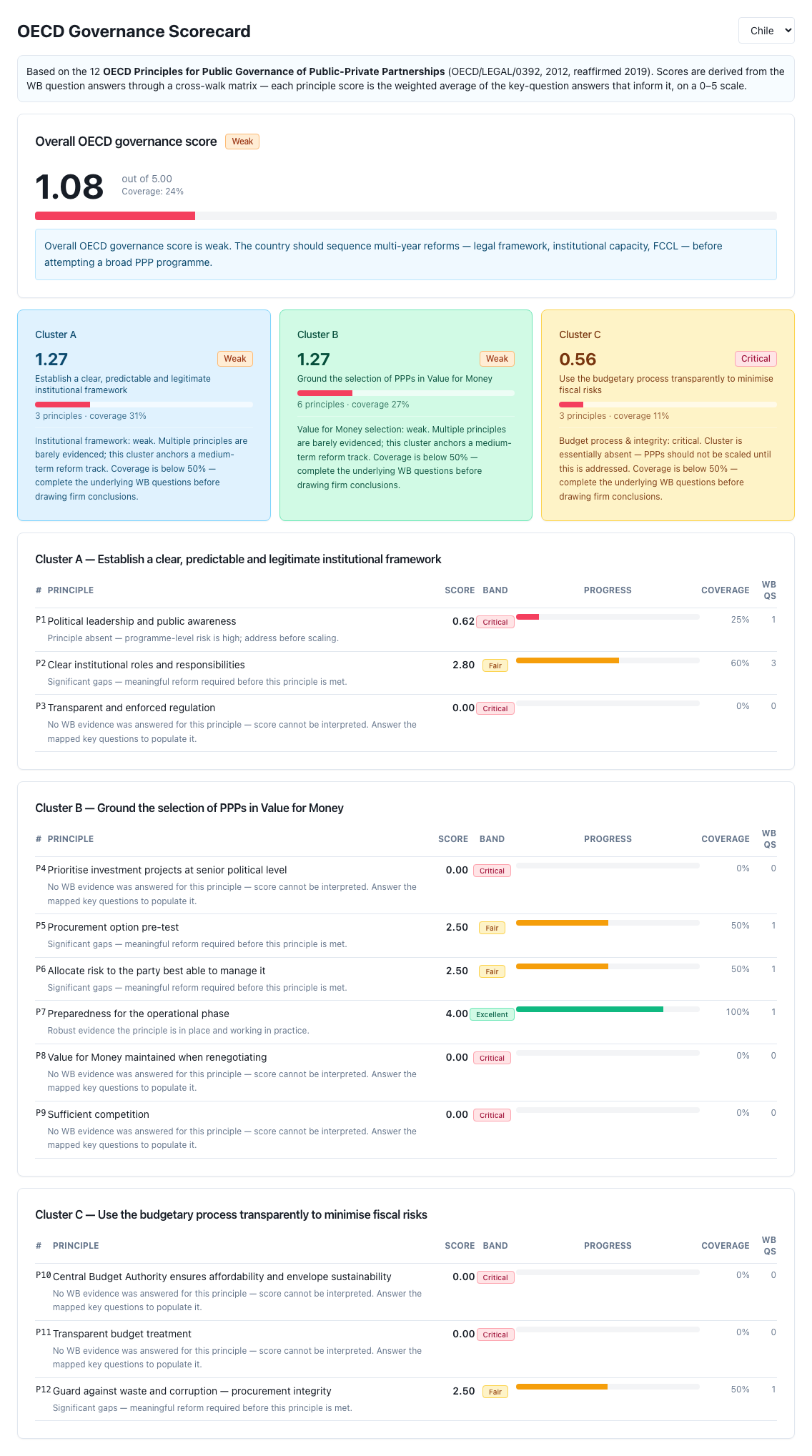
Figure 5.2 — The governance scorecard. The overall score — 1.08 out of 5.00, weak, coverage 24% — with the reading the engine writes, and the three clusters of the Recommendation each with its own coverage: A institutional 1.27 (31%), B value for money 1.27 (27%) and C budget process 0.56 (11%). Every cluster warns, in writing, that coverage is below 50% and that no firm conclusion should be drawn before the underlying questions are completed. It is the same discipline as the completion threshold, applied one level down. (5.2; Step 5.) [note: this screen is not translated: on a Spanish session it prints in English the titles of the twelve principles — which are the instrument's official names and should stay that way — and also its own chrome and its interpretive prose, which are not [to be corrected].]
The series, which is what makes this a tool and not a report. The module freezes the scorecard as a named, dated snapshot, stores the derived scores with it — so a later change in the engine cannot move the baseline — and diffs any two points dimension by dimension. The trajectory screen is now declared among the module's pages and is reached from the side navigation, not only from the module's cover panel.
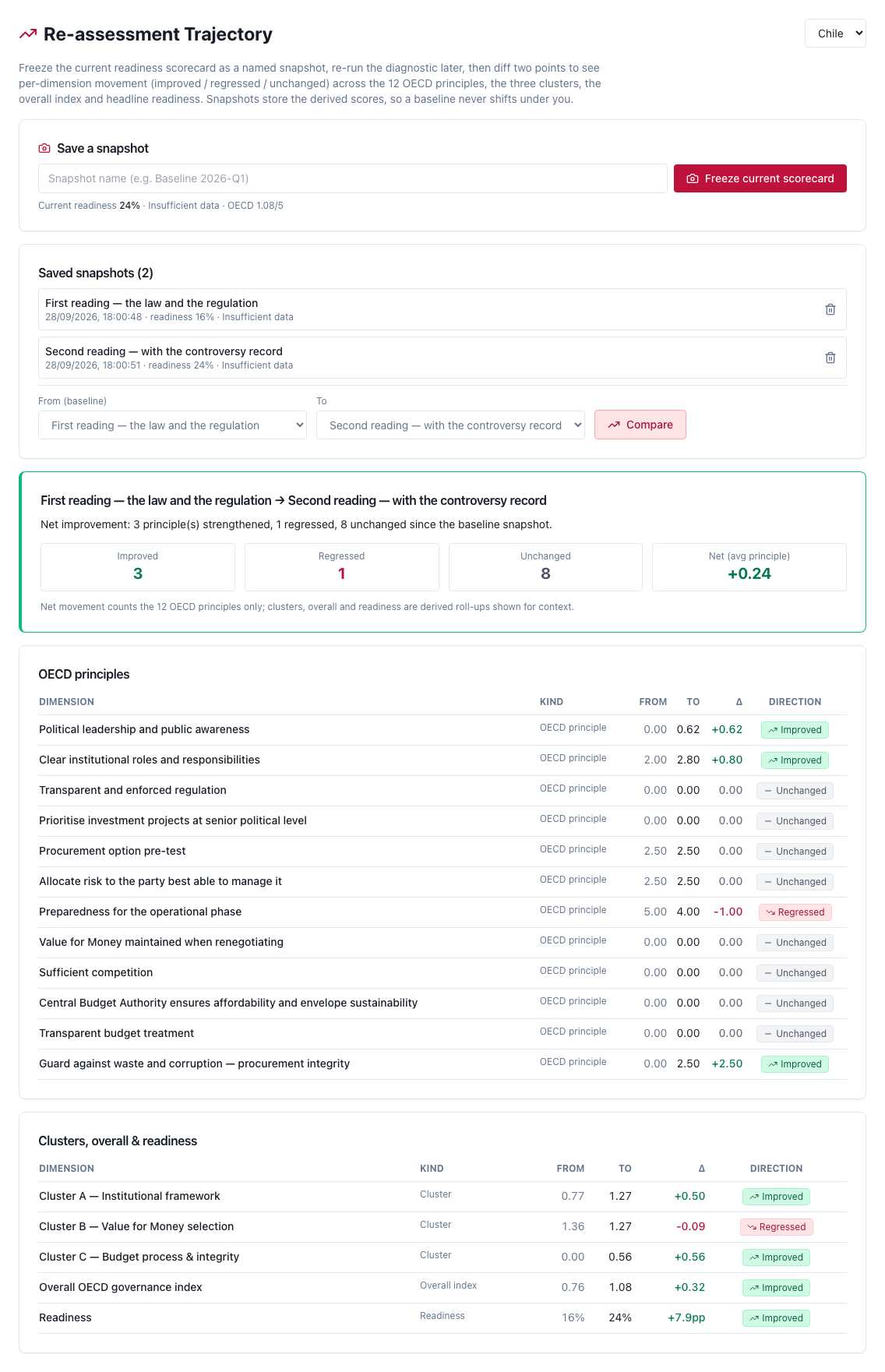
Figure 5.3 — The series over the Chilean case, with the two readings of the same desk phase that section 4 describes: the law and the regulation first, the controversy record afterwards. The summary: 3 principles strengthened, 1 regressed, 8 unchanged, net movement +0.24 per principle. Below, the twelve principles with their before, after and delta, and the three clusters with the overall reading: A 0.77 → 1.27, B 1.36 → 1.27, C 0.00 → 0.56, overall index 0.76 → 1.08 and readiness 16% → 24% (+7.9pp). (5.2; Step 9.) [note: the principle that regresses is not an error, and it is the most instructive thing in the figure. The denominator is the whole questionnaire: answering more questions cross-walked to a principle can lower a principle that rested on a single favourable answer. A reader who sees the headline figure rise while a principle falls needs that explanation, and the screen does not give it [to be built]. The screen is not translated either.]
The readiness questionnaire asks about the PPP framework. The PIMA framework asks about the public investment system that contains it, and it does so on the two axes this manual needs. That is why the service runs both and averages neither.
The page delivers the 15 institutions of the framework across their three stages — planning, allocating, implementing — each scored 1 to 3 on strength and on effectiveness, with per-stage and overall averages, the implementation gap as an explicit subtraction, a band — high from 2.5; medium from 1.5; low below — and the priority institutions named by their effectiveness.
The three this manual insists be read next to institution 5, and that a pure PPP diagnostic misses, are 3 · coordination between entities, 10 · project selection and 13 · portfolio management and oversight. This is not an editorial preference: they are, respectively, where the two-principals problem of Step 6 lives, where what enters the pipeline of Step 7 is decided, and where what already entered is supervised.
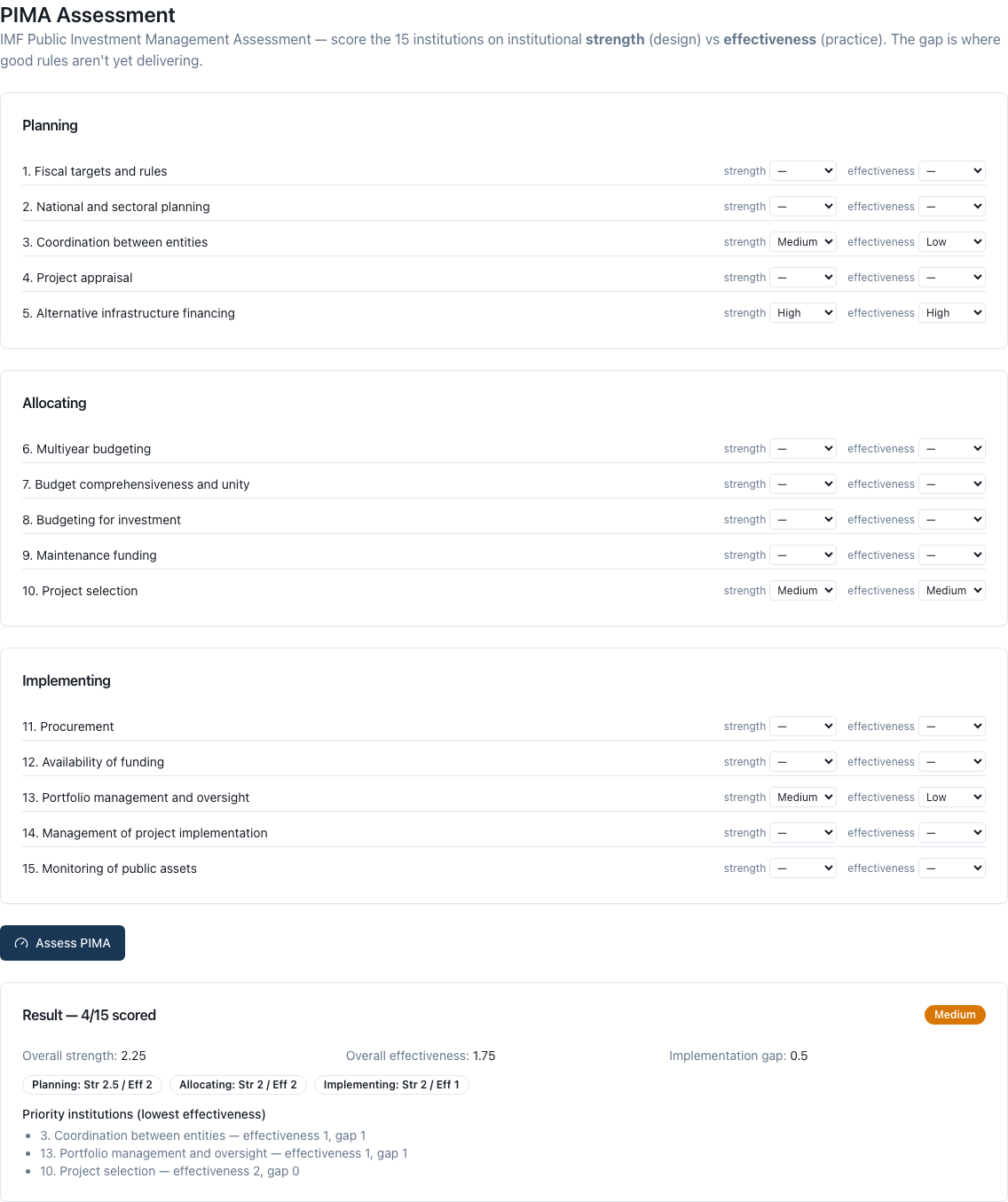
Figure 5.4 — The PIMA self-assessment over the Chilean case, with only four of the fifteen institutions scored — the ones the public sources of section 4 can sustain. Result: overall strength 2.25, overall effectiveness 1.75, implementation gap 0.5, band medium, with the three stages shown separately. The priority institutions by lowest effectiveness are 3 · coordination between entities (gap 1) and 13 · portfolio management and oversight (gap 1) — exactly the two that 4.4 and 4.6 put in evidence from the record. (5.3; Steps 3 and 8.) [note two limits. The first is a matter of method and 5.5 develops it: the eleven unscored institutions are excluded from the average, so the medium band rests on four cells; the page says so — "4/15 scored" — but it does not refuse to issue a band on low completeness, as E3 does. The second is language: the names of the fifteen institutions stay in English, which is their official designation in the framework, while the page chrome is translated.]
The service does not run the whole PEFA framework and says so. It runs PI-10 — fiscal risk reporting, in its three dimensions: 10.1 public corporations, 10.2 subnational governments and 10.3 contingent liabilities and other fiscal risks, aggregated with the framework's own official M2 conversion and not with an average. It is the institution M9 needs to exist and the only one in the framework a concession programme can move on its own. Promising the whole framework would be promising a product that is not there.
Two points this edition closes against the product rather than against the plan. First: the module now declares coverage of four indicators — PI-8, PI-10, PI-11 and PI-12, fourteen dimensions — on its cover page, while the scoring screen scores the three dimensions of PI-10. This manual describes what the screen scores and refers the reader to the module's cover for the rest. Second: the form withholds the rating when the inputs do not determine a letter — it returns not rated rather than a default D — which is the same family of decision as E3's completion threshold and is worth saying, because a formal PEFA assessment does score insufficient evidence as D.
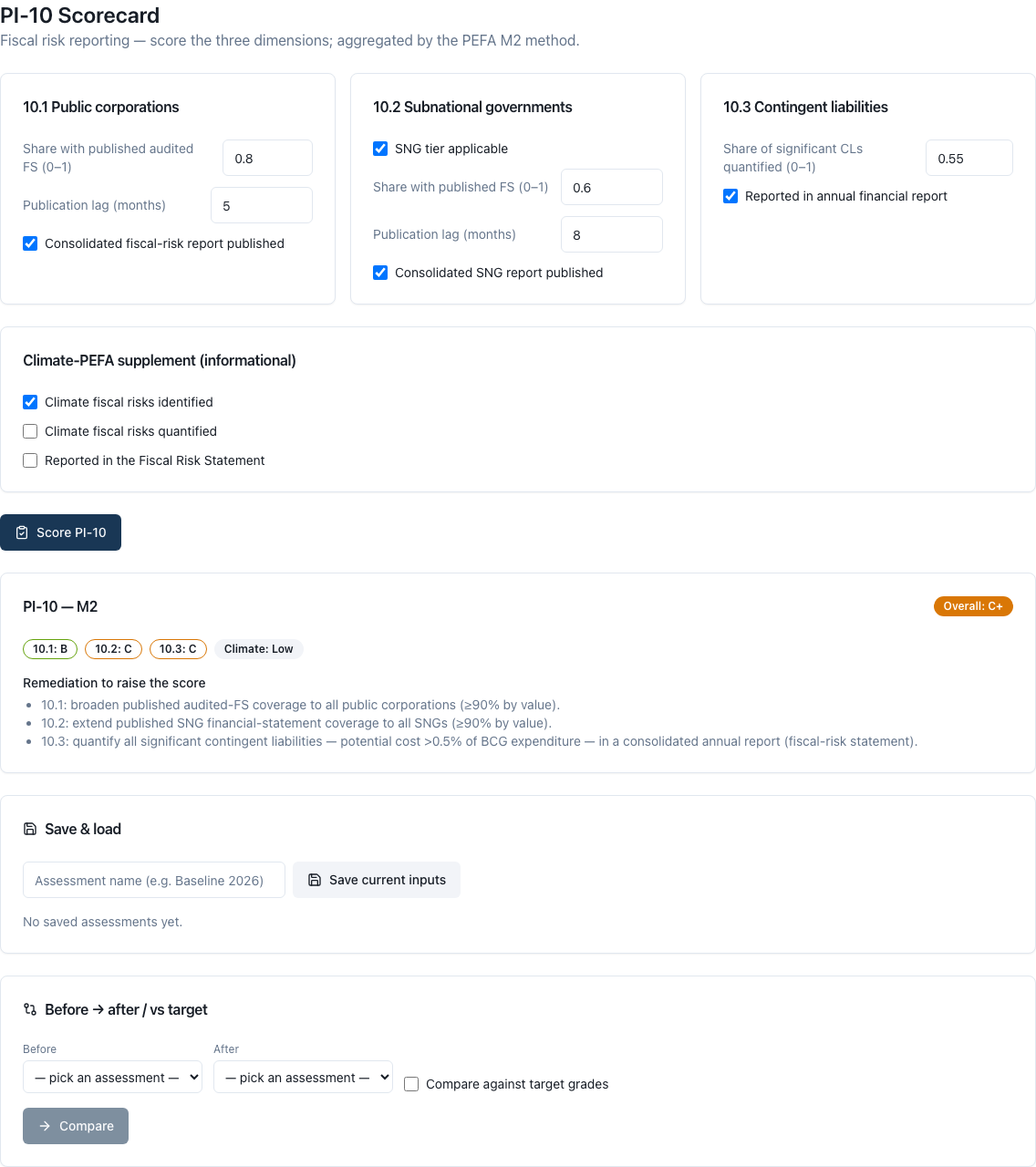
Figure 5.5 — The PI-10 scorecard with this run's inputs — the screen reads nothing from the register, the three fields are typed: 10.1 B, 10.2 C, 10.3 C, aggregated by M2 into an overall C+, plus the Climate-PEFA supplement at low, informational and outside the score. Below, the concrete measures to raise each dimension, written against the threshold that is missing. (5.4; Step 9.) [note: the remediation measures come out in English on a Spanish session [to be corrected]. This figure's inputs are declared in capturas/INDICE.md: they belong to the run, not to section 4.]
The service's two main instruments treat missing data the opposite way round, and the manual publishes both conventions rather than forcing them into one.
In E3, an unanswered key question — or one marked not applicable — counts as zero over the total of key questions. The criterion is declared in the product itself: readiness is capability demonstrated, and a condition you have not evidenced is not a condition you have. In E4, an unscored institution is excluded from the average.
The choice is not arbitrary in either case. E3 measures readiness, and there silence is information: a country that cannot show it has an institution is, for the purposes of an investment decision, in the same position as one that does not have it. E4 is an expert self-assessment, and there silence is the absence of a judgement: averaging an unscored institution as zero would turn "I did not assess it" into "it is bad", which is a different and stronger claim.
What the service owes its reader is not a single convention but the convention declared next to each aggregate, and the three surfaces where that happens are now written: E3's headline card, E4's "4/15 scored" count, and the coverage sheet of the tabular deliverable of 5.6. Where the asymmetry still bites is the absence of a completion threshold in E4: E3 refuses a band below 40%, and E4 publishes a band on four institutions out of fifteen [to be built].
The strategy note is the central deliverable of the service and the tool produces it whole, in thirteen sections: executive summary, country snapshot, governance scorecard, one section for each of the seven themes with its findings and its recommendations, prioritised action plan, next steps and documentary-evidence annex. It comes out in Spanish and English, in Markdown, DOCX and PDF, and the recommendation blocks are placeholders the analyst completes after validating the findings on site — the product says so at the foot.
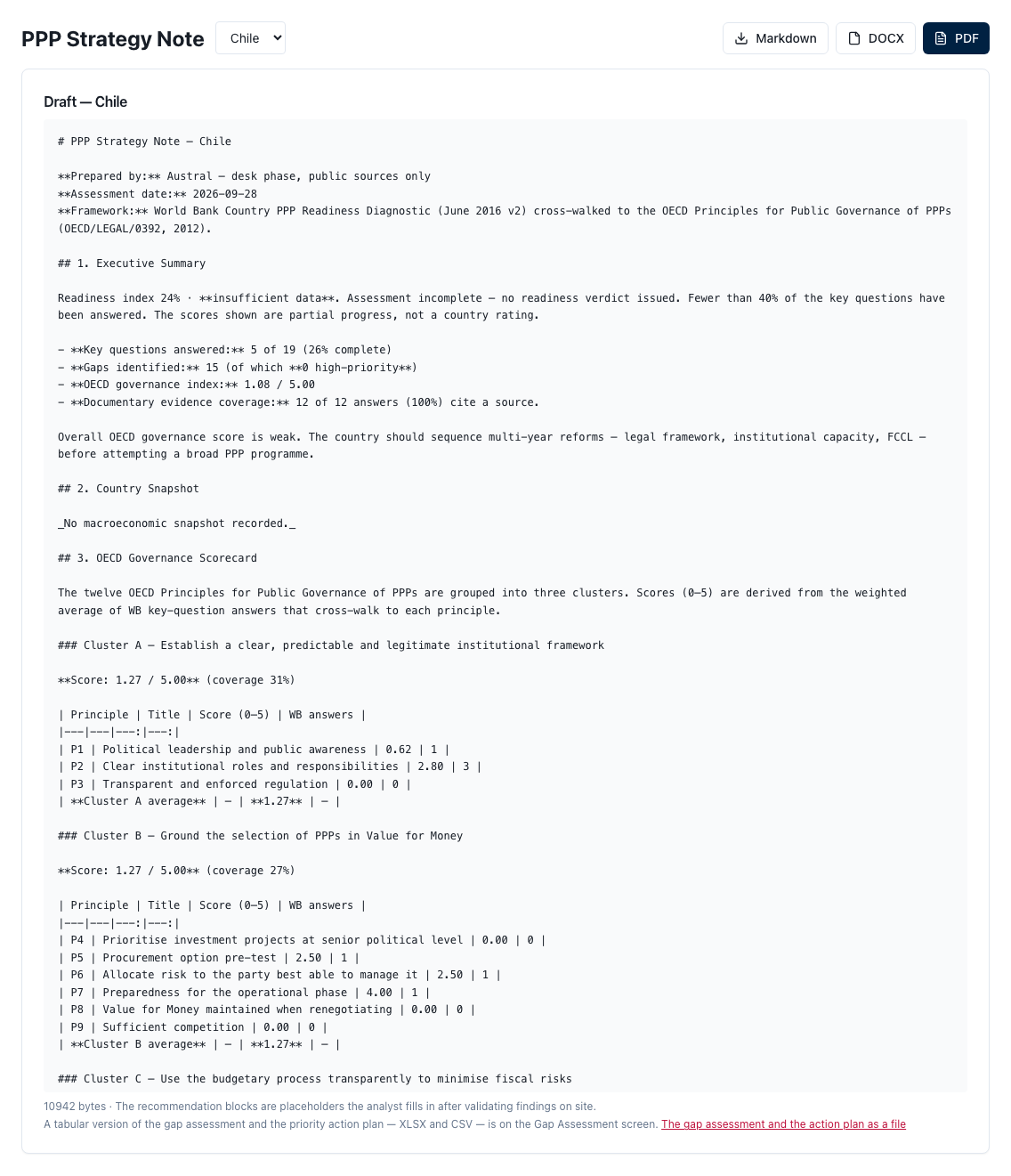
Figure 5.6 — The Chilean case's strategy note, on screen, with its three downloads — Markdown, DOCX and PDF — and its first half visible: the executive summary with readiness 24% · insufficient data, 5 of 19 key questions, 15 gaps of which 0 high priority, governance index 1.08 and evidence coverage 12 of 12 (100%); the country snapshot, which prints no macroeconomic snapshot recorded because this run did not load one; and the scorecard with its three clusters. At the foot, the line that points to the tabular version of the gap assessment and the action plan. (5.6; Step 9.)
And what the previous edition of this manual had to record as missing is now there. The gap assessment and the prioritised action plan are exported as a table today, in two formats with one content.
XLSX, three sheets. Gap assessment — one row per key question, in catalogue order; Priority action plan — the actionable gaps only, in priority order, with the horizon each priority implies and an empty owner column, because the first thing done to that table is to assign it; and Coverage and conventions — what was measured, out of what, under which rules, and what the file deliberately does not contain. Every sheet repeats the coverage line and the missing-data convention before its first number: a sheet a reader separates from the workbook and forwards on its own has to carry its own denominator, and a workbook is precisely where a sheet gets separated from its siblings.
CSV, one long table. One row per key question, with the action plan's rank and horizon as columns rather than as a second table: the action plan is not different data, it is the rows that are both a gap and prioritised, sorted. Sorting by the action number reproduces the second sheet exactly. The conventions go where their grain puts them: the missing-data one has row grain and is printed as a "Counts as" column, stating per row the 1 · 0.5 · 0 that row contributes — including the zero an unanswered question contributes while staying in the denominator, which is the rule a spreadsheet swallows in silence — and the assessment-wide figures, which have no row grain, go in a preamble of #-prefixed lines, so a spreadsheet shows them above the table and a data reader skips them.
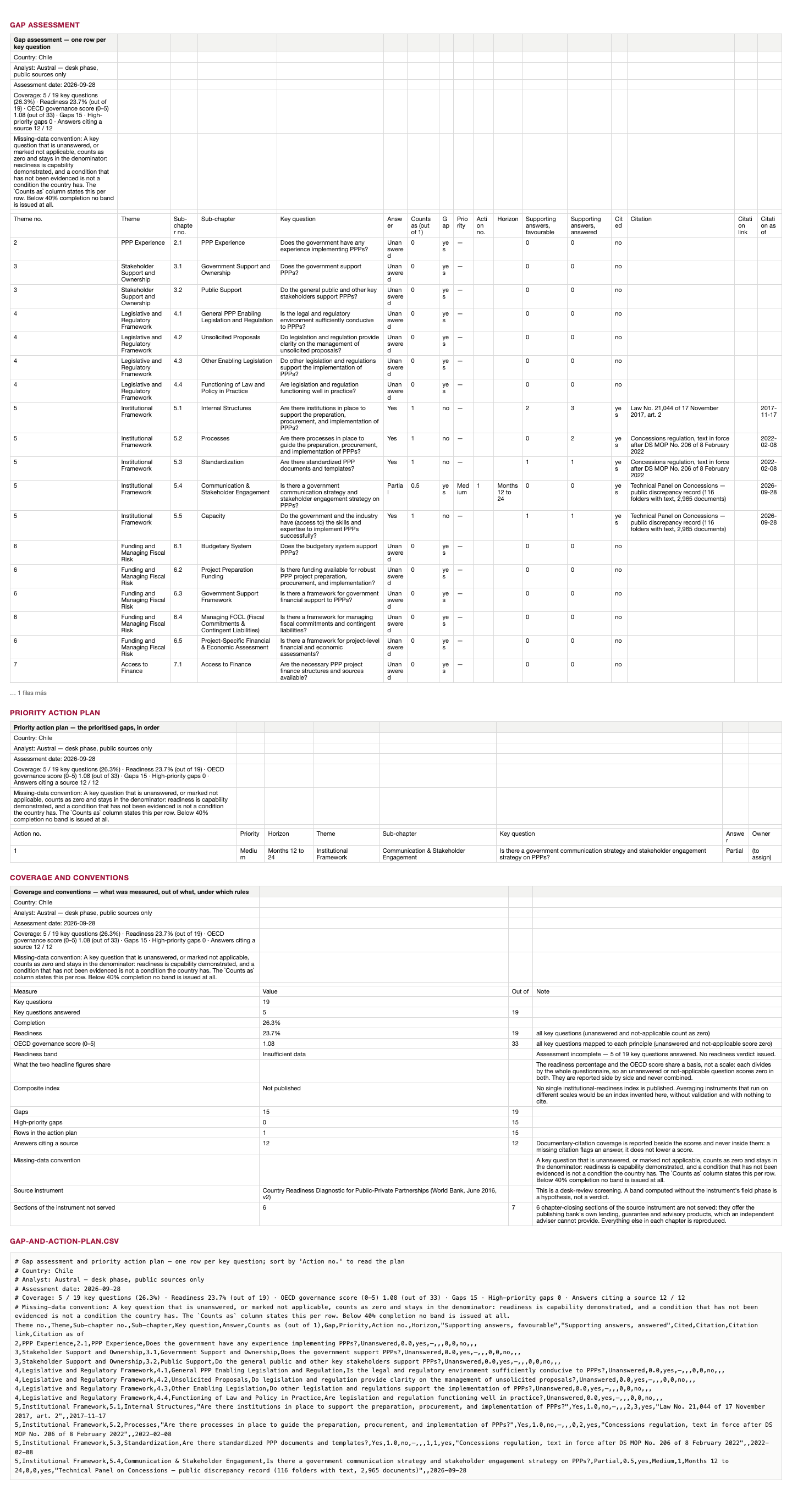
Figure 5.7 — The two tabular deliverables of the Chilean case, as they come. Sheet 1, gap assessment: the nineteen key questions with theme, sub-chapter, answer, "Counts as (out of 1)", gap, priority, supporting answers, citation and citation date — the five rows of the institutional-framework chapter with their citation, the remaining fourteen unanswered and counting as 0. Sheet 2, priority action plan: a single action, medium priority, horizon months 12 to 24, owner to assign. Sheet 3, coverage and conventions: the table of measures with its denominator alongside — completion 26.3%, readiness 23.7% out of 19, OECD score 1.08 out of 33, band insufficient data, composite index: not published, instrument sections not served: 6 out of 7 — and, below, the CSV with its preamble of # lines. All three sheets repeat coverage and the missing-data convention before their first number. (5.6; Steps 4 and 9.) [note: no score is computed in the export. Every figure comes from the same engine that feeds the screen; a total the file invented would be a fourth denominator.]
The manual presents them as proof that the institution can be operated, not as part of the diagnostic, and does not describe them screen by screen: that belongs to their own manuals.
The PPP eligibility index (/eligibility) is the qualitative gateway of Step 2 existing: eight documented questions and a conjunctive verdict — a single "no" and the project is not eligible. Manual M3.
The Fiscal Risk Statement (/frs) is the disclosure institution of Step 9 existing, with its consolidated register and its separation between provision and contingent liability. Manual M9.
The Contract Register (/contracts) is the auditable register Step 1 requires and the evidence section 4 is built from: every contract, every act that modified it, and the source document behind each entry. Manual M11.
The pipeline and the Infrastructure Fund (/budget/pipeline and /infrasfund) are the ceiling, the headroom and the rationing of Step 7. Manual M2.
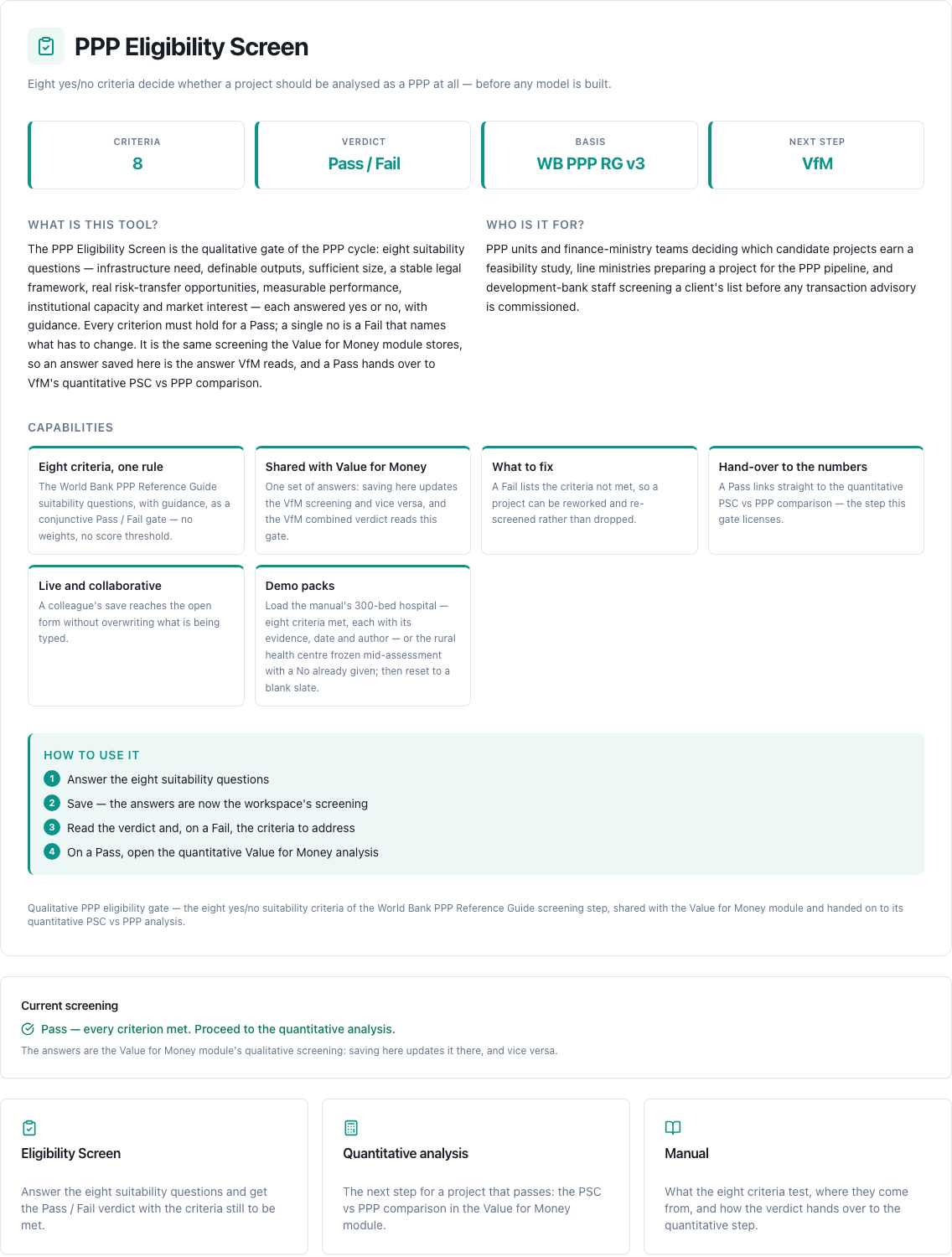
Figure 5.8 — The qualitative gateway of Step 2, existing: eight yes/no criteria, a conjunctive verdict and a hand-off to value-for-money analysis as the next step. (5.7; Step 2 — manual M3.)
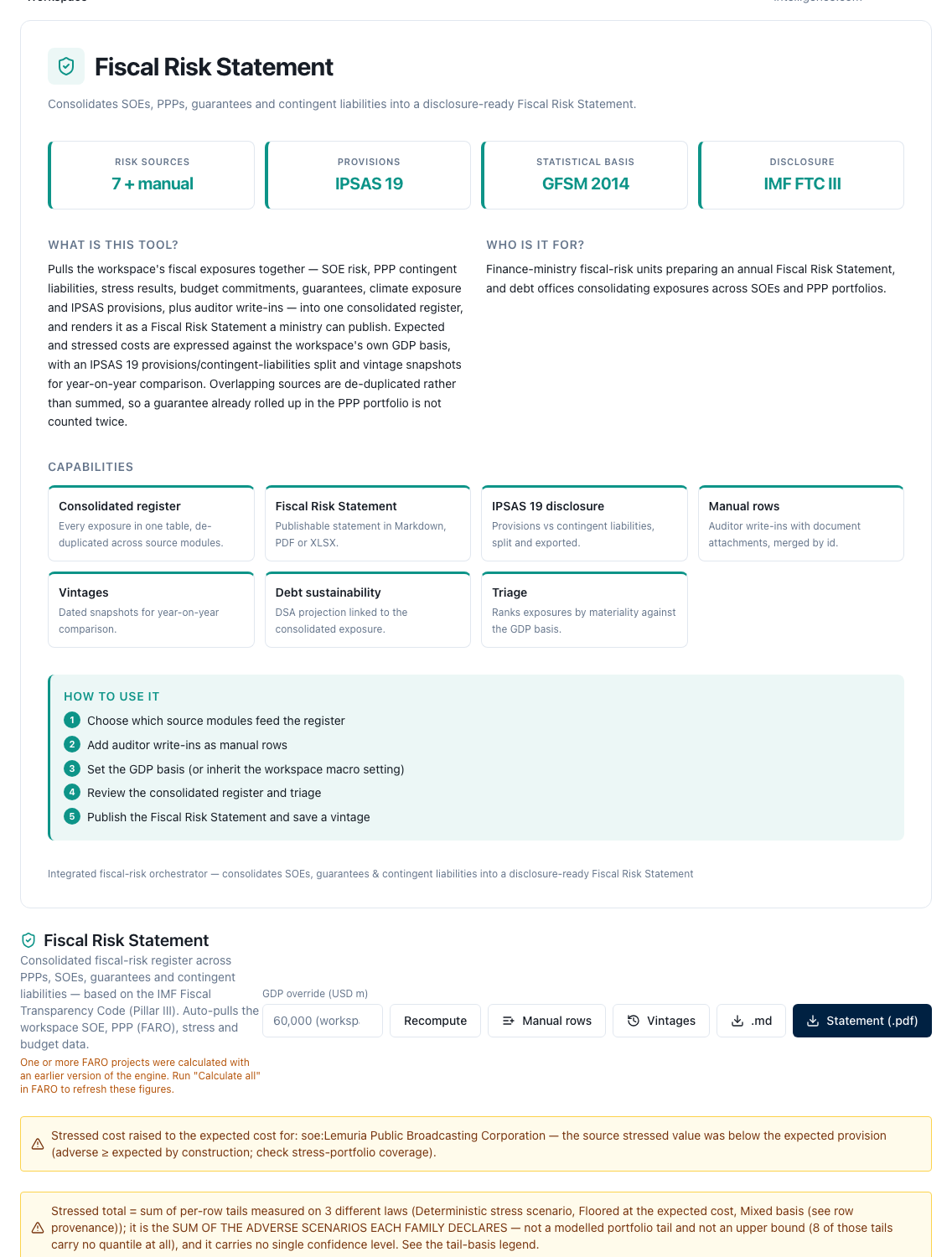
Figure 5.9 — The disclosure institution of Step 9, existing: seven risk sources plus hand-entered rows, provisions under IPSAS 19, GFSM 2014 as the statistical basis and disclosure against the Fiscal Transparency Code. (5.7; Step 9 — manual M9.)

Figure 5.10 — The auditable register Step 1 requires, existing: thirteen event types, four contract types, eight modification causes and ten compensation mechanisms, each entry with its source document. It is the surface section 4 is built on. (5.7; Step 1 — manual M11.)
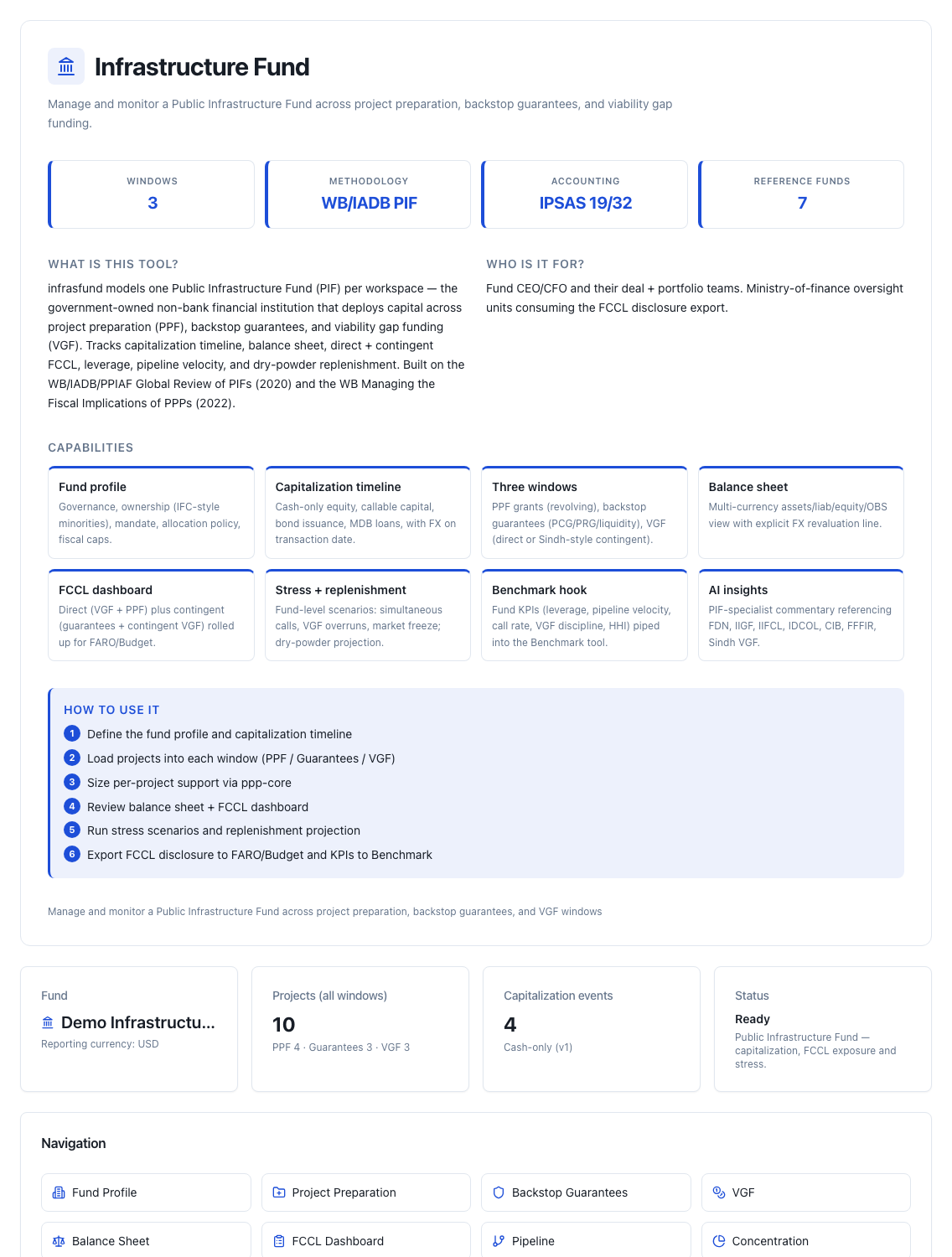
Figure 5.11 — The Infrastructure Fund, existing: three windows — project preparation, backstop guarantees and viability gap funding — with its capitalisation schedule and its direct and contingent commitments. It is the half of Step 7 that has a surface of its own. (5.7; Step 7 — manual M2.) [note: the other half, the pipeline screen, keeps its rows in the browser, which is why a new session opens it empty. A pipeline under a ceiling is an object of the programme, not of one team; until it is stored in the workspace, Step 7 has no register [to be built].]
They are listed, because a service that does not declare its limits declares them anyway, later and worse.
And the limit that governs the whole manual, said here for the third time because it is the one a reader can get wrong on their own if it is said only once: the service does not draft legislation, does not design organisations, does not do engineering and does not issue legal opinions. Where the diagnostic concludes that an institution is missing, it says what it must be able to do and with what fiscal effect; the drafting belongs to the country's legal services or its legal adviser. Where it concludes that an attribution is not exercised, it describes the evidence and its date; the judgement on legality belongs to whoever holds that mandate. And the diagnostic's bands are the country's about itself: there is no ranking, no league table and no nominal comparison that orders governments by institutional quality.
In this series' calculation manuals, this section is called "why not in Excel", and the antagonist is the spreadsheet. Not here. The institutional diagnostic is not delivered today in a spreadsheet: it is delivered as a word-processor report — a hundred pages, chapter by institution, findings and recommendations, an interview annex — and that is this method's real competitor. The section keeps its place in the manual and changes adversary, because the arguments against the report are stronger than the arguments against the spreadsheet, and because the honest title is worth more than the series' symmetry.
It is worth saying first what the report does well, because the argument is not that it is redundant. A report narrates a country's political context, explains why an earlier reform failed, conveys what was said in a meeting, and builds the consensus without which no institutional reform gets executed. None of that happens in a table, and §9 of the method — the strategy note — is a written document precisely for that reason.
The problem is something else: the report is the only format the diagnostic is delivered in today, and there are five things this method needs that that format systematically destroys, not through the author's carelessness. Each is presented the same way: what fails, why it fails by design and not by negligence, and what demonstrates it in §4.
An institutional diagnostic serves one purpose above all others: comparing the country with itself two years on. That is the question the minister will ask, and the only one that justifies repeating the exercise.
A document is not compared with another document: someone has to reread it, and whoever rereads it is not who wrote it. Even if the second report answers the same questions — which rarely happens, because the team changes and the script gets "updated" — the answers are in prose, the scale is implicit, and the missing-data convention is not declared in either one. Saying whether the country improved requires a third reading nobody commissions. In practice, the second report replaces the first instead of following it, and the first disappears from the record.
The method produces, instead, an object that is comparable by construction: the same 19 key questions, the same edition of the instrument, the same missing-data convention, and the same 45 dimensions of the PIMA framework with its two axes. The difference between two runs is a subtraction, not an interpretation. And because the method publishes the denominators, the comparison also says how much of the improvement is real improvement and how much is simply that more questions got answered this time — the most frequent and most expensive confusion, because a programme that answered twenty more questions looks like it has advanced without a single rule having changed.
What exists today and what is missing, said plainly. The service has the piece: a trajectory screen that freezes the scorecard as a named, dated snapshot, stores the derived scores, and compares two points — one snapshot against another, or a snapshot against the live assessment — with movement shown dimension by dimension and a header summary. It is exactly the input Step 9's annual review needs. [to be built]: that screen is not declared among the module's pages, so it does not appear in the side navigation and today can only be reached from the module's own front panel. The capability is there; the door to find it is not. Until that is fixed, the manual declares it here rather than let the reader discover it, and the service opens it explicitly in the working session.
The method uses three instruments with three scales: the readiness diagnostic scores 0–5 per principle with four bands; the PIMA self-assessment scores 1–3 per institution with three bands (1.00–1.49 low · 1.50–2.49 medium · 2.50–3.00 high); the PEFA indicator rates D→A with the M2 conversion. They are not commensurable, and §2 explains why the manual refuses to average them.
In prose, that refusal does not survive the executive summary. A hundred-page report needs a synthesising sentence, and that sentence will be something like "medium institutional capacity, with weaknesses in fiscal risk management". That is an average: an average of three different scales, with weights no one wrote down, over a denominator that appears nowhere in the document. And it is the one statement in the report the reader will actually cite.
The serious problem is not that the average is imprecise: it is that it is indefensible to whoever asks how it was calculated, and that is exactly the reader who matters — the audit office, the credit committee of the bank financing the reform, the legislator asking for the methodology. The method requires publishing the three scores separately, with their band, their scale and their aggregation convention, and issuing no composite figure. It is a discipline a tabular format sustains effortlessly and a narrative format cannot sustain, because narration demands closure.
And case A of §4 shows why the point is not theoretical: a country with thirty years of programme history, five bodies with powers split apart, and an enormous public case file has no single possible rating. It has a strong fiscal-approval power on paper, an omnipresent supervisory function with no power at all, and an advisory body whose prior report is mandatory on eight matters and does not bind. Any sentence that sums that up in two adjectives erases the diagnostic.
The method's most important rule is that every answer carries the document that supports it. That is what turns the diagnostic into something a supreme audit institution can audit rather than believe — its ex post role is in annex ¶2.5 of the Recommendation — and it is the difference between a method and an informed opinion.
In prose, the citation degrades in three predictable steps. First it becomes a footnote, because the paragraph cannot carry the full reference. Then the footnote gets shortened, because the editor asks for consistency. And in the document's second version — the one incorporating the client's comments — the footnote disappears, because the paragraph was rewritten and the note hung off a sentence that no longer exists. No one decided to delete the evidence; the format deleted it.
There is also a figure a report cannot calculate about itself: evidence coverage — that is, what proportion of answers carry a document. In the method it is a published figure, reported separately, and it does not touch the score — a missing citation flags a question, it does not lower a grade. In a report it does not exist, because there is no unit of answer to count. And without it, the reader cannot tell a diagnostic built on forty documents apart from one built on four interviews.
§4 demonstrates this in its most verifiable part: case A's chronology of powers — the concession statute and its consolidated text, the reform that creates the advisory council and the technical panel, and the law that transfers functions and powers to a new service — rests on published decrees that invoke it in their recitals and on case-file submissions that record the transfer of powers. With the citation, a third party can reconstruct the finding in an afternoon. Without it, they have to believe it.
The method's central result is a subtraction: what the rule grants minus what the body exercises. They are two separate measurements, with two scales and two kinds of evidence. The first is read in the statutory text; the second requires published acts that changed a decision, series of acts with consistent criteria, applied methodologies and assigned staffing.
Written in the same paragraph, the two read as a single rating. And the collapse has a known direction: it drifts toward the axis that is easier to document, which is the legal one. The rule is published, citable, read in the office and requires no one to answer the phone; evidence of exercise demands case files, fieldwork and a third source. A report written under deadline pressure leans on what it has, and produces the field's characteristic diagnosis: it reads the law and concludes the country is fine. It is the error §1.3 and Step 3 exist to prevent, and it is also the reason the international instruments that score programme design measure de jure design and not implementation.
Two fields with two scales and a printed subtraction do not get confused. And §4 shows the size of the error when they are: in case A, fiscal-approval power is high on the strength axis — the award is resolved by supreme decree that must also carry the finance minister's signature, and the supplementary agreement carries the same signature on a prior report from the Directorate — and the exercise evidence the public case file supports is much thinner: in the count over the 116 disputes in the documentary corpus with available text, the ministry of finance is mentioned in 45.7% of case files and the signature with which it approves, in 15.5%, while the contract supervisor — a function with no power to approve — appears in 100%. A report that writes "solid fiscal approval framework" has not lied on the strength axis, and has erased the other one.
In a report, the question the team never got around to answering and the question whose answer is "no" read exactly the same: as an absence. The reader cannot tell them apart, and neither can the author a month later.
The method keeps them apart and declares what it does with each. The convention is explicit and, moreover, different across the two main instruments, which the manual publishes rather than harmonises: in the readiness diagnostic, an unanswered key question counts as zero against the total, because that instrument measures readiness and a country's silence is information; in the PIMA self-assessment, an unscored institution is excluded from the average, because it is expert judgment and silence is the absence of judgment. Every table in the manual states which of the two applies and how many cells support it.
And the method does something no report does: it refuses to conclude. Below 40% of key questions answered it publishes no country band, and above 20% of questions marked not applicable it does not either. A reader who sees a band without both thresholds printed alongside it cannot tell a weak country apart from a half-filled questionnaire.
§4 demonstrates this on the uncomfortable, instructive case. A country with thirty years of programme history may fail to reach the completeness threshold if the adviser sticks to public sources, and the method then requires writing "insufficient data" where a report would have written a conclusion. The same discipline appears in a finding case A records without resolving: the regulatory provision ordering that the bidding documents be referred to the ministry of finance grounds that duty in a statutory article that, in the text currently in force, reads as repealed. The approval map records the gateway, records the rule backing it, and records the discrepancy, and issues no judgment of legality, which is not for the method to issue. A report has to decide whether to mention it or not; a cell with its note leaves it visible without adjudicating it.
The method's two most valuable pieces — the inventory of powers and the approval map — are done in a table. They need no software, do not have it in the service today, and the manual does not pretend otherwise: they are the two templates of §5, and they are also this section's argument, because they demonstrate that the objection to the report is not an objection about electronic format but about structure. A hand-built act × body × rule × phase table, with its blank cells visible, already beats the report on all five points above.
The method starts to need a tool at three specific moments, worth naming so a team knows when a spreadsheet is enough:
Outside those three cases, a ministry team can run all of §3 with the statute, the regulation, the budget and a spreadsheet, and the manual is written so it can. What it cannot do, with or without a tool, is deliver the result as a report and expect that, two years on, someone can say whether the country advanced.
All references were consulted on 28 September 2026, unless another date is given. Unless stated otherwise, each document was read in its official version: a PDF downloaded from the publisher's site, a local copy of the same PDF, the official compilation's legal text, or optically recognised text from Chile's concession documentary corpus for Chilean case files; each entry states which.
Verification convention, the same one used in M5, M6, M7 and M11. ✔ verified by direct reading for this manual · ✔ partial part of the content read directly and the rest pending, with the scope stated in the entry · ✔M2 / ✔M3 / ✔M5 / ✔M11 verified for that manual and not reread · ✔A verified in an Austral research paper with recorded verification · [to be verified] existence confirmed, and the figure cited is checked against the document before it is cited in the body text. Nothing in this manual is cited from memory: what is marked ✔ was read in the document the entry names.
World Bank Group (2016). Country Readiness Diagnostic for Public-Private Partnerships. Washington, D.C., June 2016. Self-declared as "version 2" and a "work in progress" (p. 7); origin in the operational recommendation of the independent evaluation group's assessment of World Bank Group support to PPPs in fiscal years 2002–12, published in 2014, and more than 70 input documents (p. 3); a comparative approach producing gaps rather than a score (p. 3); a table of themes and 19 key questions (pp. 5–7), five of which belong to the institutional-framework chapter (p. 23); three application phases — desk preparation, field due diligence, strategy drafting — and a PPP strategy note (pp. 3 and 44); chapter 9, gap assessment, a table of theme × key question × Yes/No × priority (p. 42); chapter 10, road map; six sections on the Bank's own potential support mechanisms (3.3, 4.5, 5.6, 6.6, 7.1 and 8.1), which the method drops. ✔ (full PDF, local copy; structure, self-declaration and the 19-key-question count confirmed on the document). Official URL of the publisher's document repository: [to be verified].
World Bank, Asian Development Bank & Inter-American Development Bank (2017). Public-Private Partnerships Reference Guide, Version 3. Washington, D.C.: World Bank Group. Module 2, "Establishing the PPP Framework"; §2.1 PPP Policy (p. 61); §2.3 "PPP Processes and Institutional Responsibilities" (pp. 69–79): §2.3.1 the process, §2.3.2 implementation responsibilities, §2.3.3 review and approval (gateway processes and successive decision points; final approval before signing; table 2.4 of example approval requirements; p. 75), §2.3.4 dedicated PPP units (functions; location and legal form by function; the balance of mandatory requirements and resource provision, and the unit's leverage; the phrase on the PPP unit in the ministry of finance "to better fulfil its role of gatekeeper", p. 78). https://ppp.worldbank.org/public-private-partnership/library/ppp-reference-guide-3-0. ✔ (house's local copy, already verified for M5; module 2 reread for this manual with numbering and pages confirmed). It is the real source of the gatekeeper-role quotation about the ministry of finance — see the note in entry 8.
Pre-2016 country self-assessment tool of the public-private infrastructure advisory facility. [to be verified]. Its existence is confirmed within the text of reference 1, which names it among its inputs. The document itself was not located; the manual asserts nothing about its content beyond the fact that the diagnostic cites it as a precedent.
OECD (2012). Recommendation of the Council on Principles for Public Governance of Public-Private Partnerships, OECD/LEGAL/0392, adopted by the Council on 4 May 2012 on the proposal of the Public Governance Committee. Twelve principles in three blocks, with the block titles verbatim (pp. 5–6). Principle 2 (clear mandates and sufficient resources for contracting authorities, PPP units, the central budget authority, the supreme audit institution and sector regulators; p. 5); principle 4 (prioritisation at the highest political level, the decision to invest kept separate from how to contract and finance; p. 6); principle 10 (project affordability and sustainability of the overall investment envelope; p. 6); principle 11 (disclosure of costs and contingent liabilities in budget documentation, coverage of the whole public sector). Annex, an integral part of the instrument: ¶1.1 (a coherent PPP approach across the public sector); ¶2.1 (roles may be housed in various ways and must be kept separate; p. 7); ¶2.3 (the PPP unit "should not decide on whether the PPP should move forward", and the green-light process "should be anchored in the Central Budget Authority"; p. 8); ¶2.4 (the four phases — Planning; Feasibility, Design and Tender Preparation; Bidding and Contract Signing; Construction and Operation — and "it needs sufficient capacity to evaluate the documentation presented to it"; p. 8); ¶2.5 (the supreme audit institution's ex post role and clear verdict; p. 8); ¶2.6 (sector regulator consulted in design and a monitor of compliance; p. 8); ¶2.7 ("The above roles should be institutionally maintained at sub-national level"; p. 8); ¶10.1 (affordability assessed while the project is being prepared). https://legalinstruments.oecd.org/en/instruments/OECD-LEGAL-0392. ✔ (full text of the legal instrument, local copy; principles, annex, paragraphs and adoption date confirmed). The copy consulted is a reprint from the publisher's series of legal instruments; the instrument and its adoption date are those of 2012.
OECD (2020). Recommendation of the Council on the Governance of Infrastructure, OECD/LEGAL/0460, adopted by the Council on 17 July 2020 on the proposal of the Public Governance Committee in cooperation with the Regional Development Policy Committee; replaces the organisation's own infrastructure governance framework, GOV/PGC(2016)34. Structure: I agreed definitions — including affordability ("can be accommodated within the government's current and future budget constraints", with the whole life-cycle cost) and fiscal sustainability; II the ten recommended dimensions, i) through x), each with lettered sub-points; III–V dissemination; VI instructs the Public Governance Committee to develop guidance and assessment frameworks and to monitor implementation and report to the Council every five years (VI.d). Sub-points cited in the body: II.i)e) (a transparent, coherent, predictable, legitimate and accountable institutional framework, with "clear and consistent mandates, ample decision making powers, right skills and competences, and sufficient financial resources"); II.ii)b) (a sustainable investment envelope in the medium and long term, measuring, disclosing and monitoring multi-year commitments "including off-balance sheet commitments and contingent liabilities"); II.ii)e) (choosing the delivery mode without institutional, procedural, fiscal or accounting bias); II.ii)f) (transparent and appropriate risk allocation with an agreed plan for management, monitoring and mitigation across the life cycle); II.v)b) (coordination instruments across levels of government, including "contracts between levels of government"); II.viii)a) (clear allocation of institutional responsibilities for data consolidation, dissemination, analysis and evaluation, with resources and competences); II.ix)d) (management of the end of PPP and concession contracts, with ex post audit and value-for-money evaluation). https://legalinstruments.oecd.org/en/instruments/OECD-LEGAL-0460. ✔ (full PDF of the instrument, publisher's legal instruments series, read on 28-09-2026; sections, sub-points, definitions and adoption date confirmed on the document). Closes pending item R2. Two precisions only direct reading allowed, which the manual publishes: (i) the organisation's promotional material lists critical infrastructure resilience as the ninth pillar and asset performance as the tenth, and the instrument gives them in reverse order — ix) "Make sure the asset performs throughout its life", x) "Strengthen critical infrastructure resilience"; the manual cites the instrument; (ii) the document itself states that Council Recommendations are not legally binding and represent a political commitment to the principles they contain.
International Monetary Fund (2022). PIMA Handbook: Public Investment Management Assessment, first edition. Washington, D.C.: International Monetary Fund. ISBN 978-1-51357-182-9 (print), 979-8-40020-415-9 (PDF). 15 institutions and three cross-cutting enabling factors across three stages, with the two axes of institutional design ("what is on paper") and effectiveness ("what is in practice") (p. 4); "How Are Institutional Design and Effectiveness Assessed in Practice?" (p. 21); indicative thresholds and the legal basis of design-axis thresholds (pp. 24–25); rubric: 3 dimensions per institution, 45 dimensions in total, scores 1 low / 2 medium / 3 high, simple average per institution, bands 1.00–1.49 low · 1.50–2.49 medium · 2.50–3.00 high; the two-condition rule; at least three years of data (p. 26); institutions cited in the body: 3 inter-agency coordination (p. 48; dimension 3.c, reporting of contingent liabilities of subnational projects, state-owned enterprises and PPPs to central government), 5 alternative infrastructure financing (p. 70; dimension 5.b, published PPP strategy or policy and legal and regulatory framework), 10 project selection (p. 114), 13 portfolio management and oversight (p. 144); cross-cutting factors: legal framework, capacity and information systems (pp. 171–175). Official framework portal: https://infrastructuregovern.imf.org. ✔ (full PDF, local copy; rubric, bands, names of the 15 institutions and dimensions cited confirmed). This edition resolves the name variant for institution 5 — the 2019 brochure alternates "provision" and "alternative" financing — in favour of "Alternative Infrastructure Financing", which is the name the manual uses.
PEFA — Public Expenditure and Financial Accountability framework, 2016 edition, indicator PI-10 "fiscal risk reporting", with the climate-sensitive supplement (2024). Three dimensions — public corporations; subnational governments; contingent liabilities and other fiscal risks — D→A rating and the official M2 (AV) conversion from table 1. https://www.pefa.org. [to be verified]: the framework text was not read in either pass; the only thing verified is the indicator's implementation as the service runs it. §5.4 describes the indicator as the service runs it and does not cite the framework's calibration until this verification is closed. The PIMA framework handbook (reference 6) confirms PEFA is the other widely used instrument scoring public-investment-management practices, with a single composite indicator for investment management (p. 6).
European PPP Expertise Centre / European Investment Bank (2014). Establishing and Reforming PPP Units — Analysis of EPEC Member PPP Units and lessons learnt. August 2014 (the publisher's publication record dates it 29 August 2014). Scope: a review of the institutional frameworks of 24 members, with information current as of between October 2011 and March 2014, and a central PPP unit identified in 18 of the 24; table 6, the location breakdown of those 18: 6 in the ministry of finance or economy, 7 as an executive agency, 4 as a state-owned corporation, 1 in the Presidency; the conclusion "There is no single best model"; the correlation between function — delivery and technical support versus policy focus — and legal form; and the two uses of "gatekeeper", both referring to the PPP unit: the filter ahead of submission to the approving committee ("the PPP Unit itself may not have the authority to issue an approval…") and the gatekeeper of access to financing, with its warning about undesired bias. ✔ (publication record and full PDF read for this manual on 25-09-2026, on the publisher's own site). URL of the publisher's publication record: [to be verified] in this pass. Attribution note the manual publishes: the phrase on PPP units housed in the ministry of finance "to better fulfil [its] role as gatekeeper" is not in this document — the words "fulfil" and "fulfill" do not appear in it — but in reference 2, §2.3.4, p. 78. The manual cites each document for what it says.
World Bank. Procuring Infrastructure PPPs (2018 edition) and its successor Benchmarking Infrastructure Development (2023 edition). The two instruments scoring the procedural design of PPP programmes across four sub-dimensions — preparation, procurement, contract management and unsolicited proposals. ✔A (scored and cross-checked in reference 12, with replication notebooks on record in its library); not reread in this pass. §2.8 cites them only for what that paper concludes about them: that they measure de jure design, not implementation, and that the signal's shift between sub-dimensions requires treating the two editions as a methodological evolution rather than a longitudinal series.
International Monetary Fund & World Bank. PPP Fiscal Risk Assessment Model (PFRAM), version 2.0 — user manual. https://www.imf.org/external/np/fad/publicinvestment/pdf/PFRAM2.pdf. ✔A · ✔M2. Cited in §2.5 and in §3 Step 5 only for what it is: the tool intended for a ministry of finance's PPP unit to calculate fiscal commitments and contingent liabilities, i.e., evidence that doctrine already assigns the ministry analytical ownership of that piece. The calculation method belongs to M2.
Chile — Decree with Force of Law MOP No. 164 of 1991, Law on Public-Works Concessions, consolidated text in Supreme Decree MOP No. 900 of 1996. Version currently in force, with the last amendment by Law No. 21,806, published 5 February 2026. Art. 1 bis (Council of Concessions, advisory in nature, composition, the eight matters requiring a mandatory prior report, reasoned and public reports, and the rule that once the deadline passes "the process shall proceed without the Council's advisory opinion"); art. 2 (Ministry of Finance approval prior to contracting under the 5% exception, requested by the Directorate-General of Concessions through a reasoned report); art. 3 (actions prior to award); art. 8 (the award is resolved by supreme decree of the Ministry of Public Works "which must also carry the signature of the Minister of Finance"); art. 19 (modification on public-interest grounds and compensation); art. 20 (supplementary agreement approved by a reasoned supreme decree with the Minister of Finance's signature, on a prior report from the relevant Directorate; background sent to the Council of Concessions on amounts above 10% of the official budget; urgency resolution by the Director-General with the Minister's approval and prior approval from the Budget Directorate); art. 20 bis (additional investments above 25%, with a favourable ruling from the Technical Panel and a Council report); art. 28 ter (early termination with a Council report and a decree carrying the Minister of Finance's signature); art. 36 (Technical Panel, "shall exercise no jurisdiction", a reasoned technical recommendation within 30 calendar days, non-binding, and the six matters that may be submitted to it); art. 39, second paragraph (competence of the Ministry of Public Works, delegation through a mandate agreement and the drag-in of "the entirety of the legal statute on public-works concessions"). https://www.bcn.cl/leychile/navegar?idNorma=16121. ✔ (full text currently in force, copy downloaded from the official compilation; articles, paragraphs and numbering confirmed on the document).
Chile — Supreme Decree MOP No. 956 of 1997, Regulation of the Law on Public-Works Concessions. Version currently in force after Supreme Decree MOP No. 206, published 8 February 2022. Art. 6 (evaluation of an unsolicited proposal's submission: consultation with the Ministry of Finance on budget availability and with the relevant sector entity, no. 3; Council of Concessions report, with the rule that if not issued "it shall be understood for all purposes to be unfavourable", no. 5; referral of background to Finance, no. 6; declaration of public interest, no. 7); art. 9 (response to the proposal; prior favourable opinion of the sector entity for works under statute art. 39(2)); art. 14 no. 3 letter a) (referral of the bidding documents and investment prospectus to the Ministry of Finance for formal approval, with approval by silence after 30 days); arts. 38 to 40 (the fiscal inspector as the sole channel of communication with the concessionaire, and its "functions and powers" in construction and in operation, listed without distinguishing between them); art. 44 ("Powers of the Relevant Director", whose sub-points are mostly to propose and recommend to the Minister, with two powers of its own: authorising acts of the concessionaire company and authorising entry into service); arts. 100 to 102 (appointment and operation of the Council of Concessions; public-interest criteria); arts. 107 and 108 (Technical Panel and its procedure). https://www.bcn.cl/leychile/navegar?idNorma=133948. ✔ (full text currently in force, copy downloaded from the official compilation; articles and sub-points confirmed).
Chile — Law No. 21,044 of 2017, creating the Directorate-General of Public-Works Concessions. Dated 17 November 2017 and published 25 November 2017 according to the marginal references in the consolidated text of the concession statute, which records its amendments. ✔ partial (the effect of article 2 — transfer of functions and powers to the new directorate-general from the date its operations begin — verified in primary source within the concession documentary corpus: supreme decrees of the Ministry of Public Works published in Official Gazette No. 42,567, of 31 January 2020, invoke it in their recitals, and a dispute submission before the Technical Panel dated 2 November 2020 records that "those powers have been transferred to the Director-General"). [to be verified]: the law's full text in the official legislative repository, to cite its articles by number; the address tested returned a timeout error page and the block was not worked around. §4.1 cites the effect of article 2 as the decrees and the submission invoke it, and cites no other articles from it.
Chile's concession documentary corpus — Austral's own evidence (2026). ✔ (count redone on 28-09-2026 with a published script). The count is no longer a manual pass: it is produced by _cifras_seccion4.py, published together with the manual, whose output lives in _cifras_seccion4_salida.md. Method, as the script executes it: it walks the 116 Technical Panel dispute folders with available text — 2,965 documents, between 9 and 43 per folder; for each folder it concatenates the text of every document, normalises accents and capitalisation without collapsing spaces, and searches for each figure and each act with the pattern declared in the script itself, so that disputing a figure means disputing a pattern. Warnings the manual publishes alongside §4's tables: a mention is not a dispute over that body; the count runs on optically recognised text and an expression split by a line break does not count, a declared false negative; the denominator is disputes with text, not the whole system's caseload; and below three cases, no percentile is published. The UF sums in §4.4 are extracted from the recommendation section of the public document D03-2020-17/Recomendacion/23.07.2020_Recomendacion.txt by the same script, not transcribed by hand. Revision note: three rows of the table move relative to the manual count recorded in index v0.1 — comptroller's office, ministry of finance and article 39 — because that pass left no recorded search expressions and this one does; the published version is the script's. The corpus additionally covers 132 contracts with ministry documentation and 41 arbitration case files, figures from the index's own inventory. READ-ONLY: the script reads the corpus and writes nothing to it.
Austral Intelligence — Austral's own research, cited as such.
The Renegotiation Triangle and The Intelligent Gate. ✔M11 (verified for M11). Cited here only by reference: the price of the modification act and the portfolio's base rate belong to M11.
Declared data of the Republic of Lemuria — Austral platform. ✔ (read on 28-09-2026 by the same script _cifras_seccion4.py, which extracts it from the code with ast, without importing the package, without a database and without starting the service). Sources in the repository: austral-platform/backend/app/modules/demo_data.py — the country (name, capital, population, sovereign rating, currency and exchange rate), the declared macro figures, the fiscal ceilings, and the 81 projects of the reference portfolio with their sector and payment mechanism — and austral-platform/backend/app/modules/series_demo.py — the M6–M12 series' GDP base, 60,000, the reference package's base, 320,000, and the restatement rule by the 0.1875 factor, with the list of consolidated-register rows that rule reaches. The four register rows §4.6 cites are not copied: the script reads them from austral-platform/backend/tests/test_aust369_lemuria_reference_portfolio.py, which is where the platform has them fixed against its own engine, so that if the platform moves them the manual moves with them, and if they disappear the script stops rather than publish an orphan figure. §4.6 expressly declares which part of case B is platform data — country, macro figures, portfolio, ceilings — and which is this example's own institutional layer.
Internal cross-references in the series. The register of fiscal commitments and contingent liabilities and the programme ceiling belong to M2; the qualitative eligibility gateway, to M3; per-contract risk allocation, to M5; consolidated fiscal-risk disclosure, to M9; the subnational fiscal diagnostic, to M10; and the price of contractual modification, to M11. This manual refers to them and does not repeat them.