Manual M11 · Austral Manual Series
Download PDF ↓Versión en español
Modificaciones y Renegociación de Contratos de Concesión — Manual M11 de Austral
Version 1.0 · 28 September 2026
Austral Intelligence · David Duarte Arancibia, with Mika (Austral's analysis agent)
Platform module that runs the method: Contract Register (/contracts) with its modifications layer — the incremental fiscal cost of an act against the financial baseline, the accept / counteroffer / terminate triangle with the option value of the threat, the four termination-value methods, the annual fiscal book by flow type, the precedent comparator and export to an open standard; plus the classification of the act on four axes (nature, cause, mechanism, trigger), the episode that links a dispute with the act that executes it, the modifications portfolio with its four descriptive flags, term versus cash in present value, and the contrast against the frozen distributions of the Chilean corpus — feeding into the register of fiscal commitments and contingent liabilities (manual M2), guarantees (manual M7) and the Fiscal Risk Statement (manual M9)
Languages: English (this edition) and Spanish · HTML and PDF at austral‑intelligence.com/manuals
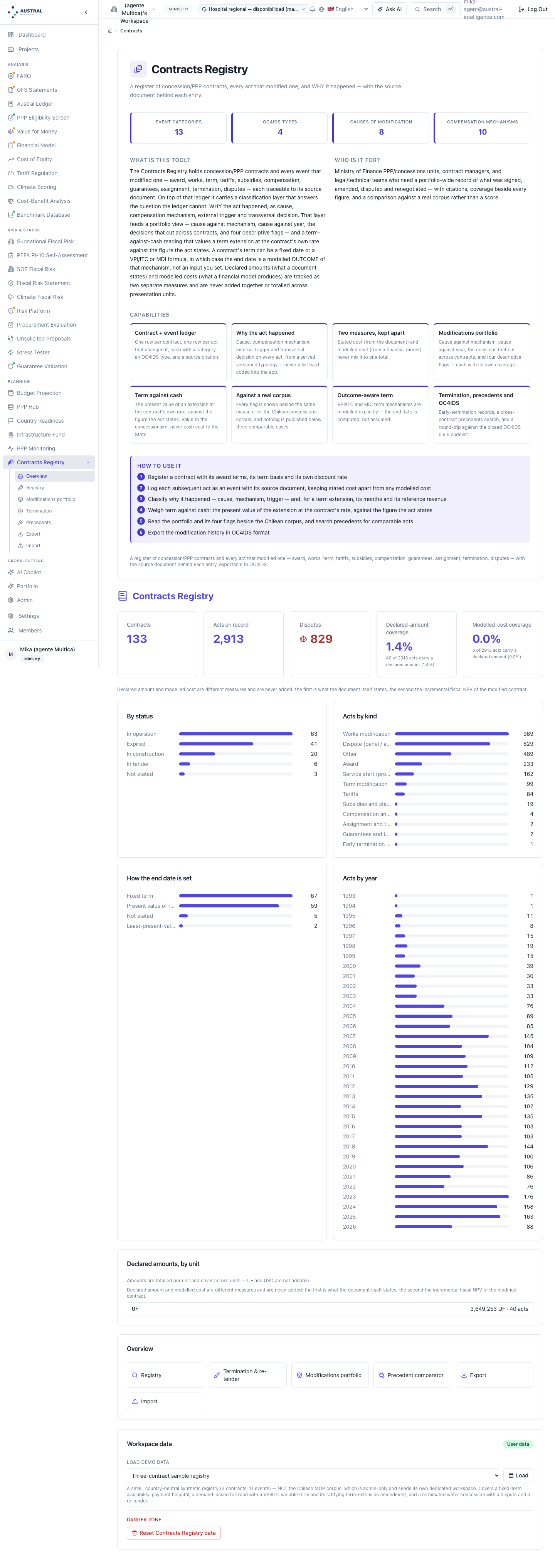
This manual explains how a granting authority, a ministry of finance, or a public-private partnership unit answers the question that arrives with every modification request: what kind of change it is, how much it costs to say yes, what the alternative is, and how many of them there are. Its thesis is that the contract is awarded with competition and modified without it, and that modification — not award — is the point in the cycle where value for money can be lost entirely with nobody measuring it: four independent measurements, with different methods and different populations — Guasch (2004) on more than a thousand Latin American concessions, Bitran, Nieto-Parra and Robledo (OECD, 2013) on 61 road contracts in three countries, Austral's own panel of 123 Chilean concessions, and the Chilean documentary corpus measured for this manual — agree that between 30 % and 63 % of concessions are modified, at a mean of two to three years from signing. It presents the diagnostic as a self-contained ten-step method, from contract design before signing to the annual portfolio report, built on three bodies that do not always agree — the empirical evidence, the economic doctrine of the soft budget constraint, and applicable law, Chilean and European Union, checked article by article — and on two of the firm's own contributions: the priced triangle of accepting, counteroffering and terminating (The Renegotiation Triangle) and the null result of the competition flag as a forecast of renegotiation (The Intelligent Gate). It classifies every act on four axes — nature, cause, mechanism and trigger — with a vocabulary declared provisional, and always keeps term compensation and cash compensation separate, which are never added together. It walks the ten steps over a real contract from the Chilean public corpus — the Ruta 43 Concession, Coquimbo Region — with two counter-examples that reverse the sign of the conclusion without changing the method; it shows how the method runs on the Austral platform today, screen by screen and on the register loaded with the Chilean corpus's public seed (133 contracts, 2,913 acts), with what the module still does not do declared as such; and it explains why this particular method breaks in a spreadsheet. It also sets the limit that governs the whole manual: it is a manual of analysis and prevention, not of representation in disputes. It is written for granting authorities, ministries of finance and budget offices, public-private partnership units, debt and government accounting offices, comptrollers and audit institutions, and legislatures.
Austral Intelligence (2026). Modifications and Renegotiation of Concession Contracts. Manual M11, Austral Manual Series, version 1.0, September 2026. https://austral-intelligence.com/manuals/contract-modifications/
This manual's figures — the worked example (section 4), the on-screen implementation (section 5) and the measurement of what happens to a spreadsheet (section 6) — are not generic and are not from a fictitious country: they correspond to the Chile Concessions Corpus, the library of the country's public-works concession contracts, loaded as a public seed on the platform (133 contracts, 2,913 acts in the register). They come from a run of the platform's engine as of this edition's date and from reproducible scripts against the same corpus, not from a hand transcription. The classification of every act on the four axes — nature, cause, mechanism, trigger — and the figures derived from it were obtained by automated extraction of the corpus — public documents from the ministry, from the Concession Technical Panel and from arbitration panels — and have not been validated case by case by specialists; the validation workshop is deferred and does not gate this publication (David's decision, 26 September 2026). The four axes' vocabulary is, for that reason, provisional, and the manual publishes its measured quality-control agreement — 97.9 % on nature, 86.9 % on cause, 60.0 % on trigger — instead of taking it for granted. Every act cited states the document it comes from, as the method's register requires (§3, Step 1). The contracts are public and no figure belongs to an Austral client; the methodologies cited are credited to their authors, and the only product name in the manual is Austral.
This is the first English edition of Manual M11, translated from the Spanish edition written on 28 September 2026. The manual is also published in Spanish, with the numerical agreement between the two editions checked section by section; where the two differ, including after a future correction to either one, the Spanish edition is the reference. Chilean instruments — statute, regulation, complementary agreement, supreme decree — keep their official name in Spanish; where this edition cites an international instrument the Spanish edition quoted in translation, this edition cites the original and marks as pending verification the version that could not be confirmed against its source (section 7).
A ministry runs a competitive tender for a concession, awards it, and signs. Three years later, on the granting authority's desk sits a letter from the concessionaire company asking for compensation for works the contract did not contain; on the same desk is an instruction from the government itself to add a new section, a discrepancy filed before the technical panel, and a request for a term extension. Each of those four papers is going to be resolved separately, each by whoever happens to be assigned it, and each resolution is going to be defensible on its own. This manual answers four questions about that desk: what kind of change each one is, how much it costs to say yes, what the alternative is, and how many of them there are.
The thesis fits in a sentence, and it is worth stating before the method. The contract is awarded with competition and modified without it. It is the point in the cycle where the value for money measured before signing can be lost entirely, and it is the only point in the cycle almost nobody measures. A ministry that evaluates projects with a ten-year apparatus and evaluates modifications with a letter is measuring, with precision, the cheapest part of the decision.
And it is not a problem of rare cases. Across more than a thousand Latin American concessions awarded between 1985 and 2000, the incidence of renegotiation is 30 % overall, 41.5 % excluding telecommunications, 54.7 % in transport and 74.4 % in water and sanitation, at a mean of 2.2 years from award (§2.1). A demand that recurs that often cannot be handled case by case: it needs a method.
The question is: a modification request has arrived; what is it, how much does it cost to say yes, what happens if I say no, and how many of them are there. The product is a register of classified and valued acts, contract by contract and for the whole portfolio: each act with its nature, its cause, its compensation mechanism and its trigger; the incremental fiscal cost of accepting it; the price of the three alternatives; and this contract's position against comparable experience.
From which follows, with the same clarity, what it does not answer.
What this method is not
- It is not a project evaluation. It does not say whether the works are worth doing or whether the public-private partnership was the right route. That is decided before the tender, and it is another manual in this series.
- It is not the register of fiscal commitments and contingent liabilities. This method feeds the commitments register the cost of what was decided and the exposure of what remained open; it does not keep that register and does not set its accounting treatment.
- It is not the valuation of guarantees. A fine or the calling of a bond appears here as the mechanism of an act; pricing it as a credit instrument is another discipline and another manual.
- It is not an appraisal of the concession. It does not say how much the contract is worth or how much a third party would pay for it. It measures the change against the baseline, which is a different question.
- It is not a predictor of renegotiation. It does not deliver a score that ranks the portfolio by danger. The reason is not commercial caution: it is a measured result, and it is in 1.8.
And the one that has to be said in full, because it is the one a reader can confuse on their own:
- It is not a manual on representation in disputes. This manual teaches how to classify, measure and decide, and how to design the contract so that modification costs less. It does not teach how to litigate. It does not propose procedural strategies before a technical panel, an arbitration panel or a court; it does not weigh one party's claims against the other's; and it is not written from either party's position. When the method touches a dispute-resolution forum — and it does, because the price of the alternative of terminating the contract is awarded there — the manual describes the fiscal effect of what the forum decides, never how to obtain a better decision from the forum. It is a manual of analysis and prevention. It is repeated in step 6 of the method and on the portfolio screen of §5, because saying it once is not enough.
Three things happen at once when a signed contract changes, and all three push in the same direction.
Price discovery disappears. The original works had a price because several bidders competed for it. The additional works have whatever price results from a bilateral negotiation between the only possible supplier and an authority that needs the works. There is no comparable bid, no market contrast, and the only anchor available is a financial model the two parties argue over. International practice itself says so bluntly: renegotiation retrospectively distorts the competitive process, because the tendered project and the renegotiated one are, in essence, two different projects (§2.7).
Budgetary control largely disappears. A public-private partnership allows spending today and paying later, and in most countries those operations are not recorded by parliamentary oversight (§2.3). The result is a spending route that does not consume the current year's ceiling. Measured on Chilean road renegotiations, 55 % of the cost was paid in future fiscal years, and 90 % of them loaded some cost onto later governments (§2.2, §2.3). A programme that defers more than half of what it grants does not have an amount problem: it has a calendar problem.
And who asks is not who the market assumes. Intuition says the concessionaire pushes and the State resists. Across road concessions in three countries, State-led renegotiations were more frequent than company-led ones — the concessionaire had the initiative in under a fifth — and in Chile 85 % were government-led, 69 % demanded additional works, and the ones that added sections or complementary works in the last year of a government turned out more expensive than the rest (§2.2). Modification is not only a risk that arrives from outside: it is also an instrument the granting authority itself uses.
Hence the shape of the method. If the problem were defence against a counterparty, the manual would be about negotiation. Since the problem is one of measurement and governance of the authority's own decision, the manual is about classification, valuation and registration — and its first step happens before signing.
A method that asks for an exception for itself does not get adopted. This one does not ask for one: what follows are four independent measurements, with four different methods and four different populations, and all of them give the same order of magnitude.
| Who measured | Population | Incidence | Time to the first one |
|---|---|---|---|
| Comparative evidence (§2.1) | more than 1,000 concessions in Latin America and the Caribbean, 1985–2000 | 30 % overall · 54.7 % in transport | mean 2.2 years; 60 % within three |
| Regional evidence (§2.2) | 61 of the 62 road contracts of Chile, Colombia and Peru, 1993–2010 | 50 of 61 modified, more than 540 renegotiations | all of the modified ones, within three years; Chile 2.7 years |
| The firm's own panel (§2.4) | 123 Chilean concessions | 78 of 123 (63 %) | median 6.3 years (cross-section of live concessions: survivorship bias declared) |
| The Chilean documentary corpus, measured on the distributions the product serves (§2.9) | 100 of 133 contracts with dated award and modification | — | median 2.37 years; 25 % within one year, 39 % within two, 66 % within three |
| Contract management practice (§2.7) | 146 projects with data, of 250 analysed | 33 % (48 events) · 45 % by year four | mean 3.6 years from financial close |
The fourth row is not of the same order as the others, and the manual says so instead of hiding it: a panel of live concessions is weighted toward the long-lived ones and does not contain the early renegotiators that were cancelled or re-tendered. The method lesson is in step 8: the early-modification flag is calibrated against the population being measured, not against a constant from the literature.
On the figures in this manual
The figures from the Chilean documentary corpus and the typology of the four axes (nature, cause, mechanism, trigger) that appear in this manual were obtained by automated extraction from the Chile Concessions Corpus — public documents from the ministry, from the Concession Technical Panel and from arbitration panels. They have not been validated case by case by specialists. Each classified act indicates the document it comes from, as the method's register requires (§3, Step 9). The vocabulary itself is provisional (D3, §3) and will change once its validation with specialists is closed out.
And there is a figure worth reading slowly, because it decides the size of the fiscal problem and not only its frequency. Across the 21 Chilean intercity concessions signed between 1993 and 2004, the 60 contractual changes across 18 of the 21 were worth around USD 1.2 billion, of which USD 900 million in fiscal cost, plus 17 years of additional term; total additional compensation equals around 25 % of the initial cost of the programme (§2.2). It is not a margin adjustment: it is a quarter of the programme, granted without competition.
Three moments, and the third is the one almost nobody executes.
Before signing. Contract design decides how much modifying it is going to cost, and there are figures behind that claim: the incidence of renegotiation is 18 % when regulation is by performance indicators and 70 % when it is by investment requirements; 17 % when the regulatory framework is in the law and 40 % when it is in the contract; 60 % when awarded on lowest tariff and 11 % when awarded on the highest transfer payment (§2.1, table 1.16 of the source, with its warning: these are cross-sectional differences with no controls, not estimated causal effects). It is step 0 of the method.
Every time a request arrives. Recording the act with its document, classifying it on the four axes, deciding whether compensation is due and on what basis, pricing acceptance, valuing the years if compensation is in term, comparing the three alternatives, and recording the outcome. These are steps 1 through 7, and it is the method's everyday use.
Every year, for the whole portfolio. Cause crossed by mechanism and by year, the series that run across several contracts, amount coverage and the four descriptive flags. It is step 8, it is the one almost nobody does, and it is the one that finds what no individual case file can show: in the Chilean documentary corpus, 105 acts spread across 8 contracts are a single public-policy decision on urban tolling, and another 38 acts in 28 contracts are a single review of the adjustment formula. Seven series of that kind, 169 acts in all. None of the eight case files in the first series can see that it is an eighth of a government decision.
Six readers, and none of them reads the same column of the same register.
A warning about the division of labour, because it is the one most often skipped. The classification of the act is not decided by whoever operates the tool on their own. The cause family — whether the fact is a discretionary act of the granting authority or the materialisation of a risk the contract had already allocated — is what decides whether compensation is due, and that decision has legal and budgetary consequences. The machine suggests and says why; a person sets the label, and the register keeps where it came from.
For each act and for the portfolio, the method produces six figures. They go together: published separately, any of the first five is misread.
And the seventh, which almost no register writes: what could not be measured and why. Acts with no figure — in the documentary corpus, 540 of 1,134 modifications (47.6 %) carry an amount in unidades de fomento, and the rest do not; contracts with no declared rate, without which figure 4 is not computed; disputes with no recorded outcome; and the transfer no register captures, the reduction in service standard, which the manual names and does not value because valuing it would require a quality model that exists in no public source. No measure of fiscal impact can be better than the fraction of acts that carry a figure, and that is why every table in this manual publishes its denominator.
It is the most common error of a granting authority, and it has a theoretical explanation and a measurement.
The explanation is from economic doctrine (§2.3): there are several ways of shifting resources to the following period — granting a term extension, raising future tariffs, lowering quality standards — and all of them transfer resources from future administrations and users, which lets the government spend today beyond the limit Congress authorised. Term's appeal to the granting authority is not technical, it is budgetary: its cost does not show up in the current fiscal year.
The measurement is from the Chilean corpus and says two things. The first confirms the intuition: the discount factor at the end of the contract, at the contract's own rate, has median 0.385 with a range of 0.03 to 0.998 — a peso of revenue arriving at the end of the concession is worth, in the median, about thirty-nine cents today. The second disproves it as a rule: of the 25 acts in the corpus that carry both months of extension and a declared figure to compare them against, 24 are valuable under the method's own rule, and across those 24 the ratio between the present value of the extension and that figure has median 0.495 — term pays, in the median, a little less than half — ranges from 0.02 to 23.55, and in 10 of the 24, term is worth more than the cash that comes with it. (Row number 25 is an act dated after its contract's declared term, and the product's rule rejects it by design: an extension after termination is not discounted from that termination. Unfiltered, the reading would be 0.55 across 25 acts with a maximum of 30.48. The manual publishes the filtered figure, which is the one its own rule admits, and leaves the other one written down, because one row does move a median of twenty-five cases.)
The conclusion the method publishes is, for that reason, stronger than the hypothesis and does not contradict it: the result does not depend on the term, it depends on when the extension falls. Twenty years from termination, thirteen months are worth a fraction of the figure that accompanies them; two years from termination, the same thirteen months are worth more. Hence the rule in step 5, and the reason the manual publishes a ratio per act and never a rule: writing "term pays half" would be exactly the kind of statement the corpus itself disproves in ten of twenty-four cases.
There is a piece of context that sharpens the warning. Chile uses the term currency much less than its neighbours: 6 of 21 intercity concessions with an extended term, against 15 of 25 in Colombia with a mean extension of 70 % of the original term (§2.2); and in the documentary corpus concession term appears in 97 of 1,360 classifiable acts (7.1 %), against the 38 % of term extensions that comparative evidence measures across the Latin American panel (§2.1). Where a currency is used little, its price is argued little — and where it is not argued is where it is given away.
The reader arrives at this manual expecting a predictor, and dismantling that expectation here, before the method, is what keeps step 8 from being read as a crippled risk model.
The firm tested exactly that hypothesis on the Chilean panel of 123 concessions (§2.5): does the single-bidder flag predict that the contract will be renegotiated? The result is a robust null. The hazard ratio for single bidder is 0.91 (95 % confidence interval: 0.47–1.73; p = 0.77) across 72 events, and three estimators over three outcome definitions agree. The design has the power to say so: with 72 events and 23 % of the panel flagged, the study detects a doubling of risk with 80 % power, and the doubling is excluded.
What does discriminate is something else. Award vintage — the year the contract was signed — has a hazard ratio of 1.31 per year, and contract scale follows it. Measured by concordance: the flag alone reaches 0.52, a coin flip; vintage with sector reaches 0.85; adding all the structural flags adds a thousandth.
And the error is not only one of information, it is one of direction: concessions with some structural flag renegotiate at 48 % and the ones with none renegotiate at 67 %. A screening gate that filtered by competition flags would spend its budget on the safer half of its portfolio. The explanation is in the study itself and is instructive — single-bidder concessions are systematically younger and have been exposed for fewer years, and reading youth as safety is the classic failure of a dashboard with no exposure control — but the resource-allocation error happens regardless.
Out of this come the two rules that govern steps 8 and 9. The flag is a signal of process integrity, not a forecast of renegotiation. And provisioning is against the base rate, without conditioning on the flag — that is, over the whole portfolio and not over the flagged part.
How large that base rate is, and against what denominator, is the last precision in this section and the easiest one to get wrong. The firm's two own Chilean panels measure the severity of what was renegotiated against the official budget of the works, which is the denominator of the Chilean statutory cap: median 11.7 % with p90 41.7 % across the 74 of 123 concessions with a declared amount, and median 13.5 % with p90 41.9 % across the 72 of 123 in the second panel. Across those 74, 46 % exceeds 15 % of the official budget and 34 % exceeds 25 %. These are the only two figures in this manual directly comparable with the fifteen-percent ceiling, and §2.6 makes the comparison. The documentary corpus additionally measures a median accumulation of 14.5 % against the declared revenue commitment (29 of 133 contracts with a declared denominator), and that number is not compared with the statutory cap however much it may look like it should be: the denominator is a different one. The manual publishes all three figures, says they measure different things, and compares against the cap only the ones that correspond.
Three things, in the series' order.
A self-contained method. §3 develops ten steps — from contract design before signing to the annual portfolio report — with what goes in, what comes out and the decision rule at each one, and closes with the checklist a reviewer should demand. It is written to be applied with a spreadsheet and a folder of decrees, with no dependence on any tool: whoever reads it should be able to execute it with what they already have. §2 credits every rule to its source, with its table, its paragraph or its article, and says where the sources do not agree and what position the manual takes.
A reproducible example. §4 walks the ten steps over real contracts from the Chilean public corpus, with opening figures, the result at each step and the reading, and with a counter-example that reverses the sign of the conclusion without changing the method. Never a client's data.
The tool that runs it, and that the client keeps. §5 shows the module screen by screen, with what it registers, what it exports and what it still does not do, declared as such. §6 measures, on the same corpus, what concretely happens to a spreadsheet that tries to keep this register. §7 gathers the sources with their verification status.
Whoever only needs to know whether a modification case file that has reached their desk for signature is well made can go straight to the reviewer's checklist at the close of §3. Whoever wants the logic on one page, to the 3.10 summary.
Every rule in the §3 method comes from a body of evidence that measured what happens, a theory that explains why it happens, a management guide that says what to do when it happens, or a norm that sets how far one can go. This section says where each one comes from, with its table, its paragraph or its article, so the reviewer can argue with the rule at its source and not in the manual. And it says, with the same precision, where those bodies do not agree, because in this manual contradiction is not a defect of the literature: it is the working material.
The split is four bodies, with a reading warning for each.
The empirical evidence — Guasch (2004) on more than a thousand Latin American concessions, and Bitran, Nieto-Parra and Robledo (2013) on the road programmes of Chile, Colombia and Peru — answers how often, when, at what price and with what instrument. It is what lets the manual say that renegotiation is the base case and not the exception, and it gives the figures for Step 0. Its limit: it measures historical populations, not the contract the reader has on their desk.
Economic doctrine — Engel, Fischer and Galetovic; the firm's own work — answers why it happens and what the State does when the demand arrives. The first result is the soft budget constraint: the concessionaire renegotiates because it expects accommodation, and the government concedes because the public-private partnership lets it bring spending forward without going through the limit Congress authorised. The second is the decision triangle and the price of the three branches. Its limit: one of the variables that governs the outcome — the credibility of a termination threat — is not observed in any register, and the manual treats it as comparative statics and never as a point estimate.
Contract management practice — the Global Infrastructure Hub's public-private partnership contract management tool with Turner & Townsend, the PPP Reference Guide in its version 3, the World Bank's guidance on contractual clauses — answers what to do. It contributes the distinction that orders Step 1 — an adjustment mechanism provided for in the contract is not a renegotiation — and a sentence about the TERMINATE branch that the manual turns into a rule. Its limit: these are good-practice guides, with no normative force, and their figures rest on small samples that they themselves declare not significant.
Applicable law — the Chilean statute and regulation on public-works concessions; the European concessions directive as a second regime; the OECD Council Recommendation on the governance of public-private partnerships — answers how far a contract can be modified without re-tendering. It is the only one of the four that binds. Its limit, and it is this section's finding: the two regimes the manual compares set the ceiling on different denominators, apply it at different moments, and only one of the two has a substantiality test — so "the 15 % ceiling" and "the 50 % ceiling" are not two numbers of the same magnitude.
Table 2.10 links every step of §3 to its source and to the §5 screen that runs it.
Reading warning, at the five points where the sources do not agree. The manual sets out both positions, adopts one, and says which.
(i) Who asks for the renegotiation. Guasch measures 61 % the concessionaire and 26 % the government across the requests in his Latin American panel; Bitran, Nieto-Parra and Robledo measure, across the road concessions of three countries, around half State-initiated and a third more jointly initiated, with the company below a fifth; the Global Infrastructure Hub tool measures a half-and-half split. Three sources, three splits. The manual does not publish a global figure for who asks: it publishes the cause axis of Step 2, which is the well-posed question — what legal route does the instrument invoke? — and which is counted contract by contract.
(ii) When the first one arrives. Guasch: mean 2.2 years, 60 % within three. Bitran, Nieto-Parra and Robledo: 2.7 years in Chile, every modified contract changed for the first time within three. The Chilean documentary corpus, measured on the distributions the product serves: median 2.37 years across 100 contracts. And the firm's own panel, across 123 Chilean concessions: median 6.3 years, with only 23 % within three. The fourth number is not of the same order as the other three, and the manual says so instead of hiding it: it is an artefact of survival and of vintage — the panel is a cross-section of live concessions, weighted toward the long-lived ones, and the early renegotiators that were cancelled or re-tendered are not in it — and the firm's own paper declares as much. The method consequence is in §3 Step 8: the early-modification flag is calibrated against the population being measured, not against a constant from the literature.
(iii) Where severity is measured. Chilean law sets its ceiling on the official budget of the works. The firm's two own panels measure severity on that same denominator. The documentary corpus measures the accumulation on the declared revenue commitment, which is a different denominator. The three numbers — median 11.7 %, 13.5 % and 14.5 % — look alike and are not comparable with one another; only the first two are comparable with the statutory ceiling. §2.6 makes that comparison and discards the other.
(iv) Whether there is a general duty to maintain the economic balance. International practice describes economic rebalancing regimes as characteristic of several civil-law jurisdictions, Latin America included. The analysis of the Chilean Congress's own advisory service, in July 2026, says the opposite for Chile: Chilean law does not expressly provide for a general duty to maintain the economic balance of the concession contract, nor a general hardship clause (cláusula general de imprevisión); what exists are specific, enumerated cases. The manual adopts the Congress service's reading and writes it into §2.6, because it decides how Step 3 gets answered.
(v) Whether the competition flag predicts. The market expects it does. The firm measured it and published that it does not (§2.5). The manual contradicts the market's expectation with its own evidence, before the method and not after.
Terminology warning. "Modification" is the instrument; "renegotiation" is the process; "act" is the register row. They are not synonyms and the manual does not use them interchangeably. Convenio complementario (complementary agreement), bases de licitación (tender documents), inspector fiscal (fiscal inspector, the State's on-site contract supervisor), presupuesto oficial de la obra (official budget of the works) and decreto supremo (supreme decree) are terms from the Chilean material and are used only there, with their local meaning declared the first time. "Provisional typology" accompanies, in those words and visibly, every category of cause, mechanism or trigger the manual publishes. And a source warning: the vocabulary this manual uses for compensation mechanisms was not invented by Austral — it was read from the sixth paragraph of article 19 of the Chilean law, and §2.6 quotes it verbatim.
Guasch, J. Luis (2004), Granting and Renegotiating Infrastructure Concessions: Doing it Right, World Bank Institute. It is the source that sets the order of magnitude of the problem, and the one the manual takes its operational definition of renegotiation from. Across more than 1,000 concessions in Latin America and the Caribbean awarded between 1985 and 2000.
The definition, which is the first thing the method needs. The book states it three times with the same wording (pp. 13, 80 and 148): "Renegotiation has occurred if a concession contract underwent a significant change or amendment not envisioned or driven by stated contingencies in any of the following areas: tariffs, investment plans and levels, exclusivity rights, guarantees, lump-sum payments or annual fees, coverage targets, service standards, and concession periods. Standard scheduled tariff adjustments and periodic tariff reviews are not considered renegotiations." Three direct consequences for §3.
The figures, with their table. The manual cites them by table number because they are the ones §3 uses as comparative reference.
| What it measures | Figure | Source |
|---|---|---|
| Overall incidence | 30 % | table 1.7, p. 13 |
| …excluding telecommunications | 41.5 % | table 1.7 |
| …electricity | 9.7 % | table 1.7 |
| …transport | 54.7 % | table 1.7 |
| …water and sanitation | 74.4 % | table 1.7 |
| Mean time to renegotiation | 2.2 years (water 1.6; transport 3.1) | table 1.8, p. 14 |
| Dispersion | 85 % within 4 years · 60 % within 3 | table 1.9, p. 14 |
| Who initiates it | 61 % the concessionaire · 26 % the government · 13 % jointly | table 1.13, p. 16 |
Two reading notes on those figures, which the manual prints every time it cites them. The first: the dispersion in table 1.9 is calculated on concessions with a 15- to 30-year term, which is why "60 % within three years" is a striking figure and not a triviality. The second: table 1.13 measures who filed the request, not who benefited from the outcome; table 1.14 shows that split changes completely with the regulatory regime — under a price cap the operator initiates almost alone (83 %), under a rate-of-return regime the government initiates in 34 % of cases — which already warns that a global average of "who asks" is not a policy datum.
Table 1.16, which is the whole of Step 0 (p. 17). It measures the incidence of renegotiation by contract features, and it is the manual's only source that turns a design decision into a number.
| Contract feature | Incidence |
|---|---|
| Award by lowest tariff | 60 % |
| Award by highest transfer payment | 11 % |
| Regulation by investment requirements (by means) | 70 % |
| Regulation by performance indicators (by objectives) | 18 % |
| Price-cap regime | 42 % |
| Rate-of-return regime | 13 % |
| With a regulatory body at award | 17 % |
| Without a regulatory body | 61 % |
| Regulatory framework in the law | 17 % |
| …in a decree | 28 % |
| …in the contract | 40 % |
And the warning that must accompany this table: these are unadjusted cross-sectional differences, not estimated causal effects. The manual uses them as the author himself uses them — to rank design decisions by their association with incidence — and not to promise that changing the award criterion divides incidence by five. The priority §3 Step 0 gives them comes from the size of the gap, not from a hypothesis test.
Table 1.17, the one M11 uses most (p. 18). It is the breakdown of renegotiation outcomes, and it is the one that lets the reader see what actually gets granted.
| Outcome | % of renegotiated contracts |
|---|---|
| Deferral of investment obligations | 69 % |
| Reduction of investment obligations | 62 % |
| Tariff increases | 62 % |
| More components with automatic pass-through to tariff | 59 % |
| Change in the asset base favourable to the concessionaire | 46 % |
| Extension of the concession term | 38 % |
| Fee adjustment favourable to the concessionaire | 31 % |
| Change in the asset base unfavourable | 22 % |
| Tariff decreases | 19 % |
| Acceleration of investments | 18 % |
| Fee adjustment unfavourable to the concessionaire | 17 % |
The percentages add up to far more than a hundred because one renegotiation produces several outcomes at once: it is exactly the argument for the multivalued mechanism axis of §3 Step 2, and here it is measured across a thousand concessions. The 38 % of term extensions is, moreover, the contrast that makes the Chilean corpus speak: in the documentary corpus, concession term appears in 97 of 1,360 classifiable acts (7.1 %). Chile uses term much less than the Latin American panel's average, and §2.2 explains why that difference is real and not a measurement artefact.
A row the manual cites and that is worth reading slowly. Tables 1.10 and 1.11 (pp. 14–15) measure incidence by award process: 46 % in competitive bidding against 8 % in bilateral negotiation. That is: in Guasch's panel, the concessions awarded with competition renegotiated more. It is not an anomaly of that table: it is the first signal that the intuition "more competition at tender, less renegotiation later" is not borne out by the data, and §2.5 finishes it off with an in-house result and a causal design.
Bitran, Eduardo; Nieto-Parra, Sebastián; and Robledo, Juan Sebastián (2013), Opening the Black Box of Contract Renegotiations: An Analysis of Road Concessions in Chile, Colombia and Peru, OECD Development Centre working paper No. 317. It is the source that lets the manual speak about Chile with a method also applied to two other countries, and that is why it gives the comparison in §2.6.
The design. 61 of the 62 road contracts of Chile, Colombia and Peru signed between 1993 and 2010 — 98 % of those awarded in the period — with 543 contractual changes analysed. Initial value close to USD 14 billion, more than 12,000 km and a mean initial term of 21 years. Headline result: 50 of the 61 contracts were modified at least once, with more than 540 renegotiations, and every modified contract changed for the first time before the third year from signing.
Chile, which is the manual's case (p. 23). The 21 intercity concessions signed between 1993 and December 2004: mean term 24 years, initial value close to USD 5 billion, 2,400 km. Across them, 60 contractual changes in 18 of the 21, for an estimated total value of USD 1.2 billion — of which USD 900 million in fiscal cost — and 17 years of additional term. Total additional compensation equals around 25 % of the initial cost, and each contract was changed, on average, 0.2 times a year.
The four contrasts the manual uses.
The authors' policy conclusion, which is the one that connects to §2.3. Renegotiations led by the State were more frequent than company-led ones — the concessionaire had the initiative in under a fifth of them, and more than 80 % were settled by bilateral agreement — and the authors attribute this to opportunistic behaviour and the political cycle: after controlling for a set of variables, State-led renegotiations that added new sections, and those that included complementary works in a government's last year, were more expensive than the rest measured as a share of the contract's initial value, and in those same ones governments deferred a larger share of the fiscal cost onto future fiscal years. For Chile specifically: 85 % of renegotiations were government-led, 69 % demanded additional works, and 55 % of the cost was paid in future fiscal years.
Those three Chilean figures are, together, the empirical description of the mechanism the §2.3 theory predicts, and the reason the manual insists that the annual fiscal book of Step 9 split by flow type and by payment year: a programme that defers 55 % of what it grants does not have an amount problem, it has a calendar problem.
(Usage note: the authors reuse their database for the §2.3 paper and say so on its cover. The figures in the two documents are the same measurement, not two independent measurements, and the manual does not count them twice.)
Engel, Eduardo; Fischer, Ronald; and Galetovic, Alexander (2014), Renegotiations in Public-Private Partnerships: Theory and Evidence, OECD International Transport Forum discussion paper No. 2014-17, prepared for the round table of 27–28 October 2014 at George Mason University.
The mechanism, in the document's own words. The model is a two-period one with an intermediate choice. Congress authorises a maximum spend per period and the government cannot exceed it. But — and this is the sentence that carries the whole manual — "PPPs have the possibility of increasing current expenditure and getting paid later, as they finance the project themselves, and most importantly, these deals are not registered by congressional oversight in most countries". The executive weighs re-election, and the public-private partnership gives it what conventional procurement does not: a credible promise of future payment that does not consume present-year budget.
And next, the paragraph that is the theoretical basis of Step 5 and of the §4 thesis:
"There are various possibilities of transferring resources to the second period: the government can grant a term extension to the PPP, raise future used fees, or lower the quality standards of the project, among others. […] these always involve a transfer of resources from future administrations and users, and allow the government to increase first period spending in excess of budgetary limits."
Three things must be kept from those two lines, because the manual turns them into rules.
The evidence the document itself provides, which refines Step 9. In Chile, most renegotiations load some cost onto the sitting government, but 90 % of them also load some cost onto future governments, through a combination of term extension, future toll increases and the assumption of additional risks; in Colombia the opposite happens — 88 % load onto the sitting government — but the 6 % that defer concentrate 60 % of all fiscal transfers. And on what gets paid: in Chile, for the renegotiations with data available, 84 % of the contracted sums were designated as additional investments and 16 % as additional payments for works already in the original contract — which the authors read as evidence of lowballing in the original bid.
(An observed erratum, worth not reproducing. The document's abstract speaks of "610 highway PPPs" where the underlying base is 61 contracts with more than 540 renegotiations. M11 cites 61 and, if it mentions the abstract, does so with this caveat. It is also worth knowing that the document's cover titles it in the singular, Renegotiation in Public-Private Partnerships, and the title page in the plural, Renegotiations in…; the manual cites the second, which is the publisher's catalogue entry.)
Austral, The Renegotiation Triangle — Accept, Counter, or Terminate. The evidence in §2.1 and §2.2 says the demand arrives; the theory in §2.3 says why; neither says what to do with the one on the table. That is the gap the firm's own paper fills, and the manual takes it without rewriting it.
The three branches on a single axis. Accept, counteroffer and terminate are priced in cost to the State, not in the parties' claims. The difference between the cost of accepting and the termination compensation is the gap G = C_ACCEPT − K, and the termination threat is only credible when G ≥ 0: if paying the demand costs less than compensating termination, threatening to terminate is a bluff. When the threat is credible, its option value is OV(p) = (1−β)·p·G, with β the concessionaire's bargaining power and p the credibility.
The four things the manual inherits and does not re-argue.
p = 0 corner of the triangle, not a separate theory. Where the State has no credible threat, the option value is zero and it pays the demand in full: exactly the §2.3 result. The triangle does not compete with that theory, it contains it.p is not observed in any renegotiation register. The manual presents it as comparative statics over a range, publishes the flip threshold p* at which the recommendation changes, and never asks the user to choose a p. The §5 screen teaches how to read the p chart; not how to estimate it.K. Both narrow the threat, and §2.6 shows that in Chile both are written into the law — which is a transparency advantage and a negotiating constraint at the same time.The empirical anchor, with its figure and its denominator. The paper's Chilean panel: 123 concessions, of which 78 renegotiated (63 %). Where the renegotiated amount is on record — 74 of 123; the other 49 carry no figure and are excluded rather than imputed — severity against the official budget has median 11.7 %, mean 25.6 %, p90 41.7 %, p95 63.6 % and maximum 430.9 %. The mean is more than double the median: a handful of runaway concessions dominate the aggregate. The same panel's severity curve — which §2.6 uses to compare against the statutory ceiling — says 51 % of the 74 exceed 10 % of the budget, 46 % exceed 15 %, 34 % exceed 25 %, 6.8 % exceed half and 4.1 % exceed the entire budget.
And the portfolio observation §3 Step 8 turns into a flag. Among the 78 renegotiated, the median is 5 modifications (mean 6.7, maximum 25), and 48 of the 78 were modified five times or more. The route of successive agreement — a concession modified again and again, each act individually unobjectionable, the accumulation in the right tail — is the pattern the register exists to interrupt.
What the paper declares it cannot do, and the manual repeats. The panel contains not a single termination: the 123 concessions are under construction, under construction and operation, in operation, or finished, with no forfeiture or re-tender on record. The TERMINATE branch is therefore priced with the contractual compensation methodology — which in Chile is the one in §2.6 — and not with observed terminations. That a programme renegotiating 63 % of its concessions terminates none of them is, by itself, the behaviour of the p ≈ 0 corner: the register itself reveals the regime, and it is why the manual insists the method's value is not in choosing a p but in building the threat that moves it away from zero.
Precedents the paper credits and the manual inherits: Guasch, Laffont and Straub on negotiation under imperfect compliance, and the real-options literature, which values flexibility from the concessionaire's side and not the granting authority's — the asymmetry that explains why the State comes to the table with no price and the concessionaire comes with one.
And an external confirmation worth having in writing, because a reader naturally distrusts an in-house framework. The Global Infrastructure Hub's contract management tool (§2.7), which does not know this paper, writes the same rule in prose: "A Procuring Authority should not accept a less favourable outcome than simply terminating the PPP contract and making the termination payment" and "the termination payment can also act as the reference price in a renegotiation". That is G = C_ACCEPT − K said without algebra, in a G20 guide. What the triangle adds to that sentence is the price of the threat when it is not executed — which is where the real decision lives.
Austral, The Intelligent Gate — Can Procurement Red Flags Forecast PPP Renegotiation? This subsection exists because the reader arrives at the manual expecting a renegotiation predictor, and the firm measured that there isn't one. Saying so here, before the method, is what keeps §3 Step 8 from being read as a crippled risk model.
The hypothesis tested. On the Chilean panel of 123 concessions: does the single-bidder flag — and, more broadly, the structural competition flags a reviewer can see at the tender stage — predict that the contract will be renegotiated?
The result, which is a robust null. The hazard ratio for single bidder is 0.91 (95 % CI 0.47–1.73, p = 0.77) on the primary outcome, across 72 events; three estimators over three outcome definitions agree, and no structural covariate — not the award procedure, not an unsolicited private-initiative origin — forecasts elevated renegotiation, in occurrence, in timing, in recurrence, or in severity.
The design has the power to say so. With 72 events and single-bidder concessions representing 23 % of the panel (28 of 123), the study has 80 % power to detect a hazard ratio of 2.2 at 5 %. A doubling of risk is the order of magnitude a flag would need to earn a place at the gate, and it is excluded. The paper does not oversell the other side: the interval's upper bound admits a modest elevation of up to 1.73, and says so.
The model does not fail, it finds a different signal. Vintage dominates: the hazard ratio for award year is 1.31 per year (CI 1.23–1.40). Scale is second: 1.49 per standard deviation of log budget (CI 1.05–2.14, p = 0.03). The decomposition of fit is the table the manual cites:
| Model | Concordance |
|---|---|
| Single-bidder flag alone | 0.52 (a coin flip) |
| Award vintage + sector | 0.85 |
| …plus scale | 0.86 |
| …plus every structural flag | +0.001 |
The error of direction, which is the serious part. It is not just that the flag carries no information: it points the wrong way. In the primary outcome, the 54 concessions with some structural flag renegotiate at 48 % against 67 % for the 69 without a flag, and single-bidder concessions renegotiate at 46 % against 62 % for the rest. A gate that filtered by competition flags would spend its screening and re-tendering budget on the safer half of its portfolio. The dashboard error becomes a resource-allocation error.
(The explanation for the sign is in the paper itself and is instructive: single-bidder concessions are systematically younger — mean award year 2014 against 2009 — and have been exposed for fewer years. Reading youth as safety is exactly the failure a dashboard of indicators commits when it has no exposure control. Once time-at-risk is adjusted for, the gap dissolves.)
The two method rules M11 draws from here, which govern §3 Step 8 and §5.6.
And the note of honesty the manual publishes alongside the null. The study is of one jurisdiction and one period. What it establishes is that in the Chilean panel competition flags do not discriminate; it does not establish that no flag can discriminate anywhere. What does generalise without effort is the procedure: before ranking a portfolio by danger, one has to demonstrate on one's own data that the ranking variable discriminates, and publish the concordance. It is the requirement §3 Step 8 places on the reader's own portfolio.
Two regimes, one by staggered quantitative ceiling and no substantiality test, and the other by substantiality test with ceilings. The comparison is half this section's value, and its conclusion is uncomfortable for both.
The norms. The Ley de Concesiones de Obras Públicas (Public Works Concessions Law), contained in Ministry of Public Works supreme decree No. 900 of 1996, which sets the consolidated, coordinated and systematised text of decree with force of law No. 164 of 1991, as amended by Law 20,410 of 2010 and Law 21,044 of 2017; and its Reglamento (Regulation), Ministry of Public Works supreme decree No. 956 of 1997.
Editorial note, updated 27 September 2026. The articles this section cites were originally read in the consolidated text in force since 25 November 2017, checked article by article against the July 2026 report of the Library of Congress's Parliamentary Technical Advisory Service (Asesoría Técnica Parlamentaria de la Biblioteca del Congreso Nacional), which quotes article 19 verbatim. That report noted that article 19 had received a new paragraph under Law 21,806, of 2026. David downloaded by hand the consolidated text in force as of 5 February 2026 (after Law 21,806), and against it the paragraph is confirmed: the Ministry of Public Works may modify concessioned works "con la finalidad de mejorar la inserción de las obras concesionadas en los sectores aledaños" (with the aim of improving how the concessioned works fit into their surrounding areas), executable by urgency resolution of the Director General of Public Works Concessions with the approval of the Minister of Public Works, and prior approval of the Budget Directorate, with compensation to the concessionaire where applicable (art. 19, ninth paragraph; Law 21,806, art. 94, Official Gazette 05-02-2026). The paragraph is added before the one requiring a reasoned supreme decree signed by the Minister of Finance, which now applies to every modification under the article and not only the last one. The Reglamento was originally read in its consolidated version as of 28 April 2010; David downloaded by hand the consolidated text in force as of 8 February 2022 (after decree No. 206), and against it the discrepancy is confirmed as still standing, unchanged: paragraph 6 of article 69 still reads as it did in 2010, even though decree 206 amended other paragraphs of the same article.
Article 19, and it is four rules, not one.
(a) The supervening act of authority — the hecho del príncipe (sovereign act doctrine), and its four cumulative requirements. The first paragraph reads, literally:
"El concesionario podrá solicitar compensación en caso de acto sobreviniente de autoridad con potestad pública que así lo justifique, sólo cuando, copulativamente, cumpla los siguientes requisitos: el acto se produzca con posterioridad a la adjudicación de la licitación de la concesión; no haya podido ser previsto al tiempo de su adjudicación; no constituya una norma legal o administrativa dictada con efectos generales, que exceda el ámbito de la industria de la concesión de que se trate, y altere significativamente el régimen económico del contrato."
The four requirements — posteriority, unforeseeability, non-generality and significant alteration — are the Chilean rule for allocating regulatory risk, and the third is the one a method has to read slowly: a general norm that affects the concessionaire the same as any other industry gives no right to compensation. §3 Step 3 turns it into an operational question: is this regulatory change specific to the concessioned industry, or does it reach the whole economy? And the second paragraph closes the door from the other side: the investment needed to meet the service levels and technical standards in the tender documents is not subject to additional compensation, save for an exception provided for in the tender documents themselves.
(b) The power to modify, and its ceiling. The third paragraph gives the Ministry the power to modify the characteristics of the contracted works and services to raise service levels and technical standards, "o por otras razones de interés público debidamente fundadas" (or for other duly grounded reasons of public interest), with compensation where applicable. The fourth paragraph sets the limit:
"Las bases de licitación establecerán el monto máximo de la inversión que el concesionario podrá estar obligado a realizar […] así como el plazo máximo dentro del cual el Ministerio podrá ordenar la modificación de las obras en concesión. En todo caso, el monto máximo de estas nuevas inversiones no podrá exceder el quince por ciento del presupuesto oficial de la obra, ni podrá ser requerida en una fecha posterior al cumplimiento de las tres cuartas partes del plazo total de la concesión, salvo los casos de expreso acuerdo por escrito con la sociedad concesionaria."
Two clarifications, and both change a comparison. First: the 15 % ceiling is measured against the official budget of the works, not against the investment the concessionaire actually made. Second: it is not a default ceiling. The law says "en todo caso" (in every case): the tender documents set a maximum amount, and that amount cannot exceed 15 %. (The default wording — "if the tender documents say nothing on this point, the maximum amount […] may not exceed 15 % of the total amount of the initial investment made by the concessionaire" — is the one in article 69, paragraph 6, of the Reglamento, which additionally sets the time limit at half the term and not three-quarters. The Reglamento and the law today say different things about the same ceiling, and the law is later in time: the 2010 reform amended article 19 and the Reglamento keeps the earlier wording of 69.6. Confirmed 27 September 2026 against the consolidated text in force as of 8 February 2022 (decree No. 206): decree 206 amended other paragraphs of article 69 but not paragraph 6, which still reads as it did in 2010. The discrepancy is not an artefact of an old source: the 2022 revision left it intact. The manual cites the law, which is the higher-ranking and later norm, and records the discrepancy.)
(c) The three procedural thresholds almost nobody cites, and that are half of governance. Within the same article 19: if the value of additional investments during operation exceeds 5 % of the official budget or UF 100,000 (unidades de fomento, Chile's inflation-indexed unit of account), its execution must be tendered by the concessionaire under Ministry supervision, and what gets compensated is the value resulting from that tender plus an amount for administration costs set in the tender documents — that is, Chilean law already requires reintroducing competition above a threshold, which is the OECD's recommendation 8.3 of §2.8 written into positive law. And if modifications to include additional works, separately or jointly, exceed 5 % of the official budget and that figure exceeds UF 50,000, they must carry a report from the relevant Directorate on the impact on service levels, the valuation of the investments, and "el respeto de la proporcionalidad y equivalencia de las prestaciones económicas mutuas" (respect for the proportionality and equivalence of the parties' mutual economic obligations).
(d) The closed vocabulary of compensation, which is the mechanism axis of §3. The sixth paragraph:
"Las compensaciones económicas referidas en los incisos precedentes, deberán expresarse en los siguientes factores: subsidios entregados por el Estado, pagos voluntarios efectuados directamente al concesionario por terceros a quienes les interese el desarrollo de la obra, modificación del valor presente de los ingresos totales de la concesión, alteración del plazo de la concesión, modificación de las tarifas u otro factor del régimen económico de la concesión pactado. Se podrán utilizar uno o varios de esos factores a la vez."
The typology did not invent the mechanisms: it read them from the law, and the manual says so. The last sentence — "one or several of those factors at once" — is the legal justification for the mechanism axis of Step 2 being multivalued, not a design preference.
(e) The calculation rule, which is Step 4 written by the legislator. The seventh paragraph requires that the calculation of compensation and the adjustment of the factors "deberá siempre efectuarse de manera tal de obtener que el valor presente neto del proyecto adicional sea igual a cero, todo ello considerando la tasa de descuento aplicable y el efecto económico que el proyecto adicional pueda tener en el proyecto original, incluido el mayor riesgo que pueda agregar al mismo" (must always be carried out so as to obtain a net present value of the additional project equal to zero, taking into account the applicable discount rate and the economic effect the additional project may have on the original project, including any additional risk it may add to it); and it defines that rate as "la tasa de interés promedio vigente para instrumentos de deuda consistentes con el plazo de la inversión, ajustada por el riesgo relevante del proyecto adicional y por el que corresponda a los mecanismos de indemnización que se apliquen" (the average interest rate in force for debt instruments consistent with the investment's term, adjusted for the additional project's relevant risk and for the risk corresponding to the compensation mechanisms applied). If there is disagreement over the rate, the parties may go to the Technical Panel or the Arbitration Panel. This is the only source in §2 that sets a discount rule by law, and it is worth reading which rule it is: the seventh paragraph's rate is the additional project's rate as seen from the concessionaire, not a fiscal policy rate. The manual does not use it as a policy rate; it uses it as one of the §3's two labelled rates — the contract's own rate, to value what the concessionaire receives — and keeps it separate from the declared policy rate used to measure the cost to the State. Conflating the two is the error §6.4 accuses the spreadsheet of committing, and here is a law that invites committing it.
Article 20 — agreed modification, with its own ceiling. The Ministry and the concessionaire may agree to modify the works and services through a convenio complementario (complementary agreement). The tender documents set the maximum amount and term; "en todo caso, el monto máximo de estas nuevas inversiones, en la etapa de construcción, no podrá exceder el veinticinco por ciento del presupuesto oficial de la obra" (in every case, the maximum amount of these new investments, during the construction stage, may not exceed twenty-five percent of the official budget of the works). During operation, if the value exceeds 5 % of the official budget or UF 50,000, the article 19 tender procedure applies — a restriction that does not apply to investments fully financed by the concessionaire that give rise to no compensation. Compensation is governed entirely by the sixth and seventh paragraphs of article 19. And when modifications, separately or jointly, exceed 10 % of the official budget, the background must be submitted to the Consejo de Concesiones (Concessions Council) to report on their advisability. The agreement is approved by reasoned supreme decree of the Ministry of Public Works signed by the Minister of Finance, following a report from the relevant Directorate.
Article 20 bis — above 25 %, during construction. Exceptionally, when a work requires redesign or supplementing such that the additional investments needed during construction exceed 25 % of the official budget, those investments may be contracted with the concessionaire only if five cumulative conditions are met: that the facts are subsequent to the award and could not have been foreseen; that on grounds of experience, performance, impacts, or management or scale economies it is more efficient to award them to the original concessionaire; that the design, features and service levels have been agreed; that compensation has been agreed under the sixth and seventh paragraphs of article 19; and that the Technical Panel issue a favourable recommendation, expressly assessing "las diferencias que se producirían en caso de aplicar lo dispuesto en el artículo 28 ter" (the differences that would arise if article 28 ter were applied instead) — that is, explicitly comparing the ACCEPT branch with the TERMINATE branch. After that, a report from the Concessions Council and a supreme decree signed by Finance.
That requirement deserves underlining because it is rare in comparative law and the manual uses it: above 25 %, Chilean law requires a technical third party to compare modification against termination. The §2.4 triangle is not an apparatus imported into a legal order that ignores it; it is the formalisation of a comparison the law already requires in the most expensive bracket.
Article 22 — risk allocation during construction. "Las obras se efectuarán a entero riesgo del concesionario, incumbiéndole hacer frente a cuantos desembolsos fueren precisos hasta su total terminación, ya procedan de caso fortuito, fuerza mayor, o de cualquier otra causa. […] No obstante, el Fisco concurrirá al pago de los perjuicios que irrogue el caso fortuito o la fuerza mayor, si así lo establecieren las bases de la licitación." (The works shall be carried out entirely at the concessionaire's risk, who must meet whatever outlays are necessary until their complete completion, whether arising from an act of God, force majeure, or any other cause. […] However, the Treasury shall contribute to paying the losses caused by an act of God or force majeure, if the tender documents so provide.) It is a harder rule than general civil law, and it is the legal basis for the "risk materialisation" family of the cause axis. Its paragraph 3 adds the symmetrical exception: if the delay is attributable to the Treasury, the concessionaire has the right to a term increase equal to the delay, without prejudice to any compensation due — which is, literally, the cause "delay attributable to the granting authority" in Step 2, with its term mechanism already assigned by law.
Article 25 — the maximum term. No concession may exceed fifty years. The term is computed under the tender documents and its start may not precede the publication of the award decree in the Official Gazette. It is the hard cap on the "concession term" mechanism, and the one that means that, in mature contracts, the term currency runs out before the cash currency does.
Articles 27, 28, 28 bis and 28 ter — the price of the TERMINATE branch. Article 27 lists the four grounds for termination: completion of the term, mutual agreement, serious breach, and those the tender documents stipulate.
Article 28 governs serious breach: it is declared by the Arbitration Panel on the Ministry's request; once declared, an administrator is appointed; within 120 days the Ministry, subject to Finance's approval, decides whether to re-tender the contract for the remaining term. If it re-tenders, the process runs in 90 days, the amount raised belongs to the original concessionaire, and in the first call "el mínimo de las posturas no podrá ser inferior a los dos tercios de la deuda contraída por el concesionario" (the minimum bid may not be below two-thirds of the debt incurred by the concessionaire); absent interested bidders, a second tender with no minimum. If it does not re-tender, the Ministry must pay the value of the investments actually made and not yet amortised, plus normal market financing costs, with indexation and interest. Article 28 bis adds the penalty: the concessionaire company and its related persons are barred for five years from bidding on tenders or taking part in a new concession.
Article 28 ter is early termination for reasons of public interest, and it is the one that gives Step 6 the formula it needs. It proceeds by reasoned decree of the Ministry signed by Finance, following a report from the Concessions Council, only during the construction stage, when a change in circumstances makes the works unnecessary or calls for a redesign whose additional investments exceed 25 % of the official budget. Compensation is "equivalente al valor de las inversiones que efectivamente se hayan realizado para la prestación del servicio conforme al contrato de concesión, excluidos los gastos financieros, llevadas a valor futuro al momento en que se acuerde el pago" (equivalent to the value of the investments actually made to provide the service under the concession contract, excluding financing costs, carried forward to future value at the time payment is agreed), plus "un porcentaje del valor presente de los beneficios netos esperados del negocio concesionado, correspondiente a la fracción de la inversión del proyecto realizada por el concesionario hasta la fecha de término anticipado" (a percentage of the present value of the concession's expected net benefits, corresponding to the fraction of the project's investment made by the concessionaire up to the date of early termination). The law itself separates the rates: to carry the investments to future value, the relevant weighted cost of capital for the business; for the present value of expected net benefits, a rate adjusted for the risk of future flows and their timing. The amount is set by mutual agreement between the Ministry and the concessionaire, approved by Finance, in 60 days; failing agreement, the Technical Panel in 10 days and, if its recommendation is not accepted, the Arbitration Panel; and if the concessionaire does not appeal in time, the highest amount the Ministry offered during the negotiation is deemed accepted. Finally, if termination was decreed over a redesign exceeding 25 % and the Ministry decides to execute the works within the following three years, the reformulated project must be granted as a concession through public tender.
Four things must be kept from that article, and all four enter Step 6.
K is not a residual: it is written down. Investments made, at future value, excluding financing costs, plus a fraction of the present value of expected net benefits. A State that does not know what its K is worth has not read its own contract.Articles 36 and 36 bis — the forum, and the filter. The Technical Panel hears, on request of either party, technical or economic discrepancies during contract execution; it exercises no jurisdiction and its recommendation, reasoned and issued within 30 running days extendable once, is not binding. Its subject matters are enumerated, and three of the six are exactly this manual's method: "la definición de que el valor de las inversiones haya sobrepasado alguno de los límites establecidos en los artículos 19, 20 y 28 ter" (determining whether the value of the investments has exceeded one of the limits set in articles 19, 20 and 28 ter); "la determinación de los efectos económicos que tendría en la concesión la realización de obras adicionales" (determining the economic effects additional works would have on the concession); and "la determinación técnica de la tasa de descuento, riesgo del negocio, costos financieros y demás factores económicos que sea necesario establecer para calcular las compensaciones" (the technical determination of the discount rate, business risk, financing costs and other economic factors needed to calculate compensation).
Article 36 bis takes disputes over the interpretation or application of the contract to an Arbitration Panel of three professionals — at least two lawyers, one of whom presides — appointed by mutual agreement from two lists drawn up by the Supreme Court and the Competition Tribunal, or to the Santiago Court of Appeals. And it carries the filter that orders the episode register of §3 Step 7: "Los aspectos técnicos o económicos de una controversia podrán ser llevados a conocimiento de la Comisión Arbitral, o de la Corte de Apelaciones, sólo cuando hayan sido sometidos previamente al conocimiento y recomendación del Panel Técnico." (The technical or economic aspects of a dispute may only be brought before the Arbitration Panel, or the Court of Appeals, once they have first been submitted to the Technical Panel for its consideration and recommendation.) The panel is a mandatory gate, not an optional forum, for everything this manual measures — which is why its recommendations are a first-order documentary source for the register, and not grey literature.
And here, in writing, the positioning limit: this manual describes the fiscal effect of what the forum decides. It does not teach how to litigate before the Technical Panel, the Arbitration Panel or the Court of Appeals, it does not propose procedural strategies, it does not weigh one party's claims against the other's, and it is not written from either party's position.
What Chilean law does NOT have, which is as important as what it has. The July 2026 report of the Congress's advisory service says it plainly: "la legislación chilena no contempla una cláusula general de imprevisión aplicable a todo cambio posterior al contrato" (Chilean legislation does not provide for a general hardship clause applicable to every change after the contract); what exists are specific, enumerated cases. And it adds, drawing on doctrine, that unlike other legal systems — Spain's among them — Chilean law does not expressly provide for a general duty to maintain the economic balance of the concession contract: doctrine and some arbitral case law have invoked the principle, but its recognition in positive law remains disputed. The two absences have a direct consequence for §3 Step 3, and the manual writes it: in Chile, the third branch of Step 3 — "a genuinely unforeseen change the contract assigned to no one" — has no general point of entry. Either the fact fits the supervening act of authority in article 19 with its four cumulative requirements, or it fits the public-interest modification power, or it fits the complementary agreement of article 20, or it fits the early termination of article 28 ter — or it does not fit, and the risk stays where article 22 put it. A method that promises a Chilean reader a hardship review is promising something the law does not give.
Directive 2014/23/EU of the European Parliament and of the Council of 26 February 2014 on the award of concession contracts, Article 43 — Modification of contracts during their term. It is the manual's second regime, chosen because it solves the same problem with an opposite architecture.
(Editorial note, corrected 27 September 2026: the article text this section relies on is the official English text of the Directive, both as published in the Official Journal of the European Union on 28 March 2014 (OJ L 94, pp. 40–41) and in its consolidated version, in force since 1 January 2026. The Spanish M11 edition quotes the official Spanish text of the same articles; the two are the same legal text in two official languages, and article 43 carries no substantive amendment between the two editions. The passages below have not been independently re-confirmed word for word against a primary EUR-Lex retrieval for this English edition and are marked pending verification against source in §7.)
Paragraph 1 — the five cases in which a concession may be modified without a new procedure.
Paragraph 2 — the de minimis, and it is the only ceiling that accumulates. Without needing to check the paragraph 4 conditions, a concession may be modified where the value of the modification is below both figures at once: the article 8 threshold and 10 % of the value of the initial concession. The modification may not alter the overall nature. And: "where several successive modifications are made, the value shall be assessed on the basis of the net cumulative value of the successive modifications." It is the only rule in the whole of §2.6 that adds the acts up, and it is the one Step 0 recommends replicating per contract even where the local framework does not require it. (The article 8 threshold, periodically revised by Commission delegated regulation, currently stands at EUR 5,404,000 under the consolidation in force as of 1 January 2026 — art. 8(1): the Directive applies to concessions of a value equal to or greater than that threshold. The manual now cites the rule with its current figure.)
Paragraph 3 — how value is calculated. For paragraph 2 and for points (b) and (c) of paragraph 1, the reference value is the updated value when the concession includes an indexation clause; if it does not, it is calculated taking into account the average inflation of the Member State. It is a small rule with a large consequence for §3 Step 8: an accumulation in current currency is not comparable with a ceiling, and whoever measures accumulation without updating it is measuring inflation.
Paragraph 4 — the substantial-modification test, which the manual recommends applying even where it does not bind. A modification is substantial when "it renders the concession materially different in character from the one initially concluded", and in any event where one or more of these conditions is met:
Paragraph 5. Any other modification requires a new award procedure.
Why the manual recommends applying the paragraph 4 test even where the local framework does not require it. Because it is the one of the two architectures that asks the right question. A quantitative ceiling asks how much; the substantiality test asks is this still the contract that was tendered? Points (a) and (c) can be checked against the tender file with no financial model. Point (b) requires exactly the Step 4 computation. And together they turn a discussion about percentages into the only discussion that matters: if the answer is "yes, it is substantial", the correct response is not better compensation — it is a new tender.
| Chile | European Union | |
|---|---|---|
| Architecture | Staggered quantitative ceiling, by enumerated statutory case | Qualitative substantiality test, with per-case ceilings |
| Unilateral modification for public interest | 15 % of the official budget (art. 19), and not after 3/4 of the term | Not regulated as a power; enters through a review clause or unforeseeability |
| Agreed modification | 25 % of the official budget during construction (art. 20) | — |
| Additional works / unforeseeability | Above 25 %: art. 20 bis, with five requirements and a favourable Technical Panel recommendation | 50 % of the initial value, per modification (art. 43.1.b and c) |
| Re-tendering threshold for the additional works | 5 % of the official budget or UF 100,000 during operation: tendered by the concessionaire | Above the ceilings: new award procedure |
| Cumulative rule | None. Ceilings apply act by act | Yes, and only in the de minimis: below the article 8 threshold and 10 %, on net cumulative value |
| Value updating | Not regulated | Yes: updated value, or average inflation if there is no indexation |
| Substantiality test | Does not exist | Yes (art. 43.4), with four conditions |
| General hardship clause | Does not exist | Covered through the enumerated case in art. 43.1.c |
| General duty of economic balance | Not expressly recognised in positive law | Not framed as a general duty; operates through the art. 43 cases |
| Forum | Technical Panel (mandatory first step) → Arbitration Panel or Court of Appeals | National law of each Member State |
| Publicity of the modification | Reasoned supreme decree signed by Finance; Concessions Council report above threshold | Notice in the Official Journal for cases (b) and (c) |
The finding, and it has to be stated with the correct denominator. Chilean law sets its ceiling on the official budget of the works. The firm's two Chilean panels measure renegotiated severity on that same denominator, which makes them the only figures in this manual directly comparable with the ceiling:
That is: the median renegotiated accumulation in Chile sits just below the 15 % ceiling in article 19, and almost half of the concessions with a declared figure exceed it. There is no contradiction with the law, and that is exactly the point: the ceiling applies act by act and the measure is cumulative, so a concession can comply with every one of its decrees and still triple the ceiling over its lifetime. That asymmetry is the finding, and it is precisely what the European de minimis resolves — and it alone — by assessing value on the net cumulative value of successive modifications.
And the comparison this manual refuses to make. The frozen distributions the product serves measure a median cumulative 14.5 % against the declared revenue commitment (p75 18.1 %, p90 34.6 %, maximum 74.2 %, across 29 of 133 contracts with a declared denominator). That 14.5 % is not comparable with the law's 15 % ceiling, however alike the two numbers look: the legal denominator is the official budget of the works and this measure's denominator is the revenue commitment. The manual publishes both figures, says they measure different things, and compares against the ceiling only the one that corresponds. It is a small rule, and it is the one that separates a manual from a slide.
Three documents, and the manual uses them for three different things.
(i) PPP Contract Management Tool — Global Infrastructure Hub and Turner & Townsend (2018), a G20 initiative, published on 19 July 2018 and built on the analysis of 250 public-private partnerships that reached financial close between 2005 and 2015, with case studies and a literature review. The manual uses its chapter 4, on renegotiation.
The distinction that orders Step 1, which the manual inherits from here as much as from Guasch: "A renegotiation of a PPP contract involves a change to the original contract terms and conditions. This is distinct from an adjustment (such as a minor scope change), which is contemplated in the PPP contract." Minor changes fall under scope-variation, claim or rebalancing clauses; error correction and drafting clarification are not renegotiation either. The scale of the change decides whether there is a renegotiation, and the criterion is the cost implications and the alteration of the agreed risk profile.
Economic rebalancing, the missing piece for reading the Chilean material. The chapter devotes a section to economic rebalancing: "modifying the financial conditions (i.e. 'economic equilibrium') that were agreed as part of the original contract, with the intention of preserving or restoring the original economic equilibrium of the PPP contract", following the materialisation of a risk with economic consequences for one party — force majeure, scope change, macroeconomic-condition change, regulatory change, a major demand change. And it notes that "rebalancing principles and provisions are specific to particular civil law jurisdictions (e.g. several countries in Latin America)", as against common-law jurisdictions, where the same facts are handled through specific scope clauses and claim procedures. Rebalancing, the chapter says, is a more fluid mechanism. Here is where the manual has to be precise and not comfortable: international practice describes rebalancing as characteristic of Latin American civil-law jurisdictions, and the analysis of Chile's own Congress advisory service says that in Chilean positive law that general duty is not expressly recognised (§2.6.1). The two statements can coexist — rebalancing operates in Chile through the enumerated cases of article 19 and whatever the tender documents agree, not through a general principle — but a Chilean reader who takes the generic description as applicable law will pick the wrong argument. The manual flags it where the reader is going to read it.
The figures, with their denominator and the editor's own warning. The chapter measures across the projects with data available, which are not 250:
| Measure | Figure | Denominator |
|---|---|---|
| Renegotiation incidence | 33 % | 48 events across 146 projects with data |
| …by its fourth year from financial close | 45 % | projects of that vintage |
| Transport sector | 42 % | — |
| Latin America and the Caribbean | 58 % | 25 of 43 |
| Europe | 28 % | 12 of 43 |
| Mean time to renegotiation | 3.6 years from financial close (2.5 during construction · 5.0 during operation) | — |
| Most frequent cause | rise in construction or operating costs (21 %), followed by public-policy change (19 %) and tariff or tariff-regulation change (16 %) | across the 48 renegotiated |
| Most frequent outcome | tariff change (13 rises and 7 falls) | across the 48 |
| Who initiates | half-and-half split between the concessionaire and the authority | across the 48 |
And the warning the manual copies because it is the discipline it preaches: the chapter itself declares the regional percentages are not statistically significant, because in several regions the number of projects studied is small; and it warns that the 58 % for Latin America is skewed by a unilateral change to electricity tariffs in Brazil in 2012, which affected projects that are 11 % of the Latin American sample and 3 % of the total. A regional figure cited without those two sentences is a badly cited figure.
The chapter's three recommendations §3 turns into steps. (C) Distinguish the materialisation of an assigned risk from a genuine change in circumstances — "ideally, the former should not trigger the need for a renegotiation" — with a list of five cases that should not give rise to renegotiation: what was foreseeable at financial close, what affects the concessionaire in the ordinary course of its business, the materialisation of a risk assigned to it or invalid assumptions in its own pricing, difficulty arising from its own performance or inaction, and failure to secure financing. It is Step 3 in other words. (D) Consider termination as an alternative, with the two sentences §2.4 already quoted. (A, F, G) Limit frequency, mind transparency and record-keeping, and ensure regulatory compliance — the chapter observes that renegotiation "has the effect of retrospectively distorting the competitive process", because the tendered project and the renegotiated one are, in essence, two different projects.
(ii) Public-Private Partnerships Reference Guide, Version 3 (2017). It is a joint product of the World Bank Group, the Asian Development Bank, the European Bank for Reconstruction and Development, the Global Infrastructure Hub, the Inter-American Development Bank, the Islamic Development Bank, the OECD, the United Nations Economic Commission for Europe and the Economic and Social Commission for Asia and the Pacific. The manual uses its section 3.6, Managing PPP Contracts, and in particular 3.6.3, Dealing with Change, which sorts change into four categories — foreseen revisions and adjustments; renegotiation or contractual variations; disputes; and expiry or termination — and which is the architecture §3 follows from Steps 1 to 7.
Two sentences the manual quotes literally come from there. The first repeats the Step 1 distinction from another source: "Renegotiation refers to changes in the contractual provisions, rather than through an adjustment mechanism provided for in the contract." The second is a normative recommendation the manual shares and does not soften: "Renegotiation is something to avoid where possible. Good use of adjustment provisions, as outlined above, can obviate the need for renegotiation." And the guide adds, specifically about Chile, the institutional observation §3 Step 9 picks up: any change to the contract during its execution must be made by supreme decree of the Ministry of Public Works approved by the Ministry of Finance, and the Technical Panel operates as a permanent advisory body that issues recommendations at either party's request.
(iii) World Bank (2019), Guidance on PPP Contractual Provisions. Chapters 6 "Termination Events" (p. 103), 8 "Termination Payments" (p. 133) and 11 "Governing Law and Dispute Resolution" (p. 189) are the ones that price the TERMINATE branch in jurisdictions that do not have the formula written into law, as Chile does in its article 28 ter. Confirmed 27 September 2026, by direct reading of the copy David downloaded by hand: chapters and pages match exactly what was already verified for manual M5. §2.7 affirms nothing further here that depends on any additional re-reading.
Recommendation of the Council on Principles for Public Governance of Public-Private Partnerships, OECD/LEGAL/0392, adopted by the Council on 4 May 2012 on a proposal from the Public Governance Committee. It is the only instrument in the international normative corpus that turns the classification of an act into a decision rule, which is why it sits here and not in §2.7.
Principle 8, verbatim:
"Value for money should be maintained when renegotiating. Only if conditions change due to discretionary public policy actions should the government consider compensating the private sector. Any re-negotiation should be made transparently and subject to the ordinary procedures of Public-Private Partnership approval. Clear, predictable and transparent rules for dispute resolution should be in place."
Note 8.1 requires that the original risk transfer and contract terms be maintained, and warns that the standards the private counterparty operates under should not be eroded without compensation to the public authority — the reverse direction of compensation, which almost no register has a field to record. It is why the mechanism axis of §3 Step 2 admits a sign, and why the fiscal book of Step 9 separates what is granted from what is recovered.
Note 8.2, which is the whole of Step 3, and it is worth reading in full and not just its famous sentence. It opens by acknowledging that the project's assumptions may turn out wrong and drive it to failure, and that the public sector has an interest, sometimes a legal responsibility, in keeping the asset operating, such that a renegotiation should take place to explore possible solutions. And it continues:
"However, even if the current project outcome differs from what the private partner expected, it may just be a realisation of the risk that it carried. Both parties should distinguish between the realisation of risk and a genuine unforeseen change in circumstances. Only if conditions change due to discretionary public policy actions (i.e., 'actions of the Principal') should the government consider compensating the private sector. Any other compensation for changes in commercial conditions should be explicitly negotiated within the contract."
Two observations on that paragraph, both the manual's own and not the source's.
The first: the first half of note 8.2 is the loss of continuity from §2.4. The instrument acknowledges the State cannot let the service fail, and that is exactly why the termination threat is worth more as a threat than as an act. Whoever quotes only the second half of the note takes away a risk-allocation rule; whoever quotes it in full also takes away the reason that rule is hard to hold at the table.
The second: the note says that any other compensation for changes in commercial conditions must be explicitly negotiated within the contract. It is the same prescription as the review clause in article 43.1.a of the Directive and recommendation (A) of the §2.7 management tool, arriving from three different places: whatever you want compensated, write it down beforehand.
Note 8.3, which is the re-tendering threshold for Step 0: any renegotiation that substantially alters the original agreement must be made public, submitted to the competent public-private-partnership approval authority, and "such an agreement should be as competitively done as possible." Note that the OECD itself uses the word substantially without defining it: the operational definition is in paragraph 4 of Directive article 43 (§2.6.2), and the manual uses one to give content to the other.
The cause axis of §3 is exactly the note 8.2 distinction made operational. The causes of Principal action — public interest or additional works, cross-cutting public policy, delay or cost attributable to the granting authority — against those of risk materialisation — force majeure and exogenous shocks, engineering cost overrun or regulatory change, breach by one party — plus the two regime causes: termination and wind-up; interpretation or scope discrepancy. The family decides whether compensation is due; the cause decides on what legal basis. The manual says so in full because it is the only sentence in the international normative corpus that turns a label into a decision.
(Caveat: the official text read is the English one. The Recommendation is published in the organisation's two official languages, English and French; any Spanish translations this manual publishes are declared as its own, per the editor's own usage note.)
Five rules in §3 are not in the guides or the norms, and the manual attributes them to the firm, with their figure and their denominator.
G = C_ACCEPT − K, the credibility condition G ≥ 0, OV(p) = (1−β)·p·G and the flip threshold p* are Austral's, from The Renegotiation Triangle, calibrated on 123 Chilean concessions, 78 renegotiated (63 %), with severity declared across 74 of 123 (median 11.7 %, p90 41.7 % of the official budget). And with the declared limit: zero observed terminations in the panel, so the TERMINATE branch is priced with the contractual methodology and not with recorded terminations.Mandatory honesty note, in three parts.
(a) The vocabulary is provisional. The cause, mechanism and trigger labels were produced by an automated pipeline with measured quality control, not a panel of specialists, and the manual flags it wherever the reader is going to read it. Quality control was run on an independent re-reading of 150 acts, of which 145 were evaluable (quotas: 95 from the ministerial digest, 35 from the technical panel, 15 from arbitration case files; the remaining 5 were not evaluable because the file carries no source text). Across those 145: agreement was 97.9 % on nature, 86.9 % on cause, 46.9 % on the exact set of mechanisms against 97.2 % on at least one, 60.0 % on trigger, and 70.3 % on the binary question "is there an external event?" Three §3 Step 2 rules follow from this: nature is the publishable axis; mechanism is checked for cardinality, not presence; and trigger is asked, not suggested, because suggesting it at 60 % agreement pushes the classifier to accept an error.
(b) One row in the corpus reference table would not pass the product's own rule. Of the 25 acts with a term/cash ratio, one has negative years to termination (−0.7) and a ratio of 30.48; the product engine returns "not valuable" for that case, by design and rightly so, so the reference table is not homogeneous with the rule the product applies. Excluding it, the median moves from 0.55 (n = 25) to 0.495 (n = 24) and the maximum from 30.48 to 23.55. Both effects are minor and neither is nil: the manual publishes the figure with its caveat and does not assume that one row cannot move a median of twenty-five cases.
(c) What the §5 tool still does not do. §3 Step 5 describes a computation that today only runs on the acts the demonstration seed carries, because the two inputs it needs — months of extension and the reference annual revenue — have no field in an act's entry or edit form; there is no surface for the contract's own cumulative cap or for recording the review clause, so Step 0 today runs outside the tool and the accumulation flag compares against the corpus distribution rather than against the contract's own limit; and the modifications portfolio has no export. It is stated here, in the section where the manual credits its sources, because the alternative — describing the full method and letting the reader assume which part the tool runs — would be exactly the silence the firm criticises in its own work.
Figures marked ◆ are declared Austral conventions, not rules from the cited source, and §3 publishes them so the reviewer can argue with them. The reverse table — from screen to step, with the steps that have no screen today — lives in 5.1.
| §3 step | Rule it runs | Source (table, paragraph or article) | §5 screen |
|---|---|---|---|
| 0 Before signing | Regulate by objectives, not by means; anchor the framework in the law, not the contract; caution on award by lowest tariff; clear, precise and unequivocal review clause; declared cumulative cap with its base; re-tender the additional works above a threshold | Guasch (2004), table 1.16 (18 % against 70 %; 17 % against 40 %; 60 % against 11 %); Directive 2014/23/EU, art. 43.1.a and 43.2–43.3; Chilean law art. 19 (5 % / UF 100,000 threshold with concessionaire tender); OECD, Principle 8.3 | No screen — no field for cumulative cap or review clause (§5.8) |
| 1 Record the act with its document | Date, authority, number, subject, legal basis, source document and literal quote; declared amount and modelled cost kept separate; a missing amount ≠ zero; a scheduled adjustment is not a renegotiation | Guasch (2004), operational definition (pp. 13, 80, 148); PPP Contract Management Tool, ch. 4.1 (adjustment vs renegotiation); PPP Reference Guide v3, §3.6.3 | Contract register · contract file with its timeline |
| 2 Classify: the four axes | Nature (one) · cause (one) · mechanism (several) · trigger (one) · cross-cutting series · confidence · provenance · vocabulary version. Trigger is asked, not suggested | Chilean law art. 19 sixth paragraph (the mechanism vocabulary, read from the law); OECD note 8.2 (the two cause families); Guasch (2004), table 1.17 (outcomes are multiple); in-house quality control on 145 evaluable acts ◆ | Act entry with suggested classification · the reasoning behind a suggestion |
| 3 Is compensation due, and on what basis? | (a) materialisation of an assigned risk → no; (b) discretionary act of the granting authority → yes, with its article; (c) unforeseen change assigned to no one → review clause, or whatever enumerated route exists; (d) is it substantial? → then re-tender | OECD, Principle 8 and note 8.2; Directive 2014/23/EU art. 43.4 (the four conditions); Chilean law art. 19 §1 (the four cumulative requirements of the supervening act) and art. 22.2 (risk during construction); PPP Contract Management Tool, ch. 4.2.C (the five cases that should not renegotiate); and the warning that Chile has no general hardship clause (report of the Congress advisory service, July 2026) | Classification block · the substantiality test has no screen (§5.8) |
| 4 Price acceptance | Incremental C_ACCEPT against the same baseline and the same remaining term, in present value at the declared policy rate; a pure toll ⇒ fiscal cost close to zero and a transfer between users and concessionaire; the mechanism → parameter mapping is confirmed by a person |
Chilean law art. 19 §7 (net present value of the additional project equal to zero; rate adjusted for risk); single-policy-rate rule inherited from M2 ◆ | Incremental cost of an act |
| 5 Value the years | Present value of the extension at the contract's own rate; no declared rate, no comparison — "not valuable" with its reason, never a default rate; the result is a ratio per act, never a rule; the discount factor at contract end is published alongside | Engel, Fischer and Galetovic (2014), §2 (term extension as a transfer to future administrations and users); Chilean law art. 19 §6 (term alteration as a compensation factor) and art. 25 (50-year cap); in-house measurement: 24 valuable acts of 25, median 0.495, range 0.02–23.55; end-of-contract factor 0.385 | Term versus cash — only on the seed's acts (§5.8) |
| 6 The three branches and the value of the threat | G = C_ACCEPT − K; credible threat if G ≥ 0; OV(p) = (1−β)·p·G; p as a range, never a point estimate, with its flip threshold; counteroffering beats terminating when loss of continuity exceeds the residual gap. And the positioning limit, in writing |
Austral, The Renegotiation Triangle; Chilean law art. 28 ter (the K formula: investments at future value excluding financing costs + a fraction of the present value of expected net benefits; two declared rates; 60 days; Technical Panel → Arbitration Panel) and art. 28 (re-tender, two-thirds-of-debt minimum); art. 20 bis.5 (the Panel compares against art. 28 ter); PPP Contract Management Tool, ch. 4.2.D |
Accept / counteroffer / terminate triangle |
| 7 Record the outcome: the episode | An unresolved dispute = contingent liability, not an expenditure (goes to M2/M7); the act that executes it closes the episode; a person confirms the link; counting acts and counting episodes give different numbers and both are published | Chilean law art. 36 (the Panel exercises no jurisdiction; non-binding recommendation within 30 days) and art. 36 bis (the prior step through the Panel is mandatory for technical or economic matters); PPP Reference Guide v3, §3.6.3 (disputes as their own change category) | Episodes block |
| 8 Look at the portfolio, not the act | Cause × mechanism × year cross-tab; cross-cutting series; amount coverage; four descriptive flags with their coverage; none is called risk and none produces a score; no percentile below three cases ◆ | Austral, The Intelligent Gate (the null, concordance 0.52 against 0.85, the error of direction); Austral, The Renegotiation Triangle (the modification series: median 5, 48 of 78 with five or more); Guasch (2004), tables 1.7–1.9 (comparative reference); Directive 2014/23/EU art. 43.2–43.3 (accumulate on net, updated value) | Comparison against the corpus · modifications portfolio and its flags |
| 9 Provision, declare and start again | Cost of the chosen branch → register of fiscal commitments (M2); open dispute → contingent liability; base rate and severity → Fiscal Risk Statement (M9); annual report with the difference explained by cause; provisioning is against the base rate, not conditioned by flag; every figure dated, with vocabulary version and coverage | Austral, The Intelligent Gate (severity across 72 of 123: median 13.5 %, p90 41.9 %); Bitran, Nieto-Parra and Robledo (2013) (in Chile 55 % of the cost is paid in future fiscal years); Engel, Fischer and Galetovic (2014) (90 % of Chilean renegotiations load something onto future governments); Chilean law art. 19 and art. 20 (reasoned supreme decree signed by Finance; Concessions Council report above 10 %) | Contract's annual fiscal book · export — the portfolio is not exported (§5.7) |
Ten steps, from the draft tender documents to the annual portfolio report. Each one states what goes in, what comes out and the decision rule, and every rule has a table, an article or a measurement behind it that §2 credits. The method is written to be executed with a spreadsheet and a folder of decrees: whoever reads it should be able to apply it with what they already have, which is why §6 can later measure where that spreadsheet breaks. Where the §5 module's practice differs from the source, or where the module does not yet do it, the step says so on the spot, not in a footnote.
Citation note: the sources this chapter quotes and whose original is English — the OECD Council Recommendation, the comparative evidence, the contract-management guides — are quoted here in their original English, the same text §2 cites and credits; the reader should take up any dispute over the quote at §2. The quotes from Chilean law and from the European Directive are literal from their official wording.
The ten steps read best as three different rhythms, because they are not run at the same frequency or by the same person. Step 0 happens once per contract, before signing, and is run by whoever drafts the tender documents. Steps 1 through 7 happen every time a paper arrives, and are run by the granting authority together with the finance ministry. Steps 8 and 9 happen once a year over the whole portfolio, and are run by the public-private partnership unit. A ministry that only does the middle seven will have impeccable case files and no answer to the question of how many there are.
Before the steps, four rules. None is a stylistic preference: each one closes off a specific error made when measuring modifications, and all four reappear, now as a check, in the reviewer's checklist at 3.10.
First: cause is not the same as object. The act's object says what changed — works, term, tariffs, guarantees. Cause says why it changed: what legal route the instrument invokes. They are independent axes that cross: a decree ordering additional works and another ordering them on the occasion of an earthquake have the same object and different causes, and only the second answers the question that decides whether compensation is due. A register that writes "additional works" in the cause column has lost the whole axis: it has written the object down twice.
Second: mechanism is multivalued. An act allocates term and cash at once, and the manual counts it that way. It is not a design choice: it is what the sixth paragraph of article 19 of the Chilean law says, listing the compensation factors and ending with "se podrán utilizar uno o varios de esos factores a la vez" (one or several of those factors may be used at once) (§2.6.1); and it is what the comparative evidence measures, in an outcomes table whose percentages add up to far more than a hundred because one renegotiation produces several outcomes at once (§2.1, table 1.17). A single-value text column loses half the axis, and §6.2 counts the cost of that.
Third: the present value of a term extension is value for the concessionaire, not a cash cost for the State. Under a toll concession, whoever pays during the extension months is the user; under an availability-payment contract, it is the budget. Both figures exist, both are legitimate, and they are not the same. The manual prints this sentence every time it publishes a ratio, and the module carries it inside the data point itself so no screen can drop it when presenting it.
Fourth: no flag is a score. Every portfolio flag publishes a fact compared with its coverage alongside it — "this contract was modified at 2.9 years; 39 % of the corpus did so within two" — and never a number that ranks the portfolio by danger. The reason is not caution: it is a measured result the firm published, and it is in §2.5. A dashboard that ranks by renegotiation risk will spend its screening budget on the safer half of its portfolio.
And a warning about division of labour that precedes everything else: a person sets the label, always. The machine suggests and says why; whoever signs decides. The cause family is what decides whether compensation is due, and that decision has legal and budgetary consequences no automated suggestion can assume.
In: the draft tender documents and contract. Out: a list of clauses with their known effect on renegotiation incidence, and two written objects: a cumulative cap with its base, and a review clause for what is foreseeable.
It is the only step not run on an act, and it is the cheapest one. The figures that order it all come from the same comparative table (§2.1, table 1.16), with the warning that must accompany it: these are unadjusted cross-sectional differences, not estimated causal effects. They are used to rank design decisions by their association with incidence, not to promise that changing one criterion divides incidence by five.
(a) Regulate by objectives, not by means. Incidence of 18 % with performance indicators against 70 % with investment requirements. It is the table's largest gap and the step's first recommendation: a contract that fixes what result must be delivered allows the route to change without renegotiating; one that fixes what works must be built turns every change of route into a modification.
(b) Anchor the regulatory framework in the law, not the contract. 17 % when it is in the law, 28 % when it is in a decree, 40 % when it is in the contract. What is in the contract is negotiated bilaterally; what is in the law requires a legislative procedure, and that friction is the point.
(c) Beware of awarding on lowest tariff. 60 % incidence, against 11 % when awarded on highest transfer payment. The lowest-tariff criterion rewards whoever bids aggressively counting on renegotiating, and regional evidence confirms it by another route: in Chile, 84 % of the contracted sums in renegotiations with data on record were designated as additional investments and 16 % as additional payments for works already contracted, which the authors read as evidence of lowballing in the original bid (§2.3).
(d) Write clear, precise and unequivocal review clauses for what is foreseeable. It is the recommendation that arrives from three different places, and the one this manual considers the step's most profitable. European law gives it its exact shape: a clause stating the scope and nature of possible modifications and the conditions under which they may be used, that does not alter the concession's overall nature, allows modification with no value limit and no new procedure (§2.6.2, art. 43.1.a). The contract-management guide says the same thing in prose — good use of adjustment clauses can eliminate the need to renegotiate — and note 8.2 of the OECD Recommendation closes the triangle: any other compensation for changes in commercial conditions must be explicitly negotiated within the contract (§2.7, §2.8). And the definitional consequence is what keeps this from being rhetoric: what the contract foresaw with precision stops being renegotiation and becomes adjustment (§2.1). A well-drafted review clause does not reduce the number of changes: it reduces the number of changes that count as renegotiation, which is different, and is exactly the point.
(e) Set a cumulative cap on what is renegotiated, and say how it is measured. Here is the §2.6 finding turned into a clause. The Chilean article 19's ceiling of 15 % of the official budget of the works applies act by act; the European de minimis, the only ceiling of the two regimes that accumulates, is calculated "sobre la base del valor neto acumulado de las sucesivas modificaciones" (on the basis of the net cumulative value of successive modifications) (§2.6.2, art. 43.2). The difference decides whether the ceiling actually binds, and the measurement shows it: the median Chilean renegotiated accumulation sits just below 15 % and almost half of the concessions with a declared figure exceed it, without any individual decree having broken any rule. A contract can honour every one of its acts and triple its ceiling over its lifetime. The step's recommendation is to write a cumulative cap even where the local framework does not require one, with its base declared: a 15 % cap on the initial investment and another 15 % cap on the revenue commitment are not the same cap, and without the base the two can only be compared by guessing which one it was.
And the small rule that makes the previous one usable has to be added: an accumulation in current currency is not comparable with a cap. European law resolves it by requiring the updated value, or average inflation if the contract carries no indexation (§2.6.2, art. 43.3). Whoever measures their accumulation in current currency over twenty years is measuring inflation.
(f) Re-tender scope expansions competitively above a declared threshold. It is OECD Principle 8.3 (§2.8), and in Chile there is no need to import it: the law already writes it. If the value of additional investments during operation exceeds 5 % of the official budget or UF 100,000, its execution must be tendered by the concessionaire under ministry supervision, and what gets compensated is the value resulting from that tender plus the administration costs set in the tender documents (§2.6.1). Whoever drafts tender documents outside Chile can copy the whole mechanism.
What the §5 module does with this step today. The contract now has two fields for the cumulative cap — the fraction and its base, which is mandatory when the fraction exists — and three for the review clause: whether it has one, whether it does not, or whether no one has checked yet, plus the clause's literal quote. That these are three values and not two is deliberate: "this contract has no review clause" is a finding about its design and "no one has looked" is a gap in the register, and conflating the two turns the second into the first for every row that was never checked. With the cap declared, the Step 8 accumulation flag compares the contract against its own limit and not only against the corpus distribution.
And the uncomfortable fact, which the manual publishes because it is the measure of how much is missing: across the 133 contracts in the Chilean demonstration package, none declares a cumulative cap and none has a record of whether it carries a review clause. The fields exist; what does not exist yet is the reading of the tender documents that fills them. It is register work, not engineering work, and it is exactly the work this step asks of the reader on their own portfolio.
In: the instrument — decree, resolution, agreement, panel recommendation, award, judgment. Out: a register row with date, authority, number, object, legal basis, source document and a literal quote, plus the data's quality.
The step's first decision is not how to register, but what to register, and it has an operational definition with a source. There is renegotiation when the contract "underwent a significant change or amendment not envisioned or driven by stated contingencies" in tariffs, investment plans and levels, exclusivity, guarantees, lump-sum payments or fees, coverage targets, service standards, and concession period; and "standard scheduled tariff adjustments and periodic tariff reviews are not considered renegotiations" (§2.1). Contract-management practice says the same thing from another source: "this is distinct from an adjustment (such as a minor scope change), which is contemplated in the PPP contract" (§2.7).
Out of that comes the first rule, and it is the one most registers skip:
(a) A scheduled adjustment is not a renegotiation, and is classified as something else. A contract that raises its tariff under the indexation formula it itself carries has not been renegotiated: it has worked as intended. Whoever fails to make this separation will count half their register as renegotiation and publish a meaningless base rate. What separates it from renegotiation is exactly what Step 0 wrote down: if it was foreseen with precision, it is adjustment.
(b) The quote is literal, never a paraphrase. A register whose evidence column contains the summary of whoever read the document is not auditable: the label cannot be re-discussed without re-reading the file. The literal quote is what lets a third party review the classification in two minutes instead of two days, and what turns the register into the ministry's defence before an auditor. The rule also applies to the Step 0 review clause: a clause asserted with no quote is an assertion with no evidence.
(c) There are three measures of what an act costs, and they are not added together. It is the precision writing this manual forced, and it is worth stating with all three names:
The reason for keeping them separate is not taxonomic: it is that the three are published together, and whoever adds them publishes a number that measures nothing. In the Chilean demonstration package the declared-amount field is deliberately left empty for the seeded acts, precisely because the digest lists every figure in the document and asserting the act is worth one of them would be a reading nobody made.
(d) A missing amount means the document gives no figure, not that the figure is zero. It is the rule that carries the whole of §1.6's coverage and Step 8's. In the documentary corpus, 540 of 1,134 modifications (47.6 %) carry a figure in unidades de fomento; the other 594 do not, and writing a zero in their cell would turn half the register into a false statement about the size of what was granted.
(e) An act with no date does not enter any time series, and is declared as such. The same package has 79 acts with no date out of 2,913. It is not a housekeeping problem: the Step 8 early-modification flag is computed on dates, and a contract with one undated act has a "time to first modification" that is an upper bound, not a datum. Whoever does not say so publishes a median that they do not know the composition of.
(f) And the mirror rule, discovered by measuring: an act dated before award is not a modification of the contract. It is a tender-stage document mis-dated in the digest, or a prior environmental record. The method filters on "after award" before computing any series, and says so: without that filter, contracts appear with negative times to their first modification.
What the §5 module does with this step today. The contract file publishes its classification coverage line — "22 acts · 19 classified · 3 unclassified · 1 undated" — and the portfolio publishes it aggregated, with a filter by that status. The warning that must accompany that line is in Step 2 and repeats in §4.2: the four numbers are not a partition.
In: the Step 1 row and the document's text. Out: nature, cause, mechanism or mechanisms, trigger, cross-cutting series, confidence, the label's provenance, and the vocabulary version.
The order of the four axes matters and is not alphabetical: nature decides whether the act enters the method, cause decides whether compensation is due, mechanism decides in what currency, and trigger decides who pushed. The first two are legal questions; the second two are factual descriptions.
Six values: contractual modification, act executing a dispute-forum decision, dispute over the contract, execution milestone, contract baseline — the award decree and its publication — and out of scope. A milestone is not a modification and neither is an award decree; the distinction looks obvious until a real register is counted, where all three arrive through the same channel and in the same format.
It is the vocabulary's publishable axis: in the independent quality-control re-reading, agreement on nature is 97.9 % (§2.9). When the manual publishes a number that depends only on this axis — how many modifications a contract has, how many disputes — it publishes it without reservation. When it depends on the other three, it publishes it with its agreement figure alongside.
Eight causes, and the split into two families is what makes them useful. Note 8.2 of the OECD Recommendation is the only sentence in the international normative corpus that turns a label into a decision, and it says: "Both parties should distinguish between the realisation of risk and a genuine unforeseen change in circumstances. Only if conditions change due to discretionary public policy actions (i.e., 'actions of the Principal') should the government consider compensating the private sector" (§2.8).
| Family | Causes | What it implies |
|---|---|---|
| Principal action | additional works or change of features for public interest; cross-cutting public policy; delay or cost attributable to the granting authority | The granting authority decided. Compensation is potentially due, and cause says with which article |
| Risk materialisation | force majeure and exogenous shocks; engineering cost overrun, an inspection requirement, or regulatory change; breach by one party | The contract had already allocated that risk. The default answer is no compensation, and Step 3 says when there is an exception |
| Regime | termination, extinction and wind-up; discrepancy over interpretation or scope | Neither of the above: the contract itself resolving or being argued over |
The family decides whether compensation is due; cause decides on what legal basis. It is the sentence the manual repeats in Step 3, and the reason the cause axis is worth half the method.
Two warnings about this axis. The first is already stated and bears repeating because it is the most common error: cause is not object. The second is about quality: agreement on cause in the control is 86.9 %, lower than nature's and high enough to publish with its figure alongside. Disagreements sensibly cluster among neighbouring causes in the same family — delay attributable to the granting authority against engineering cost overrun, interpretation against breach — which is also where lawyers disagree.
Ten values, read from the sixth paragraph of article 19 of the Chilean law and expanded with what the register observes: direct payment by the State, concession term, construction or milestone term, tariff or revenue, subsidy or payment rescheduling, guarantees and insurance, works or cost borne by the concessionaire, termination settlement, fine or guarantee call, and no determined economic effect.
Three things must be kept.
The distinction between the two terms is the axis's most important one and the most often confused. Concession term adds months at the end and therefore has present value; construction or milestone term shifts an intermediate date and extends nothing. "They extended the term" can mean either of two things, and only one of them costs future money. In the corpus the difference in magnitude is enormous: 638 acts with construction term against 97 with concession term.
Sign exists and is recorded. Note 8.1 of the OECD Recommendation warns that the standards the private counterparty operates under should not be eroded without compensation to the public authority (§2.8) — that is, compensation has a reverse direction as well as a direct one. A fine or a guarantee call is a mechanism that flows in to the State, not out; an act imposing works at the concessionaire's cost does too. A register that adds up every mechanism with the same sign publishes a cost that is not the cost.
And the quality rule, which is the manual's most specific one: the exact set of mechanisms is correct 46.9 % of the time, and at least one mechanism is correct 97.2 % of the time (§2.9). The right reading of that pair of numbers is that the classification gets which instrument was used right and gets how many wrong. The instruction for the classifier follows on its own: check cardinality, not presence. And so does the instruction for whoever publishes a cross-tab: count mentions, not combinations, because a table of combinations would be reporting exactly the number where the axis is at its worst.
Eighteen values — earthquake, pandemic, social unrest, weather and natural disaster, fire, comptroller's ruling, environmental, archaeological find, communities, expropriations, regulatory change, demand or traffic, security, input prices, government decision or programme, concessionaire request, other — plus the one that governs the reading: no external fact, which in the corpus is the majority value.
Cause and trigger are different axes on purpose. A decree ordering works on the occasion of an earthquake has a public-interest cause and an earthquake trigger; losing that distinction loses the question of who decided, which is what orders Step 3.
And this axis's operating rule differs from the other three, for a measured reason: agreement on trigger in the control is 60.0 % exact and 70.3 % on the binary question "is there an external fact?" With those figures, trigger is asked, not suggested. Offering a suggestion at 60 % agreement pushes the classifier to accept an error it would not have made on its own. What is offered is the binary question, and if the answer is yes, the code and a sentence are requested.
When the same act number, or the same decision, appears in three or more contracts, that is not a modification: it is a public-policy decision with portfolio-wide cost. It is the finding no individual case file can produce, and the one that justifies Step 8's existence. In the documentary corpus there are seven series with 169 acts among them, and the largest is 105 acts spread across 8 contracts from a single decision on urban tolling.
(i) A person sets the label, always. The machine suggests and says why; it never writes on its own.
(ii) Where the label came from is kept — hand-written, suggestion accepted, suggestion edited, imported, or read from the documentary corpus. It is the only honest road from a provisional vocabulary to a validated one: without that column there is no way to measure whether the suggestions are right, because there is no way to know which ones a human saw.
(iii) The vocabulary version is kept on every act. Without it, the first vocabulary revision silently breaks every historical series: old rows stay labelled with a name that no longer exists and nothing says which version they were written with. In the corpus, renaming a single cause category would touch 898 of 1,134 modifications.
Provisional typology. The cause, mechanism and trigger vocabulary was produced by an automated pipeline with measured quality control, on an independent re-reading of 145 evaluable acts, not a panel of specialists. The manual labels it with those two words every time it publishes a category, and publishes each axis's agreement figures in the body of the text and not in a footnote. What the method teaches is the four-axis structure, which survives any renaming: if validation with specialists changes a category, it changes one table in this chapter, not the method.
In: the Step 2 classification and the contract. Out: a reasoned decision on whether compensation is due, with its article.
Four questions, in this order. The third and fourth are the ones almost never asked.
(a) Is it the materialisation of a risk the contract allocated to the concessionaire? Then no compensation. It is the conversation most often lost by not having it, and it has three sources that say the same thing. OECD note 8.2 states it as a principle (§2.8). The contract-management guide turns it into a list: should not give rise to renegotiation: what was foreseeable at financial close, what affects the concessionaire in its ordinary course of business, the materialisation of a risk assigned to it or invalid assumptions in its own pricing, difficulty arising from its own performance or inaction, and failure to secure financing (§2.7). And Chilean law writes it in a form harder than general civil law: "las obras se efectuarán a entero riesgo del concesionario, incumbiéndole hacer frente a cuantos desembolsos fueren precisos hasta su total terminación, ya procedan de caso fortuito, fuerza mayor, o de cualquier otra causa" (the works shall be carried out entirely at the concessionaire's risk, who must meet whatever outlays are necessary until their complete completion, whether from an act of God, force majeure, or any other cause), unless the tender documents provide otherwise (§2.6.1, art. 22).
(b) Is it a discretionary act of the granting authority? New works, a change of standard, cross-cutting policy, the authority's own delay. Then compensation is due, and cause says with which article. In Chile, the power to modify for public interest is in the third paragraph of article 19 with its 15 % ceiling on the official budget; agreed modification is in article 20 with its 25 % ceiling during construction; delay attributable to the Treasury has its own rule, which additionally already assigns the mechanism: a term increase equal to the delay, without prejudice to any compensation due (§2.6.1, art. 22.3).
(c) Is it a genuinely unforeseen change the contract assigned to no one? Then the review clause applies if there is one — and if there is not, this is where the absence from Step 0 gets charged. European law resolves the case through unforeseeable circumstances, with three cumulative conditions and a ceiling of 50 % of the initial value per modification (§2.6.2, art. 43.1.c).
And the Chilean warning, which cannot be softened. The July 2026 analysis by the Chilean Congress advisory service is explicit: "la legislación chilena no contempla una cláusula general de imprevisión aplicable a todo cambio posterior al contrato" (Chilean legislation does not provide for a general hardship clause applicable to every change after the contract), and — unlike other legal systems — Chilean law does not expressly recognise a general duty to maintain the economic balance of the concession contract (§2.6.1). What exists are specific, enumerated cases. So in Chile branch (c) has no general point of entry: either the fact fits the supervening act of authority in article 19 — with its four cumulative requirements: posteriority, unforeseeability, non-generality and significant alteration — or it fits the public-interest modification power, or the complementary agreement, or early termination — or it does not fit, and the risk stays where article 22 put it. A method that promises a Chilean reader a hardship review is promising something their law does not give.
The third of those four requirements is worth reading slowly, because the step turns it into an operational question: a general norm that affects the concessionaire the same as any other industry gives no right to compensation. The question is, then: is this regulatory change specific to the concessioned industry, or does it reach the whole economy?
(d) And the one almost never asked: is this modification substantial? European law defines it, and it in any event is substantial when it introduces conditions which, had they featured in the initial procedure, would have allowed the admission of other candidates or would have attracted more participants; when it alters the economic balance in favour of the concessionaire in a way not provided for; or when it considerably extends the scope of the concession (§2.6.2, art. 43.4).
The manual recommends applying this test even where the local framework does not require it, and the reason is that it is the only one of the two architectures that asks the right question. A quantitative ceiling asks how much; the substantiality test asks is this still the contract that was tendered? The first two conditions can be checked against the tender file with no financial model; the third requires exactly the Step 4 computation. And the conclusion, when the answer is yes, is not better compensation: it is a new tender.
What the §5 module does with this step today. The four-axis classification is on screen, and the cause family is derived from it. The substantiality test has no surface of its own: it is run against the case file and recorded as a reasoned decision. It is the method's step with the least tooling behind it and the one that most depends on the judgement of whoever signs, and the manual prefers to say so rather than invent a checkbox that pretends a question got answered when nobody answered it.
In: the proposed modification and the project's financial model. Out: the incremental fiscal cost in present value, discounted at the declared policy rate.
It is the method's only figure that comes from no document: it comes from running the contract's financial model with and without the modification and subtracting. That is why the step has four rules and one negative.
(a) It is an incremental figure against the same baseline and the same remaining term, never the full modified flow. A model re-run in full contains, besides the modification's effect, every assumption update made along the way, and publishing that difference as the modification's cost is attributing the passage of time to it.
(b) A tariff modification in a pure toll concession has a fiscal cost close to zero, and transfers value between users and the concessionaire. The manual says so and does not disguise it. It is the case where the figure the decree declares and the cost to the budget diverge the most, and where a naive register publishes the year's biggest wrong number.
(c) The mapping from mechanism to model parameter is made explicit, and a person confirms it. Concession term moves the term; direct payment moves the contribution or the annual payment; tariff moves revenue; subsidy moves the calendar. Writing that mapping down is what lets it be argued with; leaving it implicit is what lets a parameter change pass for a finding.
(d) The policy rate is printed alongside the figure, always, and it is a single one for the whole portfolio. It is the single-rate rule M2 set, and no exception opens for modifications. There is a trap here that Chilean law itself invites: the seventh paragraph of article 19 requires that the calculation of compensation be done "de manera tal de obtener que el valor presente neto del proyecto adicional sea igual a cero" (so as to obtain a net present value of the additional project equal to zero), with a rate defined as "la tasa de interés promedio vigente para instrumentos de deuda consistentes con el plazo de la inversión, ajustada por el riesgo relevante del proyecto adicional" (the average interest rate in force for debt instruments consistent with the investment's term, adjusted for the additional project's relevant risk) (§2.6.1). That is the rate of the additional project as seen from the concessionaire — not a fiscal policy rate. The method uses it where it belongs, which is Step 5, and keeps it separate from the rate used to measure the cost to the State. Discounting the fiscal cost at the contract's rate, or valuing the extension at the policy rate, is the error that makes a decision look like a technical comparison.
And the negative, which is part of the step. With no financial model linked, there is no incremental cost, and the method returns a negative result naming the datum that unlocks it — not a zero, not an estimate, not the figure the decree declares. It is the rule that carries Step 8's coverage: a register whose modelled-cost field gets filled in with whatever the document says loses the ability to tell the three Step 1 measures apart, and its coverage starts to lie. In the Chilean demonstration package none of the 133 contracts has a linked financial model, so this step, on that package, returns its negative for all of them — which §4.4 puts to use to teach how to read it.
What can be said without a model, and it is the step's lesson. The figure an act declares is not its fiscal cost, because the act splits its compensation across currencies that different payers pay. Of the largest decree in the §4 contract — which declares UF 507,817.64 and compensates with direct payment, a tariff rise and thirteen months of extension — only the direct payment consumes the year's cash: the tariff is paid by the user and the thirteen months are paid by the user at the end of the concession. Breaking the declared figure down by mechanism, before having the model, already avoids the worst available error.
In: the extension months, the act's date, the contract's termination date, the contract's own rate, and a reference annual revenue. Out: the present value of the extension for the concessionaire and, if the act declares a figure, the ratio between that present value and the declared figure.
It is the manual's thesis and the step most readers skip, because the term currency looks free. The explanation for why it looks that way is theoretical and doctrine has it: there are several ways of shifting resources to the following period — granting a term extension, raising future tariffs, lowering quality standards — and all of them transfer resources from future administrations and users, letting the government spend today beyond the limit Congress authorised (§2.3). Term's appeal to the granting authority is not technical, it is budgetary: its cost does not show up in the current fiscal year.
The arithmetic is simple and worth writing down: the reference annual revenue is received during the added months after the original term, and is discounted from the act's date to that point, at the contract's rate, with the last fractional year prorated.
(a) It is discounted at the contract's rate, not the policy rate, because it is the concessionaire's flow. It is the first of the two labelled rates, and Chilean law backs it: article 28 ter declares two different rates for two different questions within the same termination calculation (§2.6.1), so the two-rate rule is not a house convention but the structure of the applicable law itself.
(b) With no declared contract rate, there is no comparison. It returns "not valuable" with the reason and the datum that unlocks it, never a default rate. A silently assumed rate here reverses the sign of the recommendation: §6.6 measures it, and the difference between a negative result and a zero is the difference between a register and a slide. The reasons are a closed vocabulary, and each one names the missing datum: the contract declares no discount rate of its own; the contract does not say when it ends; the act does not say how many months it adds; there is no reference annual revenue; the act is undated; the act is later than the contract's declared term; the act declares no figure to compare against.
(c) The result is not a rule, it is a ratio per act. Across the Chilean corpus, of the 97 acts with concession term, 25 carry both months of extension and a declared figure to compare them against; 24 of those are valuable under the method's own rule, and across those 24 the median ratio is 0.495, ranging from 0.02 to 23.55. Term pays, in the median, a little less than half — and in 10 of the 24 it is worth more than the cash that accompanies it. Publishing "term pays half" would be exactly the kind of statement the corpus itself disproves in four cases out of ten.
(d) The discount factor at the end of the contract is published alongside, which is the whole intuition in one number: what a peso of revenue arriving at the end of the concession is worth today, at the contract's own rate. Median 0.385, ranging from 0.03 to 0.998. A contract with a factor of 0.03 can grant eight years of extension and deliver a tiny fraction of what the figure suggests; one at 0.998 delivers almost everything it promises.
(e) And the warning printed alongside: this is value for the concessionaire, not a cash cost for the State. It travels with the data point, not next to it, so no screen can drop it when presenting the figure.
The conclusion the method publishes is stronger than the hypothesis and does not contradict it: the result does not depend on the term, it depends on when the extension falls. Twenty-five years from termination, thirteen months are worth a fraction of the figure that accompanies them; four years from termination, fifty-three months are worth more than double. §4.6 demonstrates it with a single contract, which pays 0.235 one year and 0.550 three years later at the same rate.
And a piece of context that sharpens the warning: Chile uses the term currency much less than its neighbours — 6 of 21 intercity concessions with an extended term against 15 of 25 in Colombia (§2.2) — and in the documentary corpus concession term appears in 97 of 1,360 classifiable acts (7.1 %), against the 38 % of term extensions comparative evidence measures across the Latin American panel (§2.1). Where a currency is used little, its price is argued little — and where it is not argued is where it is given away.
What the §5 module does with this step today. The two inputs — extension months and reference annual revenue — now have their own field on the act, with its declared provenance and the literal quote behind the revenue figure, under the label Term extension valuation and next to the concession-term mechanism selector. They sit in the classification block, which lives on an already-registered act's file and not on entry — §5.3 captured it there, and where §3 and §5 disagree about what the screen does, §5 governs. The reading order that matters is this: the register's own columns win and the demonstration package is the fallback, because whoever writes a figure onto a seeded act is correcting the corpus reading, and a correction that loses against what it corrects is not a correction. The two inputs are read separately: an act can carry its months from the register and its revenue from the package, and the negative result names whichever half is missing, not both.
And a contradiction between screens that §5.3 measured and that is worth knowing before using this: on the acts the demonstration package carries, those two fields show empty — the form says "The act does not declare it" — while the term-versus-cash screen, for that same act, prints the months and the revenue the calculation actually uses. The precedence is correctly decided; what is missing is for the screen to display the fallback value it draws on. It is a presentation gap, not an engine one.
Next to its own ratio, the screen shows the one the corpus measured for the same act, flagging when the corpus row would not pass the product's own rule. The two figures can differ by a single input: the act's date. The register uses the one on the instrument's header; the corpus used the first date in the text, which in a decree is usually the recital. Everything else — the rate, the revenue, the arithmetic — is identical.
In: the acceptance cost from Step 4, the termination compensation under the contract's own method, the loss of service continuity, the concessionaire's bargaining power, and the threat's credibility. Out: the cost of the three branches, the gap between accepting and terminating, whether the threat is credible, the option value, and the recommended branch.
The three branches — accept, counteroffer, terminate — are priced in cost to the State, not in the parties' claims. The difference between the cost of accepting and the termination compensation is the gap, and the termination threat is only credible when the gap is not negative: if paying the demand costs less than compensating termination, threatening to terminate is a bluff. When it is credible, the option value is the product of three things: what the State retains of the gap (one minus the concessionaire's bargaining power), the credibility, and the gap itself (§2.4).
(a) Credibility is not observed. It is in no renegotiation register: agreements and terminations are recorded, never the counterfactual probability of a threat that was not carried out. It is therefore presented as comparative statics over a range, together with the flip threshold at which the recommendation changes, and never as a point estimate. The manual teaches how to read the credibility chart; not how to pick a number.
(b) When the gap is negative, the threat is not credible, the option value is zero, and the framework collapses exactly onto the soft-budget-constraint case: the State pays the demand in full. It is not a separate case or a rival theory: it is this same triangle's zero-credibility corner, and it contains the §2.3 result instead of competing with it.
(c) A credible threat is worth more as a threat than as an act, because executing it destroys the service. The separator between counteroffering and terminating is loss of continuity, treated as a declared parameter and not as a residual. The method publishes the value of that loss at which the two branches cross, which is the honest way to present a parameter nobody knows: instead of asking for a number, it says the number past which the answer changes.
(d) Two prices are not set by the State: the concessionaire's external arbitration option and the awarded value of the termination compensation. Both narrow the threat, and in Chile both are written down. Article 28 ter gives the formula: investments actually made carried to future value, excluding financing costs, plus a fraction of the present value of the business's expected net benefits (§2.6.1). Four things from that article enter this step directly, and are worth numbering:
And an external confirmation worth having in writing, because a reader naturally distrusts an in-house framework: the Global Infrastructure Hub's contract management tool, which does not know this framework, writes the same rule in prose — "A Procuring Authority should not accept a less favourable outcome than simply terminating the PPP contract and making the termination payment", and "the termination payment can also act as the reference price in a renegotiation" (§2.7). That is the gap said without algebra, in a G20 guide. What this step adds is the price of the threat when it is not executed, which is where the real decision lives.
There is also a Chilean reason not to skip this step, and it is that the law requires it in the most expensive bracket: when additional investments during construction exceed 25 % of the official budget, article 20 bis requires the Technical Panel to rule, expressly assessing "las diferencias que se producirían en caso de aplicar lo dispuesto en el artículo 28 ter" (the differences that would arise from applying article 28 ter instead) — that is, explicitly comparing accepting with terminating (§2.6.1). The triangle is not an apparatus imported into a legal order that ignores it: it is the formalisation of a comparison the law already requires.
And here, in writing, this manual's positioning limit. The method measures the fiscal effect of what the forum decides. It does not teach how to litigate. It does not propose procedural strategies before the technical panel, the arbitration panel or the courts; it does not weigh one party's claims against the other's; and it is not written from either party's position. This step is exactly the point where a reader might start reading the manual as a litigation guide, which is why the limit is repeated here and in §5.6 besides §1.1. It is a manual of analysis and prevention.
In: the dispute and the act that executes it. Out: the episode, the typed pair that turns an exposure into a payment.
(a) An unresolved dispute is a contingent liability, not an expenditure. It goes to the register of fiscal commitments and contingent liabilities with that treatment, not to the book of what was granted. Confusing the two is the fastest way to publish an annual cost that is not a cost.
(b) The act that executes it closes the episode: the exposure exits and the actual payment enters. The episode is not a table: it is what results from joining the dispute with the act that resolves it, and it is computed at read time.
(c) The link is confirmed by a person. It is proposed by proximity — same contract, an executing act after the dispute — and it is never inferred on its own, because inferring it would mean inventing the register's most expensive relationship: a closed episode is a contingent liability that came off the books. The documentary sources carry no "related acts" column; whoever builds one with a heuristic will be publishing closures nobody decided.
(d) Counting acts and counting episodes give different numbers, and both are published. The chain order → decree → agreement produces two or three rows per episode. A register that adds the three publishes the same fact three times; one that counts only episodes loses the documentary trail. §6.7 measures the cost of the first of those two mistakes.
There is also a procedural reason for this step to exist in Chile and not only in theory: article 36 bis establishes that the technical or economic aspects of a dispute may only be brought before the arbitration panel or the court "cuando hayan sido sometidos previamente al conocimiento y recomendación del Panel Técnico" (once they have first been submitted to the Technical Panel for its consideration and recommendation) (§2.6.1). The panel is a mandatory gate, not an optional forum, for everything this method measures — which is why its recommendations are a first-order documentary source for the register, and not grey literature. The counterpart is that its recommendation is not binding, so a favourable recommendation is not yet a payment: it is a better-informed exposure. The episode closes with the executing act, not with the recommendation that suggests it.
And the portfolio figure that gives the corresponding Step 8 flag its point: in the documentary corpus there are 203 recorded disputes and only 25 executing acts across 19 contracts, so 148 disputes, spread across 43 contracts, have no executing act behind them. The disproportion is, by itself, the step's argument.
In: the year's complete register. Out: the cause × mechanism × year cross-tab, the cross-cutting series, amount coverage, and four descriptive flags, each with its coverage.
It is the step almost nobody runs, and the one that finds what no individual case file can show. Before the flags, three publication rules that hold for all of them.
Coverage alongside every figure. No measure of fiscal impact can be better than the fraction of acts that carry a figure. Every table that publishes a total publishes its denominator.
Below three cases, no percentile is published, "too few cases to generalise" is published instead. A median of two numbers is not a median. The rule is inherited whole from the same register's precedent comparator, and §4.6 applies it against the manual's own example, which is the best way to make it believable.
Mentions are counted, not combinations, on the mechanism axis, for the quality reason given in Step 2.
Median 2.37 years to the first modification across 100 of 133 contracts — those with an award date and some classified modification after it — with p25 1.05, p75 3.49 and p90 5.29; 25 % within a year, 39 % within two and 66 % within three.
The contrast that makes it interesting: the group modified within two years (n = 39) accumulates a median of UF 1,312,732 and 11 acts per contract, against UF 590,026 and 5 acts for the rest (n = 61) — more than double in amount and double in acts. And the control that keeps this from being read as a forecast: it is not a vintage artefact, because the two groups' mean award year is practically the same, 2008.5 against 2009.1.
Even so, it is presented as a flag and not a predictor, for two reasons. The first is mechanical: the number of acts and the time to the first one are linked by construction, and turning this into a forecast would require a proportional-hazards model with exposure control. The second is methodological, and it is the lesson of §2.2 and §2.5 together: the flag is calibrated against the population being measured, not against a constant from the literature. Four sources measure time to first modification and give 2.2 years, 2.7, 2.37 and 6.3, and the fourth differs because it is a cross-section of live concessions. Whoever imports another study's threshold will be comparing their portfolio against a population that is not their own.
Median 14.5 %, p25 3.8 %, p75 18.1 %, p90 34.6 %, maximum 74.2 %, across 29 of 133 contracts with a declared denominator; 17 of 29 (58.6 %) exceed 10 % and 5 of 29 (17.2 %) exceed 25 %.
It is the best of the four flags and the only one that can be compared against a ceiling — and here is the precision that makes it useful instead of misleading. This measure's denominator is the contract's declared revenue commitment, not the official budget of the works. The Chilean statutory ceiling is measured against the official budget. The two numbers look alike — 14.5 % against 15 % — and are not comparable. The figures that are comparable are in §2.6.3 and §1.8: median 11.7 % and 13.5 % of the official budget in the two in-house panels, with 46 % of the concessions with a declared figure above 15 % and 34 % above 25 %.
When the contract declares its own cumulative cap with its base (Step 0), the flag publishes the comparison a ministry needs: "accumulated 17.3 % · contract cap 15 % · above it", measured on the cap's own base and never on another one. With no declared cap, the flag compares only against the corpus distribution, and says so.
When the same act appears in three or more contracts. In the documentary corpus: 105 acts across 8 contracts from a single urban-tolling policy; 38 acts across 28 contracts from a revision of the adjustment formula; seven series, 169 acts among them.
And the coverage lesson in its crudest form: of the 105 acts in the largest series, only 2 carry a figure, so its total in unidades de fomento is a lower bound, and the method prints it as such. The total of a public-policy decision cannot be dissolved into eight contract lines — nor published without saying how many acts it was computed on.
A dispute with no linked executing act after n months is a contingent liability nobody closed. The corpus figures are in Step 7, and the disproportion — 148 of 203 — is the whole argument.
Single bidder. The firm tested that hypothesis on the Chilean panel of 123 concessions and published a robust null: hazard ratio 0.91 (95 % interval: 0.47–1.73; p = 0.77) across 72 events, with concordance of 0.52 for the flag alone against 0.85 for award vintage and sector (§2.5). And the error is not only one of information but of direction: concessions with some structural flag renegotiate at 48 % and the ones with none at 67 %.
Not implementing it is the result, not an omission, and the manual writes it where the reader is going to read it. What does generalise from that work is the procedure, and it is the requirement this step places on the reader's own portfolio: before ranking a portfolio by danger, demonstrate on your own data that the ranking variable discriminates, and publish the concordance.
What the §5 module does with this step today. The four cross-tabs, the series and the four flags are on screen with their coverage, and the portfolio exports with the same sheets as the screen and the coverage printed on each. The portfolio also publishes two lines the method needs and that almost no register writes: classification coverage — how many acts are classified, how many are not, and how many are undated — and the coverage of the two inputs that unlock the method, with a link to the contracts missing them. Across the Chilean package: 84 of 133 contracts (63 %) declare their rate, 51 of 133 (38 %) their revenue commitment, and 48 (36 %) both. It is the difference between a product that says "not valuable" and one that says what has to be loaded for it to be valuable.
In: the outputs of Steps 4 through 8. Out: three destinations that must tie to one another, and a clause for the next contract.
(a) The register of fiscal commitments and contingent liabilities (M2) receives two different things and does not mix them: the chosen branch's cost as a firm commitment, and the open dispute as contingent. It is the destination that requires Step 7 to exist.
(b) The fiscal risk statement (M9) receives the two portfolio figures — base rate and severity — which always travel together: how many contracts get modified and how much it costs when it happens. Neither is useful alone. And here is the rule the §2.5 null imposes: provisioning is against the base rate, not conditioned on the flag — that is, across the whole portfolio and not the flagged part.
On how large that base rate is, the method gives no global number and sends the reader to compute their own. What it publishes are the magnitudes with their denominator: incidence 63 % and median severity 11.7 % of the official budget with p90 41.7 % in the in-house panel; 13.5 % and p90 41.9 % in the second; and median 14.5 % of the declared revenue commitment in the documentary corpus. The three denominators are different, and that is why the three numbers do not agree. A base rate imported from another country is the exact error the fiscal-risk manual spends its length avoiding.
(c) The annual modifications report, with the year's difference explained by cause. Not the total: the difference. A report that publishes the accumulation without decomposing its change is a report nobody can argue with.
And the fiscal book, which is where the chapter's third rule becomes operational. The book splits by flow type and by payment year, and does not add the two currencies: a term extension enters measured in years, not converted to cash. The reason for splitting by payment year is empirical: in Chile, 55 % of the cost of the road renegotiations measured was paid in future fiscal years, and 90 % of renegotiations loaded some cost onto later governments (§2.2, §2.3). A programme that defers more than half of what it grants does not have an amount problem: it has a calendar problem.
(d) The version rule, which is what makes everything above auditable. Every published figure carries date, vocabulary version and coverage. A register with no versions is not auditable: it is impossible to explain why this year's figure is not last year's if there is no way to know which vocabulary each row was written with.
(e) And the closing of the cycle. What Step 8 found feeds back into Step 0 as a clause for the next contract. A contract whose accumulation reached 17 % of the revenue commitment without ever having declared a cap is, by itself, the argument for the next one to declare one — and to declare what base it is measured against.
The ten steps, with what goes in and what comes out.
| Step | In | Out | The rule that governs it |
|---|---|---|---|
| 0 Before signing | draft tender documents and contract | clauses with their known effect; cumulative cap with its base and review clause | what was foreseen with precision stops being renegotiation |
| 1 Record | the instrument | row with date, authority, number, object, legal basis, document and literal quote | a scheduled adjustment is not renegotiation; missing amount ≠ zero |
| 2 Classify | the row and the text | nature · cause · mechanisms · trigger · series · confidence · provenance · version | a person sets the label; the version travels with the act |
| 3 Is it due? | classification and contract | reasoned decision with its article | the family decides whether it is due; cause, on what basis |
| 4 Price of accepting | the modification and the financial model | incremental fiscal cost at the policy rate | incremental against the same baseline; no model, a negative |
| 5 Value the years | months, dates, contract rate, reference revenue | present value of the extension and its ratio | no declared rate, no comparison; it is a ratio, not a rule |
| 6 The three branches | acceptance cost, termination compensation, continuity, power, credibility | gap, credibility, option value, recommended branch | credibility as a range, never a point |
| 7 The episode | dispute and the act that executes it | the typed pair that closes the exposure | the link is confirmed by a person |
| 8 The portfolio | the year's register | cross-tabs, series, coverage and four flags | coverage alongside every figure; no percentile below three cases |
| 9 Provision and declare | the outputs of 4 to 8 | commitments, fiscal risk, annual report, and the clause for the next contract | provisioning is against the base rate, not by flag |
The reviewer's checklist. What to ask for before signing off on a modification case file, or before accepting an annual portfolio report. Thirteen questions, and none requires a model:
And the question the reviewer must ask at the end, because it is the only one a single row cannot answer: how many are there? If the case file cannot say how many modifications this contract carries, how much they accumulate to, and where it stands against the others, the case file is complete and the register does not exist.
A real contract from the Chilean public corpus, walked through the ten §3 steps, with opening figures, the result at each step and its reading. And, at the end of Step 5, two counter-examples that reverse the sign of the conclusion without changing the method, so nobody walks away with a rule where there is a ratio.
The contract is the Ruta 43 Upgrade and Maintenance Concession, Coquimbo Region, awarded by Ministry of Public Works supreme decree No. 151 of 6 March 2013. It was chosen for four reasons, and none of them is that it is a comfortable example: its timeline fits on one screen and reads end to end; it exercises all four documentary sources of the register — the ministerial digest, the technical panel, arbitration case files and judgments; it declares its own rate and its own revenue commitment, without which half the method returns a negative; and — the decisive one — the same contract pays 23 cents on the peso in 2017 and 55 in 2020, three years apart at the same rate. A single contract demonstrates that the Step 5 ratio is not a property of term but of when the extension falls.
It also has three limitations, and all three are stated up front because the manual turns them into material:
On the figures in this chapter. All of them come from a single measurement on the data package the product ships — the Chilean demonstration package with its 133 contracts and 2,913 acts, and the two frozen artefacts the module serves — run against the same engines that sit behind the screen. No figure was hand-typed and the research corpus is not read directly: the manual cites what the screen shows. The acts' classification was obtained by automated extraction of public documents, with no case-by-case validation by specialists, and every act cites the document it comes from (4.2), which is the mechanism by which the reader verifies what the manual states. The vocabulary is provisional typology.
| Ruta 43 (the walkthrough) | Puerto Terrestre Los Andes (the counter-example) | Américo Vespucio Sur (the opposite extreme) | |
|---|---|---|---|
| Award | 06-03-2013 · decree No. 151 | 30-11-2004 · decree No. 1163 | 20-08-2001 · decree No. 1209 |
| Declared term | 31-05-2043 · model-estimated | 31-08-2029 · read from the last act in force | 06-12-2032 · estimated by the maximum term |
| Term basis | variable (until the present value of revenue reaches the contract threshold), 360-month cap | fixed, 240 months | fixed, 360 months |
| Contract's own rate | 7.0 % | 10.0 % | 12.0 % |
| Declared revenue commitment | UF 3,200,000 | not declared | not declared |
| Own cumulative cap | not declared | not declared | not declared |
| Review clause | no record of it having been checked | no record | no record |
| Linked financial model | none | none | none |
| Sector | intercity roads | public buildings | urban roads |
Five readings of this table, before touching a single act.
The quality of the termination date is not a housekeeping detail: it is a Step 5 input. The walkthrough contract's is model-estimated, because it is a variable-term contract whose termination depends on when the present value of its revenue reaches the agreed threshold — and a later act touched that termination condition. The whole of Step 5's present value is discounted to that date, so an estimated date produces an estimated ratio. The register declares it in those words, and the manual repeats them every time it publishes the number.
Two of the three contracts do not declare a revenue commitment, and that alone is enough for the Step 8 accumulation flag to return "not valuable" for both. It is the first thing the reader will find in their own portfolio: a contract can unlock one computation and not another, and the tool has to say which one and why.
None of the three declares a cumulative cap or a review clause — and, measured across the whole portfolio, none of the 133 contracts in the package does either. The fields have existed since Step 0; what does not exist is the reading of the tender documents that fills them in. It is register work, not engineering work.
None has a linked financial model, so Step 4 will return its negative for all three. §4.4 puts it to use to teach how to read it.
And coverage of the two inputs across the whole portfolio, which is what a reader must check before promising anyone a figure: of the 133 contracts, 84 (63 %) declare their own rate, 51 (38 %) their revenue commitment, and 48 (36 %) both. These are necessary, not sufficient, conditions: Step 5 also requires each act to state how many months it adds, and the accumulation flag requires some modification to carry a figure — so the flag ends up published on 29 of 133 contracts (22 %), not the 51 that declare a denominator. The portfolio publishes that coverage line, with a link to the contracts missing each datum.
| # | Date | Nature | Cause | Mechanisms | Trigger | Conf. | Figure (UF) | Act |
|---|---|---|---|---|---|---|---|---|
| 1 | 06-11-2009 | unclassified | — | — | — | — | — | entry into environmental review (before award) |
| 2 | 02-08-2010 | unclassified | — | — | — | — | — | environmental qualification ruling (before award) |
| 3 | 06-03-2013 | baseline | — | — | — | high | — | award decree |
| 4 | 06-03-2013 | baseline | — | — | — | high | — | publication in the Official Gazette |
| 5 | 21-08-2015 | unclassified | — | — | — | — | — | national investment system record (expropriations) |
| 6 | 29-01-2016 | modification | public interest / additional works | construction term · direct payment · fine | no external fact | high | 508.17 | resolution No. 303 |
| 7 | 07-04-2016 | dispute | interpretation or scope | no determined effect | regulatory change | medium | — | technical panel D04-2016-8 |
| 8 | 17-08-2017 | modification | public interest / additional works | direct payment · tariff · concession term | no external fact | high | 507,817.64 | decree No. 94 |
| 9 | 10-01-2018 | dispute | engineering cost overrun or regulatory change | direct payment | regulatory change | high | — | technical panel D01-2018-8 |
| 10 | 05-07-2018 | modification | public interest / additional works | construction term · tariff · fine | no external fact | medium | — | decree No. 3339 |
| 11 | 06-07-2018 | milestone | — | — | — | high | — | resolution No. 2350 |
| 12 | 18-12-2018 | modification | public interest / additional works | direct payment · construction term · tariff | no external fact | high | 46,800.00 | decree No. 153 |
| 13 | 04-01-2019 | milestone | — | — | — | high | — | resolution No. 8 |
| 14 | 16-01-2020 | modification | force majeure and exogenous shocks | concession term · tariff · direct payment | pandemic or health alert | medium | — | decree No. 4 |
| 15 | 07-08-2020 | dispute | engineering cost overrun or regulatory change | direct payment | regulatory change | high | — | technical panel D08-2020-8 |
| 16 | 01-09-2020 | dispute | public interest / additional works | concession term · tariff | no external fact | medium | 181,533.64 | technical panel D10-2020-8 |
| 17 | 30-10-2020 | dispute | delay or cost attributable to the granting authority | direct payment | archaeological find | medium | 177,758.03 | technical panel D14-2020-8 |
| 18 | 07-02-2022 | dispute | interpretation or scope | no determined effect | no external fact | medium | 416,280.59 | technical panel D01-2022-8 |
| 19 | 08-05-2023 | modification | public interest / additional works | tariff | no external fact | high | — | decree No. 71 |
| 20 | 01-06-2023 | dispute | breach by one party | fine or guarantee call | no external fact | high | — | court judgment |
| 21 | 29-08-2023 | dispute | interpretation or scope | fine or guarantee call | no external fact | high | — | court judgment |
| 22 | undated | dispute | — | — | — | low | — | arbitration panel file |
The coverage line the contract file publishes, and the warning that goes with it. The contract file prints, next to the timeline:
22 acts · 19 classified · 3 unclassified · 1 undated
And the manual adds the sentence that has to be printed alongside it, because without it the line is misread: the four numbers are not a partition. The undated act — row 22 — is classified: it is an arbitration panel file read as a dispute, with low confidence, and its declared reason is that the text is an empty cover page with no information on cause, mechanism, amount or scope. So 19 + 3 = 22, and the "1 undated" is one of the 19, not a fourth group. A reader who adds up all four numbers gets 45 acts on a contract that has 22.
Why there are three unclassified acts, and why it is not a defect. The three come from none of the four sources the typology covers. Two are from the environmental review system — the entry into review of some river defences in 2009 and its qualification ruling in 2010 — and the third is the national investment system record for the associated expropriations project, from 2015. The four-axis vocabulary was built on concession administrative acts, panel recommendations, arbitration case files and judgments; an entry into environmental review is none of those, and forcing it into a category would be worse than leaving it out.
That the register shows them unclassified instead of hiding them is the right call: an act that exists and has not been read is a fact about the register; an act that does not appear is a hole nobody sees. Across the whole portfolio, the proportion is the same and far larger in scale: 2,363 of 2,913 acts classified (81.1 %), 550 unclassified and 79 undated.
And the two environmental acts hand over, free of charge, the Step 1 rule almost nobody writes. They are dated 2009 and 2010, that is, four and three years before the award decree. A spreadsheet that lists "every act on this contract" and takes the earliest one will place the contract's first movement in 2009, when the contract did not exist. Here it does not contaminate the series because the two acts are unclassified and the flag only counts classified modifications — but the method additionally applies the date filter, and not for elegance: measured across the whole portfolio, without that filter ten contracts come out with a negative time to their first modification (§6.8). Here is why.
The four sources, exercised. Of the 22 acts, 10 come from the ministerial digest — the six modifications, the two baseline acts and the two milestones — 6 from the technical panel, 2 from court judgments and 1 from an arbitration case file; the 3 remaining are the ones outside the typology's scope. It is the package's only contract that exercises all four sources of the method, which is why it is the example: a method only demonstrated on decrees has demonstrated nothing about the dispute register, which is the expensive half.
The breakdown by cause, against the corpus. Across the contract's 6 modifications:
| Cause | This contract | The corpus (1,134 modifications) |
|---|---|---|
| Additional works or change of features for public interest | 5 of 6 (83.3 %) | 79.2 % |
| Force majeure and exogenous shocks | 1 of 6 (16.7 %) | 3.1 % |
With six cases no percentile is published, and the manual does not publish one: what the table says is that the contract is typical in its dominant cause and that its one force-majeure modification — the January 2020 decree, triggered by a health alert — corresponds to a cause that is rare in the corpus. The useful reading is not the percentage: it is that the Chilean portfolio's dominant cause is the same as this contract's, so what is learned here transfers.
The breakdown by mechanism, counted by mentions. The axis is multivalued, which is why mentions are counted, not combinations:
| Mechanism | Mentions across the 6 modifications | The corpus (2,160 mentions) |
|---|---|---|
| Tariff or revenue | 5 | 14.8 % |
| Direct payment by the State | 4 | 29.1 % |
| Construction or milestone term | 3 | 29.5 % |
| Fine or guarantee call | 2 | 8.4 % |
| Concession term | 2 | 4.1 % |
Five of the six modifications use three mechanisms at once; one uses a single one. The mean is 2.67 mechanisms per modification, and that is exactly the number a text column with one value per row cannot represent. Whoever reads only the first mechanism of each act will lose two-thirds of the axis on this contract.
And the quality rule, applied here. The vocabulary's quality control, across 145 independently re-read acts, gives 97.9 % agreement on nature, 86.9 % on cause, 46.9 % on the exact set of mechanisms against 97.2 % on at least one, and 60.0 % on trigger. Applied to this table: the nature and cause columns can be read as they stand; the mechanisms column needs checking for cardinality, not presence; and the trigger column is the one a reviewer must answer for themselves. It is what Step 2 asks for, not a generic caution.
Figure coverage, and each one's provenance. Of the 6 modifications, 3 carry a figure (50.0 %) — practically the whole portfolio's coverage, 540 of 1,134 (47.6 %). The three that carry one are:
| Act | Figure (UF) | The literal quote behind it |
|---|---|---|
| resolution No. 303 (2016) | 508.17 | "UF 20.614 ; UF 508.171 ; UF 200.000 (disminución) ; UF 80.000" |
| decree No. 94 (2017) | 507,817.64 | "UF 507.817,64 nuevas inversiones; UF 487.203,64 construcción; alza 17 %" |
| decree No. 153 (2018) | 46,800.00 | "fija un pago de UF 46.800" |
The first row is the best available argument for the Step 1 three amount measures. The document mentions four figures — one of them a decrease — and the automated reading kept one of them, 508.17, which is none of the four exactly as the decree writes them but one of them read with a different decimal separator. The manual does not correct it here: it publishes it with its quote alongside, which is what lets a reader see it and correct it in their own register. A "declared amount" field filled in with no quote would have hidden exactly this case. The product's own register leaves the declared-amount field empty on the seeded acts, precisely for this reason.
Across the contract's 15 classifiable acts — its 6 modifications and its 9 disputes — the split from OECD Recommendation note 8.2 gives this:
| Family | Acts | Which ones |
|---|---|---|
| Principal action | 7 of 15 (46.7 %) | the five public-interest modifications, the September 2020 panel recommendation, and the October 2020 one for delay attributable to the granting authority |
| Risk materialisation | 4 of 15 (26.7 %) | the two engineering-cost-overrun-or-regulatory-change discrepancies, the 2020 force-majeure decree, and the breach judgment |
| Regime (interpretation, termination) | 3 of 15 (20.0 %) | two panel discrepancies and a judgment, all three over interpretation or scope |
| No cause assigned | 1 | the arbitration file with no text |
Almost half of what happened on this contract was decided by the granting authority. It is not an accusation: it is the description note 8.2 asks for before deciding whether compensation is due, and it is consistent with what regional evidence measures for Chile — 85 % of road renegotiations were government-led and 69 % demanded additional works (§2.2). The method does not publish a global "who asks" figure: it publishes this split, contract by contract, which is the well-posed question.
And the reading to make about the second row: four of fifteen acts are the materialisation of a risk the contract had already allocated, so for those four Step 3's default answer is no compensation. That three of them ended up before the technical panel or a court does not change the answer: it changes who gives it.
Chilean law does not require it. The manual applies it anyway, to decree No. 94 of 17 August 2017, the contract's largest act:
"Modifícanse por razones de interés público las características de las obras y servicios. Valoriza e indemniza las obras adicionales mediante cuenta CAR n.º 1, alza tarifaria 17 %, extensión 13 meses." (The features of the works and services are modified for reasons of public interest. It values and compensates the additional works through CAR account No. 1, a 17 % tariff increase, a 13-month extension.)
| Declared figure | UF 507,817.64 |
| Against the declared revenue commitment | 15.87 % (of UF 3,200,000) |
| Mechanisms | direct payment · tariff · concession term |
| Cause | public interest / additional works |
The three conditions of article 43.4 of the European Directive, answered with the case file in hand:
(a) Would it have allowed other bidders, or the acceptance of a different bid? It is the question answered with the original tender documents and no financial model. The tender documents were read (2013 Tender Documents for the concession), and the answer splits in two because article 43.4.a's condition has two halves.
Other bidders? No, for a reason unrelated to the act. Only a prequalified bidder could bid, that is — under definition 81 of the Tender Documents themselves — whoever had met "los requisitos establecidos en las Bases de Precalificación del Programa de Mejoramiento, Rehabilitación y Conservación de Redes Viales Regionales […] y que se individualizan en la Resolución DV (E) N.º 2713 de fecha 1 de julio de 2008" (the requirements set out in the Prequalification Terms for the Regional Road Network Improvement, Rehabilitation and Maintenance Programme […] listed in Resolution DV (E) No. 2713 of 1 July 2008). Admission, therefore, closed in 2008 on a named list and never depended on the scope of the works: expanding them in 2017 would not have admitted anyone else.
A different bid? Yes, and it is the half that decides. The award was not decided by a weighted set of factors: it was decided by a single scalar. Article 2.2.5 defines two alternative tender tracks — Track A, the concession's total revenue (ITC), and Track B, the subsidy factor S — article 2.2.8 bounds each one ("0 ≤ ITC ≤ 3.200.000" on A; "0,000 < S ≤ 1,000" on B, with the ITC set at UF 3,200,000) and article 2.3.4 assigns the score directly on that single figure. The technical bid is assessed beforehand and only decides whether the bid is technically acceptable: it scores nothing. The contract was awarded on Track B, with a subsidy factor of 0.589.
And there is the consequence. The 2017 decree moves at once three of the inputs a bidder uses to compute that scalar: it adds works worth UF 507,817.64 — close to 10 % of the estimated official budget of UF 5,100,000 set by article 2.1.2 of the same Tender Documents — raises the tariff by 17 % and adds thirteen months to the concession. A bidder who had had these conditions in front of them in 2013 would have bid a different S. With a single-dimension criterion and fixed tiebreakers, it takes only two bids swapping order for a different winner to emerge. And it is worth stating how strongly this is asserted: it is an inference about how bids would have been made, not a re-run tender — nobody can re-run it — but article 43.4.a's condition asks about that possibility, not proof of it, and a 10 % disturbance in works and 17 % in tariff on a single-dimension criterion is well above the threshold of the plausible. The answer is yes.
What that means, said without softening it. The three conditions of article 43.4 are alternatives: one is enough. If the European Directive applied to this decree, it would be a substantial modification and would require a new award procedure. It does not apply — this is a Chilean contract, and Chilean law contains no such test (§2.6.1) — and the manual does not say the decree was illegal: it says the test, applied, comes back positive, and that is exactly the value of applying it in a jurisdiction that does not require it. It is also, at bottom, the reason for Step 0: a contract with a clear, precise and unequivocal review clause would have foreseen this kind of change, and article 43.1.a alone would have sufficed.
(b) Does it alter the economic balance in favour of the concessionaire in a way not provided for? This condition requires exactly the Step 4 computation, and Step 4 returns a negative (4.4). What can be said is that the act moves the balance in three currencies at once — a payment, a tariff and thirteen months — and that the decree is issued "por razones de interés público" (for reasons of public interest), that is, through the very route the law reserves for what was not foreseen.
(c) Does it considerably extend the scope? The decree values additional works and does not add a new section. With the information on record, the answer is no.
What the test produces is a case file, and this time also a verdict. The three conditions are answered — (a) yes, (b) requires the Step 4 computation and what can be said without it, (c) no — each with the document that supports it on hand. That is the difference between applying the test and not applying it, and it is the whole difference: a case file that does not contain it leaves nobody able to argue with it afterward. That the answer turned out uncomfortable is, if anything, the argument for writing it down.
(And a by-product of the reading worth recording: article 2.2.8 of the Tender Documents sets the ITC at UF 3,200,000, which is the same denominator this subsection uses as the declared revenue commitment and that the next subsection compares against the accumulation. The figure the register carries is not a debatable reading of the case file: it is the ceiling the tender documents themselves wrote.)
| Modifications | 6 |
| …with a figure | 3 |
| Accumulation | UF 555,125.81 |
| Declared revenue commitment | UF 3,200,000 |
| Accumulation / commitment | 17.35 % |
And here is the precision §2.6.3 requires and that is the easiest one in the whole manual to get wrong. That 17.35 % is not compared against the 15 % ceiling in Chilean law, however alike the two numbers look: the legal ceiling is measured against the official budget of the works and this ratio against the declared revenue commitment. They are two different denominators, and the comparison would be a typographical coincidence.
What can be said, and it is uncomfortable for a different reason, is that the 2017 decree alone is worth 15.87 % of the revenue commitment — that is, a single act on this contract weighs, against the denominator the contract itself declares, more than the entire accumulation the portfolio's median reaches over its lifetime. And that the contract's accumulation, 17.35 %, would sit above a 15 % ceiling had the contract declared one on this base. It did not, and that is the subsection's operational conclusion: with no cap of its own, the Step 8 flag can only compare against the corpus distribution, which is a reference and not a limit.
The incremental fiscal cost is the method's only figure that comes from no document: it comes from running the contract's financial model with and without the modification and subtracting. The register requires that model to be linked and declared, with no exceptions and no falling back on the workspace's most recent scenario — pricing a public commitment against a model nobody chose is worse than not pricing it.
This contract has no linked financial model. The valuation therefore returns the negative "no financial baseline", one of ten in a closed vocabulary in which none is a zero.
That is the subsection's first lesson, and it is not a defect of the example. It is what is going to happen to the reader with most of their portfolio, and the right question is not how to avoid it but what can be said without it. The answer is: quite a lot, and the important part.
What can be said: the declared figure is not the fiscal cost. Decree No. 94 declares UF 507,817.64 and compensates through three mechanisms. Under a toll concession, each is paid by someone different:
| Mechanism in the act | Who pays |
|---|---|
| Direct payment by the State | the budget — the only one that consumes the year's cash |
| Tariff or revenue (17 % rise) | the user |
| Concession term (13 months) | the user, during the months added at the end |
A register that writes UF 507,817.64 into the fiscal-cost column is publishing as public spending what, in two of its three currencies, the user pays. Breaking the declared figure down by mechanism, before having the model, already avoids the worst available error — and it is an operation that fits in a spreadsheet.
And the counterfactual the engine can actually run, which is where the two-rate rule becomes a number. The same thirteen months of extension, valued two ways:
| Extension months | 13.0 |
| Reference annual revenue | UF 676,988 |
| Years to declared termination | 25.79 |
| Nominal value of the months | UF 733,404 |
| (a) At the contract's own rate, 7.0 % — value for the concessionaire | UF 119,153 (16.2 % of nominal) |
| (b) At a declared policy rate, 6.0 % — what it would cost if the budget paid it | UF 153,330 (20.9 % of nominal) |
| Difference between the two readings | UF 34,177 (+28.7 %)** |
The policy rate in this example is a declared convention of the chapter, not a recommendation: it is set by the reader's own finance ministry, and it is a single one for their whole portfolio. What the contrast teaches is that the same extension is worth two different figures depending on which question is answered, that the gap between the two is nearly a third with just one point of rate, and that adding or swapping them — discounting the fiscal cost at the contract's rate, or valuing the extension at the policy rate — is the error that makes a decision look like a technical comparison.
With no financial model there is no measured acceptance cost, and without one there is no measured triangle. The manual says what it does instead of manufacturing the missing figure: what follows is a calibrated demonstration, labelled as such, in which the inputs are declared and the algebra is the product's own. The largest act's declared figure — UF 507,817.64 — is taken as an upper bound on the cost of accepting, and the termination compensation and the threat's credibility are walked through it. It is exactly the discipline the framework itself imposes: its worked examples are calibrated model demonstrations, not empirical estimates of a threat's effect.
The gap and the option value, with the concessionaire's bargaining power at the midpoint:
| Termination compensation | The gap | Credible threat? | Option value at 0.25 credibility | …0.50 | …0.75 |
|---|---|---|---|---|---|
| 0.5 × the cost of accepting (UF 253,909) | UF 253,909 | yes | UF 31,739 | UF 63,477 | UF 95,216 |
| 0.8 × (UF 406,254) | UF 101,564 | yes | UF 12,695 | UF 25,391 | UF 38,086 |
| 1.0 × (UF 507,818) | UF 0 | yes, but worthless | 0 | 0 | 0 |
| 1.2 × (UF 609,381) | UF −101,564 | no | 0 | 0 | 0 |
The last row is the one to read slowly: when terminating costs more than accepting, the gap is negative, the threat is not credible, and the option value is zero. That corner is not a pathological case: it is exactly the soft-budget-constraint case doctrine describes (§2.3), and the State pays the demand in full. The triangle contains it instead of competing with it.
And the threshold that decides between counteroffering and terminating, which is where the manual proposes looking instead of arguing over credibility:
| Concessionaire's bargaining power | Termination compensation | The gap | Loss of continuity at which terminating and counteroffering cross |
|---|---|---|---|
| 0.3 | 0.5 × | UF 253,909 | UF 165,041 — 65 % of the termination compensation |
| 0.5 | 0.5 × | UF 253,909 | UF 190,432 — 75 % |
| 0.7 | 0.5 × | UF 253,909 | UF 215,822 — 85 % |
| 0.5 | 0.8 × | UF 101,564 | UF 76,173 — 18.7 % |
The reading, and it is what the method publishes: credibility is not chosen, the range is read. With credibility at the midpoint and no process costs, any credible threat improves on the accept branch; what decides between counteroffering and terminating is how much interrupting the service is worth, and the method states the figure past which the recommendation changes instead of asking for that figure. For an intercity highway in operation, a loss of continuity equal to three-quarters of the termination compensation is a high threshold: the recommendation, in this range, is to counteroffer. And the reason it is worth building the threat even if it is never executed is in the table's first column: the option value, with the gap at the midpoint and credibility at the midpoint, is UF 63,477 — a little over 12 % of the act.
And the positioning limit, again in writing here. The method measures the fiscal effect of what the forum decides. It does not teach how to litigate before the technical panel, the arbitration panel or the courts, it proposes no procedural strategies, and it is not written from either party's position.
| Registered disputes | 9 |
| Acts executing one of them | 0 |
| Closed episodes | 0 |
| Open exposure | 9 disputes with no linked executing act |
Of the nine, three carry a figure, totalling UF 775,572.26. That number is a lower bound on the exposure and is published as such: the other six disputes exist and do not say how much.
The pair the reader builds — and that the product proposes and never infers — is the one from the 1 September 2020 panel recommendation, the contract's only dispute that arrives with a concession-term mechanism and a figure. The concessionaire asked for 646 days — 534 for additional works and 112 for force majeure — plus UF 181,533.64; the panel upheld 534 days and an uncosted compensation. Until a decree executes that recommendation, there is no payment: there is a better-informed exposure. And that is Step 7's lesson in its cleanest form — the panel's recommendation is not binding, so the episode does not close with it but with the act that executes it.
The portfolio says it is not a rare case: the documentary corpus has 203 disputes and 25 executing acts across 19 contracts, so 148 disputes across 43 contracts have no executing act behind them.
The contract has three acts with concession term and three more with construction or milestone term. The second group adds no months at the end and therefore has no present value here; confusing the two is the most common misreading of "they extended the term," and the example contract serves it up ready-made: it has exactly as many of one kind as the other.
Decree No. 94, of 17 August 2017.
| Extension months | 13.0 |
| Years to termination | 25.79 |
| Rate (the contract's) | 7.0 % |
| Reference annual revenue | UF 676,988 |
| Nominal value of the months | UF 733,404 |
| Present value of the extension | UF 119,153 |
| Discount factor at termination | 0.175 |
| Act's declared figure | UF 507,817.64 |
| Ratio | 0.235 |
Decree No. 4, of 16 January 2020 — not valuable.
Not valuable · the act does not say how many months of concession term it adds. It has a rate (7.0 %), a reference revenue (UF 342,816) and a concession-term mechanism. It is missing one datum, and the negative names it.
Panel recommendation D10-2020-8, of 1 September 2020.
| Extension months | 17.8 |
| Years to termination | 22.74 |
| Rate (the contract's) | 7.0 % |
| Reference annual revenue | UF 342,816 |
| Nominal value of the months | UF 508,510 |
| Present value of the extension | UF 99,833 |
| Discount factor at termination | 0.215 |
| Act's declared figure | UF 181,533.64 |
| Ratio | 0.550 |
First, and it is the manual's thesis: the same contract pays 0.235 in 2017 and 0.550 in 2020. Same rate, same mechanism, same authority, three years apart — and term delivers more than double the value per declared peso in the second case. The reason is in the years-to-termination column: from 25.79 to 22.74. The ratio is not a property of the term: it is a property of when the extension falls. A single contract is enough to demonstrate it, which is why this contract is the example.
Second: the negative is a result, not a gap. The 2020 decree does not return zero, nor an estimate, nor the declared figure: it returns the sentence the act does not say how many months it adds, which is actionable — whoever reads the decree can load the datum and unlock the computation. A silent zero in that cell would have entered the contract's median and sunk it. §6.6 measures by how much: across the corpus, a default rate fabricates 15 of 27 ratios and multiplies the median by 2.4.
Third: the contract's median is withheld, and the example celebrates it. With 2 of 3 ratios valuable, Step 8's three-case rule applies against the manual's own example:
Contract median: not published — too few cases.
0.39 is not published, which is what the two numbers give if averaged. A median of two numbers is not a median, and a manual that made an exception for its own example could not ask the rule of anyone else.
Fourth: the product shows alongside it the ratio the corpus measured for the same act, and flags when they differ. For the 2017 decree, the corpus gives 0.240 against the register's 0.235; for the 2020 recommendation, both give 0.550. The first difference has a single cause and the product names it: the act's date. The register uses the one on the decree's header (17 August 2017); the corpus used the first date in the text, which in a decree is usually the recital (16 November). The rate, the revenue and the arithmetic are identical. Publishing both figures with their reason is what turns a discrepancy into an explanation.
Discounted from award at the contract's own rate, a peso of revenue arriving at this concession's termination is worth 0.129 today. In the corpus, the median is 0.385 with a range of 0.03 to 0.998. This contract sits well below the median: it is long and its rate is not low, so its term currency is especially devalued — which explains why both of its valuable ratios land below the corpus median.
| Acts with concession term | 97 |
| Acts with construction or milestone term | 638 |
| …of the first, with present value and a declared figure | 25 |
| …of those, valuable under the method's own rule | 24 |
| Median ratio | 0.495 |
| Range | 0.02 – 23.55 |
| Acts where term is worth more than the cash that accompanies it | 10 of 24 (41.7 %) |
| Discount factor at termination, median (range) | 0.385 (0.03 – 0.998) |
Row number 25 is the one that keeps the set honest, and the product flags it instead of hiding it: an act dated after its contract's declared termination — years to termination −0.7 — with a ratio of 30.48. The method's rule returns "not valuable" for that case, by design: an extension after termination is not discounted from that termination. Excluding it, the median moves from 0.55 to 0.495 and the maximum from 30.48 to 23.55. Both effects are small and neither is nil, and the manual publishes the filtered figure because it is the one its own rule admits, with the rejected row in view and its reason written down.
And the conclusion the range forces. Between 0.02 and 23.55 there is no rule: there is a ratio per act. "Term pays half" is false in four out of every ten acts in the corpus. The only thing that transfers from one contract to another is the procedure: measure it, publish it per act, and print alongside it how many years remained to termination.
The one that reverses the conclusion: Puerto Terrestre Los Andes, decree No. 49 of 8 April 2025.
| Extension months | 53.0 |
| Years to termination | 4.40 |
| Contract rate | 10.0 % |
| Reference annual revenue | UF 646,708 |
| Nominal value of the months | UF 2,856,294 |
| Present value of the extension | UF 1,458,209 |
| Discount factor at termination | 0.658 |
| Declared figure | UF 620,000 |
| Ratio | 2.352 |
Here term is worth more than double the cash that accompanies it. Same calculation, same type of instrument, opposite conclusion — and the explanation is entirely in two numbers: 4.4 years to termination and a discount factor of 0.658. When the extension falls near the end, the added months are worth almost what they are worth nominally.
This contract also hands over, free of charge, the second lesson the manual needs: it declares no revenue commitment, so its accumulation of UF 1,242,349.50 has no denominator and the accumulation flag returns "not valuable" — while Step 5 does run. A contract can unlock one computation and not another, and that is exactly what is going to happen to the reader with their own portfolio. And it carries a second concession-term act, from January 2025, that also does not say how many months it adds: two acts on the same contract, one valuable and one not.
The opposite extreme: Américo Vespucio Sur, agreement of 16 February 2004.
| Extension months | 96.0 (eight years) |
| Years to termination | 28.80 |
| Contract rate | 12.0 % |
| Reference annual revenue | UF 2,457,625 |
| Nominal value of the months | UF 19,661,000 |
| Present value of the extension | UF 466,599 |
| Discount factor at termination | 0.038 |
| Declared figure | UF 8,138,023 |
| Ratio | 0.057 |
The hypothesis in its purest form: much is granted and little is delivered. Eight years of extension, with a nominal value of nearly twenty million unidades de fomento, are worth in present terms UF 466,599 — 2.4 % of their own nominal value. The discount factor at termination, 0.038, explains it on its own: at nearly twenty-nine years and 12 %, a peso from the end is worth four cents.
The two together — 2.352 and 0.057 — lay the range bare and make it impossible for a reader to walk away with a rule.
And this contract additionally hands over a register case §6.7 measures in the abstract — and that §6.7 now cites from here — that is worth seeing up close: the same fact appears twice. The 16 February 2004 agreement and a decree of the same date declare the same 96 months and figures that differ by one unidad de fomento — UF 8,138,023 and UF 8,138,024. They are the agreement and the decree that sanctions it: one episode, two rows. Whoever adds the two publishes UF 16,276,047 of compensation where there are eight and a half million. Step 7 exists for this, and the Step 1 rule — counting acts and counting episodes give different numbers, and both are published — is what prevents the error.
The comparison runs against 133 contracts, with the provisional typology and the frozen distributions of 24 September 2026. Every line carries its coverage.
| Measure | This contract | Corpus (median) | n | Where it falls |
|---|---|---|---|---|
| Registered modifications | 6 | 6 | 104 | above the p25 |
| Years to first modification | 2.90 | 2.37 | 100 | above the median |
| Accumulation against the declared commitment | 17.35 % | 14.5 % | 29 | above the median (p75 = 18.1 %) |
| Registered disputes | 9 | 2 | 53 | above the p75 (p90 = 9) |
The first reading corrects what this manual's own index assumed, and it is worth saying so. This contract is not a case of early modification: its first classified modification after award falls at 2.90 years, above the corpus median (2.37) and within the interquartile range. The early-modification flag does not trigger here, and the example is better for it: it teaches how to read a flag that does not light up, which is half a dashboard's job and the half nobody illustrates.
What does stand out on this contract is its disputes: nine, against a median of two and a p90 of nine. It sits in the ninetieth percentile of the Chilean portfolio's conflictiveness. And none of the nine has an executing act behind it.
Early modification. Corpus: median 2.37 years, p25 1.05, p75 3.49, p90 5.29; 25 of 100 (25 %) within a year, 39 (39 %) within two, 66 (66 %) within three. Coverage: 100 of 133 contracts — excludes those with no award date or no classified modification after it. The group contrast: those modified within two years (n = 39) accumulate a median of UF 1,312,732 and 11 acts, against UF 590,026 and 5 acts for the rest (n = 61); and the control that keeps this from being read as a forecast — mean award year 2008.5 against 2009.1 — says it is not a vintage artefact.
Accumulation. Corpus: median 14.5 %, p25 3.8 %, p75 18.1 %, p90 34.6 %, maximum 74.2 %; 17 of 29 (58.6 %) above 10 % and 5 (17.2 %) above 25 %. Coverage: 29 of 133 contracts — excludes those declaring no revenue commitment, such as fixed-term contracts, and those where no classified modification carries a figure. This contract, at 17.35 %, sits between the median and the p75. This contract's own cap: not declared, so the flag compares against the distribution and not against a limit.
Cross-cutting series. This contract has no act in a cross-cutting series. The corpus has seven series with 169 acts:
| Series | Acts | Contracts | With a figure | Declared total |
|---|---|---|---|---|
| urban tolling policy | 105 | 8 | 2 | UF 670,481 |
| 2023 adjustment-formula review | 38 | 28 | 2 | UF 1,538,768 |
| electronic-toll interoperability | 10 | 2 | 8 | UF 1,365,616 |
| hospital facilities, in bulk | 5 | 5 | 0 | — |
| three minor ministerial series | 11 | 11 | 1 | UF 1 |
The first row is Step 8's lesson in one line: 105 acts, 8 contracts, 2 with a figure. A public-policy decision's total is published as a lower bound or not published at all, and none of the eight case files can see it is an eighth of a government decision.
Dispute with no outcome. This contract: 9 disputes, 0 executing acts. The corpus: 148 of 203 disputes, across 43 contracts, with no executing act behind them, against just 25 executing acts across 19 contracts in the whole register. The disproportion is the flag's argument.
The flag that is not there. There is no single-bidder flag, and it is not an omission: it is a published result (§2.5). A dashboard that ranked this portfolio by renegotiation danger using competition flags would send its screening budget to the safer half.
| This contract | Corpus | |
|---|---|---|
| Dominant cause | public interest / additional works — 5 of 6 (83.3 %) | 79.2 % |
| Dominant mechanism | tariff or revenue — 5 mentions | 14.8 % |
The contract is typical in its cause and atypical in its currency: it is compensated mostly through tariff, while the portfolio is compensated mostly through construction term and direct payment. It fits what it is — a variable-term toll concession — and it is the kind of finding that only shows up when the contract is crossed against the portfolio.
133 contracts · 2,913 acts · 2,363 classified (81.1 %) · 550 unclassified · 79 undated. None of this subsection's figures is better than that line, which is why the portfolio publishes it at the top and not in a footnote.
| Line | Figure | On what |
|---|---|---|
| Firm commitment in cash | UF 555,125.81 | 3 of 6 modifications with a figure |
| Change in term | 30.8 months = 2.57 years | 2 of 3 concession-term acts valued |
| Contingent liability | UF 775,572.26 | 3 of 9 disputes with a figure — lower bound |
The first two rows are not added together, and it is not a convention: the present value of the 30.8 months is UF 218,986 for the concessionaire at its own rate, and that figure is not a cash cost for the State because under a toll concession the users pay it in the months added at the end. The book records the term change in years, and whoever converts it to cash and adds it to the first row will have published a fiscal cost nobody will pay.
The third row is the one most often misread in the opposite direction: it is a lower bound, because six of the nine disputes do not declare how much. Publishing it as if it were the whole exposure asserts that those six are worth zero.
Contract: Ruta 43 Upgrade and Maintenance, Coquimbo Region. Firm: UF 555,125.81, in 3 acts with a figure of 6 modifications. Contingent: 9 open disputes; UF 775,572.26 declared across 3 of them. Term: +30.8 months, across 2 valued acts. Vocabulary: provisional typology, single version, on 19 of the 22 acts; 3 acts unclassified.
That last line is what makes everything above auditable. Without it, the vocabulary's first revision would silently break the series.
It is not this contract's: it is the portfolio's, because that is what gets provisioned.
With the denominator warning this manual repeats: that 14.5 % is not the figure comparable with the Chilean statutory ceiling. The comparable ones are those in §2.6.3 — median 11.7 % and 13.5 % of the official budget — and the manual publishes all three saying they measure different things.
| What this contract declared | What this contract did |
|---|---|
| Cumulative cap: none | Accumulated 17.35 % of its revenue commitment across three acts with a figure, and a single act was worth 15.87 % |
| Review clause: no record of it having been checked | Five of its six modifications were issued "por razones de interés público" (for reasons of public interest), the route the law reserves for what was not foreseen |
| Step 5's two inputs: declared (rate 7.0 %, commitment UF 3,200,000) | Which is why this contract is the example, while the two counter-examples cannot even compute their accumulation |
Three clauses, then, for the next tender, and all three come from having read this one: a cumulative cap with its declared base; a clear, precise and unequivocal review clause for what is foreseeable, with its quote in the register; and the obligation that every act compensating in term declare how many months it adds — the datum the January 2020 decree does not carry, and that left a third of this example unvalued.
The cycle closes there. What Step 8 found feeds back into Step 0 as a clause for the next contract, and that is the only part of the method that produces not a figure but a sentence in a tender document — which, measured across a thousand concessions, is the cheapest one of all.
The §3 method is self-contained: it runs with any tool, and §4 walked it end to end on a real contract. This chapter answers a different, narrower question — what part of that method the Contract Register module runs today, screen by screen, and what part it does not run yet.
The twenty figures in this chapter were taken in production, with an English-language interface, on the register loaded with the public seed of the Chilean corpus: 133 contracts and 2,913 acts. They are not mock-ups or a demonstration environment staged for the occasion; they are the screens as a user sees them, with their gaps in view. Every figure maps to a §3 step, and where the screen does not do what the step asks, the chapter says so by naming the gap, not with a euphemism. Each figure's full provenance — date, workspace, visible figures and differences against §4 — is in capturas/INDEX.md.
A reading warning that governs everything that follows. The manual is worth no more than its product, and this chapter is the one that proves it or disproves it. A §5 that described a tool more capable than it is would be the worst place in the manual to lie, because it is the only one a reader can verify in ten minutes by opening the application. It is written, therefore, by the same rule as the rest: coverage alongside every figure, and [to be built] wherever it applies.
A note on the screenshots for this English edition: they are the same twenty frames as the Spanish edition, retaken with the interface in English — the same workspace, the same seed and the same figures, so a reader comparing the two editions is comparing translations and not two different runs. The differences the English set does carry, down to the pixel, are listed in capturas/INDEX.md.
§2.10 gave the table in one direction — from the methodological question to the surface. This is the reverse: from the screen to the step it runs.
| Screen | Route | §3 step | What it does today |
|---|---|---|---|
| Module landing page | …/contracts |
— | Names the modifications layer and its four axes; counts the workspace |
| Register (list) | …/contracts/registry |
1 | Filters by country, sector, status and term basis |
| Contract file | …/contracts/{id} |
0, 1, 2, 7, 9 | Identity, term and value, design (Step 0), provenance, fiscal series, episodes and timeline |
| Timeline | (on the file) | 1–2 | Acts and disputes interleaved, with classification coverage and a filter by status |
| Classification block | (on each act) | 2 | The four axes, the suggestion with its reasoning, and the two term inputs |
| Act's fiscal cost | (on each act) | 4, 6 | Incremental cost, triangle and termination value — requires a linked financial-model scenario |
| Term versus cash | …/contracts/{id}/benchmark |
5 | Present value of each extension against the declared figure, act by act |
| Contract against the corpus | (same screen) | 8 | Four measures against the frozen distributions, with their n |
| Modifications portfolio | …/contracts/modifications |
8 | Coverage, cross-tabs, series, four flags and XLSX/CSV export |
| Precedent comparator | …/contracts/precedents |
3, 4 | Comparable acts with their similarity broken down |
| Termination and re-tender | …/contracts/termination |
9 | Chains of generations of the same asset |
| Export | …/contracts/export |
9 | Complete package, two CSVs, an Excel workbook and OC4IDS 0.9.5 |
The ten-minute walkthrough, worth doing before reading the rest of the chapter:
The order matters and it is §3's own: whoever reads the flags before the coverage will be reading a portfolio whose denominator they do not know.
Figure 1 — The module's landing page (…/contracts) on the workspace loaded with the Chilean seed: 133 contracts · 2,913 acts · 829 disputes, and the figure that governs everything else — declared-amount coverage 1.4 % (40 of 2,913), modelled-cost coverage 0.0 %. Four of the eight capabilities it announces belong to the modifications layer. (§5.1.)
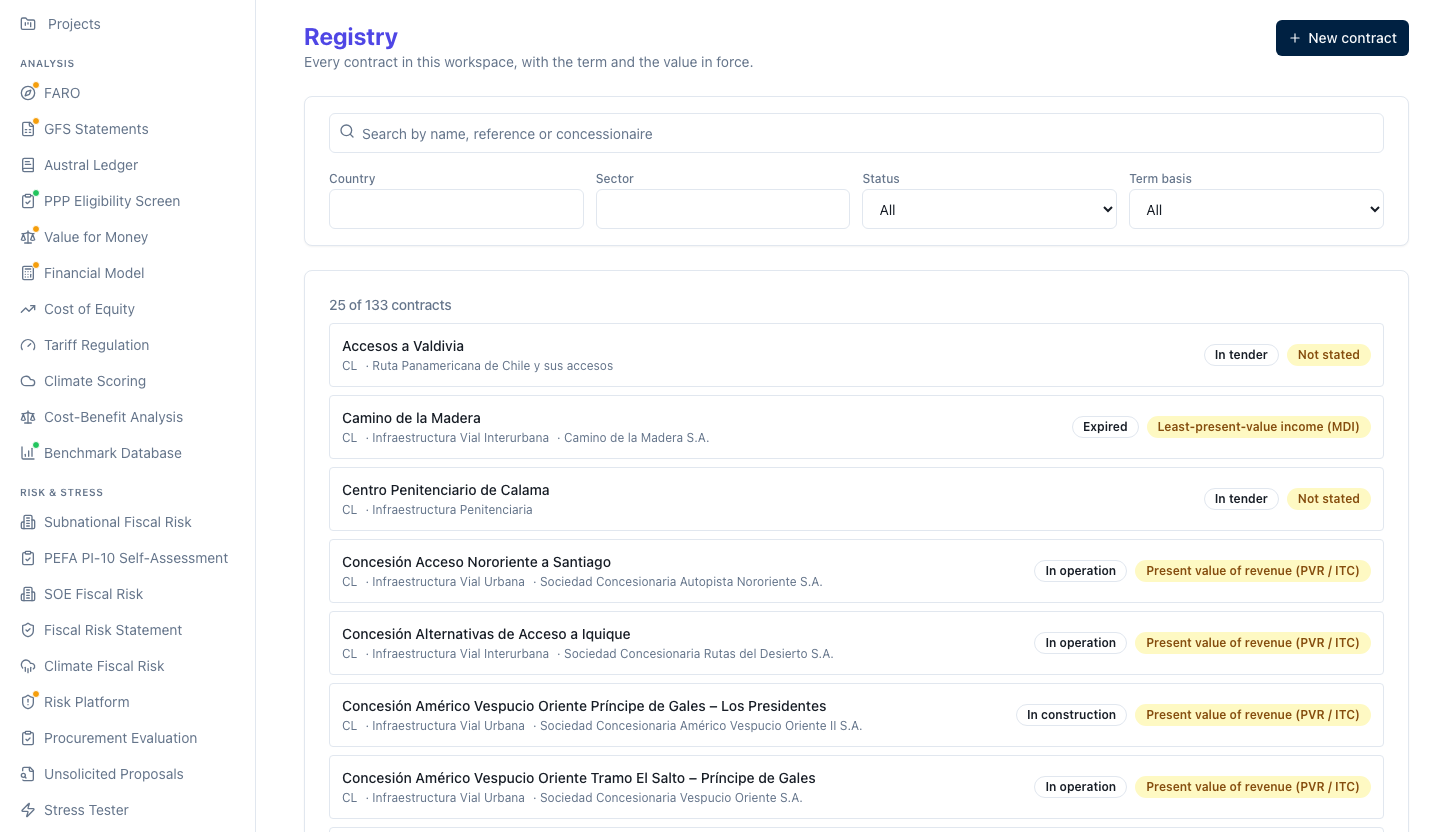
Figure 2 — The register (…/contracts/registry) and its filters, among them term basis: "25 of 133 contracts" on the first page. That filter is what separates the contracts where a term extension is a transfer from those where it is an arithmetic gift. (§5.1; Step 1.)
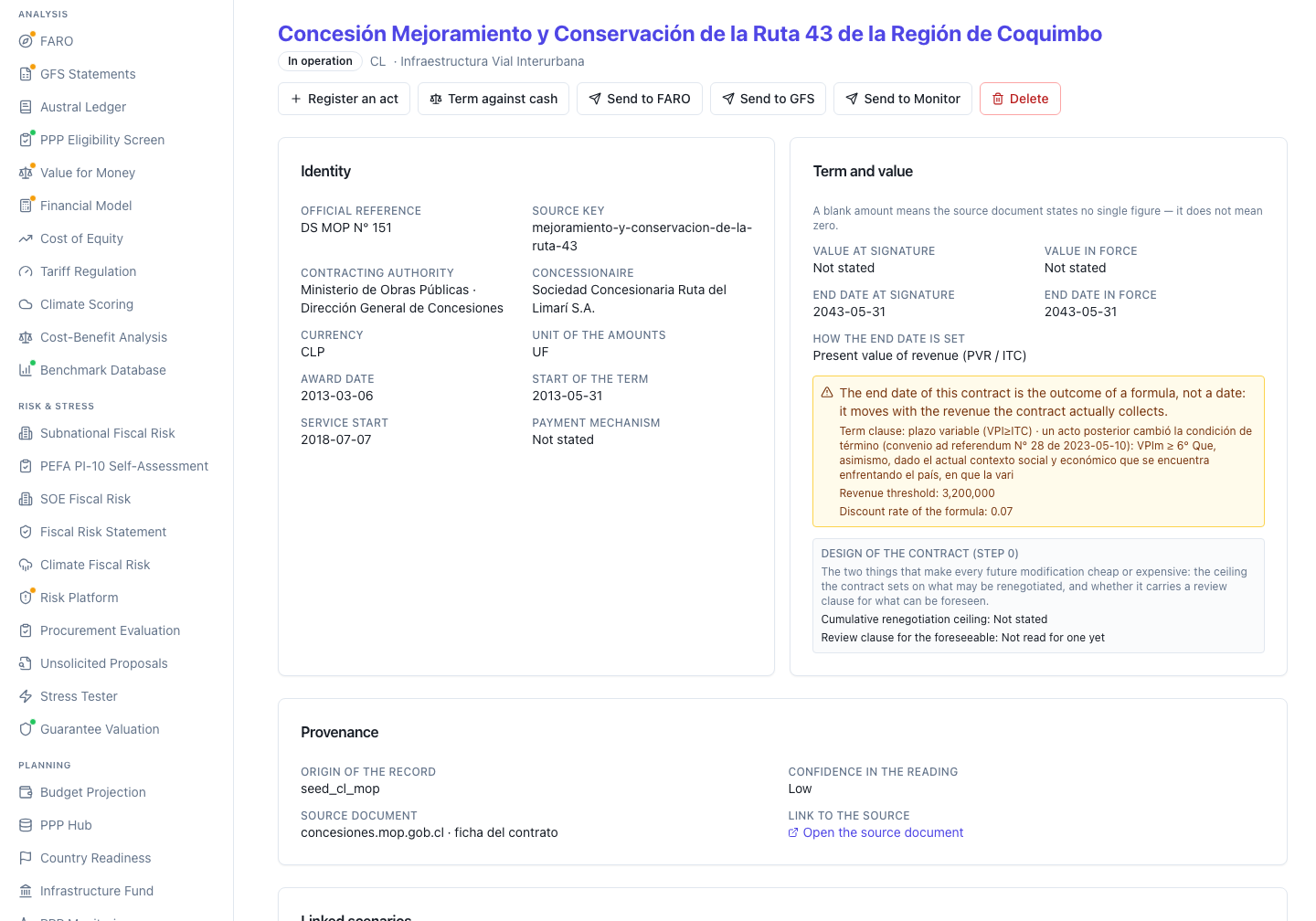
Figure 3 — The Ruta 43 file, with the Contract design (Step 0) box: revenue threshold 3,200,000, rate 0.07, cumulative cap: not stated, review clause: not yet read for that, reading confidence Low. Step 0 publishes, above all, what it does not know. (§5.1; Steps 0 and 1.)
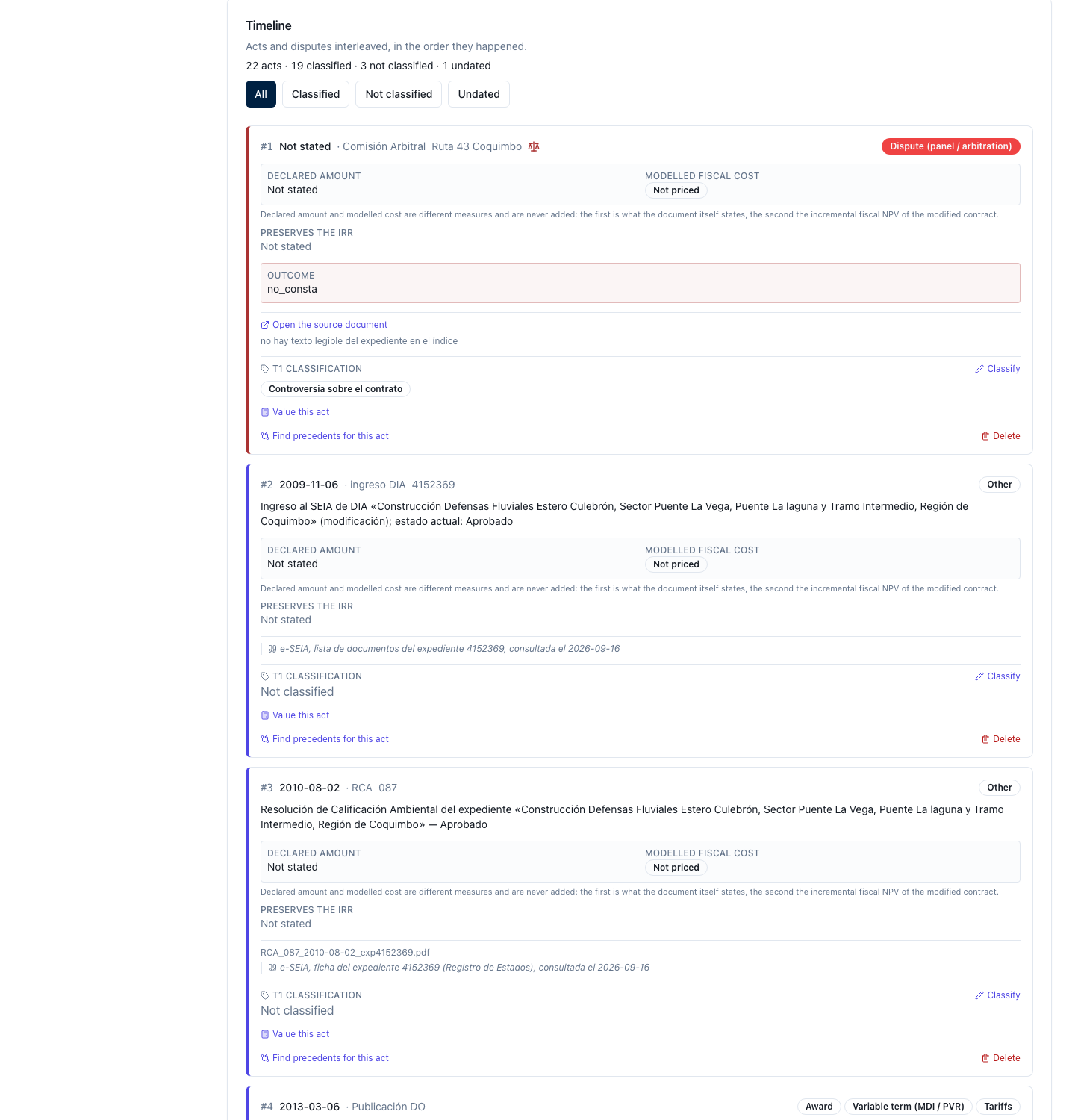
Figure 6 — The file's timeline, with classification coverage stated up front: 22 acts · 19 classified · 3 unclassified · 1 undated. Act No. 1 shows "not stated" in its date field — the gap named in its own place. (§5.1; Steps 1 and 2.)
§6 devotes eight subsections to this question from the spreadsheet's side. From the product's side it is four things, and only four.
The vocabulary is served, not hard-wired. The eight cause values, the ten mechanism values and the eighteen trigger values are not written into the application: they arrive from the typology artefact, with its version (v1-provisional), and the screen paints them. The classification block says so where the user reads it: "Every option comes from the served typology (v1, provisional) — nothing is hard-coded in the application." The practical consequence is what §6.1 measures: when the vocabulary is revised, the series does not silently break, because every act keeps which version it was classified with.
The suggestion travels with its reasoning. The deterministic rules propose nature, cause and mechanism, and with every proposal return the identifier of the rule that fired and the literal quote from the document that fired it (figure 9). A suggestion with no reasoning is an opinion; with its reasoning it is a reading that can be argued with.
The cross-tab runs on the whole portfolio, not on a sample. Cause × mechanism across 1,134 modifications, cause × year across the same, and every cell with its own amount coverage alongside. No spreadsheet emailed around carries its denominator pinned to every cell; the book this screen downloads does, and reprints it across all four sheets.
The comparison runs against frozen distributions that ship with the product. The screen says so: "Frozen distributions of 133 Chilean contracts. No data from this workspace ever leaves, and the server never queries the corpus." Frozen on 24 September 2026. This is not a privacy note: it is the condition that makes the comparison publishable. A comparator that needed to send a client's contract to a server to place it against the Chilean portfolio would be a comparator no concessions unit could use on a live case file.
It is the Step 2 surface and the module's newest one (figures 7 to 9).
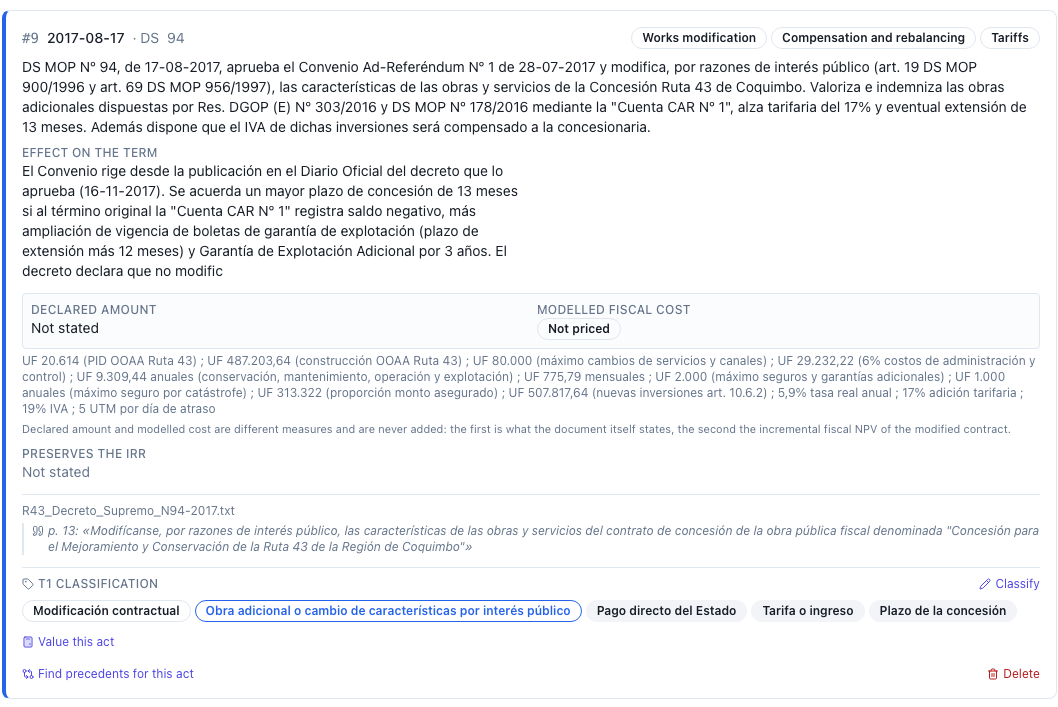
Figure 7 — A classified act: DS No. 94 of 17-8-2017, with its axes (MOD · A1 · B1 B4 B2), its quote and the three amount measures — declared not stated, modelled cost not valued, and the list of figures the classifier read, among them UF 507,817.64. (§5.3; Step 2.)
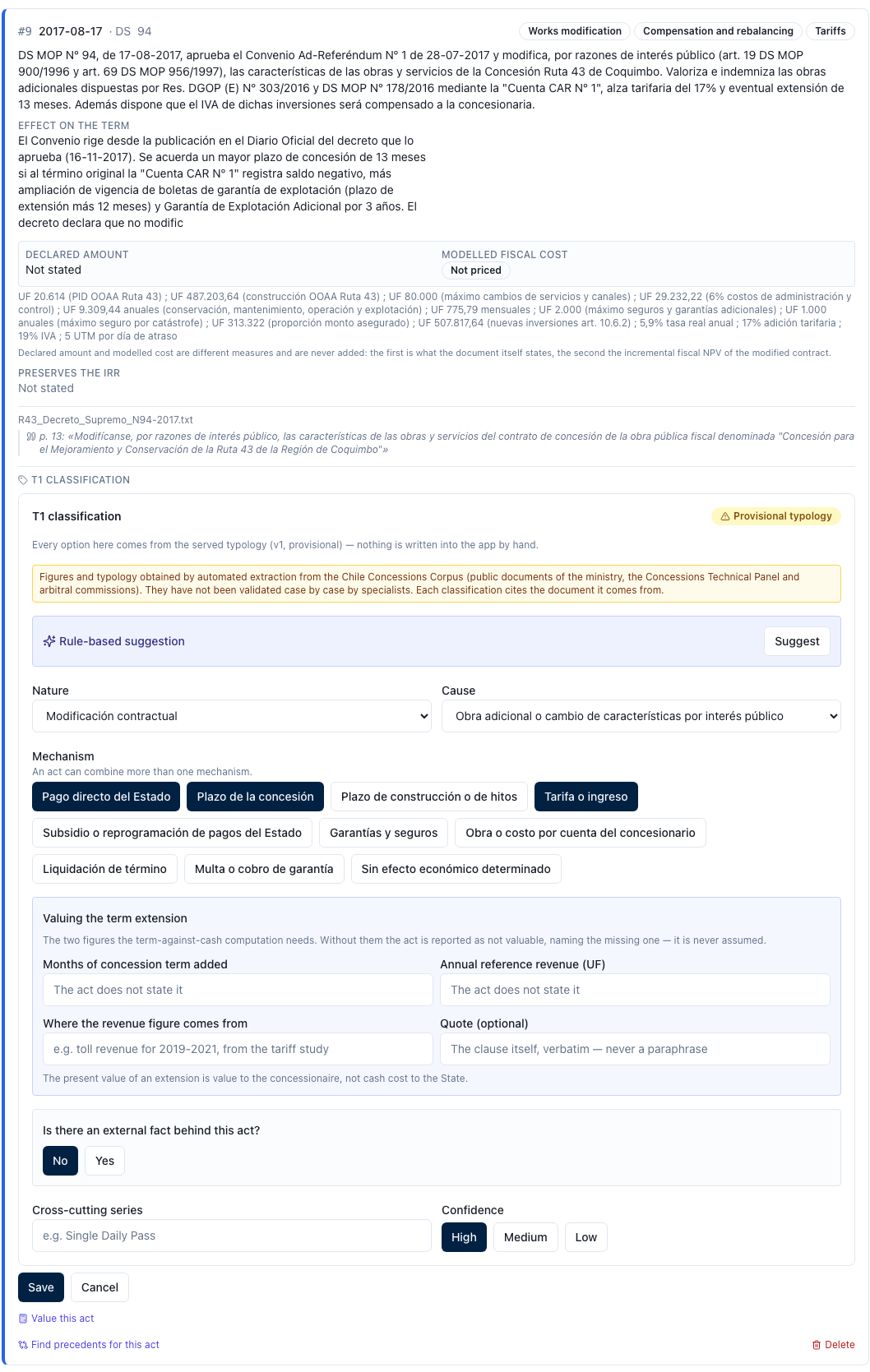
Figure 8 — The classification block open: the four axes served from the v1-provisional typology, the binary trigger that is never suggested, and the two term fields — "Concession-term months added" and "Reference annual revenue (UF)" — empty, marked The act does not declare it, on the very act figure 11 does value. (§5.3; Step 2.)
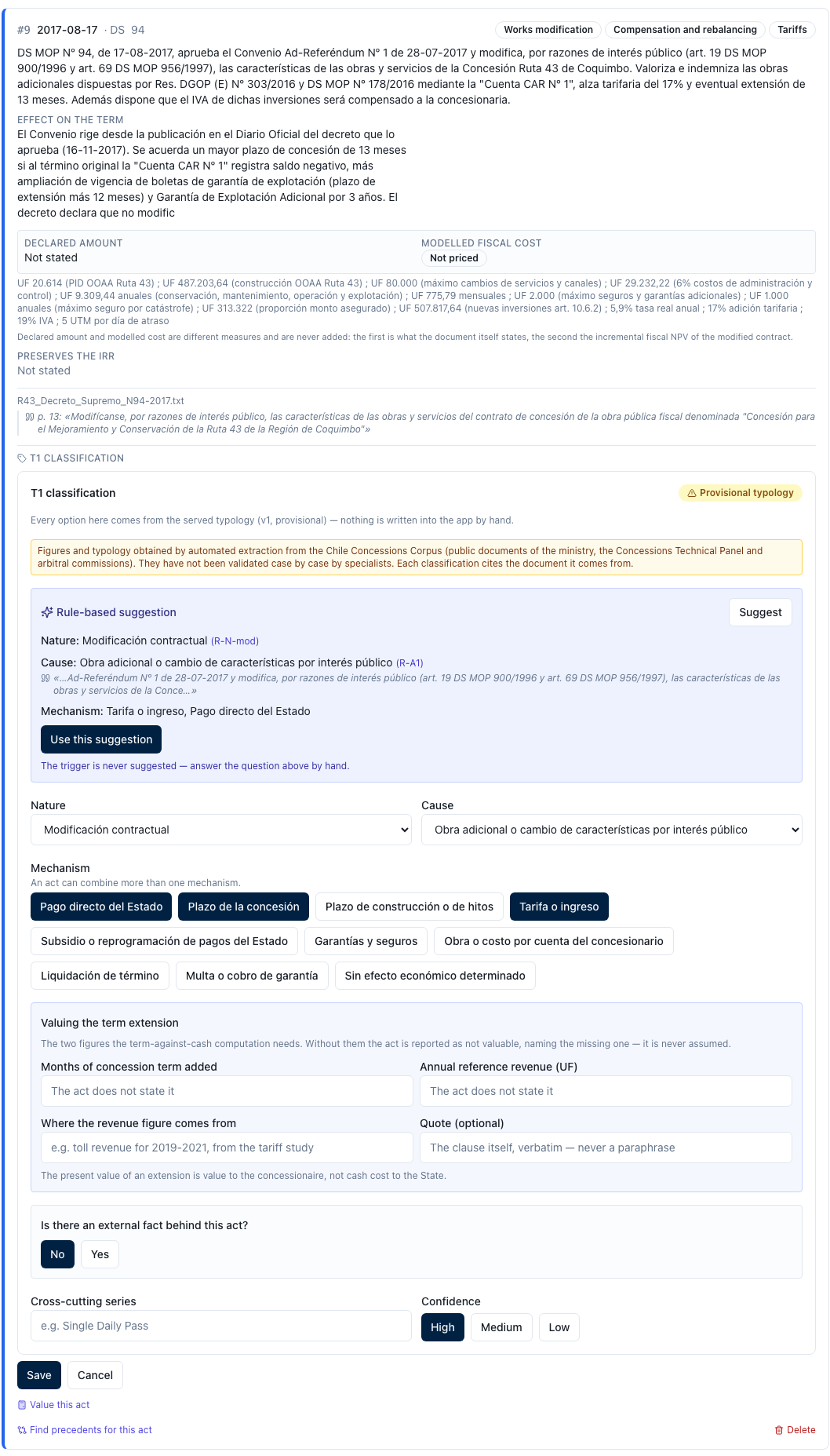
Figure 9 — The suggestion travels with its reasoning: nature Contract modification (R-N-mod), cause A1 (R-A1) with the literal quote from the document that fired it, mechanism Tariff or revenue · Direct State payment — and, underneath, "Trigger is never suggested". (§5.3; Step 2.)
The suggestion is never saved on its own. The Suggest button calls the rules; the result appears in its own box, with the rule and the quote, and "Use this suggestion" has to be clicked to send it down to the fields. Between the two there is a person. The provenance that gets saved distinguishes four states — manual, suggestion accepted, suggestion edited, import — and that distinction is what makes it possible to measure, against real users, how often the product gets it right: an edited suggestion is a suggestion that got something wrong, and the register knows it.
Trigger is never suggested. The screen asks "Is there an external fact behind this act?" with two buttons, and underneath clarifies: "Trigger is never suggested — answer the question above by hand." The reason is from §2.4: cause is the legal route the instrument invokes and is read from the text; trigger is the fact of the world that caused it and is not in the text except by coincidence. A rule that inferred it from the decree's vocabulary would be inventing half of the question of who decided.
The "provisional typology" label cannot be dismissed. It appears in the block's header, on the portfolio, on the term-versus-cash screen and on the file, with no way to close it. Next to it, the automated-extraction notice: "Figures and typology obtained by automated extraction from the Chile Concessions Corpus […]. They have not been validated case by case by specialists." It is §1's publication decision, executed on the screen and not in a footnote.
The two term inputs have their own field. Under the label Term extension valuation, the block asks for the concession-term months added and the reference annual revenue in UF, with its provenance and its optional quote, and warns: "The two figures the term-versus-cash calculation needs. Without them the act is reported as not valuable, naming the missing one — it is never assumed." Until this release, those two numbers only ever existed inside the Chilean seed package, and a reader's own contract always returned the same negative. It is the change that makes Step 5 executable on the reader's own contract.
[A reading note, and not a minor one.] On the acts the seed carries, those two fields show empty even though the engine does value the act: the engine reads the register's own fields first and, when they are empty, falls back to the seed package. The result is that decree No. 94 of 2017 shows "The act does not declare it" on the classification form while the term-versus-cash screen, for that same act, prints 13.0 months and UF 676,988. The precedence is correctly decided — whoever corrects the corpus reading has to beat the corpus — but the screen does not display the fallback value the calculation actually uses, and that is a visible contradiction between two screens for the same act.
It is the Step 5 surface and the manual's thesis (figure 11). On the §4 contract it prints, act by act:
| Act | Months | Years to termination | PV of the extension | Declared figure | Ratio |
|---|---|---|---|---|---|
| DS No. 94 · 2017-08-17 | 13.0 | 25.8 | UF 119,153 | UF 507,818 | 0.23 |
| DS No. 4 · 2020-01-16 | — | — | — | — | not valuable |
| Panel D10-2020-8 · 2020-09-01 | 17.8 | 22.7 | UF 99,833 | UF 181,534 | 0.55 |
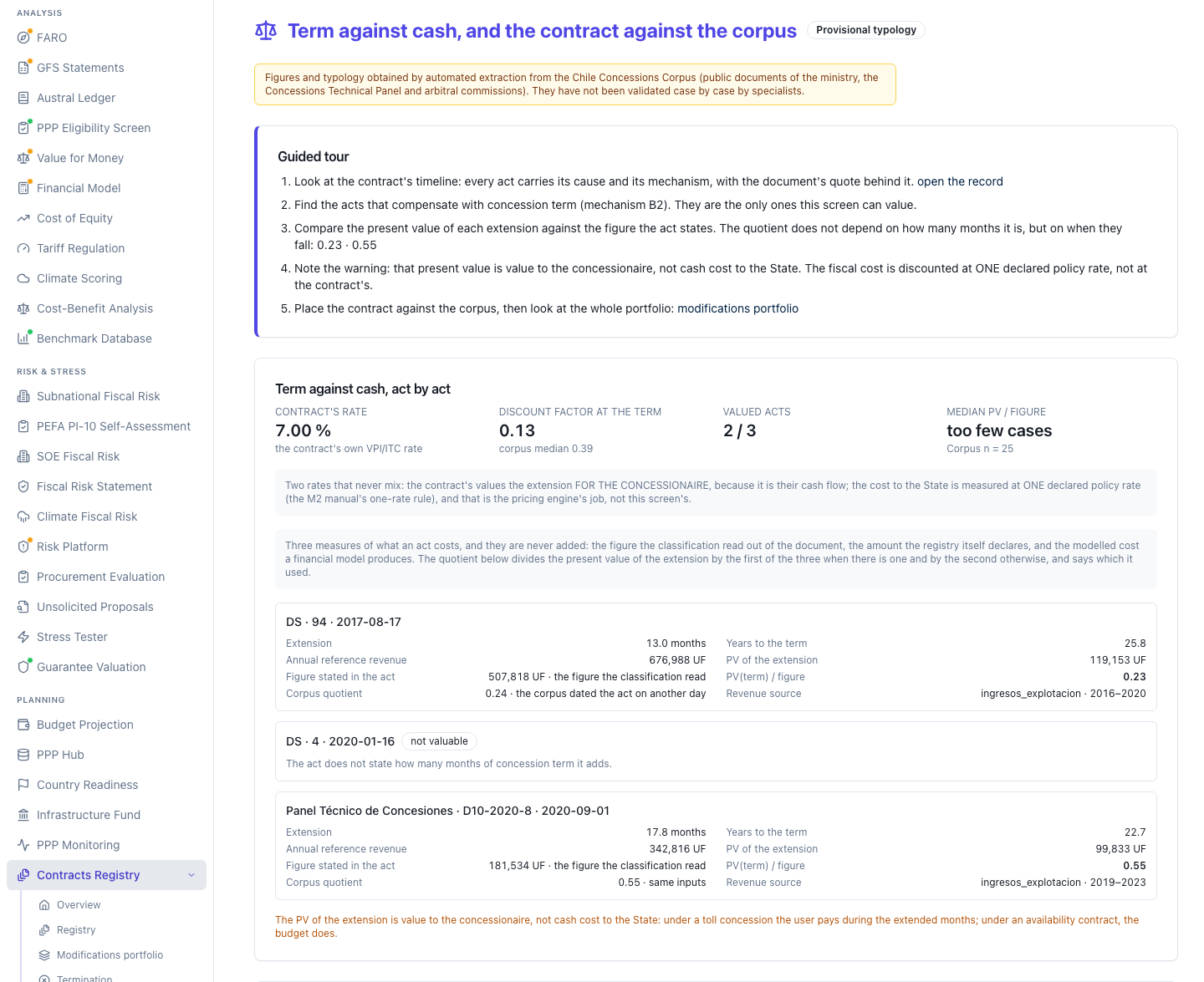
Figure 11 — Term versus cash (…/contracts/{id}/benchmark): rate 7.00 %, discount factor at termination 0.13 (corpus median 0.39), 2 of 3 acts valued and the contract's median withheld as "too few cases". The three acts with their ratio beside the one the corpus measured — DS 94 0.23 (corpus 0.24, different day), DS 4 not valuable, Panel D10-2020-8 0.55 (corpus 0.55, same inputs). (§5.4; Step 5.)
Four things this screen does that are worth naming one by one.
It publishes the negative with its reason, not a zero. The January 2020 decree shows up with the not valuable tag and the sentence "The act does not declare how many months of concession term it adds." That is actionable: it names the missing datum and who can load it.
It withholds its own median. With 2 of 3 acts valued, the header prints "too few cases" where the contract's median would go. §3's three-case rule is applied against the manual's own example, which is the only proof the rule is a rule.
It names the three amount measures, and says which one it used. The box heading the acts spells it out in full: "Three measures of what an act costs, and they are never added together: the figure the classification read from the document, the amount the register itself declares, and the modelled cost a financial model produces. The ratio below divides the extension's present value by the first of the three when it exists and by the second when it does not, and says which one it used." Below, each act labels its denominator — "the figure the classification read." It is the fix for an ambiguity the module itself used to have: two amount fields, and the one the manual teaches to leave empty in the seed.
It prints the corpus's ratio alongside, and flags when it differs. For the 2017 decree the corpus gives 0.24 against the register's 0.23, with the reason written down — "the corpus dated the act on a different day" — for the 2020 recommendation, both give 0.55 and the screen labels it "same inputs." Publishing both figures with their reason is what turns a discrepancy into an explanation.
And the warning the screen repeats in its footer, because it is the one that prevents the expensive error: "The extension's present value is value for the concessionaire, not a cash cost for the State: under a toll concession the user pays it during the extension months; under an availability payment, the budget does."
[To be built.] The header prints "Corpus n = 25" but does not print the corpus median (0.495) or its range (0.02 – 23.55), which are the two figures §4.6 cites. The engine returns them; the screen does not paint them. And that n = 25 is the count before excluding the row the product's own rule rejects — an act dated after its contract's termination — while the median the manual publishes is computed on the remaining 24. Two denominators in the same spot, one of them invisible.
It is the Step 8 surface applied to one contract (figure 12). Four measures, each with its n:
| Measure | Ruta 43 | Corpus | n |
|---|---|---|---|
| Registered modifications | 6 | median 6 | 104 |
| First modification (years) | 2.9 | median 2.4 | 100 |
| Accumulation / revenue commitment | 17.3 % | median 14.5 % | 29 |
| Disputes | 9 | median 2 | 53 |
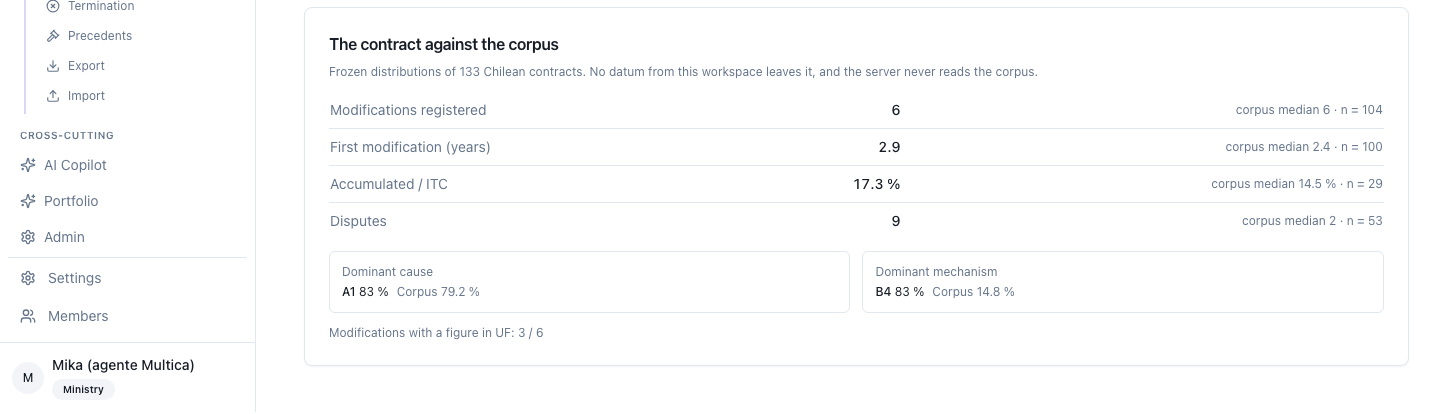
Figure 12 — The contract against the corpus, each measure with its n: modifications 6 (median 6, n = 104), first modification 2.9 years (2.4, n = 100), accumulation / ITC 17.3 % (14.5 %, n = 29), disputes 9 (2, n = 53). Below, dominant cause A1 83 % against the corpus's 79.2 % and dominant mechanism B4 83 % against 14.8 %: typical in its cause, atypical in its currency. (§5.5; Step 8.)
The n is not decoration: it is half the datum. That the accumulation is compared against 29 contracts and not 133 is what prevents "17.3 % against 14.5 %" from being read as a position in the whole Chilean portfolio. It is a position among the twenty-nine contracts that declare a revenue commitment and carry some modification with a figure.
And the withheld percentile. Below three cases the screen does not publish a percentile: it publishes that there are too few. It is visible in this very run, in the withheld median of §5.4.
Below, two boxes: dominant cause (A1, 83 % against 79.2 % for the corpus) and dominant mechanism (B4, 83 % against 14.8 %). It is the finding that only shows up when the two are crossed: typical in its cause, atypical in its currency. (Both boxes print the axis code — A1, B4 — and not its name, unlike the rest of the screen; it is the module's only surface where the reader has to translate a code on their own.)
It is Step 8 applied to the whole set (figures 13 to 16), and the screen is deliberately ordered this way: coverage first, cross-tabs next, and only at the end the flags.
Coverage, stated up front. Four figures in the header: 133 contracts · 2,363 / 2,913 acts classified · 1,134 modifications · 540 / 1,134 (48 %) with a UF figure. Below, two lines that did not exist on any screen before this release:
What the method needs loaded. Contract rate: 84 of 133 · revenue commitment: 51 of 133. Without the rate, the term-versus-cash reading is denied for every act on the contract; without the revenue commitment, the accumulation flag has no denominator. Neither is ever assumed.
Review clause: 0 yes · 0 no · 133 unchecked, out of 133.
With a linked list of the contracts missing each input. It is the difference between a product that says "not valuable" and one that says what has to be loaded for it to be valuable. And the second line is a small model of register honesty: "A contract with no review clause turns every foreseeable change into a negotiation: that is a fact about its design. A contract nobody has checked for one is a gap in the register, and that is why the two are not counted together."
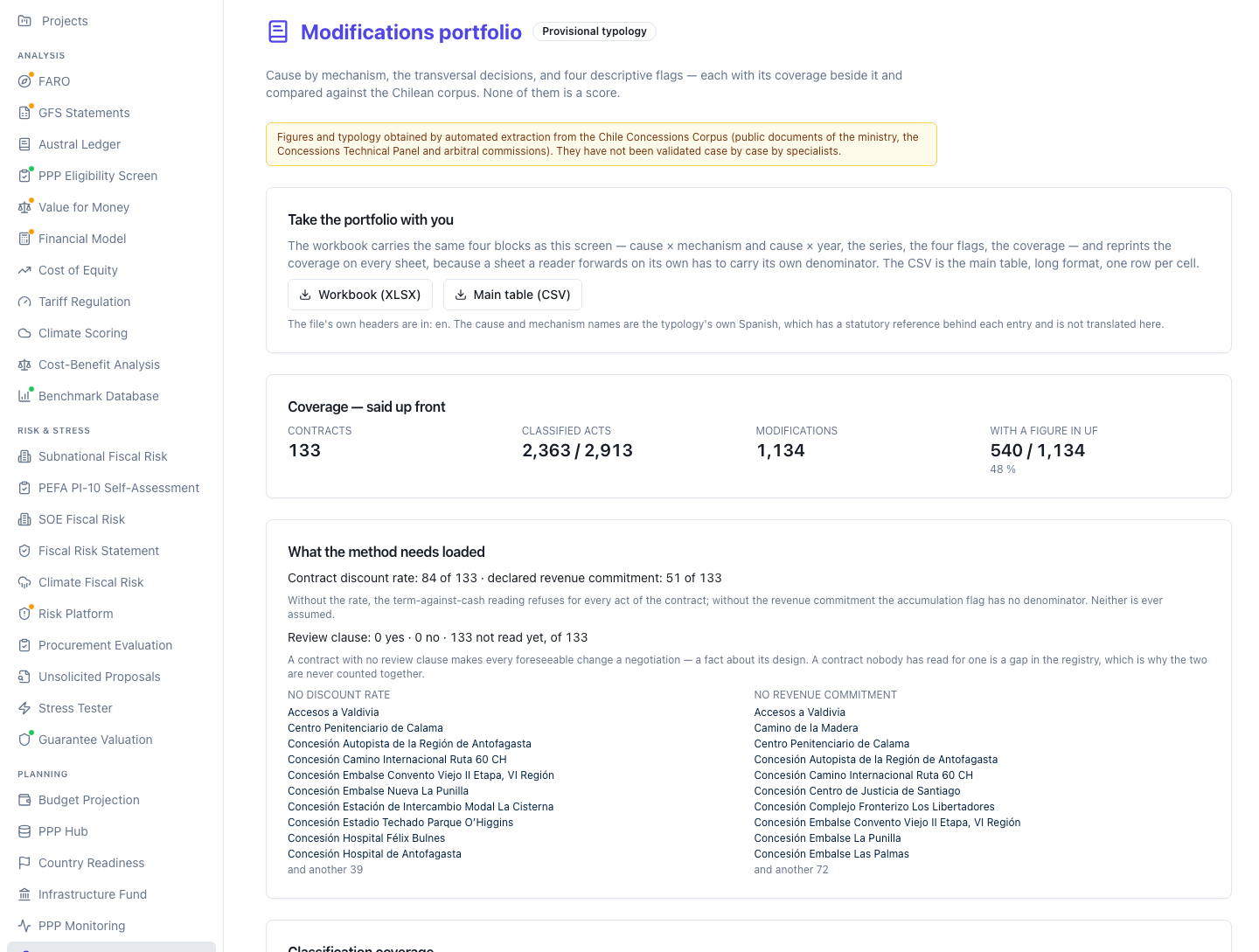
Figure 13 — The portfolio (…/contracts/modifications) opens on coverage and not on the flags: 133 contracts · 2,363 / 2,913 acts classified · 1,134 modifications · 540 / 1,134 (48 %) with a figure. Below, what the method needs loaded — contract rate 84 of 133, revenue commitment 51 of 133, review clause 0 yes · 0 no · 133 unchecked; above, the automated-extraction notice and the two download buttons. (§5.6; Step 8.)
Then, classification coverage, with its consequence spelled out: "2,913 acts · 2,363 classified · 550 unclassified · 79 undated. An unclassified act does not appear in any cross-tab on this screen, and an undated one enters no series — including the early-modification flag, which is computed on dates." With two tabs listing the affected contracts. A fifth of the seed unclassified is a lot; what cannot be accepted is that it go unsaid.
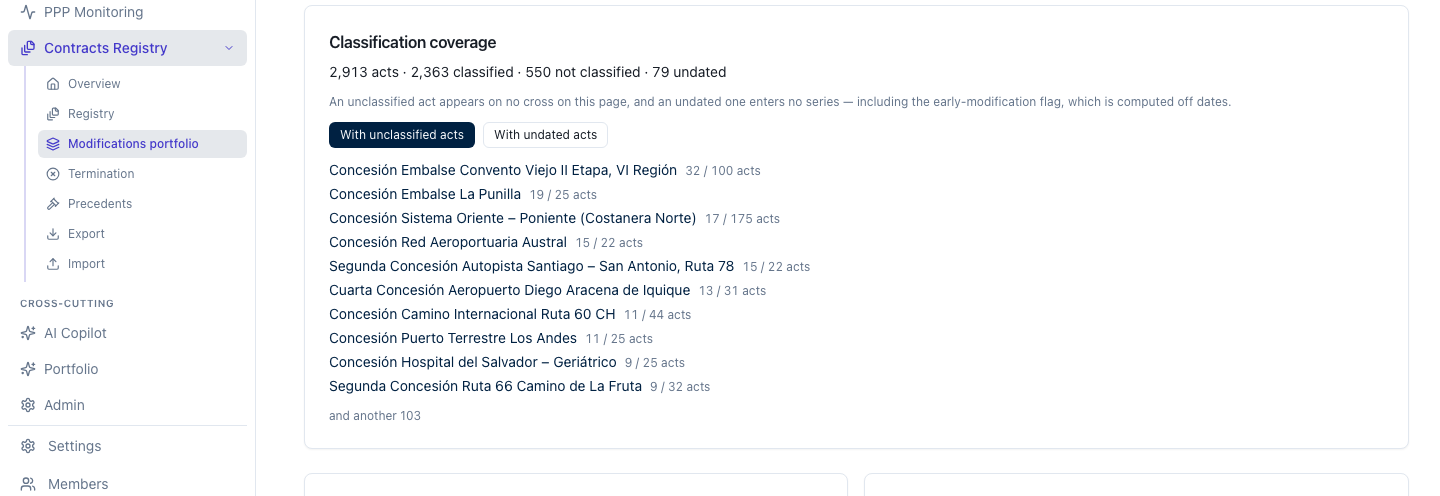
Figure 14 — Classification coverage with its consequence spelled out and its per-contract detail: 2,913 acts · 2,363 classified · 550 unclassified · 79 undated; Convento Viejo 32 / 100, La Punilla 19 / 25, Costanera Norte 17 / 175. (§5.6; Step 8.)
The cross-tabs. Cause (8 rows), mechanism (9 rows, with the warning "Mentions, not combinations: an act with two mechanisms adds one to each"), the cause × mechanism matrix and the cause × year one. The matrix's largest cell — public interest × construction term, 573 acts — is half of §4 in one number.
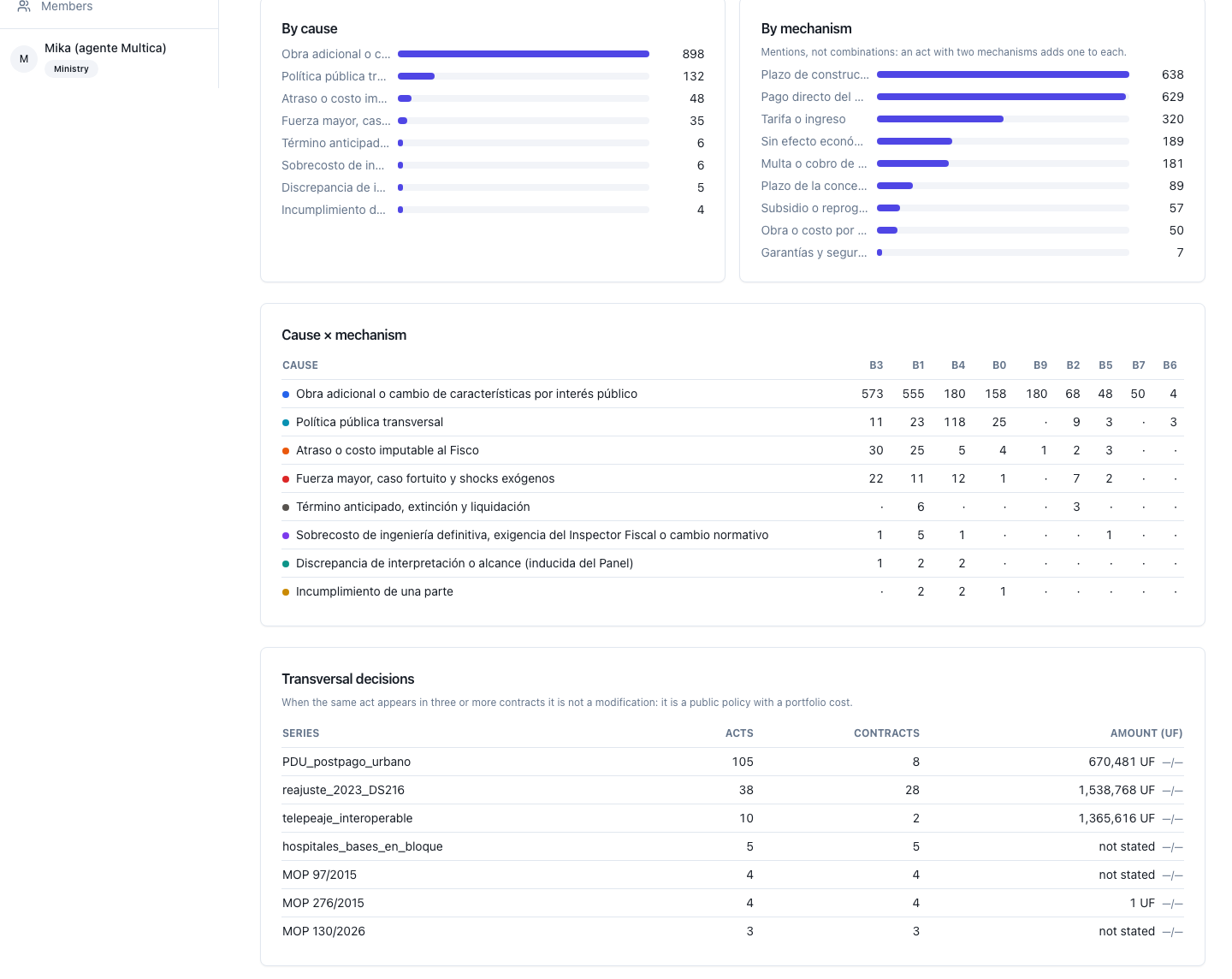
Figure 15 — The cross-tabs: by cause (A1 898, A5 132, A3 48, A4 35), by mechanism (B3 638, B1 629, B4 320, B0 189, B9 181, B2 89), the cause × mechanism matrix with its largest cell A1 × B3 = 573, and the cross-cutting decisions — 7 series / 169 acts, the largest PDU_postpago_urbano with 105 acts across 8 contracts and UF 670,481. (§5.6; Step 8.)
The four flags, and here the manual's positioning limit is repeated for a third time. The screen states it this way: "Every flag is a fact compared against the corpus, with its coverage. There are no scores and nothing here is called 'risk'." The four:
| Flag | What it compares | Coverage |
|---|---|---|
| Early modification | Contracts modified within two years of award | 100 / 133 |
| Accumulation against the original investment | Accumulated modifications against the declared ITC/VPI | 29 / 133 |
| Accumulation of a cross-cutting series | A government decision instrumented across three or more contracts | 159 / 1,134 |
| Dispute with no outcome | Disputes with no linked executing act | 203 / 203 |
Two design details worth more than the flags themselves. The first: the early-modification flag carries its own partial rebuttal printed alongside it — "The number of acts and the time to the first one are mechanically linked (more acts ⇒ the minimum falls earlier). This is a compared fact, not a predictor." The second: the accumulation flag prints "Contracts declaring their own cap: 0 / 133", so it compares against the corpus distribution and says it is not comparing against the contract's own limit, which is the comparison a ministry needs.
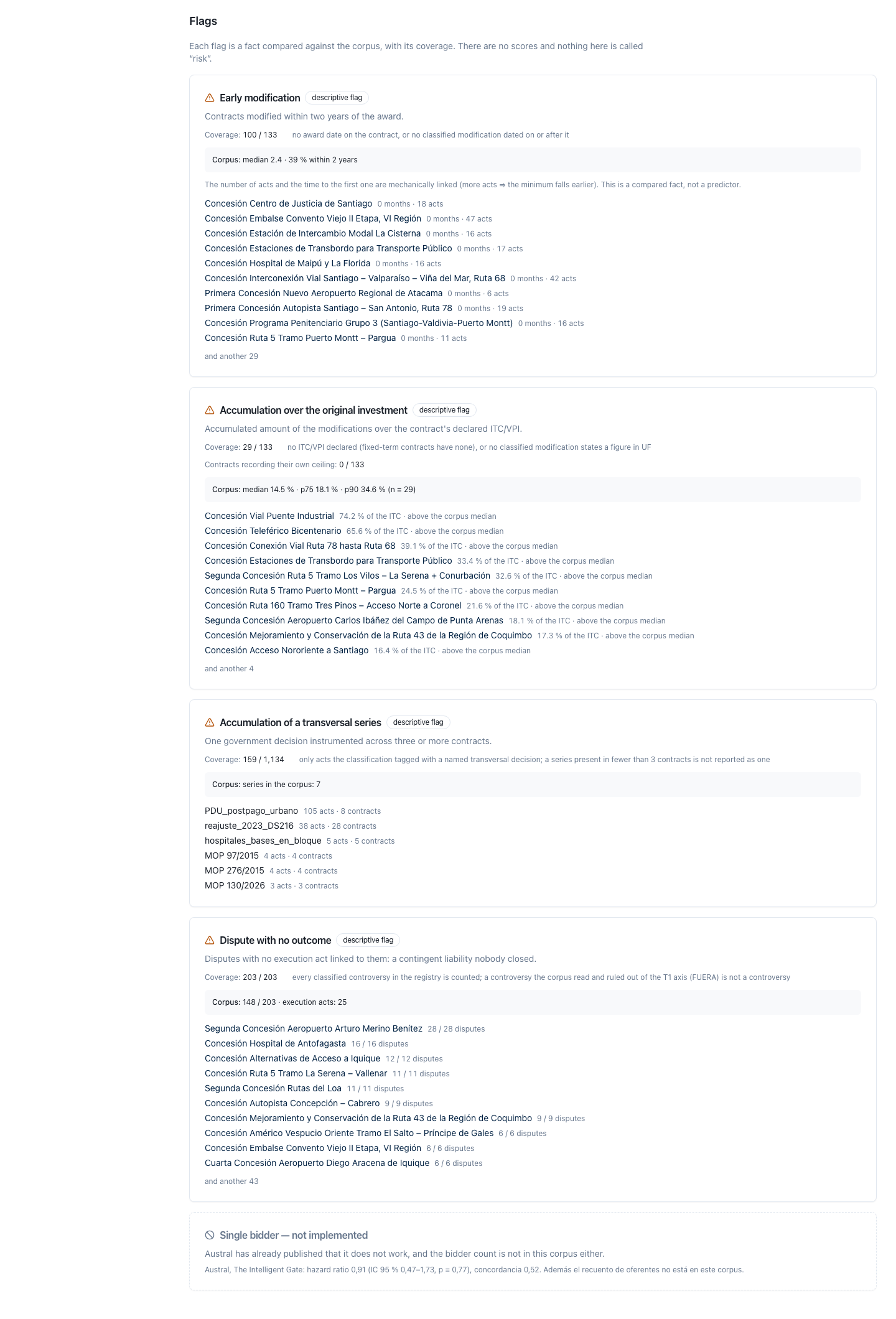
Figure 16 — The four flags with their coverage and their caveat: early 100 / 133 (median 2.4 years · 39 % ≤ 2 years), accumulation 29 / 133 (median 14.5 % · p75 18.1 % · p90 34.6 %, with own cap 0 / 133), cross-cutting series 159 / 1,134 (6 series), dispute with no outcome 203 / 203. And the box for the flag that is not implemented: single bidder, hazard ratio 0.91 (CI 0.47–1.73, p = 0.77), concordance 0.52. (§5.6; Step 8.)
[To be built.] The Cross-cutting decisions table and the cross-cutting-series flag do not count the same thing, and the screen does not say so. The table publishes seven series with 169 acts, including one present in only two contracts; the flag publishes six series and a coverage of 159 / 1,134, because its own rule — printed alongside it — excludes "a series present in fewer than 3 contracts." The difference is exactly those 10 acts. The two readings are each defensible on their own; published four inches apart with no note, they are two different totals for the same thing on the same screen.
And the flag that is not there. A separate box, at the end: "Single bidder — not implemented. Austral has already published that it does not work, and besides, bidder counts are not in this corpus." With the figure: hazard ratio 0.91 (95 % CI 0.47–1.73, p = 0.77), concordance 0.52 (Austral, The Intelligent Gate). It is the only part of the screen that explains why something is missing, and it says the most about how the rest was built.
Here, for a third time, the positioning limit. This screen orders a portfolio by compared facts and never by danger. It produces no score, proposes no one to sue, and weighs neither party's claim in a dispute. The dispute with no outcome flag points to a contingent liability nobody closed — a fiscal-register problem — and not to a dispute worth winning. M11 is a manual of analysis and prevention; it does not teach how to litigate, and neither does its product.
The contract package with its history. The export screen (figure 18) offers four outputs: the complete, lossless package — the one that re-imports with nothing lost — two deliberately separate CSVs ("Two grains, two files, on purpose: a contract repeated across each of its acts is a table that sums wrong"), a three-sheet Excel workbook, and the projection to OC4IDS 0.9.5.
The open standard is a projection, and the screen does not pretend otherwise. Its own text: "The standard models modifications but not disputes, nor the distinction between declared amount and modelled cost, nor provenance; that is why the acts it cannot express travel in an extension instead of being lost." Checked on the export of the 133 contracts: acts go under the austral:events key, and no field from the T1 classification appears in the file. It is the right call: inventing a projection of cause and mechanism for the standard would be publishing a house's provisional vocabulary as though it were a standard.
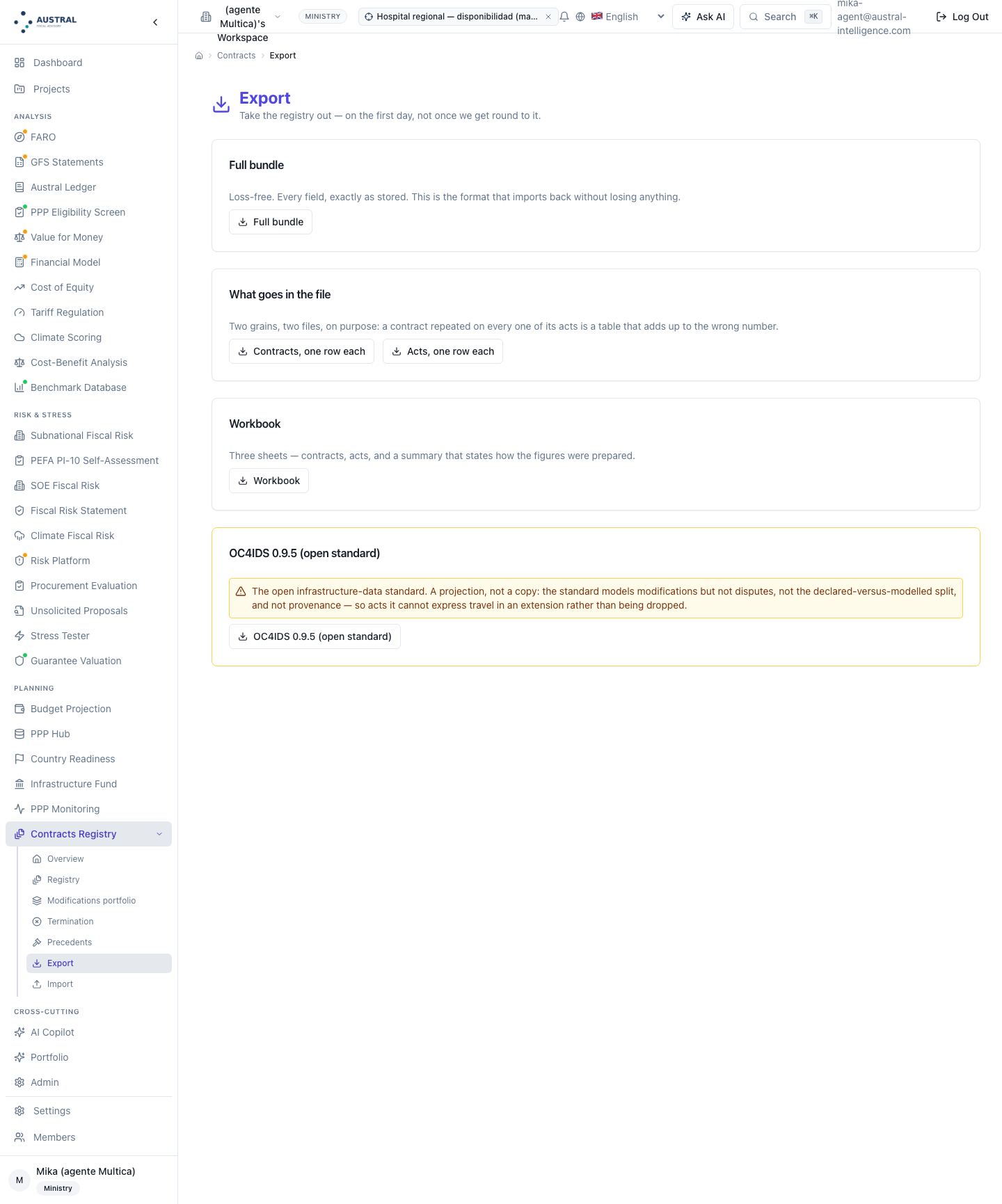
Figure 18 — Export (…/contracts/export): the complete lossless package, two deliberately separate CSVs, a three-sheet Excel workbook and the projection to OC4IDS 0.9.5, with the text that declares, on the screen itself, what the open standard cannot express. (§5.7; Step 9.)
The portfolio now exports. As of this release, the portfolio screen (figure 13) offers spreadsheet (XLSX) and main table (CSV), and both were downloaded during this run. The workbook carries four sheets — Cause x mechanism x year, Series, Flags, Coverage — and reprints the full coverage line on every one, with the reasoning written on the screen itself: "a sheet someone forwards on its own has to carry its own denominator." The CSV is the main table in long format, one row per non-empty cell, with that cell's amount coverage alongside — not a pivot, because a pivot with one mechanism per column duplicates every act that compensates through two routes the moment anyone sums the row. It is exactly the flaw §6 accuses the spreadsheet of, avoided in the very file the product delivers.
[To be built.] The workbook downloaded in Spanish mixes two languages: the headers and the cause and mechanism names are in Spanish, but each flag's key (early_modification), each row's detail ("0 months to the first act · 18 acts") and each flag's coverage reason stay in English. The same on screen: the coverage reasons for the four flags — "no award date on the contract, or no classified modification dated on or after it" — print in English over a Spanish-language interface. It is the part of the deliverable a ministry forwards on, and it is the part still untranslated. The same thing, more visibly, in the valuation panel: the frame is translated and the triangle's arithmetic and its five warnings — "Term change rounded from +1.083 to +1 years", "Treat C_ACCEPT as a LOWER BOUND here" — print in English regardless of edition (figure 10). They are the sentences that explain why the figure is what it is; published in another language they are worth less than the figure.
~~[To be built.] The module's navigation labels appear in English in the side bar of a Spanish-language interface.~~ — closed, and after the figures were taken. The side bar now serves Resumen · Registro · Cartera de modificaciones · Término anticipado · Precedentes · Exportar · Importar in the Spanish edition, and their English equivalents here. The figures in this chapter, taken on 28 September, still show the untranslated labels in the Spanish edition's set: they predate the fix by a few hours, and they are published as they were taken rather than retaken so the chapter looks better than it was.
Three screens in the module belong to the original register and not to the new layer, so the manual cites them without explaining them. The precedent comparator (figures 19 and 20) answers Step 3 — what has the administration done before in comparable cases, and what did it cost — and its virtue is that it breaks similarity down into its six components (what changed, how it was compensated, the grounds invoked, sector, term basis, country) instead of publishing a single opaque number; in this chapter's run, on decree No. 94, it returned 20 precedents of which none declares an amount, which is §6 in one example. Termination and re-tender (figure 17) solves the trap of counting three tenders of the same road as one contract: the screen groups by family and numbers generations. The contract's fiscal series (figure 4) and the episodes block (figure 5) are the Step 9 and Step 7 surfaces on the file; the state of the two on the §4 contract — zero rows and zero episodes — is what §5.8 declares.
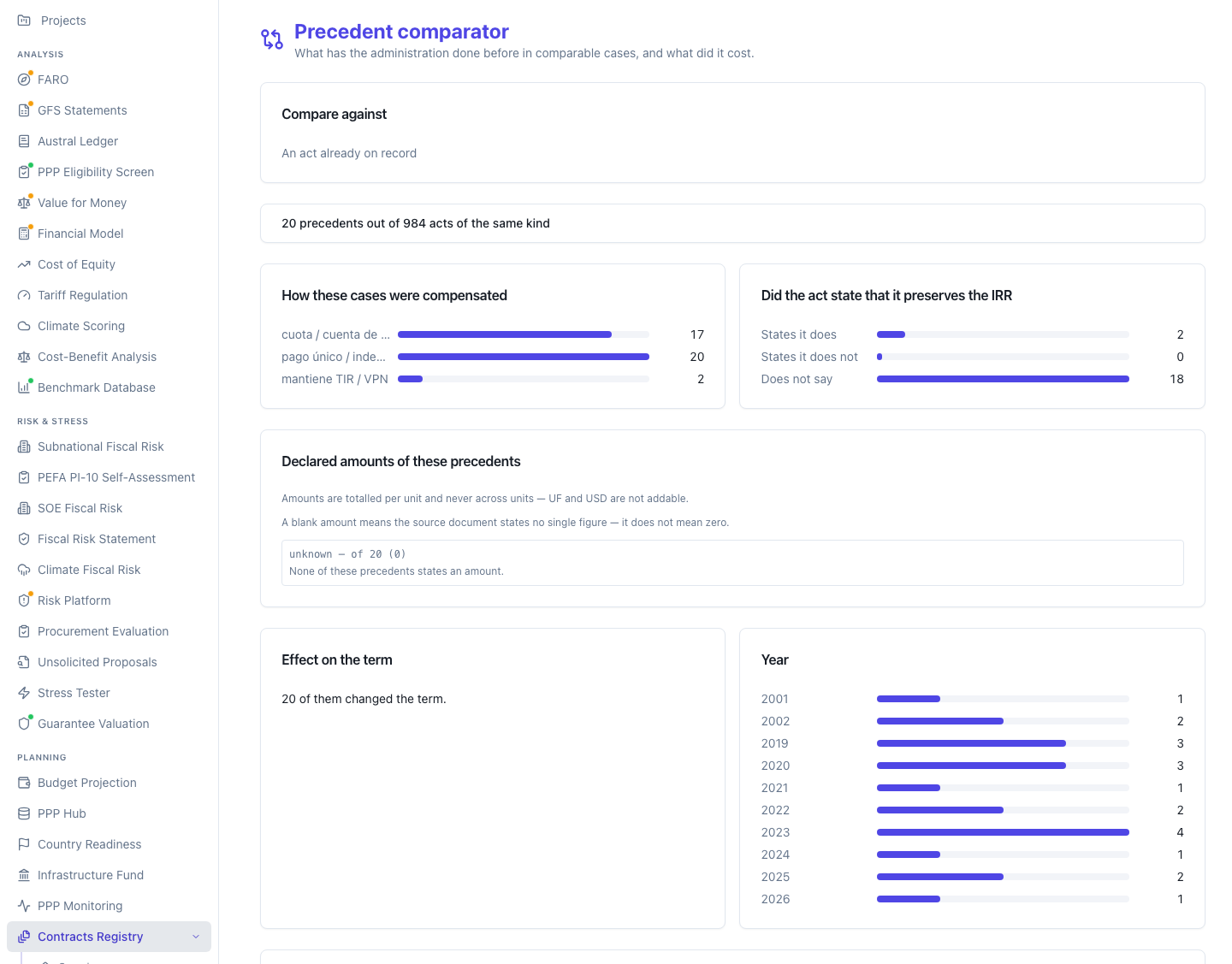
Figure 19 — The precedent comparator on decree No. 94: 20 precedents out of 984 candidates, 20 of 20 changed the term, keeps the IRR yes 2 · no 0 · does not say 18 — and the line that is §6 in one example: "None of these precedents declares an amount". (§5.7; Step 3.)
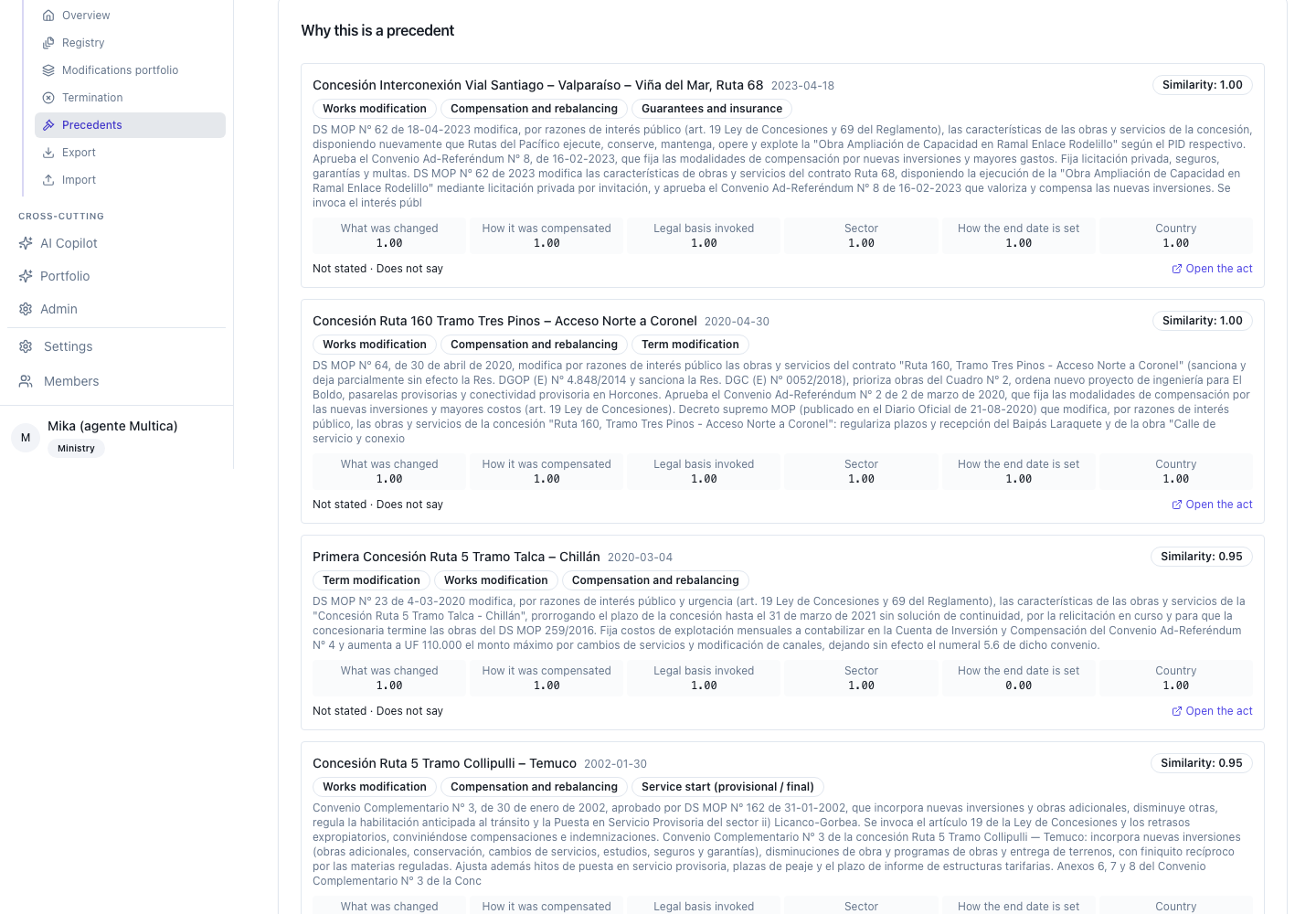
Figure 20 — "Why this is a precedent": similarity broken down into its six components — what changed, how it was compensated, the grounds invoked, sector, term basis and country — on Ruta 68, DS No. 62 of 2023, with 1.00 on all six and total similarity 1.00. (§5.7; Steps 3 and 4.)
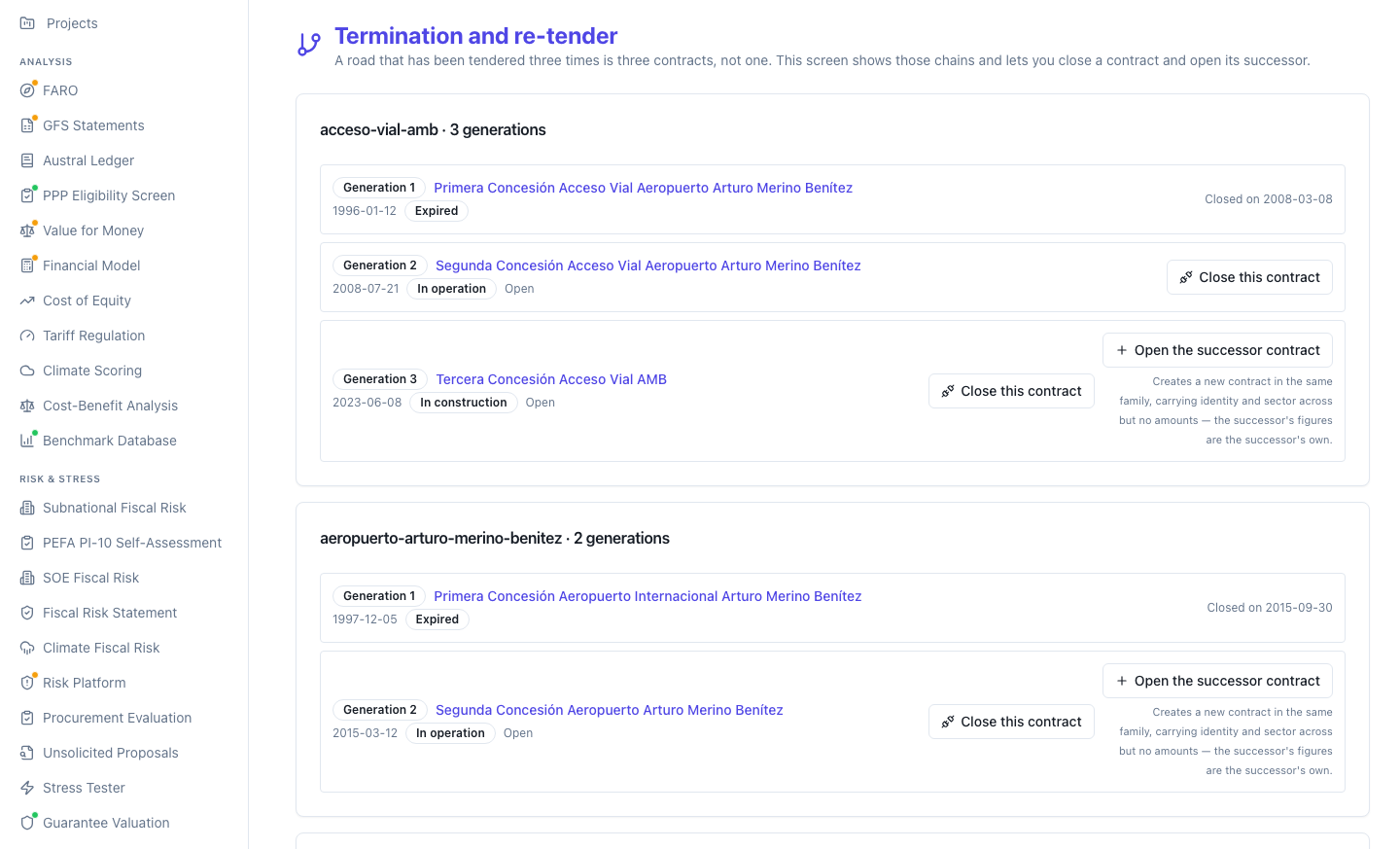
Figure 17 — Termination and re-tender: the chains of generations of the same asset — acceso-vial-amb with three generations (1996, 2008, 2023) and two more chains of two. It is what stops three tenders of the same road being counted as one contract. (§5.7; Step 9.)
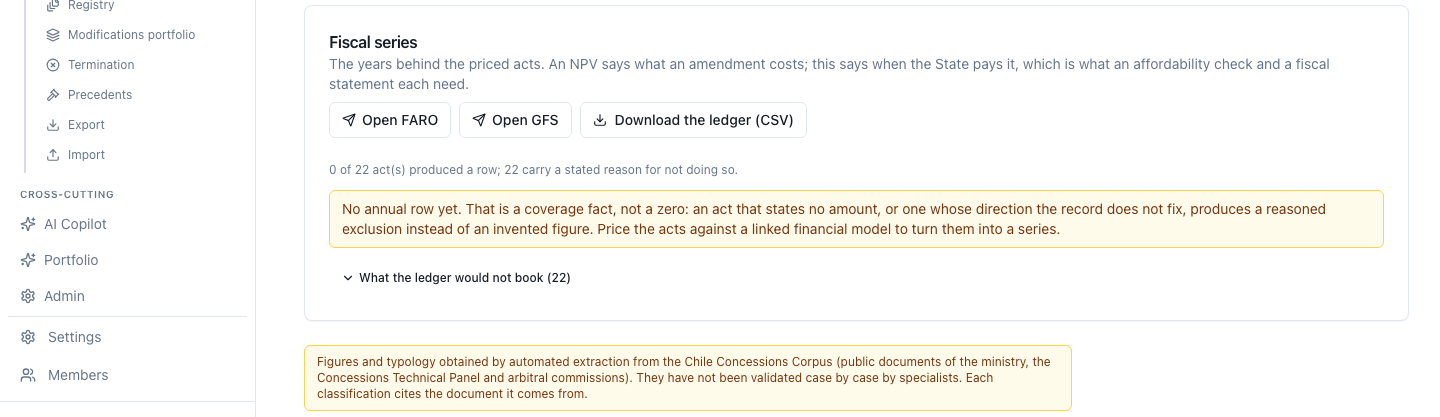
Figure 4 — The contract's fiscal series, empty and with its reason: 0 of 22 acts produced a row; 22 carry a declared reason, and the sentence that saves the datum — "That is a coverage fact, not a zero." (§5.7 and §5.8; Step 9.)

Figure 5 — The episodes block: 9 disputes · 0 executing acts · 9 unlinked. The dispute → act pair is proposed by the module and confirmed by a person; on this contract not one has been formed. (§5.7 and §5.8; Step 7.)
In a list, each with its figure:
v1-provisional, labelled as such on every screen that publishes a category. It was produced by an automated pipeline with measured quality control, not a panel of specialists.The incremental fiscal cost, the triangle and the termination value pass through two gates, not one. The first is the linked financial-model scenario, and for the §4 contract it is closed: the seed writes one demonstration scenario and links it to Ruta 43 only, so the panel no longer refuses for want of a baseline and states what it prices against — "Priced against 'Ruta 43 · escenario de demostración', denominated in UF-mn." The other 132 contracts still return the negative, which is the register's true state and not a defect of the panel. The second gate is still open and it is the one the reader meets: until someone states the change, all 22 acts on the contract return "Variable term and no declared end date", because this concession's term is the outcome of a PVR/ITC formula and not a date. With the change decree No. 94 itself describes stated — 13 months and 17 % — the triangle prints in full (figure 10): accept 0.05 · counter-offer 0.05 · terminate 5.6 million UF, with its reading written alongside — "Terminating costs more than granting: the threat is not credible and buys nothing" — and both figures labelled stated by the analyst. What is missing is no longer the engine or the bridge: it is that the classification should feed the valuation. The 13 months §5.4 reads from the package to print its ratio have to be typed again by hand into this panel, and an amount change additionally cannot cross the gap between the contract's unit (UF) and the scenario's (UF-mn) without a conversion factor and its source, which the register asks for and does not invent.
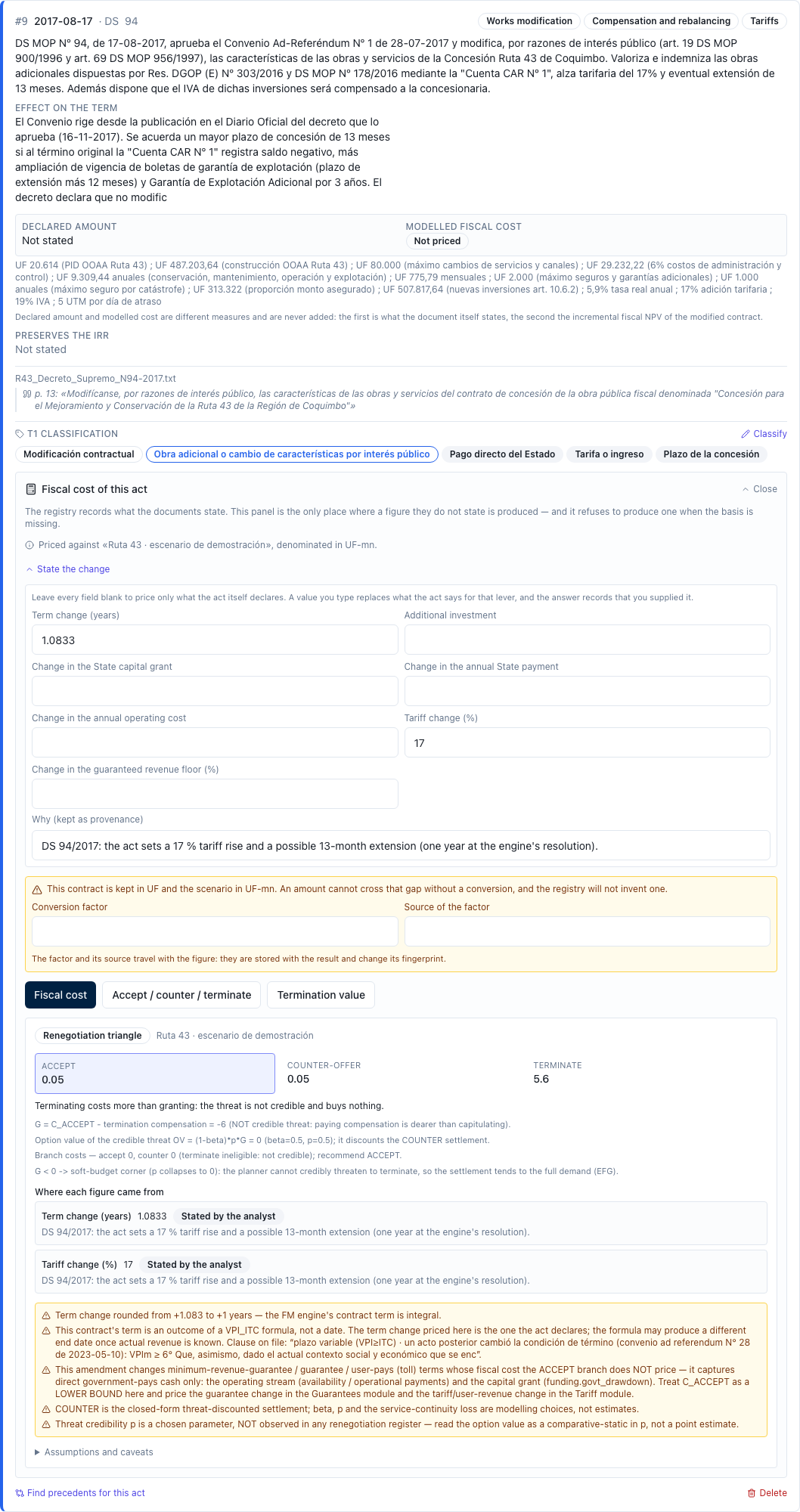
Figure 10 — Fiscal cost of the act on decree No. 94, with both gates visible on one screen: above, the line saying what it prices against — "Ruta 43 · escenario de demostración", in UF-mn — and the notice that an amount does not cross from UF to UF-mn without a factor and a source; below, the renegotiation triangle solved — accept 0.05 · counter-offer 0.05 · terminate 5.6 million UF, with the verdict written out, the arithmetic of the threat, and the provenance of each figure, stated by the analyst, right after it. The five warnings in the footer — including the one that demotes the cost of accepting to a lower bound, because the branch does not price the tariff side — print in English. (§5.8, limit 9; Steps 4 and 6.)
Step 9's annual fiscal book produces no row for the §4 contract. The file says so exactly: "0 of 22 act(s) produced a row; 22 carry a declared reason for not doing so", adding the sentence that saves the datum: "That is a coverage fact, not a zero." The fiscal-book table §4.8 publishes — firm commitment UF 555,125.81, +30.8 months, contingent liability UF 775,572.26 — the method calculates it, not this screen, and a reader looking for it in the application will not find it. It is a direct consequence of the previous limit.
p is not estimated. The module publishes no probability that a contract will be modified. It publishes base rate and severity across the portfolio, which is what §3 Step 9 requires to be provisioned.contracts does not. The manual ↔ screen alignment the series established since M1 does not exist here yet, and it is what should be opened once M11 is published.The §3 ten steps have a surface in the module, and five of them run today end to end on the reader's own contract: recording the act with its document (1), classifying it on the four axes with its provenance (2), searching comparable precedents (3), valuing a term compensation against the act's declared figure (5), and placing the contract and the portfolio against the frozen distributions (8). Steps 4 and 6 — pricing acceptance and the triangle — run end to end on the §4 contract now that the seed links it a scenario, with the caveat that the change has to be stated by hand; on the other 132 contracts they still have no baseline. Step 9 exports the register but does not fill in the fiscal book.
That is the product's honest measure as of 28 September 2026, and it is better than the previous month's on the five things this manual needed: the two term fields, on-screen classification coverage, input coverage, portfolio export, and the three amount measures named where they are used. What is still missing is above, counted, and not disguised: a §5 with no limits list is not an implementation chapter, it is a brochure.
Start with a concession, and it is not a courtesy. The §3 method can be run in a spreadsheet, and in fact that is how it runs today in almost every ministry that keeps any account of what it has modified. One contract, one act, one ratio: that fits on a sheet and is understood better on a sheet than on a screen. This chapter is not written against a spreadsheet's arithmetic, which is correct.
The argument is different and narrower: what happens to a spreadsheet when it stops being a calculator and becomes the modifications register of a concessions portfolio. A register has a thousand acts arriving from four different sources — the ministerial digest, technical panel recommendations, arbitration case files, and judgments — each with its date, its literal quote and its figure when it carries one; it has a classification vocabulary that is going to be revised; it has two discount rates that measure different things; it has disputes that open in one year and close in another; and it has, at the end, a table someone is going to bring to Congress. None of those five things is a computation problem. All of them are problems of provenance, invariants, and versions, and none is solved with a better formula.
The eight failures that follow are not hypothetical and not illustrative: each one is measured on the Chilean documentary corpus of 133 contracts and 2,913 acts that the product itself ships, with the same engine that runs behind the §5 screens. All are presented the same way — where it occurs (which §3 step), what fails in the spreadsheet, how much it costs, and what the tool does, including what it still does not do. And several of them were committed by the product itself before being corrected; they are told that way because the difference between a spreadsheet and a program is not that the program never errs, but that when it does, it leaves a trace, gets corrected once for all thousand acts, and leaves a record that keeps it from happening again.
(Every figure in this chapter is sourced in appendix 6.A. None was hand-typed.)
A reading convention, and the reason it exists. This chapter was written before the module's delivery chain was integrated, and two of its eight failures described a tool that is no longer today's. Where that happens — 6.4 and 6.6 — the original paragraph is ~~struck through~~ and followed by the "closed" mark with its date and what the product does now. It is not deleted: a chapter about figure discipline that rewrote its own past would be doing exactly what it accuses a spreadsheet of. No measurement changes because of it — what changes is which part of each failure is still open in the tool, not how much it costs to commit it.
Where it occurs. Step 2, and the damage shows up in Step 9.
What fails in the spreadsheet. A text "cause" column. The day the validation workshop renames a category — and this manual's vocabulary is provisional and is going to change — the old rows are left with a name no longer on the list, and the new ones with one that was not there before. A spreadsheet cannot say which vocabulary version labelled each row, because it has nowhere to put it: version is a property of the label, not of the sheet. The result is not a visible error; it is a historical series that has stopped being comparable, with nobody noticing.
How much it costs, measured. The corpus has 2,363 of 2,913 acts (81.1 %) with the vocabulary version saved on the act, and the remaining 550 unclassified. Across the 1,134 classified modifications, the breakdown by cause is dominated by a single category:
| Cause | Acts | Across the 1,134 |
|---|---|---|
| Additional works or change of features for public interest | 898 | 79.2 % |
| Cross-cutting public policy | 132 | 11.6 % |
| Delay or cost attributable to the granting authority | 48 | 4.2 % |
| Force majeure, act of God and exogenous shocks | 35 | 3.1 % |
| The other four causes, together | 21 | 1.9 % |
Renaming a single category touches 898 acts, four-fifths of the register. And there is no way to tell, in a spreadsheet, whether the row that says "public interest" was written before or after the rename — so the cause-by-year cross-tab, which is the Step 8 output an annual report publishes, turns into a comparison between two vocabularies with the table saying nothing about it.
What the tool does. It saves the vocabulary version on every act, and the vocabulary is served from a versioned artefact instead of being written into the screen. A version change does not break the series: it splits it, and the table can say how many acts are on each side. It also saves the label's provenance — hand-set, suggestion accepted, suggestion edited, imported — which is the only honest road from a provisional vocabulary to a validated one: without it, the suggestion's hit rate cannot be measured against real users.
Where it occurs. Step 2, and the damage shows up in Step 8, which is where it gets counted.
What fails in the spreadsheet. The compensation mechanism is a set, not a value: Chilean law itself says one or several factors may be used at once (§2.6.1), and a decree that allocates cash and term at once uses two. A spreadsheet flattens it to a text cell — direct payment | execution term — and from there two ways of counting fit, both wrong. The first is pivoting on the text, treating each string as a category. The second is reading the chain's first mechanism and calling it "the mechanism", which is what anyone needing a single-entry column does.
How much it costs, measured. Across the 1,132 modifications with at least one mechanism:
| Vocabulary mechanisms | 9 |
| Distinct sets observed | 72 |
| Distinct order-sensitive text strings | 124 |
| Sets written in more than one order | 33 |
| Acts split across those duplicated orders | 577 — 51.0 % |
More than half the register falls into a set the sheet writes two or more ways. The largest case is the pair "direct payment + execution term", which is 180 acts and which a pivot table splits into two categories — "direct payment, execution term" with 121 acts and "execution term, direct payment" with 59 — two report rows where there is one fact. The trio "direct payment + execution term + fine or guarantee call" is 101 acts split into four pieces (80, 11, 7 and 3). Nobody wrote anything wrong; the order in which the document's mechanisms were read is not a datum, and the sheet treats it as though it were.
The second way of counting is worse, because it is invisible:
| Mechanism | Mentions | If only the first is read | Loss |
|---|---|---|---|
| Execution term | 638 | 311 | −51.3 % |
| Direct payment | 629 | 462 | −26.6 % |
| Tariff or revenue | 320 | 201 | −37.2 % |
| No determined economic effect | 189 | 56 | −70.4 % |
| Fine or guarantee call | 181 | 5 | −97.2 % |
| Concession term | 89 | 50 | −43.8 % |
| Subsidy or rescheduling | 57 | 9 | −84.2 % |
| Works or cost borne by the concessionaire | 50 | 31 | −38.0 % |
| Guarantees and insurance | 7 | 7 | — |
Of 2,160 mentions, 1,132 remain: 47.6 % of the axis is lost. And the loss is not even, which is the serious part. The mechanism that comes out worst is the fine or guarantee call, which disappears in 97.2 % of cases because it is almost never the first thing a decree mentions — and it is precisely the compensation that flows toward the State, the direction the international governance rule itself asks to be recorded, and that almost no register has a field for (§2.8, note 8.1). Concession term, the currency of Step 5, loses 39 of its 89 acts.
What the tool does. Mechanism is a multivalued field on the act, and the cause-by-mechanism cross-tab counts mentions, not combinations. Counting mentions is not a convenience: the vocabulary's quality control gets the exact set right 46.9 % of the time and gets at least one mechanism right 97.2 % of the time (§2.9), so a table of combinations would publish precisely the number at which the classification is worst. The rule the manual gives the reviewer follows from that: mechanism is checked for cardinality, not presence.
Where it occurs. Step 1 on loading, Step 8 on publishing.
What fails in the spreadsheet. An amount column with gaps, and a sum cell at the foot. The sum is correct. What is lost along the way is how many rows it was computed over, and with it the only figure that lets the total be read: an average divided by the sheet's row count instead of by the rows with data, and a cross-cutting series whose total looks like a total.
How much it costs, measured. Of the 1,134 modifications, 540 (47.6 %) carry an amount in unidades de fomento, for a total of UF 199,263,828. Two readings follow, both arithmetically correct:
| Reading | UF per act |
|---|---|
| The total divided by the acts that carry a figure | 369,007 |
| The total divided by all rows | 175,718 |
A 52.4 % bias with not a single cell wrong. And there is a detail in the corpus itself worth looking at because it is uncomfortable: the register's field meant for the declared amount — the one Step 1 teaches how to fill in — is populated in 0 of the 1,134 modifications, and the figure the whole module uses is the single figure the classifier read from the document, with its quote behind it, populated in 540. The reason is documented and sound — the digest lists every figure a decree mentions, and asserting that the act is worth one of them would be a different assertion — but the result is that there are three amount measures in circulation (the one the classifier read, the register's declared amount, and the modelled cost) where the manual teaches two. §3 Step 1 names all three.
Coverage turns raw in the cross-cutting series — the same act repeated across several contracts, which is not a modification but a public-policy decision with portfolio-wide cost:
| Series | Acts | Contracts | With a figure | UF (lower bound) |
|---|---|---|---|---|
| Urban tolling policy | 105 | 8 | 2 | 670,481 |
| Adjustment-formula review | 38 | 28 | 2 | 1,538,768 |
| Electronic-toll interoperability | 10 | 2 | 8 | 1,365,616 |
| The other four series | 16 | — | 1 | — |
Of the 105 acts in the largest series, only 2 carry a figure (1.9 %). Its total in unidades de fomento is a lower bound and the manual prints it as such. A spreadsheet that publishes that UF 670,481 as the policy's cost is publishing 1.9 % of the evidence with the face of 100 %.
What the tool does. It publishes the denominator alongside every aggregate, without exception, and withholds the percentile below three cases with the phrase "too few cases to generalise" instead of a median of two numbers. What it does not do, and is declared: it does not count on screen a contract's unclassified acts, so a timeline can look incomplete without saying so. It is a counter and a filter, not an engine, and is named as pending in §5.
Where it occurs. Step 0 in drafting the contract, Step 8 in monitoring it.
What fails in the spreadsheet. Two chained errors, and the first is committed before the sum.
The first is one of denominator. The Chilean statutory fifteen-percent ceiling is measured against the official budget of the works (§2.6.1). What a modifications register has on hand, instead, is the contract's declared revenue commitment, which is a different magnitude. A spreadsheet that divides the accumulation by the datum it has and compares the result against fifteen percent is comparing two things that do not compare — and the two numbers look alike enough that nobody notices.
The second is one of timing. The ceiling applies act by act; the measure any register produces is cumulative. A concession can honour every one of its decrees and multiply the ceiling over its lifetime, and a spreadsheet that looks column by column does not see the difference because it does not have both columns.
How much it costs, measured. Of the 133 contracts, 29 declare a denominator and carry at least one act with a figure. Those 29 have 233 modification acts, of which 98 (42.1 %) carry an amount.
| Against the declared revenue commitment | Median | p75 | p90 | Max |
|---|---|---|---|---|
| Contract's accumulation | 0.145 | 0.181 | 0.346 | 0.742 |
| Largest individual act | 0.056 | 0.155 | 0.227 | 0.327 |
The accumulation's median is 2.6 times the largest individual act's. And the asymmetry shows better counting contracts above each threshold:
| Accumulation | Some individual act | |
|---|---|---|
| Above 15 % | 13 of 29 | 10 of 29 |
| Above 25 % | 5 of 29 | 2 of 29 |
An act-by-act review — the one the law requires — lets through three contracts at each threshold that the cumulative measure flags. It is exactly the asymmetry the European de minimis resolves, and it alone, by assessing value on the net cumulative value of successive modifications (§2.6.2).
There is a third layer, and it is the one that joins this failure to the previous one: the accumulation is itself a lower bound, because the numerator only adds up the acts whose figure is on record, and across these 29 contracts that is 42.1 % of their acts. Imputing to every unrecorded act the mean of its own contract — the most conservative assumption available:
| Measured | Imputed | |
|---|---|---|
| Median accumulation | 0.145 | 0.319 (×2.2) |
| Contracts above 15 % | 13 of 29 | 20 of 29 |
| Contracts above 25 % | 5 of 29 | 15 of 29 |
The median doubles and contracts above 25 % triple. It is not an estimate of the true accumulation: it is the demonstration that the published figure does not bound it from above, and that a ministry using the observed accumulation as though it were the real one is reading half the case file.
What the tool does. It publishes the accumulation with its numerator's coverage alongside and compares it against the corpus distribution with its denominator named.
~~And here a piece is missing that has to be declared with no dressing up: the module today has no field for the contract's own cumulative cap or its base, so the flag compares this contract against the Chilean portfolio but not against the limit its own tender documents set — which is the comparison a ministry needs. Step 0 runs, for that reason, outside the tool. It is two fields on the contract and one more line on the flag, and it is named as pending in §5.~~ — closed (28-09-2026). The contract now has two fields for the cap — the fraction and its base, mandatory when the fraction exists — and three values for the review clause with its literal quote, so the flag can compare against the contract's own limit and Step 0 stops running outside the tool (§3 Step 0, §5.2). What remains open is not a surface gap but a data one: none of the 133 contracts in the package declares a cumulative cap, and that zero is tender-document reading work, not engineering.
No measurement in this subsection changes because of that. The accumulation, its asymmetry against the largest individual act, and the effect of imputing what is missing were measured on the same 29 rows and still say the same thing: what changes is where the comparison is run, not how much it costs not to run it.
Where it occurs. Steps 4 and 5, and it is this chapter's most expensive error.
What fails in the spreadsheet. A "rate" column, filled top to bottom. The method needs two, not one: the contract's own rate values the term extension, because it is the concessionaire's flow; a single declared policy rate measures the cost to the budget. On a sheet the two are identical cells, with the same format and the same name, and whoever fills the column downward with the policy rate has just valued the extension at the wrong rate. There is, moreover, a law that invites the mistake: article 19 of the Chilean law sets a discount rule by statute, and the rate it sets is the additional project's rate as seen from the concessionaire, not a fiscal policy rate (§2.6.1).
How much it costs, measured. The corpus's frozen table carries 25 acts with extension months, a declared figure and the contract rate — which ranges from 4.88 % to 15 %, median 7 %. Across those 25, the ratio between the extension's present value and the accompanying figure has median 0.55 and ranges from 0.02 to 30.48. Redoing the calculation with the same engine, the same table and a single 6.5 % policy rate — the median of the 84 contract rates declared in the corpus, that is, the most favourable possible counterfactual for the spreadsheet:
| Contract rate | A single policy rate | |
|---|---|---|
| Median ratio | 0.552 | 0.875 (+59 %) |
| Present-value deviation per act: median | — | 10.2 % |
| Maximum deviation | — | +423 % |
| Acts where present value rises | — | 18 of 25 |
The average hides what matters. The deviation concentrates in the contracts with a high rate and a far-off termination, which are exactly the ones Step 5 exists to watch:
| Contract | Years to termination | Rate | Ratio | With a single rate | Deviation |
|---|---|---|---|---|---|
| Sistema Américo Vespucio Sur / Ruta 78 | 28.8 | 12.00 % | 0.06 | 0.30 | +423 % |
| the same contract, next act | 28.4 | 12.00 % | 0.06 | 0.31 | +412 % |
| Primera Concesión Autopista Santiago–San Antonio | 19.9 | 15.00 % | 0.23 | 1.14 | +398 % |
| Estación de Intercambio Modal La Cisterna | 18.4 | 10.00 % | 0.14 | 0.26 | +88 % |
| Ruta 5, tramo Puerto Montt–Pargua | 26.0 | 9.00 % | 0.02 | 0.03 | +87 % |
The third row is the whole argument. That act crosses one: at its own contract's rate, the extension is worth 23 cents per peso of the accompanying figure — term is the cheap currency, and granting years instead of cash was, for that contract, a reasonable decision — with a single policy rate, the same extension is worth 1.14 and the reading reverses: term is now worth more than the cash. There is no calculation error in either figure, and the recommendation flips sign. It is one act out of twenty-five, and it is exactly the kind of act a complementary agreement gets signed over.
(And a caveat already declared, because a chapter about figure discipline cannot skip it: one of the 25 rows corresponds to an act dated after its contract's declared termination — years to termination −0.7 — with a ratio of 30.48, and the product's own rule rejects it. Excluding it, the median moves from 0.55 to 0.495 across 24 acts and the maximum from 30.48 to 23.55. Both effects are small and neither is nil; the manual publishes the figure with its caveat and does not assume that one row cannot move a median of twenty-five cases.)
What the tool does. The two rates are two fields with two labels and two provenances, and the one that values the extension comes from the contract and only the contract: the screen prints the rate alongside every result and says where it came from. There is no operation that mixes them because the extension calculation has no access to the policy rate. And the warning travels inside the result, not in the screen's footer, so whoever copies the figure into a report takes the sentence with it: it is value for the concessionaire, not a cash cost for the State.
Where it occurs. Step 5, on loading and in the result.
What fails in the spreadsheet. Two gaps a formula fills on its own. The first is the contract rate: if it is missing, the formula returns a zero, or — worse — someone plugs in whatever rate they have at hand. The second is the mechanism: a single "term" column does not distinguish concession term, which adds months at the end of the contract, from execution term, which shifts a construction milestone and adds not a single month to the end of anything. Neither gap produces a signal, because both produce a number.
How much it costs, measured. Of the corpus's 96 acts with a concession-term mechanism, the engine values 30 and publishes a ratio for 12 — the other 18 carry no figure to compare against. (The 96 are the complete register: 89 modifications — the §6.2 denominator — and 7 disputes that also invoke concession term. The manual publishes both numbers and says which one each table counts, because a register cannot cite two figures for the same fact without reconciling them.) The remaining 66 receive a negative with its reason:
| Reason for the negative | Acts |
|---|---|
| The contract declares no discount rate of its own | 33 |
| The act does not say how many months of term it adds | 30 |
| There is no reference annual revenue for the contract | 2 |
| The act is dated after the declared termination | 1 |
Now the counterfactual: the spreadsheet fills the missing rate with 6.5 %.
| With a negative | With a default rate | |
|---|---|---|
| Published ratios | 12 | 27 |
| Of those, invented | — | 15 (55.6 % of the table) |
| Median ratio | 0.228 | 0.550 (×2.4) |
More than half the resulting table is arithmetic over a rate nobody declared, and the median is multiplied by 2.4. No cell is miscalculated. What is wrong is the table.
The second gap weighs more:
| Acts | |
|---|---|
| With concession term | 96 |
| With execution term | 658 |
| With both at once | 20 |
| What a single "term" column adds up to | 734 — ×7.6 |
And if they are also valued, which is what a sheet with a formula and a column does: 172 execution-term acts have every input the formula needs to run, and running it produces UF 67,683,594 of present value for extensions nobody granted. It is this method's most common confusion — "they extended the term" said without saying which one — and a spreadsheet has nowhere to keep the difference.
What the tool does. It returns "not valuable" with the reason and the datum that unlocks it, from a closed vocabulary of reasons, and never a default rate: a silent assumption here reverses the sign of the recommendation, and the list above is what the user sees instead of a number. The two terms are two distinct mechanisms in the vocabulary, and the calculation only accepts the concession one.
~~And here it must be declared what the tool still does not do, because it is this chapter's most important limit: the two inputs Step 5 needs — extension months and reference annual revenue — have no field on an act's entry or edit form. Today they only exist on the acts the demonstration package carries, so a reader registering their own contract and classifying an act compensated in concession term will always get a negative for missing extension months. The manual's flagship computation runs on the corpus and not yet on the reader's own portfolio. It is two fields and a form, the engine does not change, and it is named as §5's first pending item.~~ — closed (28-09-2026). The two inputs have their own field on the act, with declared provenance and a literal quote behind the revenue figure, so the flagship computation now runs on the reader's own portfolio (§3 Step 5, §5.3). What remains is a gap in presentation, not engine, which §5.3 measures: on the acts the seed carries, the two fields show empty while the calculation uses the package's fallback value, and two screens for the same act visibly contradict each other.
No measurement in this subsection changes because of that. The 15 ratios a default rate invents, the median multiplied by 2.4, and the UF 67.7 million that come from valuing execution terms as extensions were measured on the same rows and still say the same thing. What changes is that a reader can now commit — or avoid — that error on their own contract, not only on the corpus.
Where it occurs. Step 7, and the damage shows up in Step 9, which is what hands the figures to the commitments register.
What fails in the spreadsheet. One row per document, and one sum per column. The problem is that an episode — a dispute and the act that executes it — is two or three documents and one fiscal fact: the dispute is a contingent exposure and the act that closes it is a payment. Adding the two figures in the same column counts the same money twice, once as risk and once as expenditure. And the usual chain — order, decree, agreement — produces yet another row.
How much it costs, measured.
| Rows | UF with a figure | |
|---|---|---|
| Registered disputes | 203 | 34,129,382 |
| Acts executing a dispute | 25 | 9,852,564 |
| Modifications (including those 25 executing acts) | 1,134 | 199,263,828 |
The sum a spreadsheet makes without meaning to — every row with a figure, the dispute's claim next to the payment that closes it — publishes UF 233,393,210 where the modifications register is worth UF 199,263,828: an overcount of 17.1 %. And it is not just an inflated total: it is two different accounting entries mixed into one, so the figure serves neither as a firm commitment nor as a contingent liability.
There is also a disproportion visible only by counting episodes and not rows: of the corpus's 203 disputes, 148 — spread across 43 contracts — have no executing act behind them. They are contingent liabilities nobody closed in the register, and a sheet that counts rows counts them as though they were resolved acts.
And the real case, in case the aggregate sounds abstract: it is in §4.6. The opposite-extreme contract — Américo Vespucio Sur — carries a 16 February 2004 agreement and the decree of the same date that sanctions it, with the same 96 months and figures that differ by one unidad de fomento: UF 8,138,023 and UF 8,138,024. One episode, two rows. Whoever adds them publishes UF 16,276,047 of compensation where there are eight and a half million. It is exactly the overcount this subsection measures across the portfolio, happening on a single contract, in plain sight.
What the tool does. The episode is its own object: the typed pair that joins the dispute with the act that executes it, and that turns an exposure into a payment. The link is confirmed by a person — it is proposed by proximity and never inferred on its own, because inferring it would mean inventing the register's most expensive relationship — and the module publishes the count of acts and the count of episodes separately, because they are different numbers and both are needed. The open dispute travels to the commitments register as contingent, and the act that closes it as actual expenditure, each to its own destination.
Where it occurs. Step 1 on registering, Step 8 in building the early-modification flag.
What fails in the spreadsheet. A subtraction of two dates. The problem is not the subtraction: it is which rows enter it. An undated act drops out of the series with no trace, so the contract shows up with a "time to first modification" computed only over the acts that carry one. And an act dated before award — a tender-stage document mis-dated in the file, a document the digest ordered by its submission date — enters the subtraction and poisons it, because a concession cannot have been modified before it existed.
How much it costs, measured. The corpus has 79 undated acts out of 2,913, of which 30 are modifications, spread across 18 contracts; and 10 modification acts dated before their contract's award, across 10 different contracts. With and without the "acts after award only" filter the product applies:
| n | Minimum | Median | ≤ 1 year | ≤ 2 years | ≤ 3 years | |
|---|---|---|---|---|---|---|
| With the filter (the product) | 100 | 0.00 | 2.374 | 25.0 % | 39.0 % | 66.0 % |
| Without the filter (the spreadsheet) | 102 | −3.35 | 2.259 | 31.4 % | 44.1 % | 68.6 % |
Ten contracts get a negative time to first modification, the most extreme at −3.35 years, and the early-modification flag — the one a ministry uses to decide which contract to look at — fires for all of them. In the aggregate the damage looks modest, and that is the problem: the share of contracts "modified within a year" goes from 25.0 % to 31.4 %, six and a half points nobody is going to audit, coming entirely from ten mis-dated rows.
And the bound almost nobody writes down: of the 100 contracts whose time to first modification the distribution publishes, 16 also carry an undated modification. For those sixteen, the published figure is an upper bound — the first modification could have been earlier — and not a datum. Put differently: the early-modification flag is the best-built of the four, and even so, one row in six needs a caveat.
What the tool does. It filters out acts before award and states why, and an undated act enters no time series instead of entering with an assumed value. What it does not do, declared: no screen today counts a contract's undated acts alongside its flag, so the upper bound exists in the data and not in the reading. It is the same presentation fix as §6.3.
| # | Failure | Step | What it costs |
|---|---|---|---|
| 6.1 | A vocabulary with no version | 2, 9 | Renaming a category touches 898 of 1,134 modifications, and nothing says which version they were written with |
| 6.2 | The multivalued axis in one column | 2, 8 | 72 sets written in 124 strings; 577 acts (51.0 %) split by order. Reading only the first loses 47.6 % of the axis, and 97.2 % of one mechanism |
| 6.3 | Coverage is lost first | 1, 8 | UF per act: 369,007 against 175,718, a 52.4 % bias. The largest series: 105 acts, 2 with a figure |
| 6.4 | The accumulation against the cap · closed on the platform | 0, 8 | Median accumulation 2.6 times the largest individual act's. Imputing what is missing, the median moves from 0.145 to 0.319 and contracts above 25 % from 5 to 15 |
| 6.5 | Two rates on the same sheet | 4, 5 | Median ratio 0.552 → 0.875 (+59 %), maximum deviation +423 %, and one act crosses 1.0: 0.23 → 1.14 |
| 6.6 | A silent zero instead of a negative · closed on the platform | 5 | 15 of 27 ratios invented by a default rate, and the median ×2.4. A single "term" column sums 734 acts where there are 96, and valuing them invents UF 67.7 million |
| 6.7 | The same episode counted twice | 7, 9 | UF 199.3 million published as 233.4: +17.1 %, and two accounting entries mixed into one |
| 6.8 | The undated act and the act before the contract | 1, 8 | 10 contracts with a negative time to first modification; those modified within a year go from 25.0 % to 31.4 % |
Six of the eight — 6.1, 6.2, 6.4, 6.5, 6.6 and 6.7 — are resolved in the tool: the vocabulary version travels with the act, the mechanism is multivalued, the cumulative cap and the review clause have fields on the contract, the two rates are two fields with two provenances, the flagship computation's two inputs have fields on the act, and the episode is its own object. The two remaining — 6.3 and 6.8 — are presentation gaps, not engine ones: classification coverage and date coverage exist in the data and not on the screen. A third of the same nature joins them, found by §5.3 while capturing screenshots: on the acts the seed carries, the two term fields show empty while the calculation uses the package's fallback value, and two screens for the same act contradict each other. All three are named in §5 as open pending items.
And the distinction this tally forces, because it is the whole manual's: 6.4 and 6.6 closed as engineering and remain open as register work. The fields exist and none of the 133 contracts in the package fills them in — 0 with a cumulative cap, 0 with a checked review clause. A missing field is engineering work; an empty field is tender-document reading work, and it is what this manual asks of the reader. No measurement in this chapter changes because of that closure: what changes is which part of each failure remains open in the tool, not how much it costs to commit it. A chapter that only listed other people's failures would be a brochure.
Four things, and they are not rhetorical concessions.
Understanding one act. To see how an extension's present value moves when the rate or the date changes, nothing beats a cell and a key. §6.5's tables are understood better on a sheet than on a screen, and whoever has not done them by hand once does not understand what the screen is showing them.
Pricing a request that arrived on Thursday. A ministry asked for compensation for additional works does not need a database: it needs the incremental cost against the baseline, the price of terminating, and the difference between the two. That fits on a sheet and should fit, because if it does not, the method has not been understood.
Arguing over the method before adopting it. A spreadsheet is a method that can be read: the formula is in view, it can be followed, argued with and corrected. It is exactly what a ministry needs to adopt a method it is later going to have to defend. A program hides the formula; a spreadsheet publishes it. That is why this manual is written to be executable without the tool.
Teaching. A two-day workshop on classifying and valuing modifications is done in a spreadsheet, and this manual recommends doing it that way.
What does not get done in a spreadsheet is the register: a thousand acts arriving from four sources, each with a literal quote, a vocabulary that is going to be revised and has to say which version labelled each row, a multivalued axis that has to be cross-tabbed, two rates that cannot be mixed, coverage alongside every aggregate, episodes that join two rows into one fact, and an annual version that explains why this year's figure is not last year's.
And the boundary between the two can be said in one line, because the corpus itself draws it: the portfolio starts sooner than the reader thinks. A cross-cutting series runs across eight contracts with 105 acts and is invisible from any one of them — not from any of the eight spreadsheets, not from the sum of the eight, because each one correctly records its own eighth. The spreadsheet is better for understanding one act; the register, for governing a modifications portfolio and defending its number before an auditor.
No figure in this chapter was hand-typed. All of them come from a single measurement on two sources, both the product's own: the Chilean seed package the module ships (133 contracts, 2,913 acts, with the four-axis classification and the figure the classifier read from each document) and the two frozen artefacts that travel inside the module — the provisional typology, with its table of 25 term-versus-cash acts, and the reference distributions the screen prints. The research corpus is not read: the manual cites what the screen shows.
The term arithmetic was not reimplemented for this chapter: the §6.5 and §6.6 counterfactuals call the same engine that runs behind the §5 screen, changing only the input the failure describes. A counterfactual calculated with a parallel formula would demonstrate something about the parallel formula.
| § | Figures | Where they come from |
|---|---|---|
| 6.1 | 2,363 of 2,913 · 898 · 132 · 48 · 35 | breakdown by cause across the seed's 1,134 modifications |
| 6.2 | 72 · 124 · 33 · 577 · 2,160 → 1,132 · the nine loss rows | mechanism sets, strings and mentions across the same 1,134 |
| 6.3 | 540 of 1,134 · 199,263,828 · 369,007 / 175,718 · the seven series | classifier figures and cross-cutting series from the seed |
| 6.4 | 29 of 133 · 233 / 98 · 0.145 / 0.056 · 13 and 10 · 5 and 2 · 0.319 | accumulation and largest act against the declared commitment, with the imputation described |
| 6.5 | 25 rows · 0.55 · 0.02–30.48 · 0.552 → 0.875 · +423 % · 0.23 → 1.14 · 0.495 / 23.55 | frozen term-versus-cash table, recalculated with the product's engine at a single rate |
| 6.6 | 96 · 30 · 12 · the four reasons · 12 → 27 · 0.228 → 0.550 · 96 / 658 / 734 · 172 and UF 67.7 M | the engine run on the seed's term acts, with and without a default rate |
| 6.7 | 203 · 25 · 1,134 · UF 34.1 M / 9.9 M / 199.3 M / 233.4 M · 148 across 43 | disputes, executing acts and their figures in the seed |
| 6.8 | 79 · 30 across 18 · 10 across 10 · 2.374 / 2.259 · 25.0 % / 31.4 % · 16 of 100 | dates of modification acts, with and without the award filter |
This chapter's general coverage figures are checked, in the same run, against the distributions artefact the module serves: contracts, acts, classified acts, modifications and modifications with a figure match exactly. It is the check that makes the rest citable: if the measurement and the screen disagreed, the manual would be citing a third truth.
All references were consulted on 25 September 2026. Unless stated otherwise, each document was read in its official version — a PDF downloaded from the publisher's site or from the publisher's open repository. ✔ = verified by direct reading for this manual · ✔M2 / ✔M3 / ✔M5 / ✔M6 = verified for that manual in this series and not re-read · ✔A = verified in an in-house research paper with a recorded verification · PV = to be verified (existence confirmed; the datum indicated is checked against the document before being quoted in the body). Where a document was read through another one, it is said. Where the route of access was not the primary publisher's, the route is declared.
Rule applied, with no exceptions: no citation from memory. Everything marked ✔ was read in this pass, in the document indicated and by the route indicated. (Updated 27-09-2026: the sources that in the previous pass returned an automated-verification challenge (403) or whose consolidated version could not be opened owing to restricted access (401) — the Directive in Spanish, the Concessions Law after Law 21,806, its Regulation after decree 206, and the World Bank guide — were downloaded by hand by David and are now closed; see references 9, 11, 12 and 13.)
A note on the legal citations in this English edition. Each Chilean instrument keeps its official name in Spanish, with an English rendering in parentheses on first use. Quotations from Chilean law, from the Chilean Congress advisory report and from the tender documents are given verbatim in their official Spanish, which is their original and only official language, with an English gloss where the manual's own body text does not already supply one. Quotations from sources whose original is English — Guasch, the OECD Recommendation, the contract-management guides, Engel/Fischer/Galetovic — are given in their original English, the same text this manual's §2 cites and credits. Quotations from Directive 2014/23/EU (reference 11) are given in English, the Directive's other official language; this edition's specific renderings of articles 43.1 through 43.5 were not independently re-confirmed word for word against a primary EUR-Lex retrieval for this pass, and are marked [to be verified against source] below and in "What remains to be verified" — the figures and legal effect they describe are unchanged and identical to the Spanish edition, which quotes the official Spanish text confirmed against source.
✔ (complete publisher's PDF, read in this pass). Route declared: the PDF was obtained through the World Bank's own open-repository public API, which serves it unrestricted; the repository's HTML page had returned a 404 on the old path. There was no block to route around. ✔M3 · ✔M4 · ✔A for the entry. Usage note: the 38 % of term extensions is the contrast that makes the Chilean corpus speak, where concession term appears in 97 of 1,360 classifiable acts (7.1 %). Mandatory caution note: table 1.16 is an unadjusted cross-section, and §2.1 cites it as an association and not as a causal effect.
✔ (official publisher's PDF, read in this pass). Corrects the working list, which attributed "a further third" to the company's initiative; the source says that third is joint initiative, and places the company below a fifth.
Warnings the corpus itself declares and the manual repeats: the figures are per act and not per episode — the chain order → decree → agreement produces two or three rows per episode; the cause, mechanism and trigger labels were produced by an automated pipeline, not a specialist validation; and the UF amount is the primary figure read from the text, with sub-limits and bands the reader can confuse. Correction recorded in this pass: one of the 25 rows in the ratio table has negative years to termination (−0.7) and a ratio of 30.48, a case the product's engine rejects by design; excluding it, the median moves from 0.55 (n = 25) to 0.495 (n = 24) and the maximum from 30.48 to 23.55.
✔ (official publisher's PDF, read in this pass). Two entry-level errata worth not reproducing: the abstract says "610 highway PPPs" where the base is 61 contracts with more than 540 renegotiations; and the cover titles it in the singular (Renegotiation in…) while the title page and the publisher's catalogue entry title it in the plural (Renegotiations in…). M11 cites 61 and the plural title.
Engel, E.; Fischer, R.; and Galetovic, A. (2014). The Economics of Public-Private Partnerships: A Basic Guide. Cambridge University Press. The soft-budget-constraint account in its book form. ✔M1 · ✔A for the entry · PV the renegotiation chapter, to cite with a page. This manual's §2.3 does not rest on the book: it rests on reference 4, verified paragraph by paragraph.
Guasch, J. L.; Laffont, J.-J.; and Straub, S. (2007/2008). Econometric studies on the determinants of concession renegotiation in Latin America; they place the factors in the regulatory and institutional framework and in contract design ahead of award-stage competitiveness. ✔A (cited with that reading in Austral, The Intelligent Gate, and in Austral, The Renegotiation Triangle) · PV direct reading and the complete bibliographic reference — there are two versions, 2007 and 2008, and the manual must say which one it cites. §2.4 names them as a credited precedent from the firm's own paper, and attributes no figure to them.
✔ (chapter 4 PDF, published by the publisher, read in full in this pass) · ✔ launch date, editors and study universe size, in the publisher's own launch note. Closes the mark the working list had open on this source: the chapter does distinguish the contractual adjustment mechanism from renegotiation proper, in its §4.1, with the same logic the manual inherits from reference 1.
✔ (complete PDF, read in this pass in the firm's archived copy, verified for M5 in its §§3.3 and 3.4). Closes the mark the working list had open on this source, which was the only one in §2.7 nothing could be asserted about. It also corrects the working entry on two points: version 3 is from 2017, not a later date, and it is a joint product of nine institutions, not three — the "World Bank, ADB and IDB" attribution corresponds to the two earlier editions, as the foreword itself declares.
OECD (2012). Recommendation of the Council on Principles for Public Governance of Public-Private Partnerships, OECD/LEGAL/0392, adopted by the Council on 4 May 2012 on a proposal from the Public Governance Committee. What M11 cites:
✔ (official PDF of the publisher's compendium of legal instruments, read in this pass; numbering, principle text and explanatory notes confirmed). ✔M1 · ✔M3 · ✔M5 for the other principles. Language caveat, per the publisher's own usage note: the instrument is official in English and French; any Spanish translations this manual publishes are declared as its own. And a precision §2.8 writes: note 8.3 uses the word "substantially" with no definition, and the manual gives it content with paragraph 4 of article 43 of reference 11.
Directive 2014/23/EU of the European Parliament and of the Council of 26 February 2014 on the award of concession contracts (Text with EEA relevance). Article 43 — Modification of contracts during their term, paragraphs 1 to 5. [to be verified against source] — see the note at the top of this section. What this edition's body text relies on, paragraph by paragraph:
The Spanish M11 edition (this manual's edition of reference) read this article originally in English, from the copy the UK legislation repository keeps of the Directive, because the EU publisher's own server returned, on every route tried, an acceptance response with an empty body · ✔ closed 27-09-2026 in the Spanish edition: David downloaded the literal Spanish text by hand, both in its original publication — Official Journal of the European Union, OJ L 94, pp. 40-41, of 28 March 2014 — and in its consolidated version in force since 1 January 2026; article 43 carries no substantive amendment between the two editions. This English edition's paragraph-by-paragraph English wording above was drafted from the same standard EU legal English this provision is known in, and not independently re-confirmed against a primary EUR-Lex or Official Journal English-language retrieval for this pass; it is [to be verified against source] before a future edition. The article 8 threshold in force is EUR 5,404,000 (consolidated text 01-01-2026, art. 8.1: "La presente Directiva se aplicará a las concesiones de un valor igual o superior a 5 404 000 EUR"), periodically revised by Commission delegated regulation — this figure is unchanged from and identical to the Spanish edition's verified source.
Chile — Ley de Concesiones de Obras Públicas (Public Works Concessions Law). Ministry of Public Works supreme decree No. 900 of 1996 (published 18 December 1996), setting the consolidated, coordinated and systematised text of decree with force of law No. 164 of 1991, as amended by Ley 20,410 of 2010 (O.G. 20-01-2010) and Ley 21,044 of 2017 (O.G. 25-11-2017). Articles cited by M11, all read in the text in this pass:
✔ (consolidated text, version in force since 25 November 2017, in the document generated by the Library of the National Congress and published by the Senate of the Republic of Chile, read in full in this pass) · ✔ checked article by article against reference 14, which quotes article 19 verbatim and describes articles 19, 20, 20 bis, 28 ter, 36 and 36 bis with the same thresholds, in July 2026. ✔ closed 27-09-2026: David downloaded by hand the consolidated text in force as of 5 February 2026 (Ley Chile, including Law 21,806), which confirms the paragraph reference 14 had on record. Article 19 receives a new, ninth paragraph, under art. 94 of Law 21,806 (O.G. 05-02-2026): the Ministry of Public Works may modify concessioned works "con la finalidad de mejorar la inserción de las obras concesionadas en los sectores aledaños" — acoustic screens, pedestrian safety, reclamation of vacant land, green areas and street furniture, among others of the same nature — executable by urgency resolution of the Director General of Public Works Concessions, with the approval of the Minister of Public Works and prior approval of the Budget Directorate, compensating the concessionaire where applicable. This paragraph is inserted before the one requiring a reasoned supreme decree signed by the Minister of Finance, which the 2026 reform extends to every modification under the article (not only the last, as in the 2017 text). Nothing this manual cited depended on the text after Law 21,806, and the reading confirms there are no further changes to the article.
Chile — Reglamento de la Ley de Concesiones de Obras Públicas (Regulation to the Public Works Concessions Law). Ministry of Public Works supreme decree No. 956 of 1997 (published 20 March 1999). Articles cited: 68 (the Ministry's powers during construction: substitution of works up to a maximum the tender documents set, which may not exceed 5 % of the official budget; minor additional works; what is not considered a new work); 69 (modification of works and services for public interest: notice by the fiscal inspector, valuation per the tender documents, the power to require the modification for urgent reasons even while compensation is pending, and paragraph 6, which is the one that departs from the law); 70 (complementary agreement by consent, with compensation in one or several factors at once); 71 (revision of the tariff system, its adjustment formula or the term, for supervening causes, and the referral to article 36 of the law where the tender documents are silent); 103 (public tender of additional investments during operation required under arts. 19 and 20 of the law) and 108 (procedure before the Technical Panel). The Technical Panel's general regime is in art. 107, immediately before 108; art. 103 does not mention it in any of its items — it is cited here for referring to arts. 19 and 20, not for the panel.
✔ (consolidated text in force since 28 April 2010, in the document generated by the Library of the National Congress, read in this pass) · ✔ closed 27-09-2026: David downloaded by hand the consolidated text in force as of 8 February 2022 (decree No. 206, Ley Chile). Arts. 68, 70, 71, 103 and 108 did not change in substance. Discrepancy confirmed, not resolved by the 2022 reform: decree 206 amended items 2 to 6 of art. 69, but item 6 keeps, word for word, its pre-2010 wording — "Si las bases nada dicen a este respecto, el monto máximo de estas nuevas inversiones no podrá exceder el 15 % del monto total de la inversión inicial efectuada por el concesionario", with the time limit at half the term — while article 19 of the law, as it stands after Law 20,410, sets the 15 % ceiling against the official budget of the works, "en todo caso" and not as a default rule, with the time limit at three-quarters of the term. The 2022 revision had the chance to fix the discrepancy and did not; the manual cites the law, which is the higher-ranking and later norm, and records the point.
Library of the National Congress of Chile, Parliamentary Technical Advisory Service (2026). Alvarez D., Paola. Cambios sobrevinientes de circunstancias en contratos de concesión de obras públicas (Supervening changes in circumstances in public-works concession contracts). July 2026, 11 pp., prepared for the Emergency, Disasters and Fire Department Committee of the Chamber of Deputies (No. SUP 154909). What M11 cites:
✔ (official PDF from the institution's own repository, read in full in this pass). Reference added in this pass, and it is the one that closes the verification of the Chilean material: without it, reference 12's articles would be verified only against a 2017 consolidated text. Its doctrinal references, useful as further reading and not directly verified by this manual: Figueroa Valdés, J. E. and Illanes Sotta, M. E. (2018), "Notas sobre la ecuación económica financiera en el Contrato de Concesiones de Obras Públicas en Chile", in Arancibia Mattar, J. and Romero Seguel, A. (eds.), La Concesión de obra pública: aspectos jurídicos y económicos, Cuadernos de Extensión Jurídica No. 31, Universidad de los Andes; Rosas Zambrano, M. (2025), "Covid-19 y asignación de riesgos: Contratos de concesión de obra pública en Chile", Revista de Derecho Aplicado LLM UC, 15; Ponce de León, S. (2013), "El contrato de concesión de obra pública en la legislación chilena", Revista de Derecho Público, 79, pp. 115–144; Martínez Layuno, J. J. (2014), "El equilibrio económico en los contratos públicos", Documentos de Trabajo 3/2014, Facultad de Derecho de la Universidad Alberto Hurtado. PV all of them.
14b. Ministry of Public Works, Directorate General of Public Works (2013). Bases de Licitación de la «Concesión para el Mejoramiento y Conservación de la Ruta 43 de la Región de Coquimbo» (Tender Documents for the Ruta 43 Upgrade and Maintenance Concession), with its clarifying circulars No. 1 to 7. Public tender document for the contract §4 walks through. What M11 cites, and only that: - Art. 2.1.2 — "El presupuesto oficial estimado de la obra es de UF 5.100.000" (The estimated official budget of the works is UF 5,100,000), a figure corrected by Clarifying Circular No. 3 (the original text said UF 4,760,000) and repeated in the award decree. - Definition 81 — "Precalificado: […] han cumplido con los requisitos establecidos en las Bases de Precalificación del Programa de Mejoramiento, Rehabilitación y Conservación de Redes Viales Regionales […] y que se individualizan en la Resolución DV (E) N.º 2713 de fecha 1 de julio de 2008". - Arts. 2.2.5 and 2.2.8 — the two alternative tender tracks and their single factor each: the concession's total revenue ("0 ≤ ITC ≤ 3.200.000") or the subsidy factor ("0,000 < S ≤ 1,000", with the ITC set at UF 3,200,000). - Art. 2.3.4 — the score assigned directly on that single factor, and award to the highest score in the track, with the prior technical assessment only deciding whether the bid is technically acceptable. - Art. 10.2.1 — the fixed investment subsidy as the State's payment to the concessionaire company.
**✔** (tender document text read in this pass, in the contract file). **Reference added 28-09-2026**, and it is the one that closes the only `[to be verified]` mark §3 and §4 had left: condition (a) of the substantiality test in §4.3. *It is the first time this manual reads a set of tender documents, and it is worth saying why: the test in article 43.4 of the European Directive **cannot be answered from the register**, because it asks about the award procedure and not about the act. No field in the module contains it, nor should it.*
Cited as "Austral, title". Series numbers are omitted, as in M2, M6 and M7.
Austral (2026). The Renegotiation Triangle — Accept, Counter, or Terminate. What M11 cites, with its figure and its denominator: the three branches on a single cost-to-the-State axis; G = C_ACCEPT − K and the credibility of the threat on the termination compensation; OV(p) = (1−β)·p·G and the flip threshold p*; the p = 0 corner as the soft-budget-constraint result; the loss-of-continuity separator between counteroffering and terminating; the two prices the State does not set; and the warning that p is not observed in any register. Chilean panel: 123 concessions, 78 renegotiated (63 %). Severity against the official budget, declared for 74 of 123 (the other 49 with no figure, excluded and not imputed; two of the 74 are negative net settlements, kept as reported): median 11.7 %, mean 25.6 %, p90 41.7 %, p95 63.6 %, maximum 430.9 %. Severity curve: 51 % exceeds 10 % of the budget, 46 % exceeds 15 %, 34 % exceeds 25 %, 6.8 % exceeds half, 4.1 % exceeds the entire budget. Modification series across the 78 renegotiated: median 5, mean 6.7, maximum 25; 48 of 78 with five or more. Limits the paper itself declares and the manual repeats: the panel contains zero recorded terminations, so the TERMINATE branch is priced with the contractual methodology and not with observed terminations; and the time to first renegotiation in the panel is median 6.3 years (mean 8.9; only 23 % within three years), notably longer than reference 1's ~2.2 years — the paper attributes it to survivorship and vintage, because the panel is a cross-section of live concessions and the early renegotiators that were cancelled or re-tendered are not in it. ✔ (read in this pass: abstract, §1.1–§1.2, §2.1–§2.7, §4, §10.1–§10.2, §11.1–§11.3 and the calibration table). ✔M3 · ✔M4 for the sections already cited there. §2.4 of this manual publishes that 6.3-versus-2.37-year divergence instead of smoothing it over, and §3 Step 8 draws from it the rule of calibrating the flag against the population being measured.
Austral (2026). The Intelligent Gate — Can Procurement Red Flags Forecast PPP Renegotiation? What M11 cites, with its figure and its denominator: single-bidder hazard ratio 0.91 (95 % CI 0.47–1.73, p = 0.77) in the primary outcome, across 72 events in 123 concessions, with three estimators over three outcome definitions agreeing; 28 of 123 (23 %) single-bidder concessions; 80 % power to detect a hazard ratio of 2.2, so a doubling of risk is excluded, with the interval's upper bound admitting up to 1.73; vintage 1.31 per year (CI 1.23–1.40) and scale 1.49 per standard deviation of log budget (CI 1.05–2.14, p = 0.03); concordance 0.52 for the flag alone against 0.85 for vintage plus sector (0.86 adding scale; +0.001 adding every structural flag); the error of direction — 48 % renegotiation among the 54 with some structural flag against 67 % among the 69 without one, and 46 % among single-bidder concessions against 62 % among the rest — explained by the systematic youth of the flagged ones (mean award year 2014 against 2009); the contestability index built and applied, which separates the procedures (single-stage open tender 74, two-stage 72, private initiative 39) and carries no renegotiation signal (hazard ratio 1.05 [0.82–1.35], p = 0.70; concordance 0.51); and severity across the 72 concessions with a recorded amount: median 13.5 %, mean 26.3 %, p90 41.9 % of the official budget, with renegotiation adding around 15.7 % to the portfolio's committed value. ✔ (read in this pass: §6.1, §6.3–§6.5, §7, §8.1–§8.5 and the reference notes). The paper does not hold that single bidder predicts renegotiation: it holds the opposite, and M11 writes it that way.
Austral (2026). Series manuals M11 cites and refers to: M2 (the single-declared-policy-rate rule, and the register of fiscal commitments and contingent liabilities that receives the cost of the chosen branch), M5 (risk matrix and its verification of references 9 and 8), M7 (guarantees and contingent liabilities; the treatment of the open dispute and of the fine or guarantee call), M8 (granting-authority accounting; the accounting treatment of the termination payment) and M9 (Fiscal Risk Statement; portfolio base rate and severity). ✔ internal.
Not cited: the firm's own work in preparation on this subject: the series rule is not to cite what the reader cannot open.
[to be verified] mark left in §3 and §4: condition (a) of the substantiality test in §4.3, which asks about the award procedure and therefore cannot be answered from the register. With it, §4.3 answers the three conditions of article 43.4 and the test comes back positive — a result the subsection publishes as is.[to be verified against source] above; the closures for references 12 and 13, which quote Chilean law verbatim in Spanish, transfer unchanged.Two points, and neither is still in §3 or §4: the only mark those two sections had left — condition (a) in §4.3 — was closed on 28-09-2026 with reference 14b. There were six, and eight before that: the two the working list put first — the PPP Reference Guide and the complete report of the contract management tool — were closed in the previous pass; the next four — the text of article 19 after Law 21,806, the Regulation after decree 206, the Spanish wording of article 43, and the World Bank guide — closed 27-09-2026 with the sources David downloaded by hand (see references 9, 11, 12 and 13). This pass's finding was not on the list: reference 13's entry misdescribed article 103 of the Regulation (it does not deal with the Technical Panel); it is now corrected.
(i) Guasch, Laffont and Straub (reference 6). Verified as a second-hand reading in two in-house papers; direct reading and the complete bibliographic reference are missing, and the manual must say whether it cites the 2007 or the 2008 version. §2.4 names them as a precedent and attributes no figure to them, so the citation is defensible without direct reading — but it is the only one in §2 in that position.
(ii) The Chilean doctrine reference 14 cites (Figueroa and Illanes 2018; Rosas 2025; Ponce de León 2013; Martínez Layuno 2014). The manual uses it through the Congress advisory service's report, which is how it credits it. If a future edition wants to rest directly on the doctrinal discussion of the duty of economic balance — which is where §2.6.1's disputed part lies — those four texts have to be opened.
(iii) The specific English wording of Directive 2014/23/EU article 43 quoted above (reference 11), for this English edition only. The Spanish edition's underlying Spanish text is closed and verified against the Official Journal; this edition's English rendering of the same article was not independently re-confirmed word for word against a primary EUR-Lex or Official Journal retrieval before publication. The legal effect, figures and thresholds described are unchanged and carry over identically from the verified Spanish text.
None of the three changes a rule of the method or affects a whole section.